
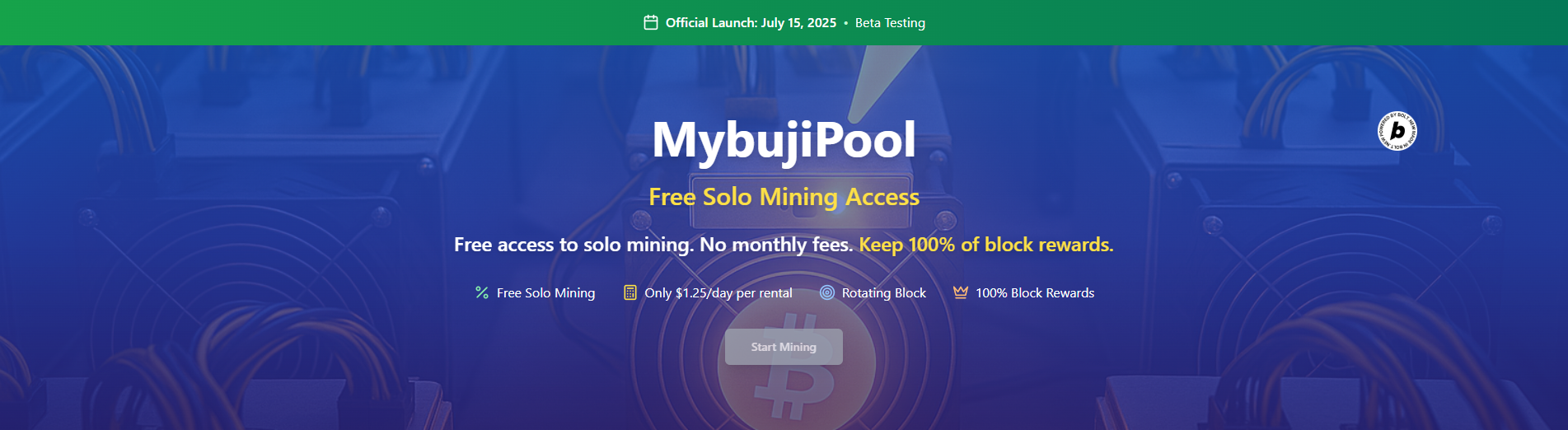
🚀 MyBujiPool_x – Project Story 💡 Inspiration MyBujiPool_x was inspired during a Bolt.new hackathon while developing the PWC Miner, a solo mining algorithm written in C. The Predictive Waveform Collapse (PWC) Miner was designed to explore alternatives to brute-force Bitcoin mining.

To test and showcase this innovation, I needed a platform where miners could run experimental code, evaluate profitability, and offset operational costs through a rental marketplace—MyBujiPool_x was created to meet that goal.

🧠 What I Learned Solo mining can be profitable with the right model—especially when paired with direct wallet payouts.

Centralized pools limit transparency and innovation.

A zero-fee, non-custodial approach opens the door for new types of miners and algorithms.

🛠️ How I Built It Platform: MyBujiPool_x was developed entirely in Bolt.new, using its integrated workflow to manage both front-end and Supabase connections.

Supabase: Used for authentication and dynamic auction tracking, seamlessly integrated through the Bolt.new stack.

Frontend: Built with React and Tailwind CSS for a clean, responsive user experience.

Pool Software: The mining pool is currently under development and will use open-source stratum server software to support solo mining with non-custodial wallet routing.

🧗 Challenges Faced Simulating fair, solo mining conditions while maintaining usability for both miners and ASIC owners.

Designing a transparent system for wallet-based payouts that avoids custodial risk.

Building a rental pricing model that aligns incentives for both sides of the marketplace.

🏁 Outcome MyBujiPool_x is a zero-fee solo mining pool and rental marketplace that allows:

Miners to rent hashrate and keep 100% of the Bitcoin block reward.

ASIC owners to lease machines without losing custody or relying on intermediaries.

Developers to experiment with alternative mining logic like PWC Miner in a real-world environment.

Built in Bolt.new to power a new era of solo mining and innovation.

Built With

Share this project:

Updates

posted an update

Ease of Use and ROI: Bolt.new vs Traditional Web Development

As a professional web developer since 2013, I’ve built dozens of full-stack websites using traditional stacks like React, Django, Node, and Flask. However, this was my first time using Bolt.new—and the results were staggering.

Time and Effort Comparison

To replicate this full-stack MVP manually, including:

  • A public-facing solo mining pool interface
  • Backend logic for miner integration
  • Wallet support and basic telemetry
  • API routing and authentication
  • Static asset handling
  • Containerization (Docker)

...would normally take 3–4 weeks of full-time development, even for a seasoned engineer.

With Bolt.new:

  • Actual time to live MVP: ~2 hours from prompt to deployment
  • Reduction in setup/config: ~90%
  • Lines of code manually written: under 200

Estimated Cost Savings

Assuming U.S. freelance rates or in-house developer cost:

Metric Traditional Stack Bolt.new
Time to Launch 120–160 hours 2 hours
Cost at $75/hr $9,000–$12,000 <$50
DevOps / CI/CD setup 1–2 days None
Hosting (first 30 days) $50–100 $0
Backend boilerplate (auth, DB) 10–15 hours Instant

Total savings: Over 98% in time and cost.

Strategic Advantage

Because of Bolt.new:

  • I was able to deploy both PWC Miner Simulator and MyBujiPool_x in parallel
  • Reallocated saved time to build actual Rust-based mining infrastructure, not just mock UIs
  • Accelerated my roadmap from MVP → Production-ready architecture within days

In short, Bolt.new transformed what would have been a $10k+ full-stack build into a prompt-to-deployment sprint. This kind of speed, automation, and developer-first interface is something I’ve never experienced in 10+ years of web development—and it's now central to how I launch new ideas.

Log in or sign up for Devpost to join the conversation.

posted an update

Final Project Comment

What began as a simple MVP to showcase an ASIC-hosting pool for the hackathon has rapidly evolved into a broader and more ambitious initiative. The original goal—demonstrating a minimal viable pool interface—has shifted toward realizing a fully functional Predictive Wave Collapse (PWC) miner, with both simulation and live integration capabilities.

Project Evolution

  • PWC Simulation Miner: Originally prototyped in C and later rewritten in Python for improved testing and accessibility.
    pwc-miner

  • Rust-Based Solo Mining Pool: A foundational solo pool was created in Rust to support CPU-based solo mining.
    solo-pool

  • Test Miner Integration: A simple test miner was successfully connected to the solo pool, confirming basic functionality.
    test-miner

  • Distributed CPU Miner in Rust: The final stage involves replacing Python with a performant, scalable Rust implementation for distributed CPU mining.
    distributed_cpu_miner

Why This Is Going Live

This project is no longer just a technical demo for a hackathon. It is launching as a live experimental mining alternative, exploring:

  • Decentralized CPU-based mining
  • Custom solo pool integration
  • Alternative algorithms like Predictive Wave Collapse (PWC)

The shift from MVP to production-ready infrastructure marks the beginning of a potentially disruptive contribution to the mining ecosystem.


"What started as a simple project to host ASIC miners has evolved into an experimental alternative miner—for miners."

Log in or sign up for Devpost to join the conversation.