1) Prototype link (Please submit a link to a playable prototype, not a link to your design file) Link
2) Describe your project (max 150 words)
My Pod: Strengthening long-distance friendships for college students with fun prompts and real-time moods, making every conversation count.
How do you keep up with your long-distance home friends while at college? College students struggle to maintain long-distance friendships amidst busy schedules and newfound priorities, despite current digital communication tools. The issue isn’t that people lack the means to stay connected—it’s that they may not remember to reach out or know what to talk about.
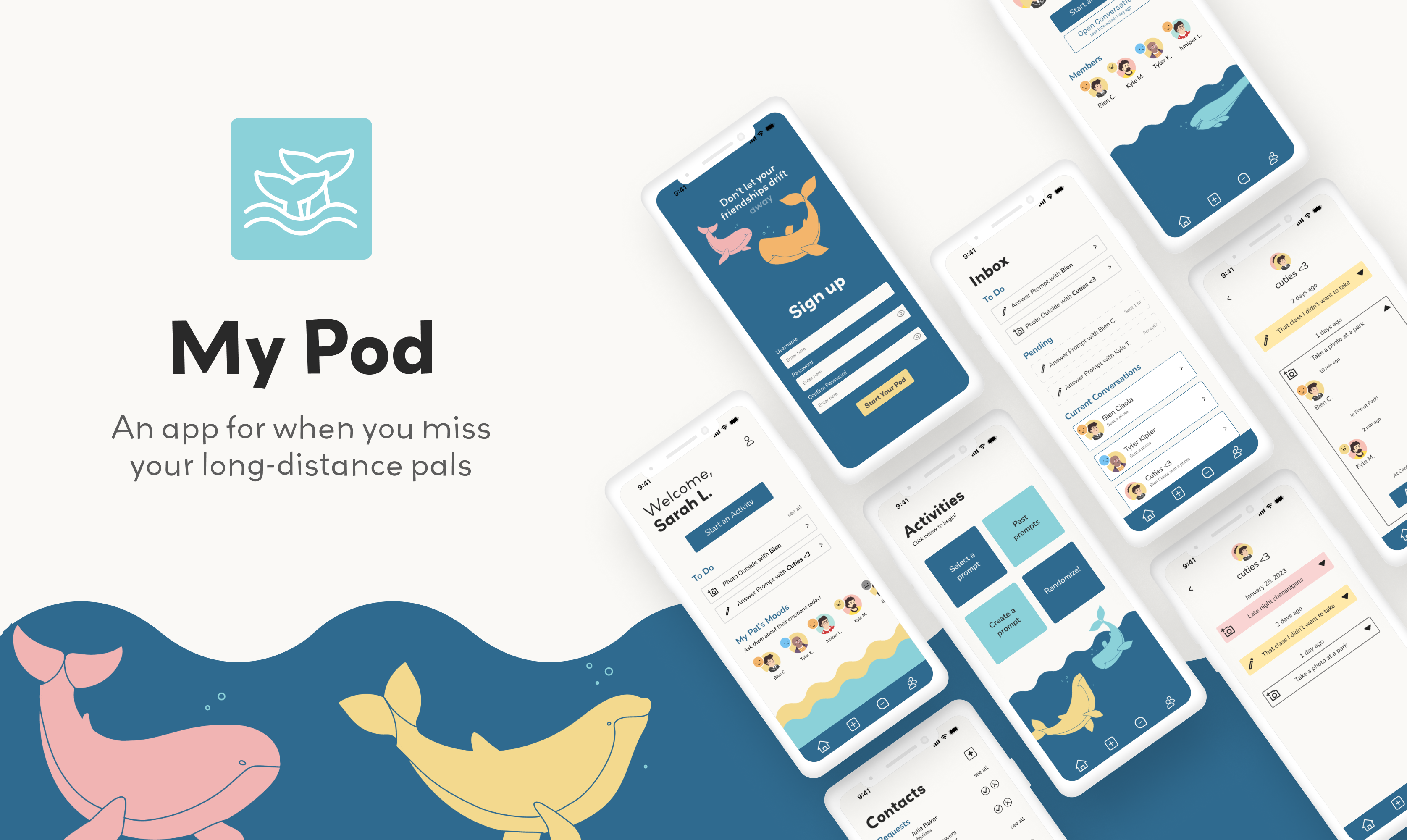
My Pod is designed to bridge the gap between long-distance friends (pals) whether they're spread across colleges, states, or countries. It offers quick, engaging activity prompts to keep pals connected via photos, texts, and voice messages. Suitable for one-on-one or friend group (pod) interactions, My Pod adapts to different friendship dynamics. It also features real-time mood statuses for glimpses into how friends are feeling, sparking meaningful conversations.
Make every conversation and friendship count with My Pod!
3) Describe your research process and findings. If you conducted any surveys or interviews, please include the survey form and/or interview questions here. If you conducted secondary research by pulling from online sources, please include a link to your sources. (Max 500 words)
Research Overview
Our research process was primarily rooted in primary research. After our initial idea to target the issue of staying connected to long-distance friends during college was born, our team wanted to make sure every survey question was tailored to support significant UX decisions later on. From the multiple choice results as well as the short answer responses, we were able to clarify our problem statement and identify college students’ pain points and hopes when it came to their long-distance friendships.
Problem Statements Before and After
Problem Statement Before Survey: College students struggle to maintain long-distance friendships because they are too busy to keep up with those friends and lose interest in others’ lives.
Problem Statement After Survey: College students struggle to maintain long-distance friendships because they are uncertain about how to reach out to those friends in meaningful ways and are not regularly informed on their friends’ lives.
Survey Findings
From the multiple choice questions, we gained an idea of our target demographics’ current psychographics.
- 48% have 1 close friend group but the other 52% are mixed between having individual long-distance friends (no group) and multiple friend groups
- Most people either contact their long-distance friends seven days a week or less than once a week. The lack of data in between suggests a polarization in long-distance friendships: they either involve constant communication or almost no communication at all
- The majority, 52%, of students report being willing to spend 5-25 minutes daily on a virtual activity with long-distance friends. This indicates people are willing to spend time on maintaining friendships
Why do 49% of respondents report weakened friendships then? From the short answer responses, we discerned what works and doesn’t work when it comes to maintaining long-distance friendships.
Challenges
- Frequency of Interactions: College students note that their busy schedules and differing life paths often lead to reduced frequency of interactions. Without any physical or digital reminders to contact long-distance friends, students may lack awareness of their weakening friendships.
- Lack of Shared Experiences: A common sentiment is the feeling of growing apart due to an absence of shared daily experiences. Without the context of being in the same physical space, students find conversations difficult to start.
- Unengaged Digital Interactions: The limitations of digital platforms are evident in their inability to sustain meaningful interactions. Group chats often lose activity and interest, and communication that is confined to social media leads to a sense of disconnect.
Successes
- Shared Online Activities: Video calls and group chats are successful in keeping friends connected and updated. Sharing photos, voice memos, and jokes helps in maintaining a sense of closeness despite physical distance.
- Scheduled Updates and Calls: By setting specific times for calls or updates, students ensure regular communication. There's a mutual understanding and respect for each other's schedules. Interactions with Personal Touches: Responding directly to Instagram stories, for example, adds a personal touch beyond otherwise passive viewing on social media. These approaches help bridge emotional distance, making each interaction more memorable.
See Survey here- 78 responses.
4) Describe your most important design decisions. What research findings and/or user testing results led you to make these decisions? (Max 500 words) Many questions and decisions had to be made during the ideation, wireframing, and branding & visual identity stages of our ~36 hour design process.
Ideation Decisions
- Functionality Selection: We knew from the beginning we wanted to foster long-distance friendships but the ways to do so were limitless. While brain-dumping, we developed so many way to approach this goal. Virtual maps with avatars and location-based statuses, shared journaling, gamified activity tracking, and homescreen widget functionalities were all possibilities explored with quick sketches. Post-survey, we refined our focus to regular, meaningful interactions. This led us to choose activity prompts as My Pod's core feature, designed to foster shared experiences.
- Activity Prompt Mechanics: Our approach to activity prompts is personalized. We decided that prompts would be something decided by individuals rather than a universal prompt that every user receives (a la BeReal). This way, being sent a prompt actually feels personal and people can take agency in their friendship journeys. Additionally, we decided against having people input preferences that would show their friends which activity prompts (or category of prompts) they liked the most, assuming that long-distance friends would already understand each other's likes. Prompts cater to both individual and group interactions, reflecting the varied dynamics of college friendships.
Wireframing Decisions
- Home Page Content: Given the relative complexity of the primary “send/receive prompts” functionality, along with the secondary mood status functionality, it was hard to narrow down what exactly belongs on the home page. We debated whether to prioritize sent or received prompts. Ultimately, we decided to prioritize received prompts.
- Mood Integration: Deciding how to incorporate mood updates was crucial. We chose to use a modal for mood updating on app opening, ensuring constant mood updates. Friends' moods are displayed as colored icons on their profile pictures, striking a balance between visibility and subtlety.
- Prompt Sending Process: With a wide range of activity prompts and media types, we crafted a step-by-step process to avoid choice overload. It starts with choosing a prompt category, selecting a specific prompt, deciding on the media type, and finally sending it to chosen friends or groups.
Branding & Visual Identity Decisions
- Whale Iconography: Our choice of whale imagery as a central motif in our branding was intentional. Whales, known for their long-distance migrations, perfectly symbolize the vast spans over which our app's users maintain friendships. This analogy captures the essence of our app's purpose - connecting people across great distances.
- Typography Selection: For our body text, we chose Nunito, a humanist sans-serif typeface. Its friendly and approachable style aligns with the welcoming vibe we aim to convey. For titles, we chose Grenadine MVB, an interesting sans-serif font with unique tilts. This choice adds a sense of liveliness and fun to the app.
- Color Palette: Our color scheme revolves around muted blues and soft yellows. These colors were selected to mirror the app's gentle and calming energy. The muted blue evokes a sense of reliability and trust while the soft yellow adds a touch of warmth and optimism.
Built With
- figma


Log in or sign up for Devpost to join the conversation.