Meet Iman
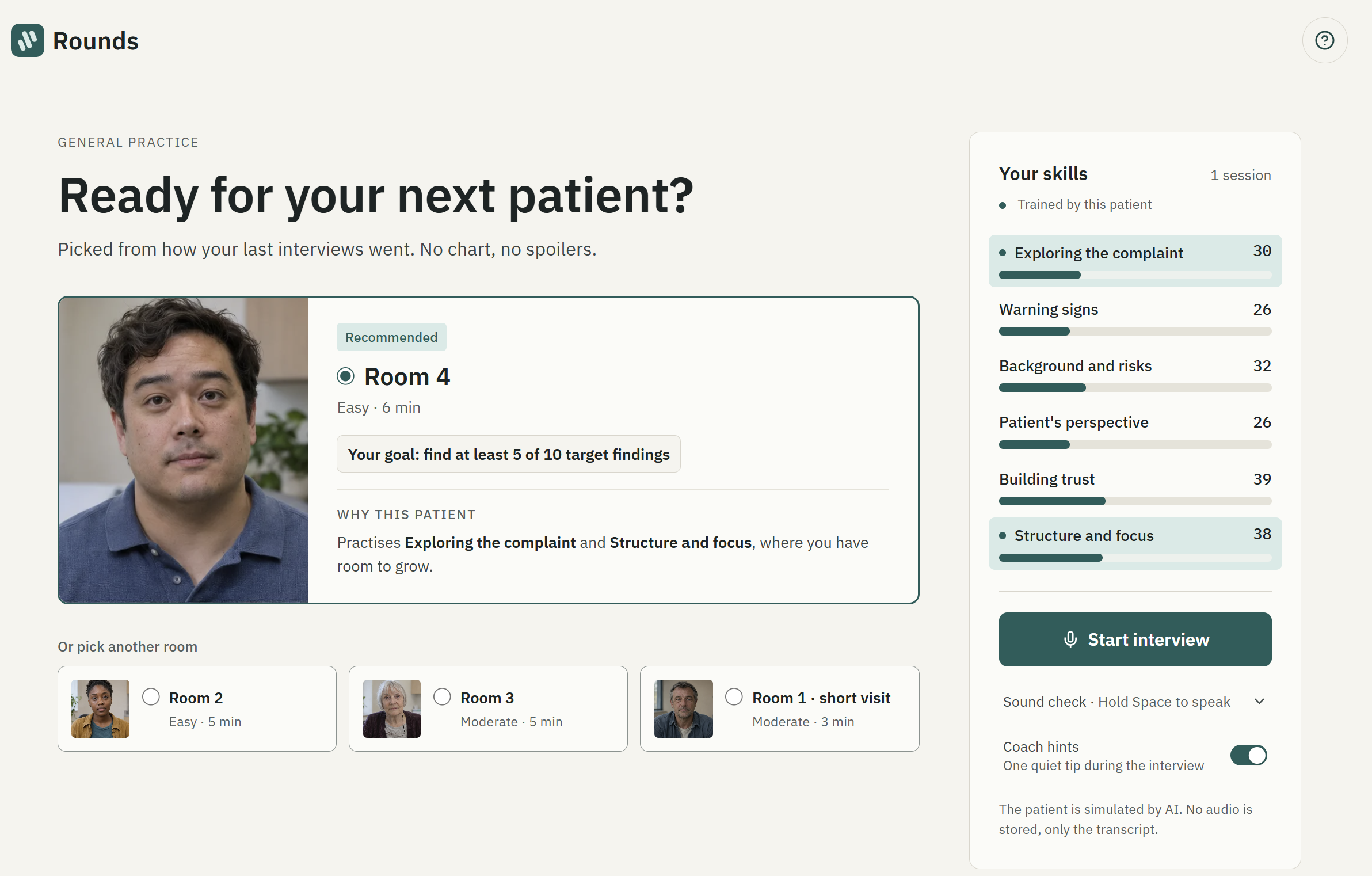
Medical students get few chances to practise with a trained actor, while regular chatbots give everything away at once. For the Avelios challenge at hackaTUM, we built My Patients Don't Lie: voice patients who are always available, hold back like real people, and never make up a symptom.
Iman had to put her fiddle down during the first tune at rehearsal. What would you ask her? Open Room 2, choose Start interview, and hold Space to speak. One way in is "What were you doing just before the wheeze?"
Meet Iman · Try it without a microphone
What the student learns
Each of our four exam rooms has its own voice, face, and story, with no chart and no spoilers. Patients open with two short sentences and hold back key details until you ask specifically, build trust, and catch emotional clues (with live captions and a text mode built in).
After the visit, a five-question quiz tests recall and technique. Then the debrief shows your question beside the patient's exact words for every credited finding, a question to try next time for anything missed, and adaptive coaching across six skills that picks your next patient.
How we built it
Built with Next.js and TypeScript, keeping case files and API keys on the server. One OpenAI Realtime session listens to the student and voices the patient over WebRTC. Before each reply, our server engine checks the question and rapport against the private case file, then passes the model only what it may share. Because the voice never sees locked facts, nothing leaks or gets made up. Research on why patients withhold information shaped those rules (Levy et al., JAMA Network Open).
The hardest part
What if a patient gets interrupted mid-answer, or a loud room trips the mic? We defaulted to hold-to-speak with browser noise filtering, and scored asking a good question separately from actually hearing the answer. A finding only counts once audio finishes playing and an independent reviewer finds the exact quote in the transcript. We also calibrated scores to a five-minute visit, and every saved session can be re-graded offline.
What's next
Each case is a single JSON file, so adding new rooms needs no new code. Next, we want to work together with clinical educators and students to build a unique learning experience, compare our debriefs with teacher feedback, and add spaced repetition. Over time, opt-in anonymized sessions could also gather real interaction data to help train better patient-like systems.
Built with
OpenAI Realtime API (gpt-realtime), WebRTC, WebSocket, OpenAI Responses API, OpenAI speech-to-text, Next.js, React, TypeScript, Node.js, Web Audio API, RNNoise (WebAssembly), Playwright
Built With
- next.js
- node.js
- openai
- playwritgt
- react
- render
- rnnoise
- typescript
- webrtc

