-
-
My Crafted Career
Inspiration
Since switching careers into technology around 2020, I followed the standard job-search advice: tailor every résumé to the posting, mirror the employer’s language, and present each experience in the strongest possible light.
That approach helped me earn interviews and opportunities, but it also exposed a deeper problem. A polished application could make adjacent experience sound more direct than it really was. That sometimes created a gap between what an employer expected and what I had actually done.
I worked with recruiters, college career centers, résumé services, and career fairs across multiple industries. Much of the guidance focused on keyword alignment, presentation, and persuasive phrasing. Those things matter, but they are not the same as proving that a position is attainable, strategically useful, and honestly aligned with a candidate’s evidence.
Nobody explicitly told me to lie, but the process often rewarded making adjacent experience sound more direct than it really was.
I would rather enter a role with accurate expectations and overdeliver than win an opportunity by creating the wrong impression.
My Crafted Career is the custom designed system I wish I had during the last five years of navigating career changes.
What it does
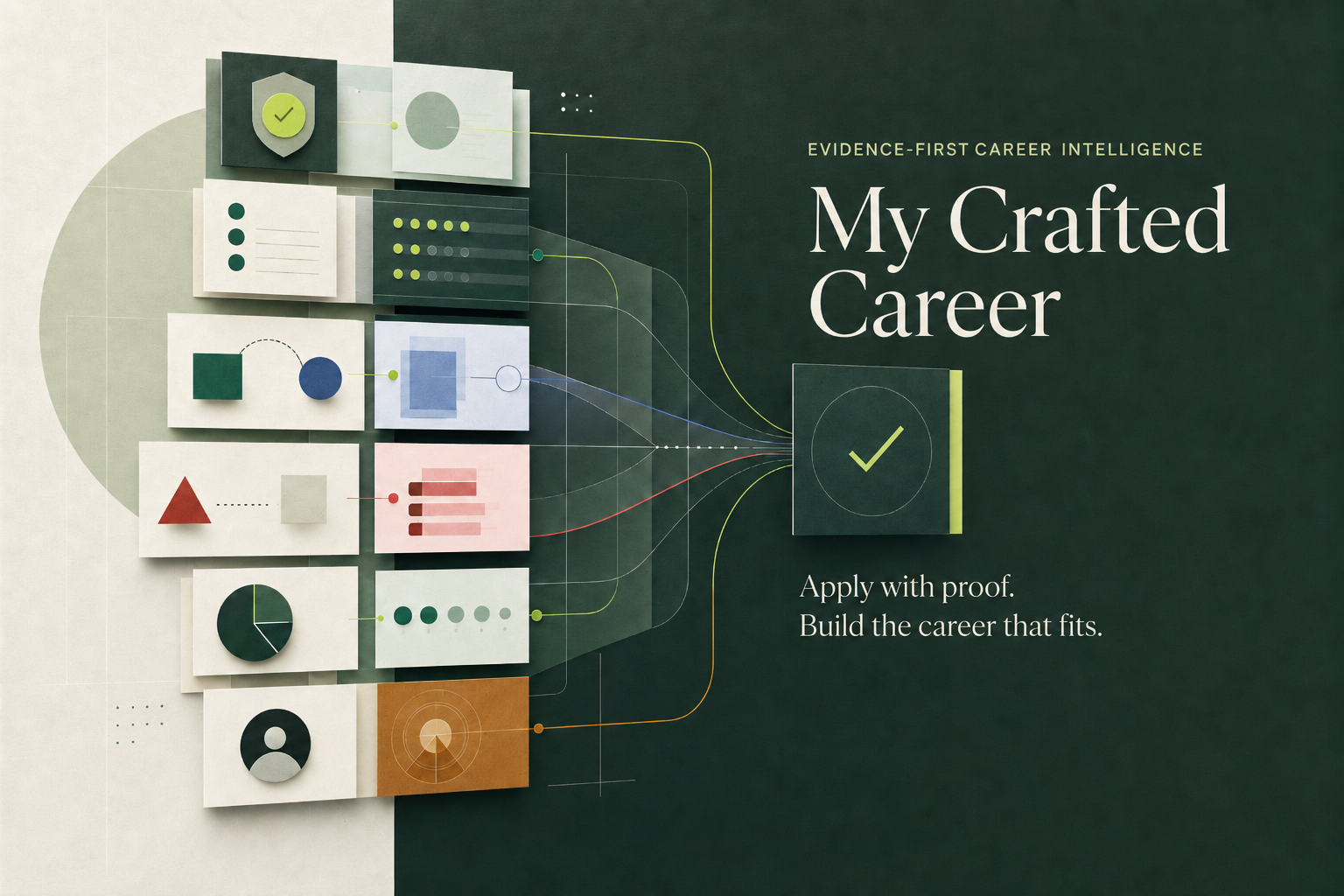
My Crafted Career is an evidence-first personal career-intelligence system.
It begins with two separate sources of truth:
- A Career Goal Profile describing the direction the person is trying to build toward, including preferred employment model, training needs, stability, location, and professional-development priorities.
- A separate Evidence Bank containing verified experience, transferable skills, unresolved information, known gaps, supported application statements, and statements the candidate should not make.
OpenAI Deep Research investigated real opportunities across four target-market groups. The public demonstration preserves sanitized research provenance and seven dated snapshots derived from real employer postings.
The system then:
- separates source quality and eligibility from qualification fit
- evaluates qualification fit separately from career-goal alignment
- maps employer requirements to verified evidence
- keeps direct experience, transferable skills, weak evidence, gaps, unknowns, and blocked statements visibly distinct
- recommends opportunities using transparent deterministic rules
- carries verified evidence into a grounded application
- blocks unsupported statements even when they sound persuasive
- keeps optional GPT-5.6 output separate and unapplied
- requires deterministic validation and exact-version human approval
- records outcomes without pretending that a rejection proves its cause
- updates future strategy without rewriting evidence, applications, scores, or historical facts
The clearest comparison is between two Allstate opportunities.
The Catastrophe Field Property Adjuster role, requisition R31547, has the strongest raw qualification score at 88, but its strategic result is 79.
The CAT Property Inside Adjuster role, requisition R32791, has a strategic result of 85 and ranks first because its structured inside-carrier training, predictability, and claims-development path better match the Career Goal Profile.
The most obvious qualification match is not always the best career move.
Public demonstration boundary
Alex Morgan is a fictional identity.
The career objective, qualification categories, decision constraints, research workflow, and learning problem are based on a sanitized real-world career transition. The application and outcome sequence is presented as a sanitized real-world replay through Alex.
Displayed jobs are dated snapshots derived from real public employer postings. Their status at capture does not guarantee current availability, and no employer affiliation or endorsement is implied.
Private reports, résumés, messages, identifiers, source records, credential numbers, and real application materials are not included.
Why it is different
Most AI career tools optimize for application volume, keyword similarity, or persuasive language.
My Crafted Career asks a different question:
What can this candidate actually prove, which opportunity fits the career they are trying to build, and where should they invest their effort?
The system keeps several boundaries separate:
- career goals versus current qualifications
- public employer facts versus candidate facts
- verified evidence versus unresolved information
- transferable experience versus direct experience
- model-generated drafts versus reviewed application content
- deterministic validation versus human approval
- historical facts versus inference and future strategy
This allows career intelligence to improve without changing the candidate’s history.
The product is not primarily a résumé generator. It is a decision and evidence system that carries research, goals, proof, application content, human approval, and outcome learning through one governed workflow.
How I built it
I am the solo entrant and creator of My Crafted Career.
I conceived the product from my own career-transition problem, selected the scenario and target outcome, defined the privacy and evidence boundaries, established the truthfulness rules, and made the final product, design, engineering-scope, approval, interpretation, and release decisions.
OpenAI Deep Research investigated real career opportunities across the target markets and produced the private source research from which I derived the sanitized opportunity set.
ChatGPT with GPT-5.6 helped me clarify the product thesis, define the workflow and privacy boundaries, plan the implementation, challenge product decisions, and refine the demo and submission strategy.
Codex running GPT-5.6 was the primary repository implementation workflow. Codex helped:
- inspect and structure the existing workflow
- define the application’s typed data contracts and architecture
- implement the Next.js interface
- translate ranking and evidence rules into deterministic TypeScript
- implement the bounded OpenAI integration
- add and expand automated tests
- investigate concrete review findings and regressions
- complete the research-to-application refactor
- perform release verification and documentation work
I also used a separate read-only AI review workflow with Claude Code to challenge known commits for correctness, privacy, usability, and regression risk. It was a reviewer, not the primary implementation workflow or a co-builder.
The application uses:
- Next.js, React, and TypeScript
- static sanitized fixtures and typed domain contracts
- deterministic opportunity-ranking and evidence-validation logic
- the OpenAI Responses API with GPT-5.6
- Zod Structured Outputs
- an unapplied model-draft boundary
- exact-version human approval
- Vitest automated testing
- Vercel deployment
The final release passes 245 automated tests across 14 files.
The complete judge path works without an API key or successful live model call.
Challenges
The hardest challenge was deciding where AI should have authority and where it should not.
Runtime GPT-5.6 may regenerate one bounded application or résumé section. The server resolves trusted context and section-specific allow-listed evidence. The model returns structured output, but that output remains a separate unapplied draft.
GPT-5.6 does not:
- rank opportunities
- establish eligibility
- verify evidence
- approve an application
- submit anything
- determine why an outcome occurred
- rewrite historical facts
Deterministic checks remain the authority for evidence grounding and approval prerequisites. Human review remains the authority for the exact application version.
Privacy was another major challenge. I wanted to preserve the meaning of a real personal workflow without publishing the private records behind it. The final system separates fictional identity, sanitized candidate records, public employer facts, synthetic testing controls, and a sanitized outcome replay.
Accomplishments
My Crafted Career demonstrates a complete research-to-application workflow rather than only generating a document:
- four target-market groups and five sanitized Deep Research studies
- seven dated public opportunity snapshots
- separate Career Goal Profile and Evidence Bank inputs
- explainable qualification and strategic scoring
- explicit gaps, concerns, unknowns, and blocked statements
- a grounded saved application tied to a dated evidence snapshot
- optional bounded GPT-5.6 drafting
- deterministic post-model validation
- exact-version human attestation and approval
- cautious learning from a real-world outcome replay
- immutable evidence and historical facts
- 245 passing automated tests
The system can identify a strong opportunity, explain why another opportunity is strategically better, and tell the candidate when a statement is not supported by the evidence.
What I learned
The most valuable role for AI is not always generating more words.
Sometimes the better product is a system that structures evidence, preserves uncertainty, blocks unsupported statements, and helps a person make a better decision before applying.
I also learned how valuable Codex can be beyond scaffolding. I used it across implementation, testing, debugging, refactoring, release verification, and documentation while retaining control over the problem, evidence boundaries, and consequential decisions.
What’s next
Future versions could add:
- secure user-controlled evidence-bank persistence
- résumé and career-document imports -custom résumé and career-document creation for strong matched jobs, one click creation
- explicit opportunity refresh and source-verification workflows
- live opportunity ingestion
- a Voice Fit Check for collecting missing context
- document export
- longer-term outcome tracking
- user-controlled memory across career transitions
- employer and recruiter views centered on evidence-backed fit
- custom bi-weekly lessons learned report based on opportunities available and outcomes over time
My Crafted Career is intended to become a living career-intelligence system, not another high-volume application generator.
Built With
- codex
- deep-research
- gpt-5.6
- next.js
- react
- typescript
- vitest
- zod


Log in or sign up for Devpost to join the conversation.