Inspiration
Daily commuting in Egypt is fragmented and inefficient. Metro, buses, and microbuses operate as separate systems without a unified way to plan routes. This leads to wasted time, higher cost, and confusion, especially for students and new users. The idea originated from the need for a simple tool that helps people move across cities without relying on local experience or guesswork.
What it does
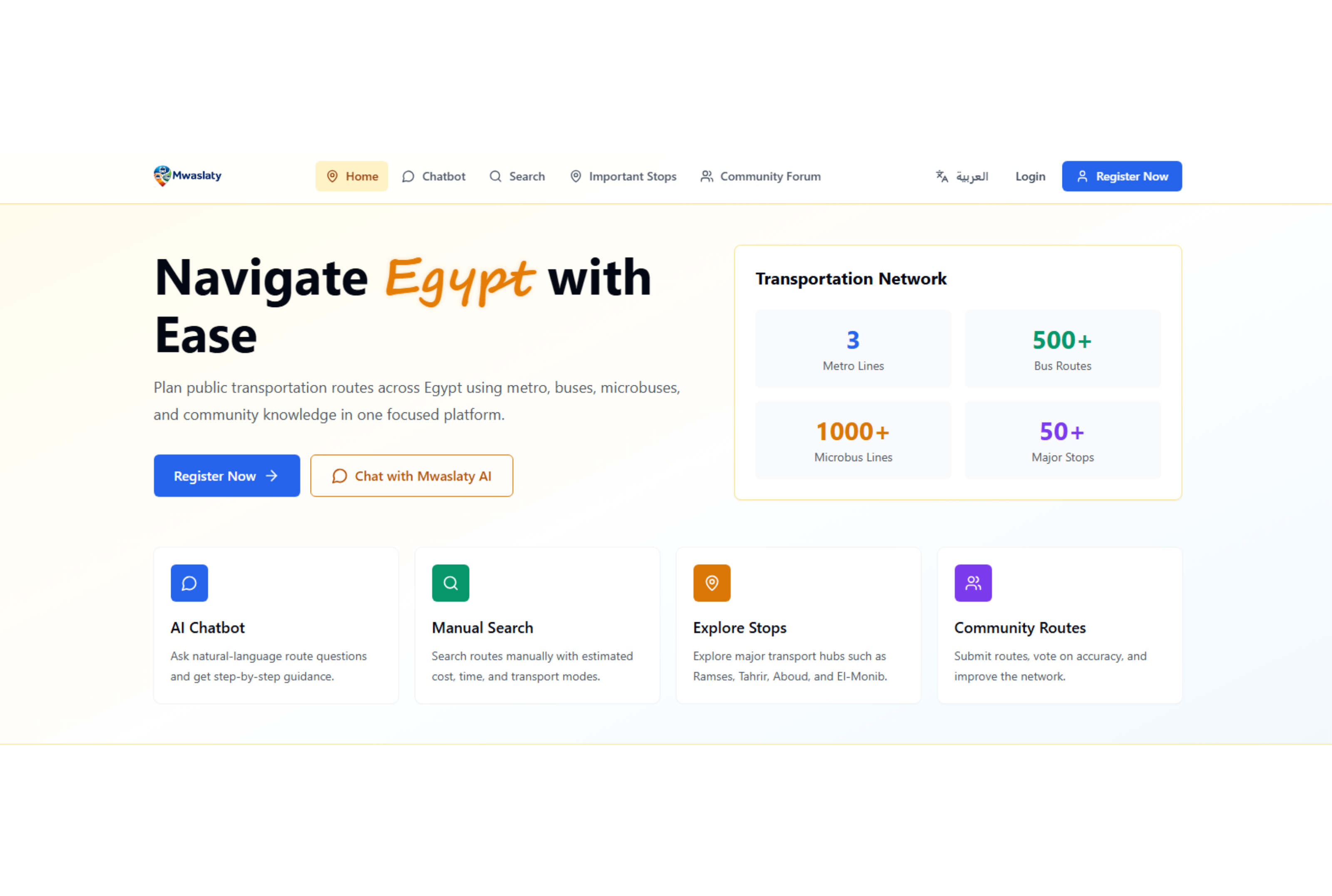
The platform enables users to find the best route between two locations in Egypt using metro, buses, and microbuses. Natural language queries are supported, and routes are returned with estimated time and cost. The system also improves over time using community feedback and real-world user input.
How it was built
A web application is built using Next.js for the frontend and FastAPI for the backend.
Transportation routes are modeled as a graph where:
- Nodes represent stations or stops
- Edges represent possible transport connections
The AI system processes user input using NLP and converts it into structured data:
Inline math example: The travel request is represented as ( (origin, destination, preference) )
Route optimization is computed using a weighted cost function:
$$ cost = time + price + congestion $$
The system continuously updates route reliability using community feedback and user validation.
Challenges encountered
The biggest challenge was modeling informal transportation systems like microbuses, since no fixed schedules or official datasets exist. Another challenge was balancing AI-based recommendations with real-world user feedback while keeping results consistent and reliable.
Accomplishments that are proud of
A unified mobility system was successfully designed to integrate formal and informal transportation in Egypt. A hybrid approach combining AI-based routing with community-driven validation was also created to improve accuracy and adaptability.
What was learned
Complex urban transportation systems were explored, especially in cities with informal networks. Experience was gained in combining AI concepts like NLP and graph-based modeling with real-world system design.
What's next for the project
A working MVP is planned focusing on Cairo, starting with major routes and stations. The AI routing engine will be improved, and the community verification system will be expanded to increase accuracy and trust.
Built With
- css
- firebase
- leaflet.js
- next-intl
- next.js
- react
- sql
- supabase
- tailwind
- typescript
- vercel


Log in or sign up for Devpost to join the conversation.