Inspiration
MUTATION STUDIO began with my sister, Azra, and her work as an independent fashion designer.
I have seen how much thought, experimentation, and manual work goes into building a collection. Every silhouette, seam, proportion, and fabric decision is part of a language she has developed over time. But presenting that work to a wider audience is a different challenge. A collection is normally experienced through a limited set of photographs, a physical show, or the opportunity to see the garments in person.
We wanted to explore whether AI could give her work a larger stage without speaking over her. The goal was not to ask AI to invent a generic collection or imitate a designer. The goal was to begin with clothes that already exist, preserve the designer's identity, and use technology to make the collection interactive.
Perfect Corp.'s YouCam APIs made that idea possible. Skin Analysis gave us an unexpected way to introduce a human subject into the creative process, while Apparel Virtual Try-On allowed that same person to experience a designer look on their own body. Together, they helped us turn a physical fashion collection into a personal digital experience.
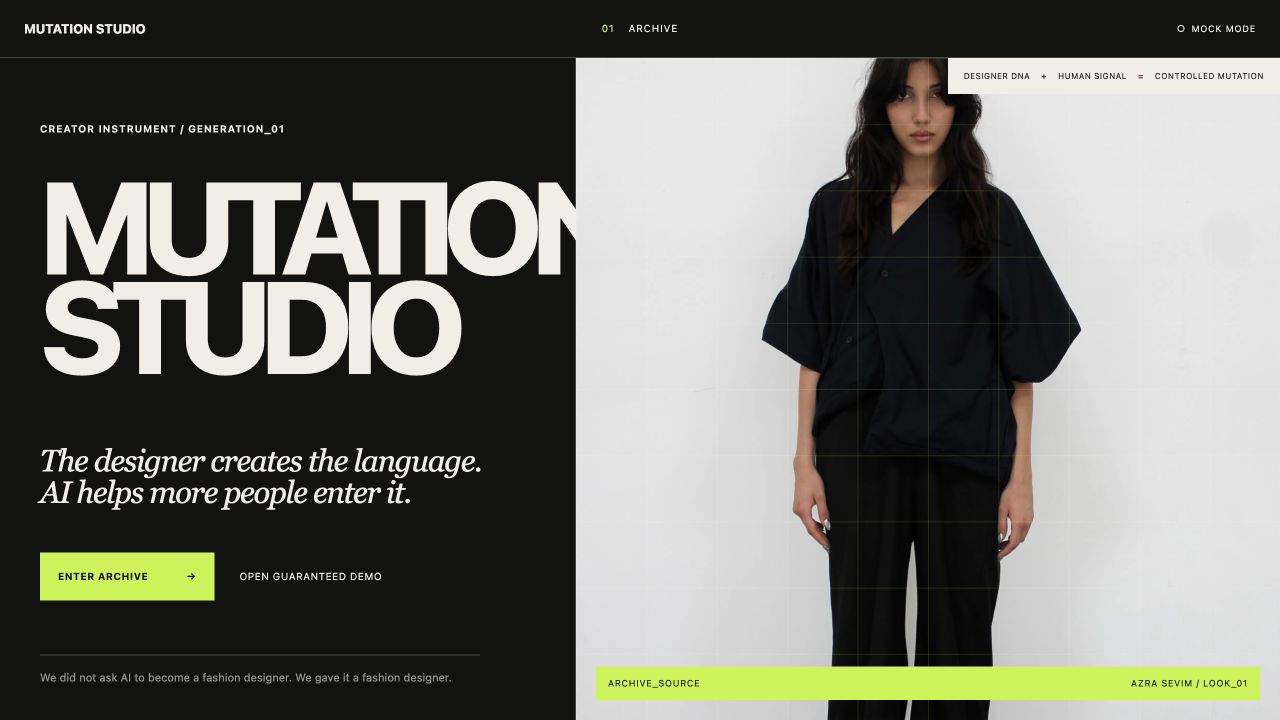
The designer creates the language. AI helps more people enter it.
What it does
MUTATION STUDIO transforms Azra's collection into an interactive fashion archive.
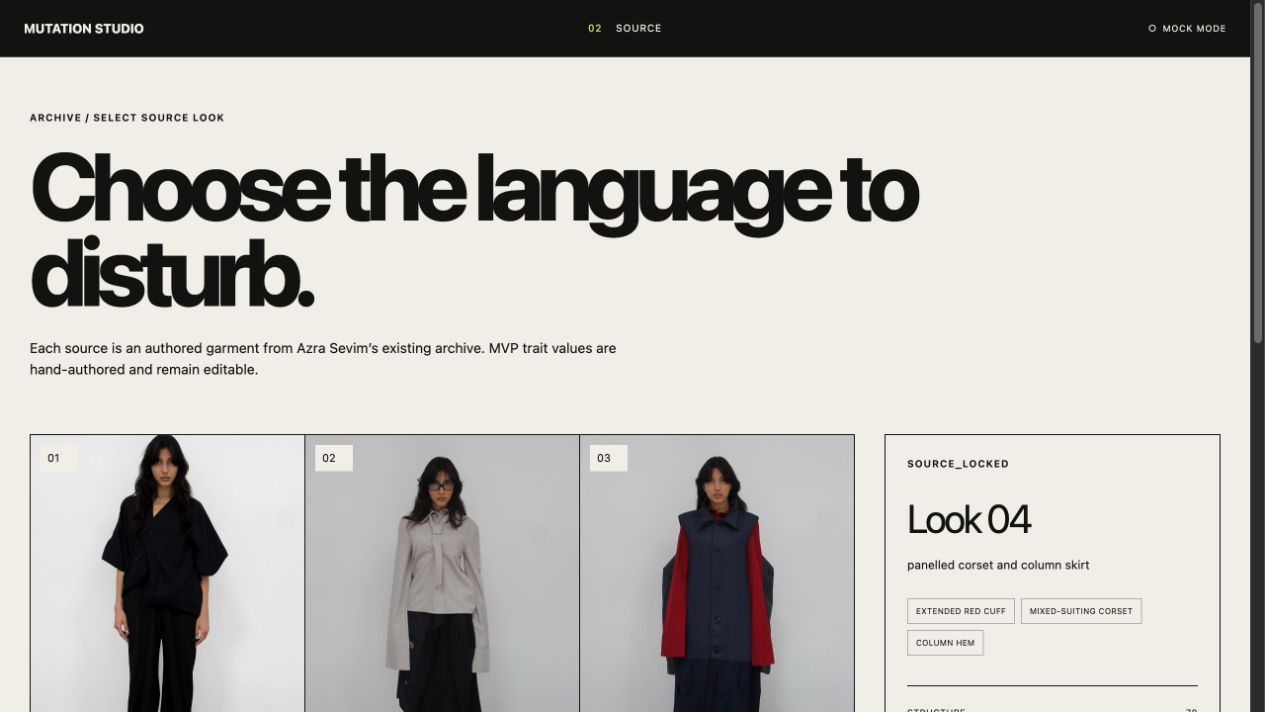
The experience begins with the designer's real garments. A visitor browses the collection, chooses a source look, and sees its Designer DNA: a structured description of characteristics such as silhouette, construction, layering, asymmetry, surface treatment, and panel complexity. Each look has its own profile based on the actual garment rather than one repeated set of values.
The visitor then becomes part of the presentation. They upload a clear portrait, which is processed using YouCam Skin Analysis. We translate the API results into neutral creative signals such as surface variation, linear detail, chromatic variation, and micro-pattern density. These values are never presented as flaws, diagnoses, beauty scores, or skincare advice.
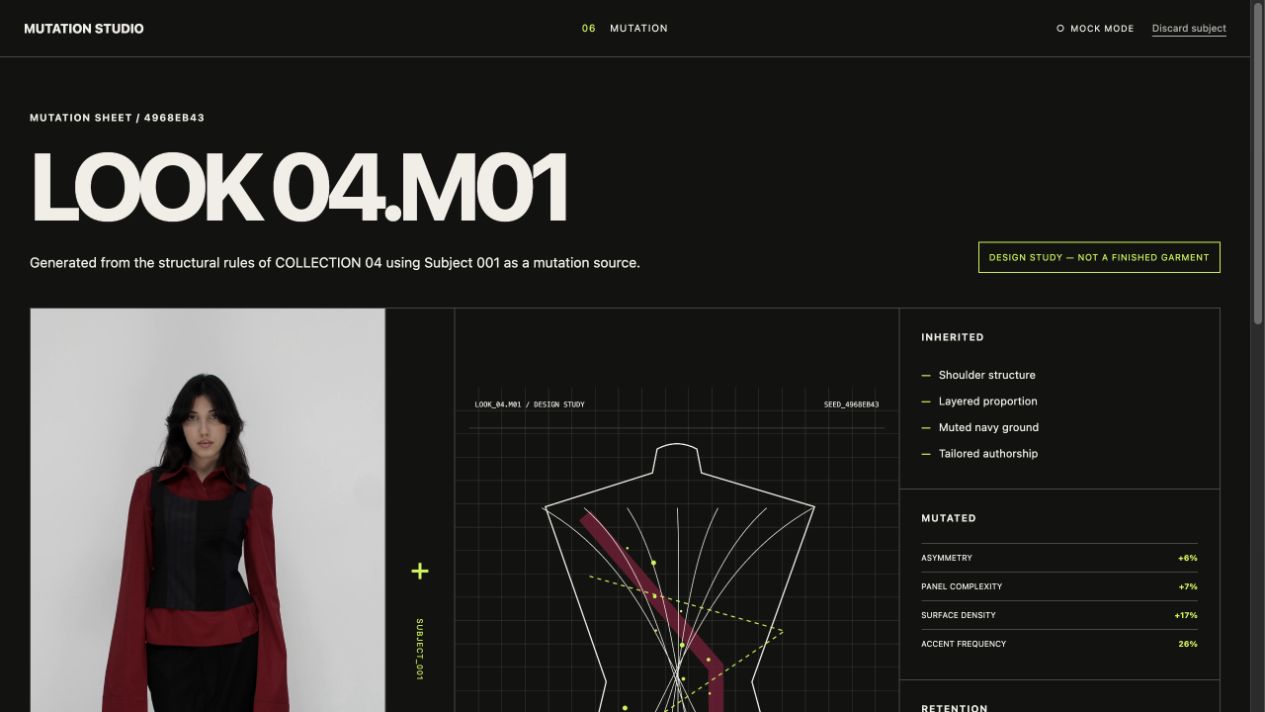
A deterministic mutation engine combines those signals with the selected garment's Designer DNA. The user can choose a Subtle, Disrupt, or Break intensity, and the system creates a reproducible Mutation Sheet. It shows what remains inherited from Azra's design language, what changes, and which design directions could be explored next.
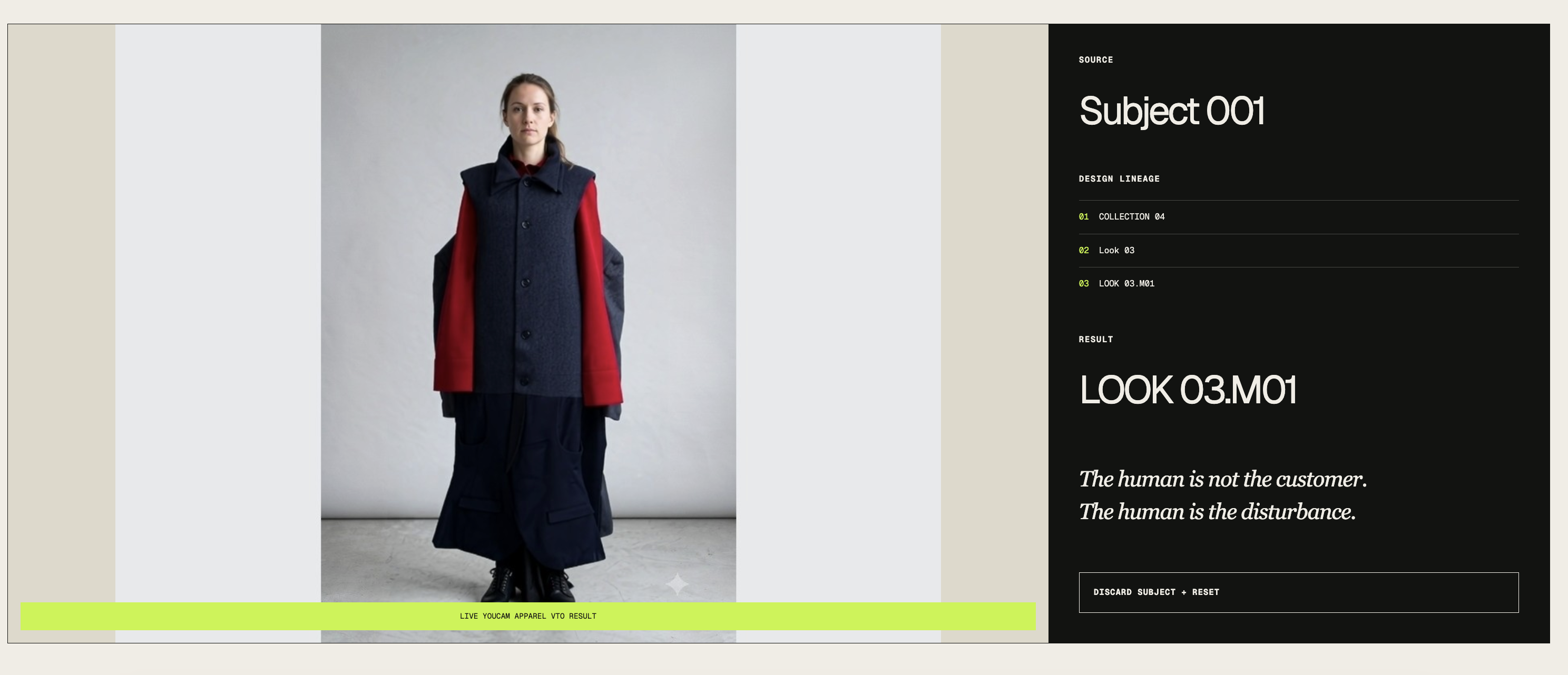
Finally, the visitor uploads a full-body photograph. YouCam Apparel Virtual Try-On places the selected designer look onto that person. Someone who may never have been able to attend a show, visit a studio, or physically access the garment can now see themselves inside the collection.
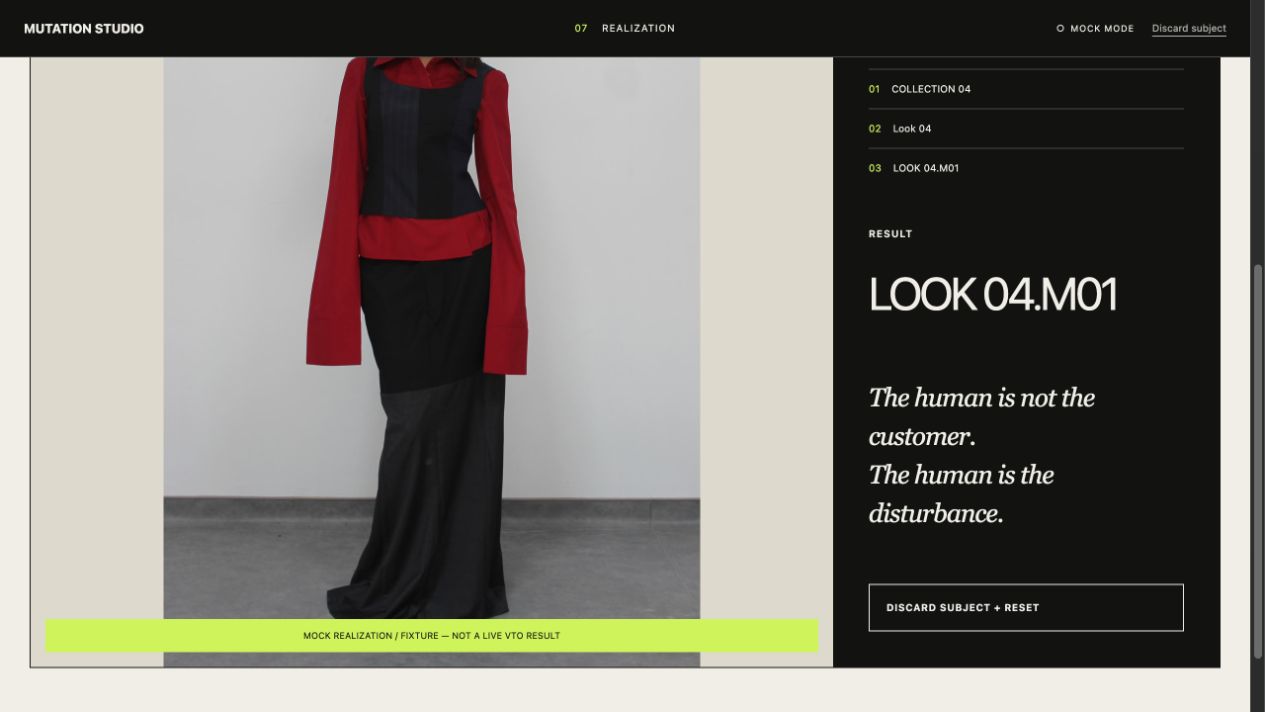
The current realization uses the closest supported source garment for virtual try-on. The Mutation Sheet is presented honestly as a creative study, not as a finished garment that has already been manufactured.
How we built it
We built MUTATION STUDIO with Next.js, TypeScript, the App Router, server-side API routes, HTML Canvas, and JSON-based design configuration.
The archive contains six looks from Azra's collection. Her photography and garments remain the visual focus of the experience. We reviewed each look and created an individual trait profile describing its structure, asymmetry, layering, panel complexity, surface, and color behavior. These values are explicitly hand-authored; we do not pretend that computer vision inferred decisions that came from reviewing the designer's work.
The local mutation engine maps normalized human signals to specific design traits. The selected intensity controls how far the result can move while retaining the source look's identity. The same look, signal, and intensity always produce the same seed, retention values, deviations, design directives, and Canvas study. This keeps the process traceable and allows users to adjust the mutation without consuming another API call.
We isolated YouCam behind a server-side service layer:
- YouCam Skin Analysis v2.1 handles image registration, secure upload, task creation, polling, and score normalization.
- YouCam Apparel VTO (
cloth-v3) receives the full-body subject and selected designer garment, then returns a virtual realization. - The YouCam API key stays on the server and is never exposed in client-side code.
- Live and clearly labeled mock modes use the same internal data model, giving us a reliable demonstration path when an external service or network is unavailable.
- Successful operations can be cached so repeated interactions do not unnecessarily consume API units.
We also built two image-preparation pipelines in the browser. Portraits are reframed so the face occupies enough of the analysis image for Skin Analysis. Full-body photographs are placed inside a neutral 1024×768 frame without cropping the head, body, or shoes before being sent to Apparel VTO.
Challenges we ran into
Our first major wall was a portrait that looked completely suitable to us but repeatedly produced the message: “The face area in the uploaded image is too small.” The original photograph was clear and front-facing, but the API evaluated the detected face relative to the entire image. We solved this by automatically preparing a centered close-up analysis frame before upload while preserving the photograph's quality and proportions.
Apparel VTO presented the opposite challenge. A tall, full-body photograph was being cropped into a landscape frame, removing the subject's head or shoes and producing torso-only results. We created a role-aware preprocessing step that fits the complete person inside YouCam's recommended 4:3 frame with neutral letterboxing. We also changed the preview and result viewer so front-end image styles could not crop the output again.
The most important product challenge was protecting Azra's authorship. It would have been easy to build a generic “AI fashion designer” and make the technology the hero. Instead, we designed every stage around the source collection. The garment, its design traits, its lineage, and the designer's original decisions remain visible throughout the experience.
We also had to translate Skin Analysis responsibly. Concern-oriented API fields may make sense in another context, but they did not belong in our creative interface. We built an abstraction layer that converts them into neutral visual behavior and prevents medicalized or evaluative language from reaching the design surface.
Accomplishments that we're proud of
The accomplishment I am most proud of is seeing my sister's work become the center of a complete interactive experience. The clothes are not decoration for an API demo. They are the reason the technology matters.
We built and tested a full live workflow with real images. A visitor can explore six distinct garments, choose one, upload a portrait, receive a normalized creative signal, generate a deterministic Mutation Sheet, upload a full-body image, and see the selected look realized on that body through YouCam Apparel VTO.
We are also proud that:
- Every garment has an individual Designer DNA profile suited to the actual image.
- The collection photography dominates the interface instead of being hidden behind dashboards or generic AI graphics.
- Skin Analysis and Apparel VTO feel like two parts of one story rather than separate API demonstrations.
- The mutation engine is deterministic, local, reproducible, and does not spend API units when the intensity changes.
- The final full-body result preserves the complete subject from head to shoes.
- API credentials remain private, and uploaded face and body images are treated as temporary creative inputs.
- A labeled demo path keeps the project understandable even when an external API or network is unavailable.
Most importantly, the project demonstrates how AI can give an independent designer's existing work a new form of visibility without taking ownership of the creative language that made the work distinctive.
What we learned
We learned that AI is most meaningful when it begins with something human that already has value. The strongest part of MUTATION STUDIO is not automatic generation. It is the connection between Azra's real garments, her design decisions, and a visitor who can finally interact with those decisions personally.
We also learned that API integration is as much about interpretation as implementation. YouCam provides powerful analysis and visualization capabilities, but we had to decide how those capabilities should behave inside a fashion-design context. Translating raw fields into respectful creative signals was just as important as making the requests work technically.
Image preparation became another major lesson. Face coverage, subject scale, aspect ratio, garment framing, and browser display rules can determine whether a sophisticated AI workflow succeeds or fails. Solving those details turned an impressive prototype into a reliable experience.
Finally, we learned that technology does not have to replace a creator to expand what is possible for them. It can provide presentation, participation, and reach while leaving the designer's voice intact.
What's next for MUTATION STUDIO
The next step is to expand MUTATION STUDIO into a richer digital home for Azra's work. We want to add more collections, garment details, process photography, sketches, and designer notes so visitors can understand not only what a look is, but how it came into existence.
We would also like to let the designer edit the mutation rules directly. Azra could decide how different human signals affect silhouette, construction, color, surface, or material behavior, making the system an extension of her own process rather than a fixed technical interpretation.
For presentation and retail, future versions could include exportable Mutation Sheets, saved realizations, campaign experiences, and collection-specific virtual fitting rooms. This could help independent designers present garments to people beyond the physical reach of a studio or fashion show, while giving audiences a much more personal relationship with the collection.
The larger opportunity is collaborative capsule design. Artists, models, musicians, customers, or other invited subjects could generate controlled mutation vectors from a collection. The designer would curate the most interesting directions and decide which ones deserve to become real garments. Participants influence the process, but the designer remains the author.
Future image-generation tools could visualize the Mutation Sheet more literally, but only as an optional layer. MUTATION STUDIO will continue to begin with real designer work, use AI to create access and interaction, and keep human creative judgment at the center.
We did not ask AI to become the fashion designer. We used AI to help people experience the designer who was already there.
Built With
- ai
- cloudflare-workers
- computer-vision
- css3
- github
- html
- html5
- image-processing
- javascript
- json
- next.js
- node.js
- openai
- perfect-corp
- react
- rest-apis
- typescript
- virtual-try-on
- vite
- youcam-api
- youcam-apparel-vto
- youcam-skin-analysis

Log in or sign up for Devpost to join the conversation.