-
-
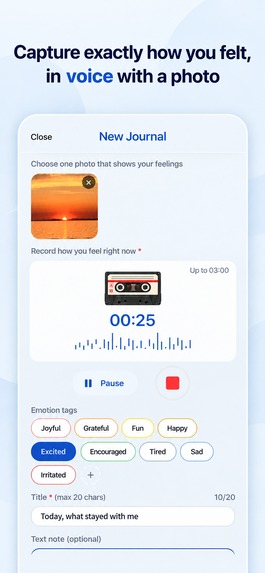
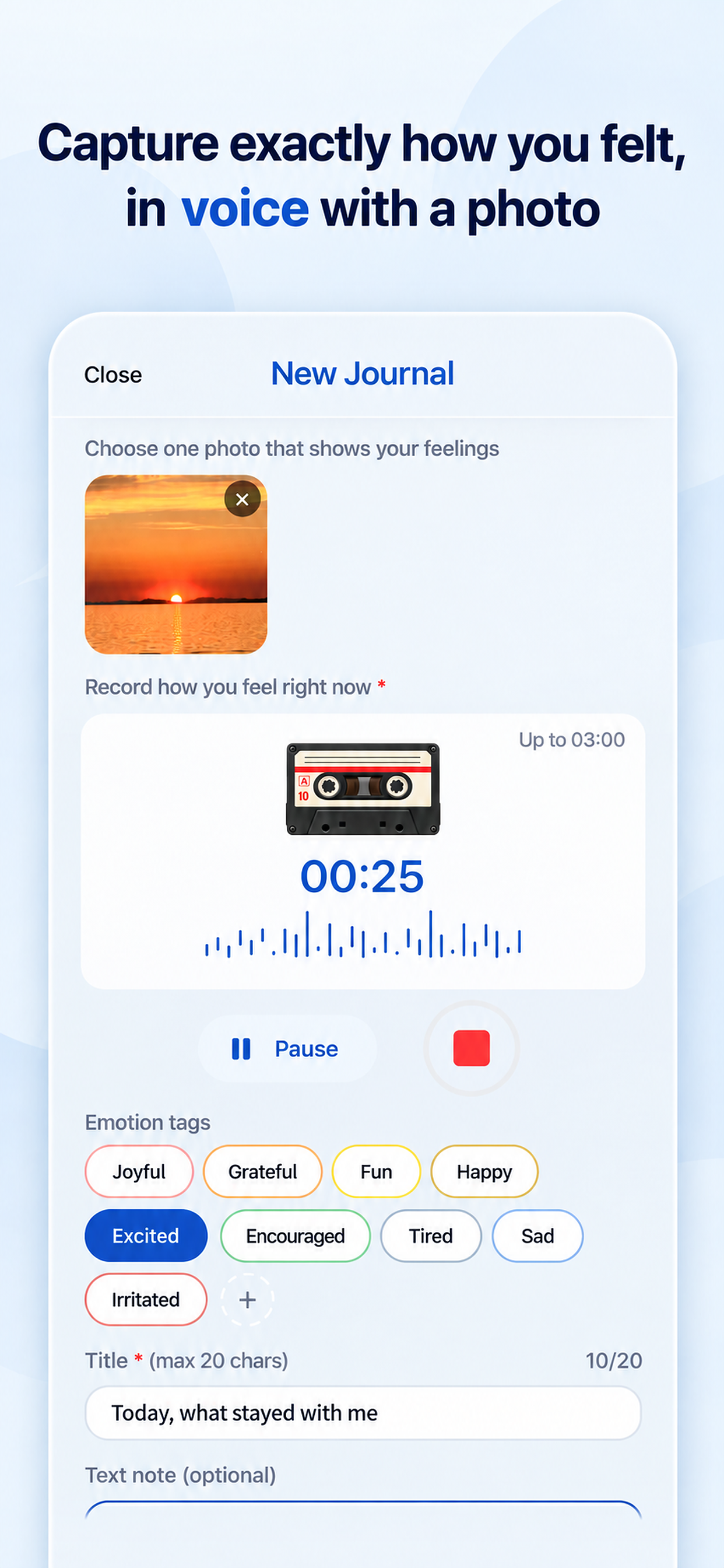
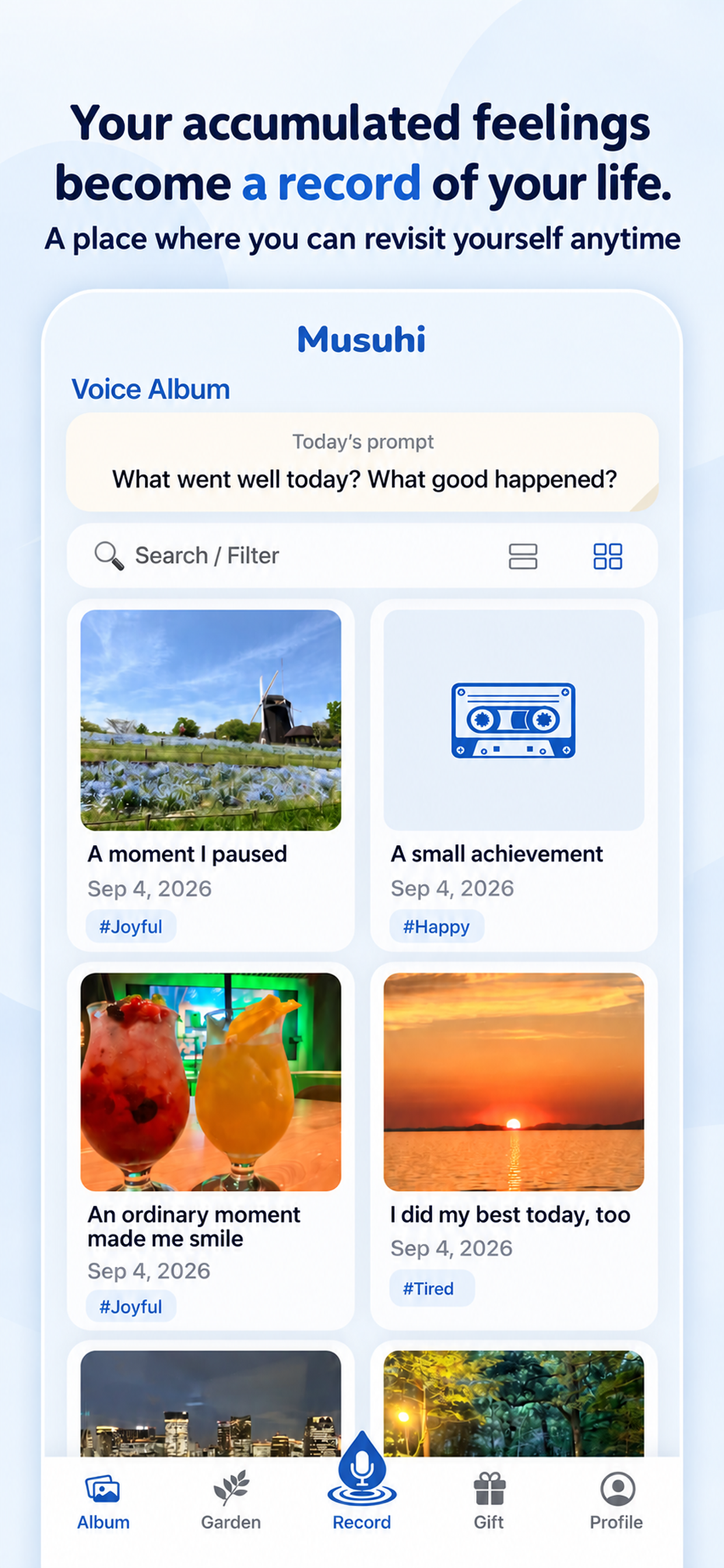
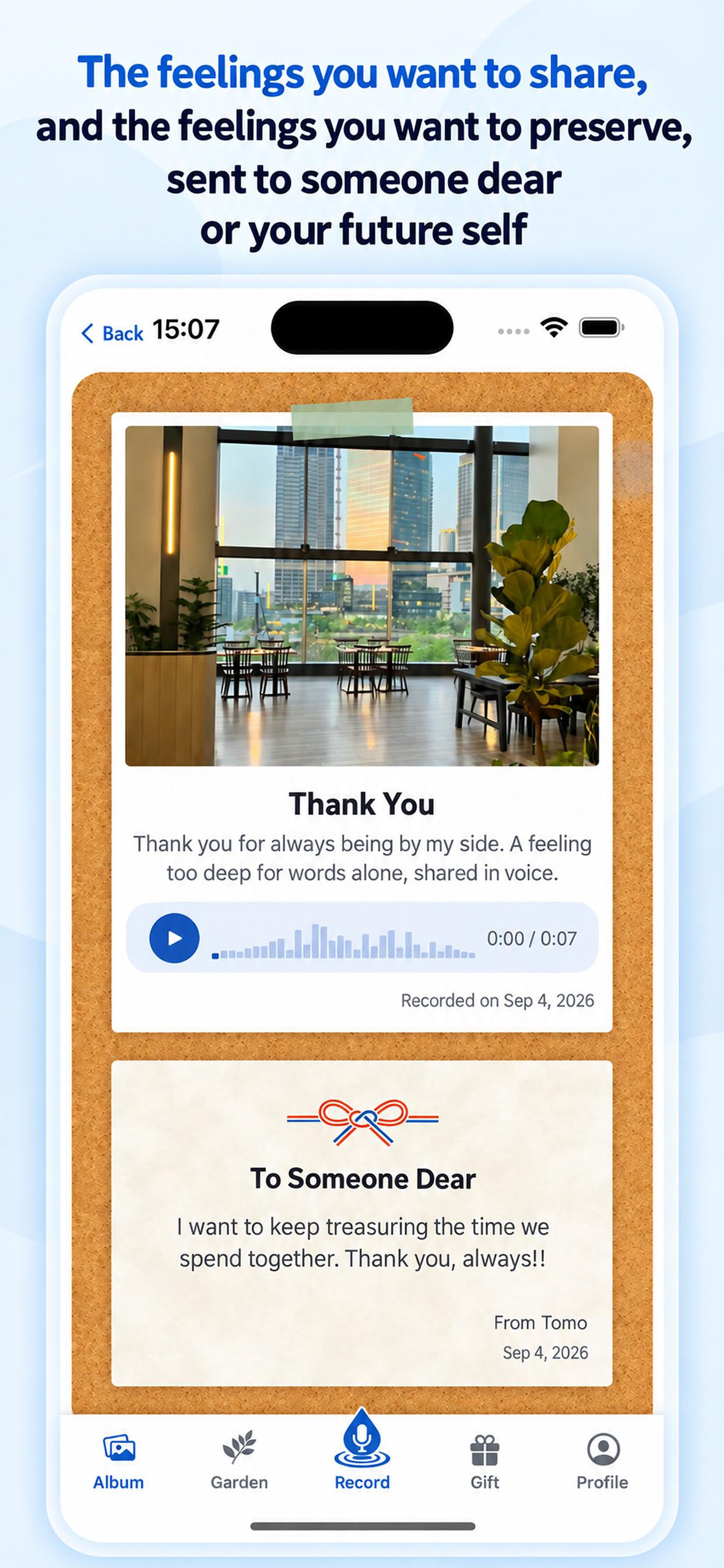
Capture everyday moments with your voice, a photo, emotion tags, and a short note.
-
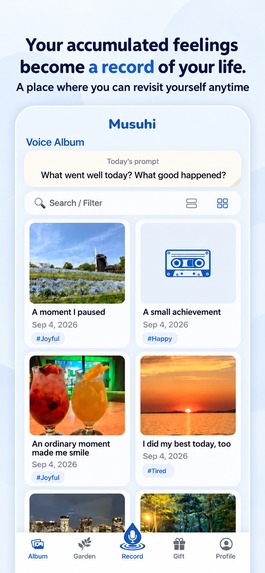
Your recorded moments accumulate into a personal voice-and-photo lifelog you can revisit anytime.
-
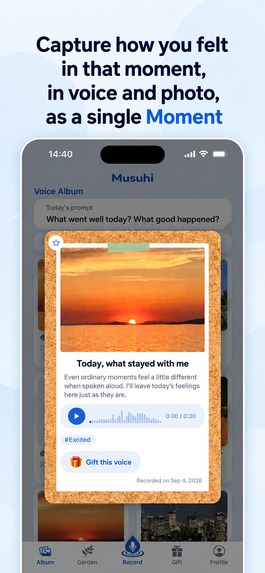
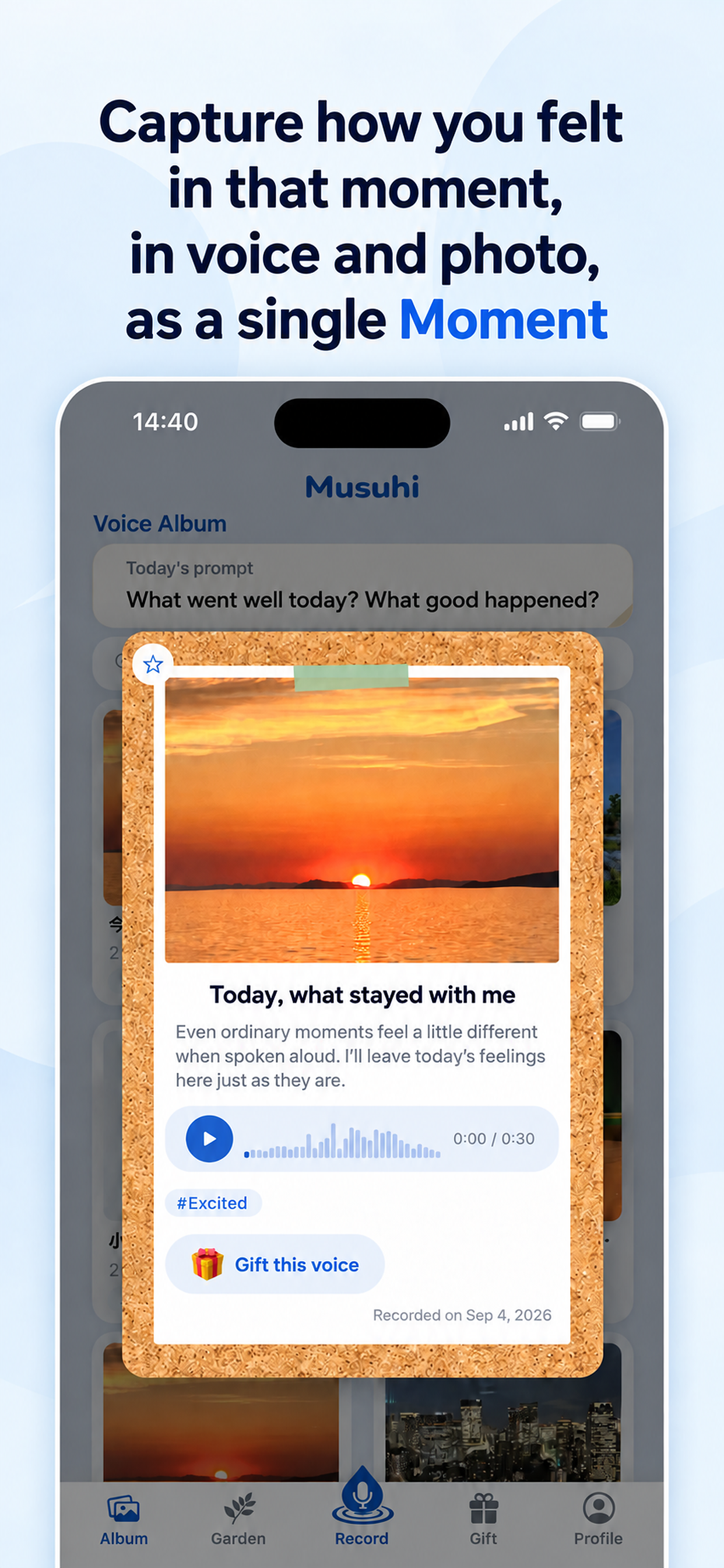
Revisit a Moment with the original photo, voice recording, emotion, and memory attached to it.
-
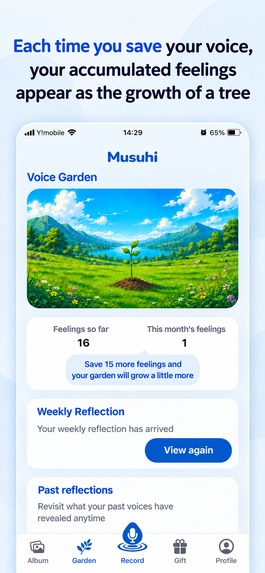
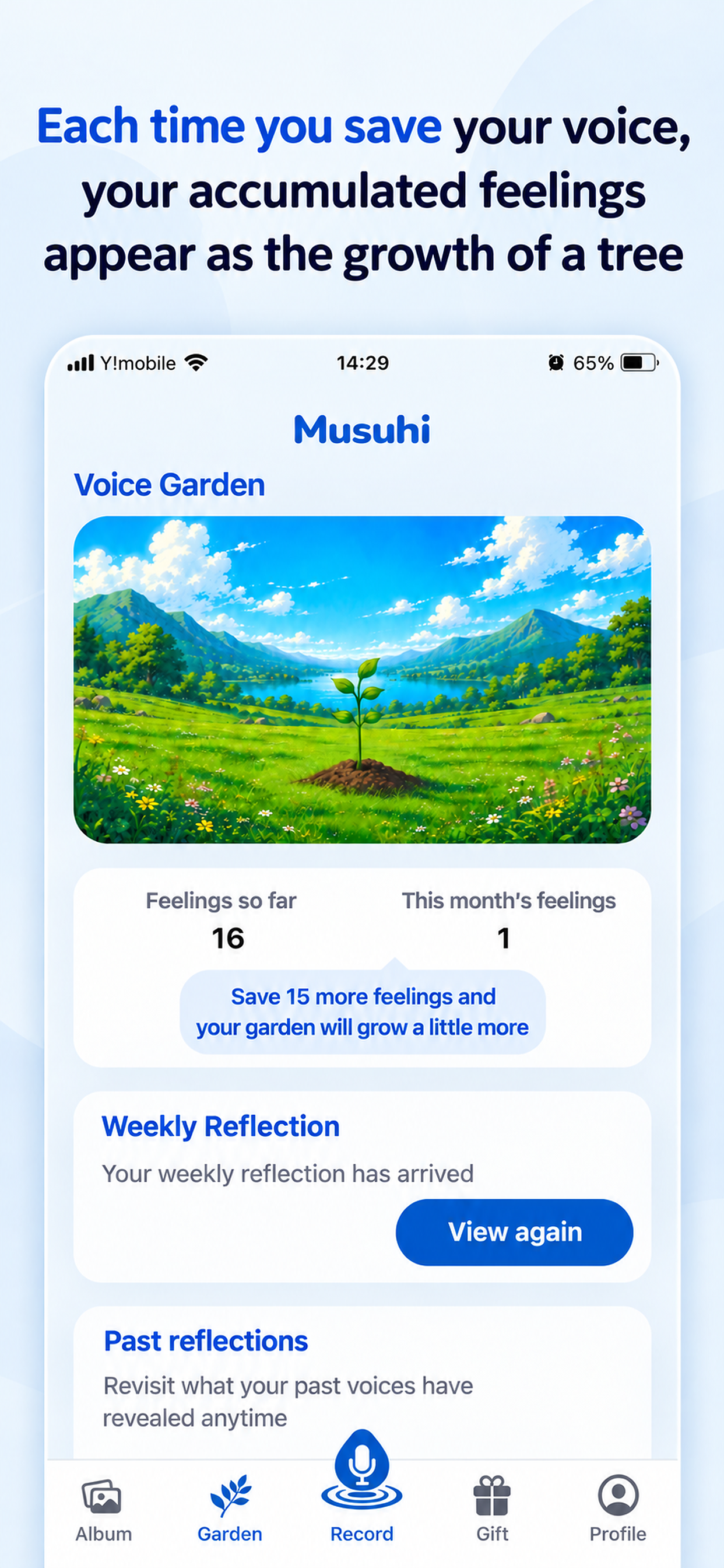
Each saved voice helps your Voice Garden grow, making the habit of reflection visible over time.
-
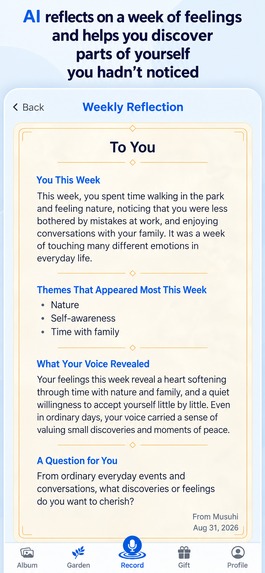
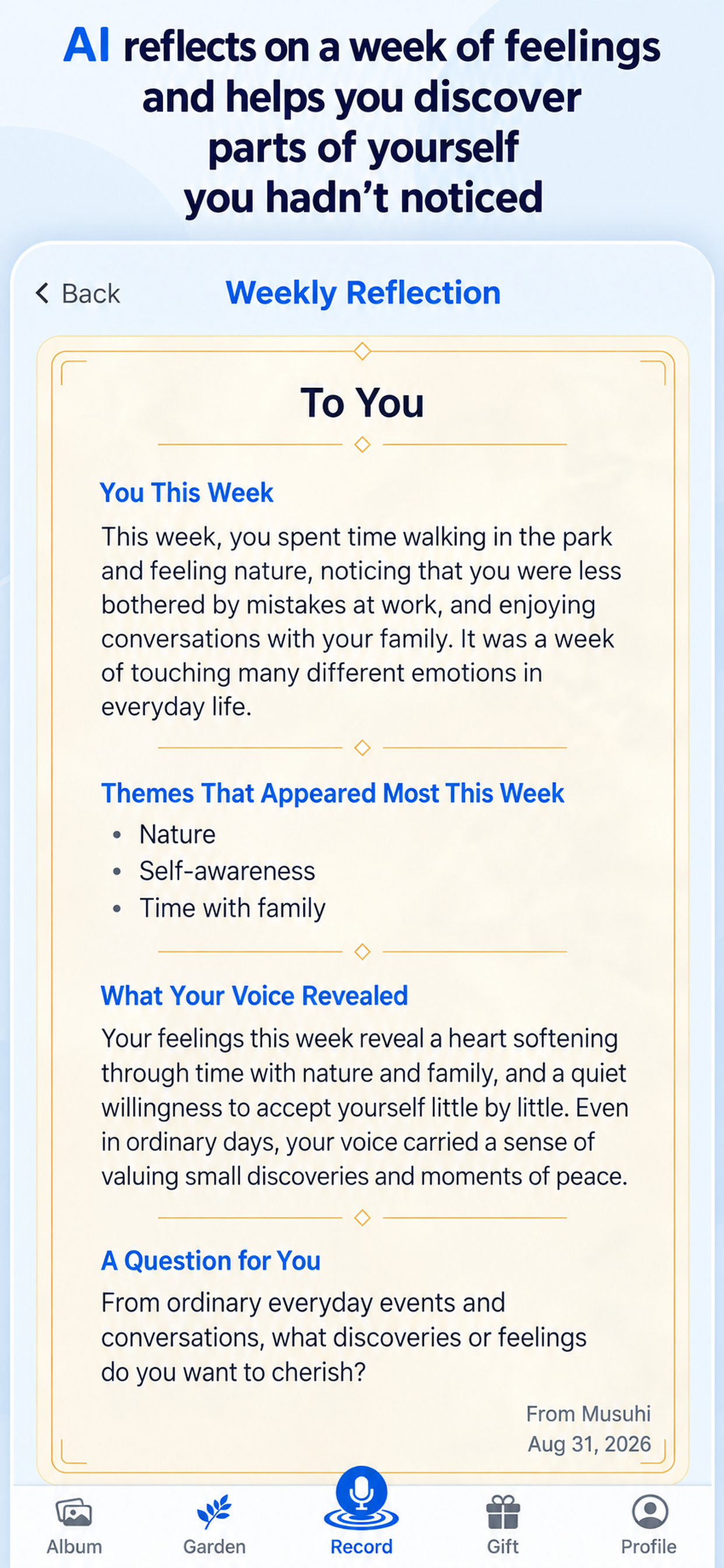
AI reflects on the past seven days of journal entries and helps surface recurring themes and emotions.
-
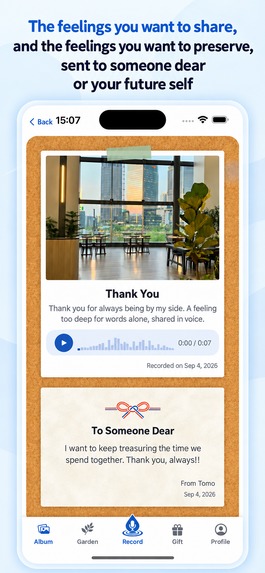
Send a voice, photo, and message to someone important now—or schedule it for the future.
-
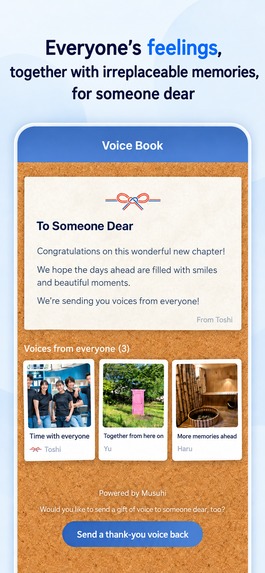
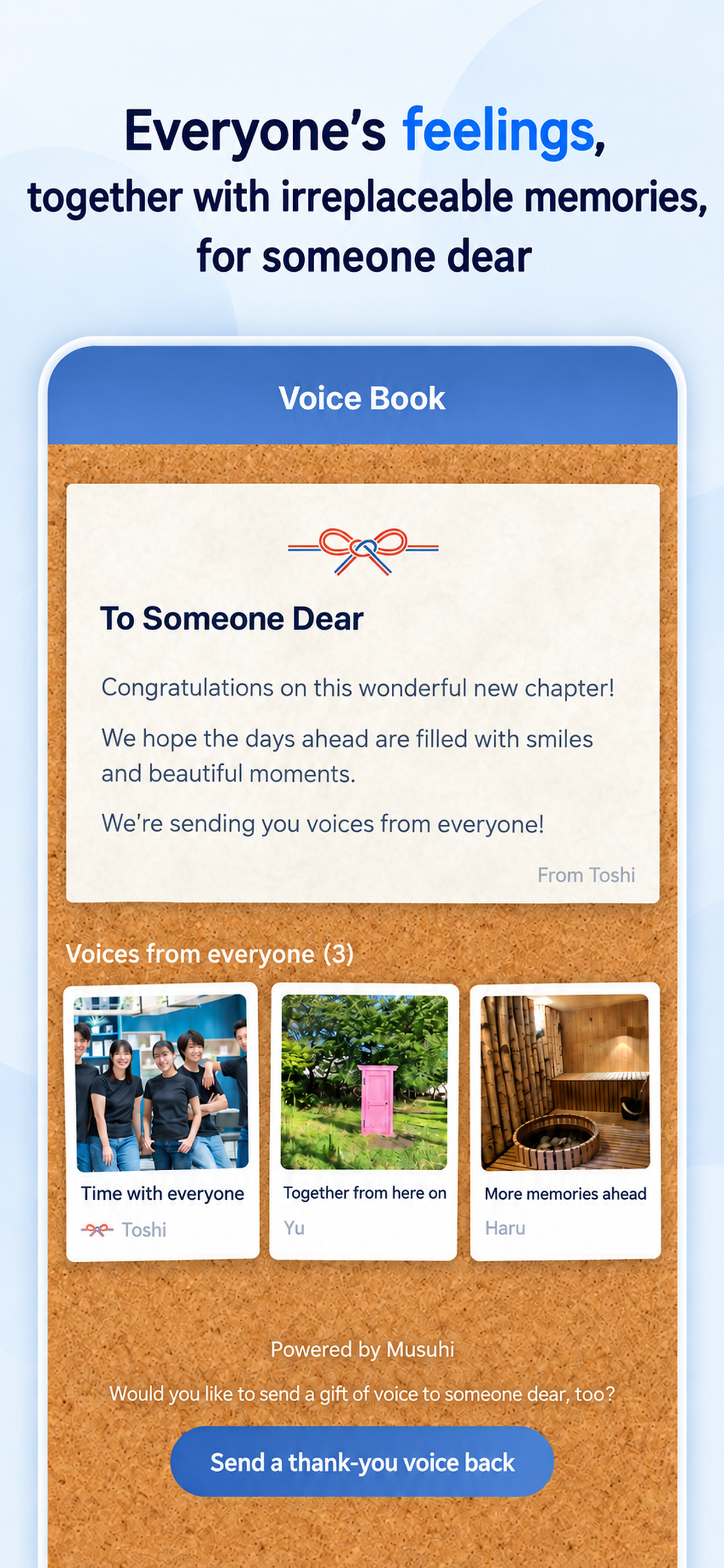
Bring together voices, photos, and messages from multiple people into one collaborative gift.
Inspiration
Photos show what a moment looked like. Text records what happened.
But voice preserves something different: emotion, hesitation, warmth, laughter, and the atmosphere of a moment.
That is why I created Musuhi, a voice-first journaling and lifelog app built around a simple idea:
Dialogue with yourself. Connection with others. Starting with your voice.
I wanted to create a place where people could preserve not only what happened in their lives, but also how they felt at that moment — and where those voices could someday reconnect them with themselves or with someone important to them.
Musuhi combines personal reflection with meaningful communication through voice and photos.
What it does
Musuhi has four core experiences.
Voice Album
Users can preserve everyday moments with a photo and up to three minutes of voice, together with a title, memo, emotion tag, and visibility setting.
Instead of requiring users to write a long journal entry, Musuhi lets them simply speak about what happened and how they feel.
Weekly Reflection
Musuhi uses AI to reflect on the user's recent Voice Album entries.
Rather than analyzing one moment in isolation, Weekly Reflection looks across the past seven days and helps users notice recurring experiences, emotions, and patterns they may not have recognized themselves.
The goal is not to judge the user, but to create another opportunity for self-reflection.
Voice Gift
Voice Gift lets users create a personal digital letter using voice, a photo, and a written message.
It can be sent immediately or scheduled for a future date.
The recipient first sees a digital envelope addressed to them, opens it, and then discovers the letter and the sender's voice.
This experience was designed to make receiving a voice message feel more meaningful than opening a normal chat notification.
Voice Book
Voice Book is a collaborative voice album.
Friends, family members, or colleagues can contribute a photo, short voice recording, and message to create one collective gift for birthdays, farewells, celebrations, and other important moments.
Together, these features connect two sides of Musuhi:
preserving your own life through voice, and using voice to stay connected with others.
How we built it
Musuhi is an iOS-first application built with Expo, React Native, and TypeScript.
The backend uses Next.js APIs deployed on Vercel, with Supabase for authentication, database, and storage.
RevenueCat powers Musuhi's monetization infrastructure, including Premium monthly and annual subscriptions and in-app purchases.
The Premium model is designed around continuity rather than reducing the quality of the free experience. Premium expands how often and how far users can use features such as Weekly Reflection and future delivery.
OneSignal powers push notifications and re-engagement messaging.
OpenAI is used for AI-powered Weekly Reflection.
Musuhi supports both Japanese and English and includes production features such as:
- Apple Sign In
- Email authentication
- Password reset
- Account deletion
- User-generated content reporting and blocking
- Private and public visibility controls
- Secure access to uploaded voice recordings and photos
- Deep linking and shared receiving experiences
During Shipaton, I also moved Musuhi from a web-first approach to a native-first product, while keeping the web experience for flows where it is still valuable, such as receiving shared content and account-related links.
Challenges we ran into
One of the biggest challenges was creating an emotional product without letting the technology become the center of the experience.
Voice Gift is a good example.
Technically, it could have been presented as a standard list of messages with a play button. Instead, the recipient sees an envelope, the recipient's name, the sender's name, and the delivery date before opening the letter.
Typography, spacing, timing, and the transition from envelope to letter were all designed to make the experience feel personal.
Another major challenge was the transition from a web-first prototype to a production-ready native app.
That required rebuilding and validating authentication, audio recording, sharing links, anonymous receiving flows, subscriptions, push notifications, localization, and access control across the product.
Preparing for a real App Store launch also required work that users may never see directly: privacy, account deletion, subscription disclosures, user-generated content safety, secure media access, production environment separation, and many release QA cycles.
Balancing all of this while keeping Musuhi simple and emotionally approachable was one of the hardest parts of the project.
Accomplishments that we're proud of
The biggest accomplishment is simple:
Musuhi became a real product that people can download from the App Store. As the solo founder, I took Musuhi from concept to production and App Store release end to end, personally leading product strategy, UX/UI design, development, AI integration, monetization, localization, production QA, and the Shipaton submission.
During Shipaton, I shipped and productionized:
- Voice-and-photo journaling with Voice Album
- AI-powered Weekly Reflection
- Scheduled Voice Gifts
- Collaborative Voice Books
- RevenueCat subscriptions and in-app purchases
- OneSignal push notifications
- Japanese and English localization
- Apple Sign In and email authentication
- User reporting and blocking
- Account deletion
- Sharing and anonymous receiving experiences
- Production security improvements
- A complete App Store release
Musuhi was officially released on the App Store in September 2026 and is available in both Japan and the United States.
Another accomplishment I am proud of is building in public throughout Shipaton.
I have continuously shared the development process — including progress, problems, design decisions, App Store review, release preparation, and lessons learned — rather than only showing the finished product.
What we learned
The biggest lesson from building Musuhi is that emotional products need restraint.
More features do not automatically create a better experience.
Some of the most important decisions were about what not to show, when not to interrupt the user, and how to keep the voice itself at the center of the experience.
I also learned how different building a prototype is from shipping a real consumer app.
Authentication, privacy, user-generated content safety, monetization, notifications, localization, App Store requirements, and production security all become part of the product experience once real users are involved.
Building in public was another important part of that learning process.
Sharing the process forced me to repeatedly explain Musuhi from the perspective of someone encountering it for the first time. That helped me simplify both the product and the way I communicate its purpose.
What's next for Musuhi
Now that Musuhi is publicly available, the next focus is learning from real usage.
In the short term, I want to improve:
- First-time user activation
- The habit of recording everyday moments
- Weekly Reflection engagement
- Retention
- Voice Gift and Voice Book sharing
- The path from Free to Premium
I also want to continue improving the quality of Weekly Reflection so that it helps users discover meaningful patterns in their lives without becoming intrusive or overly analytical.
Musuhi is currently focused on consumers, but in the future I also want to explore how this type of voice-based reflection could support employee wellbeing and human connection within organizations.
The long-term vision is to create a place where voices, feelings, and memories that would otherwise disappear can remain.
A voice recorded today may become something meaningful to yourself — or someone you care about — years from now.
Shipaton 2026 Awards
Musuhi is being submitted for consideration for:
- Grand Prize
- HAMM Award
- RevenueCat Peace Prize
- RevenueCat Design Award
- Keep Them Coming Back Award — OneSignal
Built With
- applesignin
- expo.io
- ios
- native
- next.js
- onesignal
- openai
- postgresql
- react
- revenuecat
- supabase
- typescript
- vercel
