There was a talk not long ago at ICFP, by Youyou Cong: Continuations in Music. She spoke about the link between continuations, a powerful concept in functional programming, and patterns and structures in music.
I found this really interesting and wondered how far we might be able to take it!
The SK combinator calculus
Believe it or not, we can define a language using just two symbols which is as powerful as the lambda calculus. Defined by reduction rules. (Using ., non-standardly, to denote application. Lowercase letters are meta-variables and not part of the calculus.)
S . f . g . x = (f . x) . (g . x)
K . x . y = x
Surprisingly we can do a lot in this language. We can't hear it though.
Notes and sequences
Music consists of two dimensional sequences. Melodies are horizontal and chords are vertical.
I decided that the primitives in my calculus shouldn't be individual symbols, but should instead be sequences, of the two-dimensional sort. We represent these by syntactic juxtaposition, and use square brackets for verticals.
MUSIK> C C G G A A G
C C G G A A G

MUSIK> [(C C) [C E G]] [(G G) [G C]] (A A) [C E G]

┌   ┐ ┌   ┐
│C C│ │G G│       ┌ ┐
│┌ ┐│ │┌ ┐│       │C│
││C││ ││G││ (A A) │E│
││E││ ││C││       │G│
││G││ │└ ┘│       └ ┘
│└ ┘│ └   ┘
└   ┘
We hear horizontal sequences as rows, and verticals are played as chords. These compose and nest nicely, and behave as expected.
The MUSIK calculus
We have new data, we ought to have new combinators to deal with them. We need three, as it happens.
M . c . n . ()     = n
M . c . n . (x y ...) = c . x . (M . c . n . (y ...))

U . (x y ...) . (a b ...) = (x y ... a b ...)
U . [x y ...] . (a b ...) = [x y ... a b ...]

I . p . s . z . C = z
I . p . s . z . i = s . (I . p . s . z . (i-1))     if i > 0
I . p . s . z . i = p . (I . p . s . z . (i+1))     if i < 0
M and I stand for "catamorphism" and "interval", and U for "union". M and I let us fold over the structure of sequences and intervals (i.e. notes). U lets us concatenate together sequences. It also gives us the power to transpose them.
Notes are combinators
It only makes sense that we can use notes and musical passages as combinators too! They act as shifting operations, resp. their interval relative to middle C.
MUSIK> C# . [A B C]

     ┌ ┐
     │A│
C# · │B│
     │C│
     └ ┘

  ... 4 steps ...

┌  ┐
│A#│
│C5│
│C#│
└  ┘
This is interesting in itself, but it lets us do cool things like converting sequences into sequences of chords, or arpeggiating.
MUSIK> [C E G] . (A B)

┌ ┐
│C│
│E│ · A B
│G│
└ ┘

  ... 9 steps ...

┌   ┐ ┌   ┐
│ A │ │ B │
│C#5│ │D#5│
│ E5│ │F#5│
└   ┘ └   ┘
MUSIK> (C E G) . (C C G G A A G G F F E E D D C C)

C E G · C C G G A A G G F F E E D D C C

  ... 65 steps ...

(C E G) (C E G) (G B D5) (G B D5) (A C#5 E5) (A C#5 E5) (G B D5) (G B D5) (F A C5) (F A C5) (E G# B) (E G# B) (D F# A) (D F# A) (C E G) (C E G)
Operations on, and within, music
Music therefore can be seen simultaneously as data and code. For one example, we can use the I combinator to create a musical passage which inverts another.
MUSIK> (I . C# . Cb . C) . (C D E)

I · C# · B3 · C · C D E

  ... 16 steps ...

C A#3 G#3
We might also want to reverse a sequence. No worries, we can do this with the M and U operators.
MUSIK> M . (\a -> \rest -> U . rest . a) . () . (C E G)

M · (S · (K · (S · (S · (K · U) · (S · K · K)))) · (S · (K · K) · (S · K · K))) · () · C E G

  ... 43 steps ...

((() G) E) C
Sound
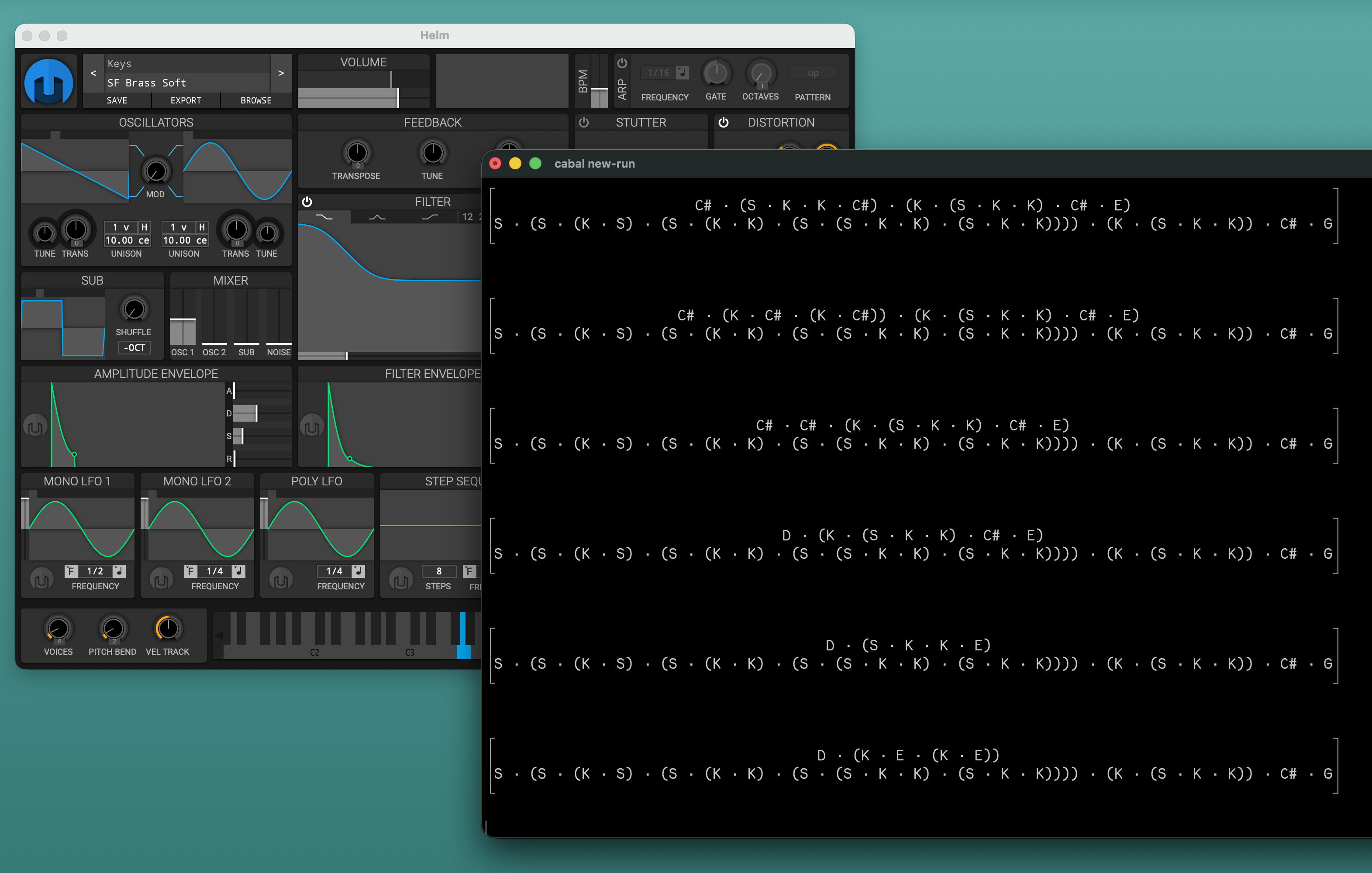
Terms in this language can be interpreted by playing them through a MIDI synth. It sounds pretty funky sometimes.
Logic
We can represent booleans as musical notes, too. C and F# are false and true; application therefore corresponds to XOR, if we consider intervals modulo 12 (i.e. an octave).
C
Built With
- haskell


Log in or sign up for Devpost to join the conversation.