-
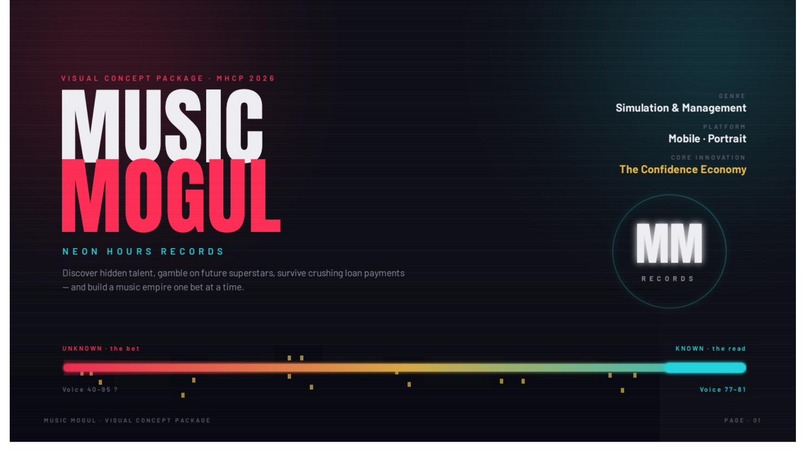
Music Mogul: a mobile record-label sim where the scarce resource isn't money — it's certainty. Every signing is a calculated bet.
-
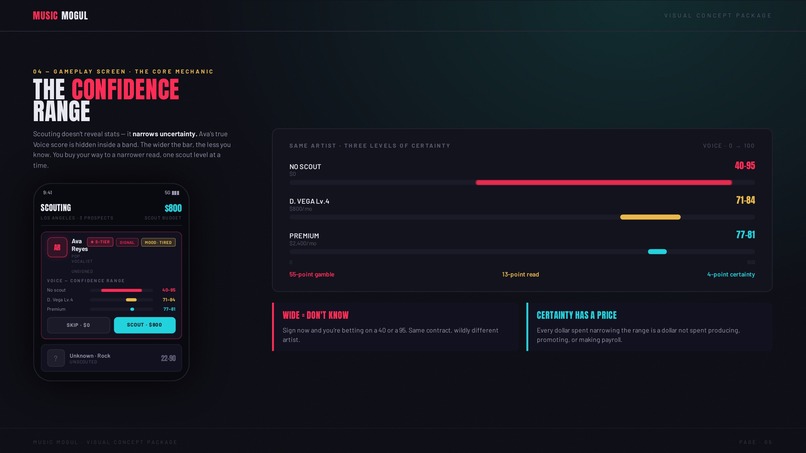
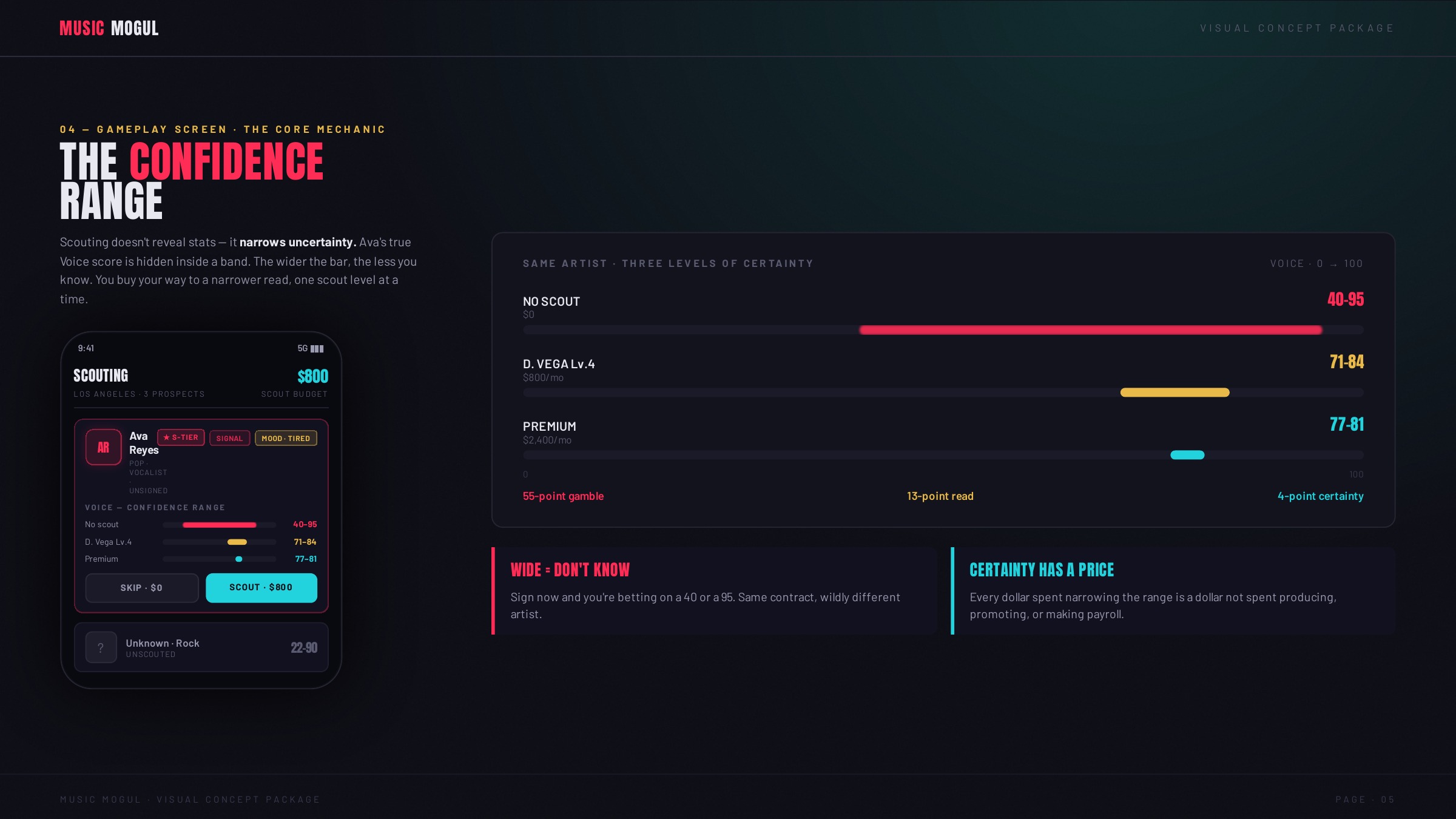
The core mechanic: scouting narrows uncertainty rather than revealing stats. Same artist, three certainties — pay your way to a read.
-
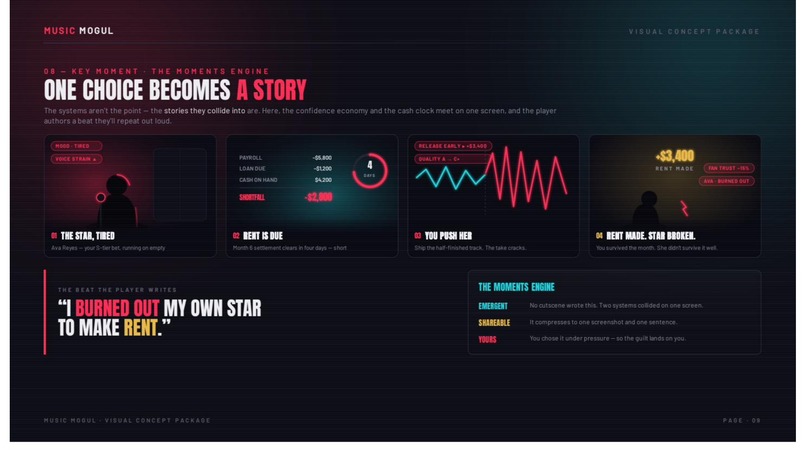
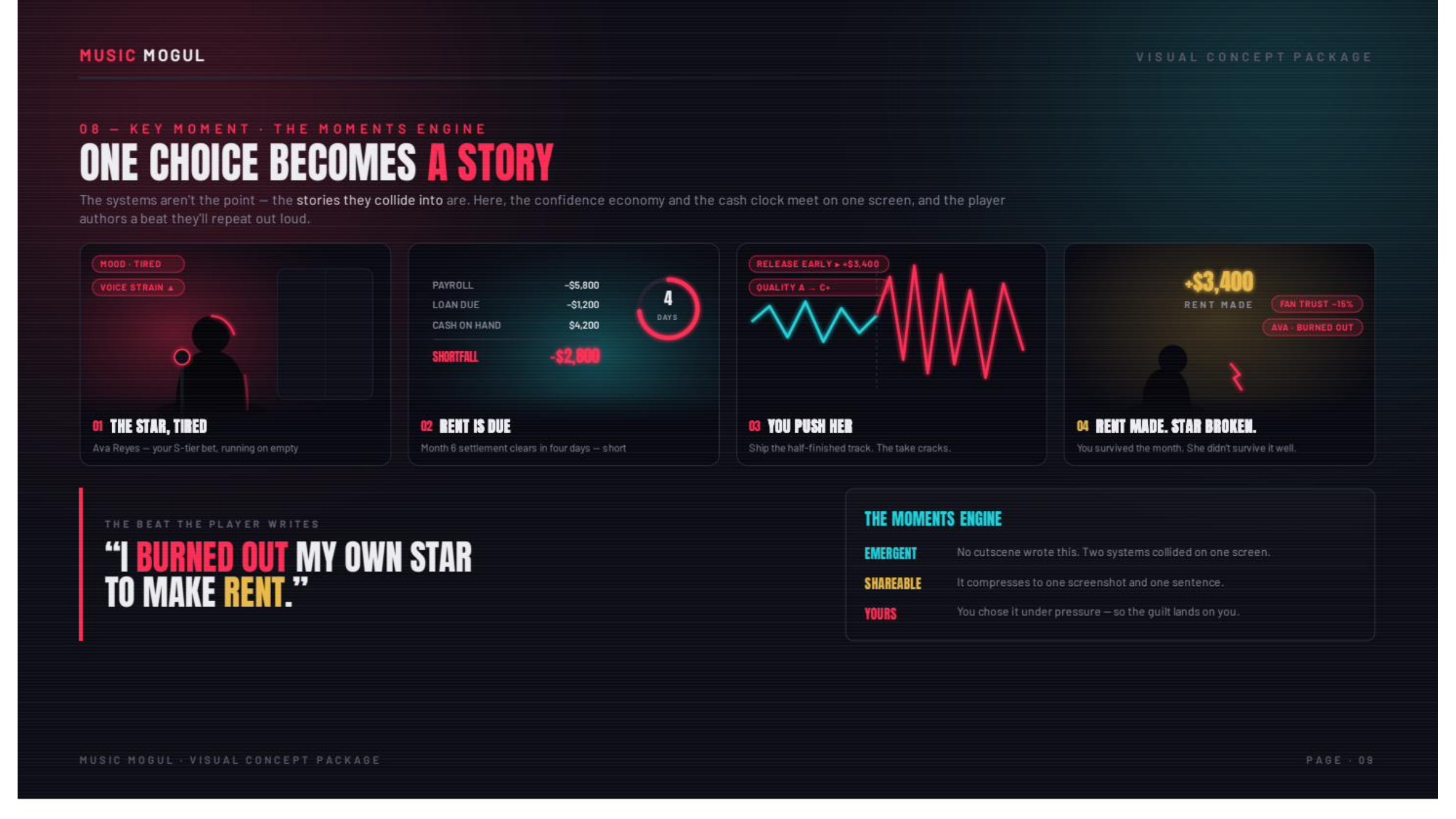
The Moments Engine: systems collide into a story the player retells out loud. "I burned out my own star to make rent." Month 6 cash crunch.
-
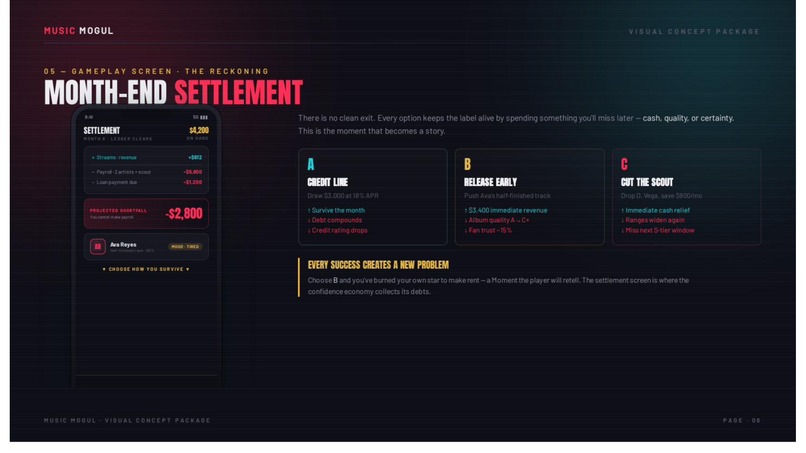
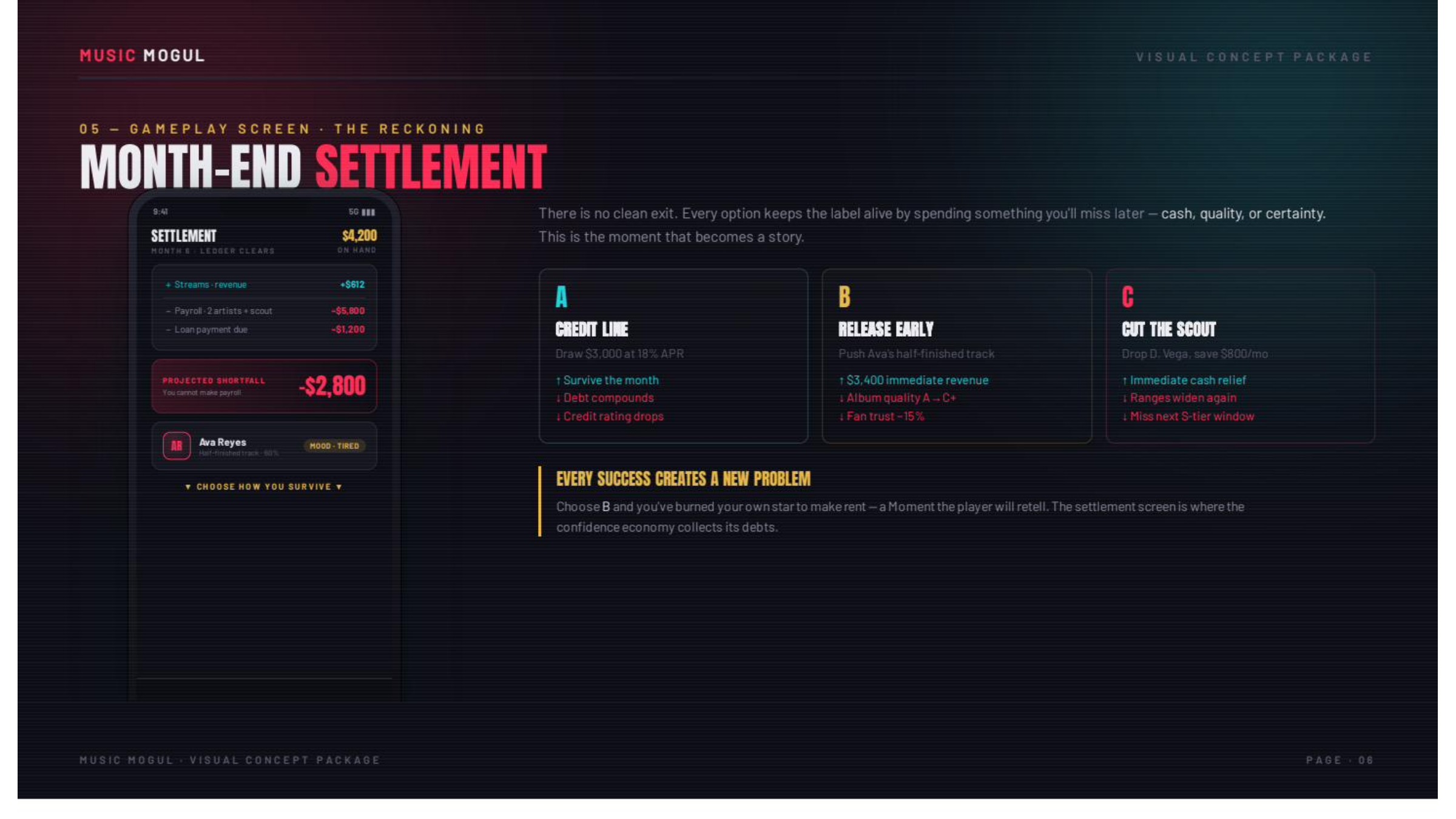
Month 6 settlement: $4,200 on hand, $7,000 owed. 3 ways to survive, each costs something you'll miss later. The Confidence Economy bites.
-
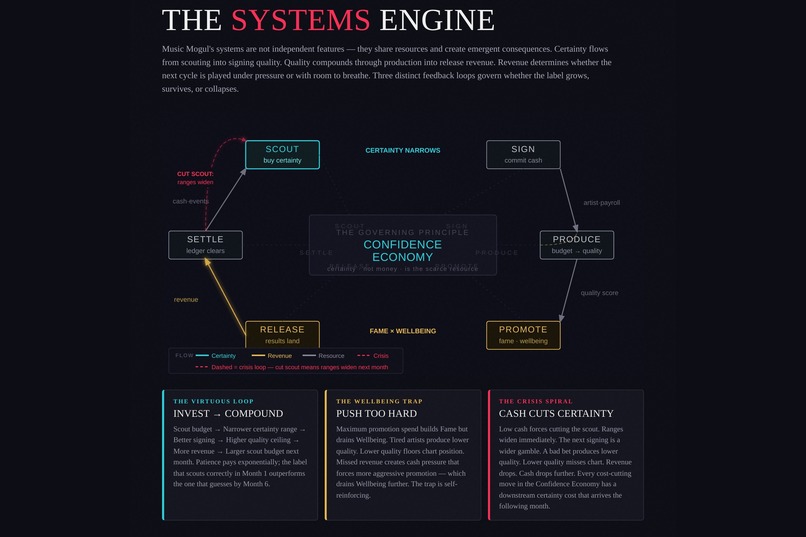
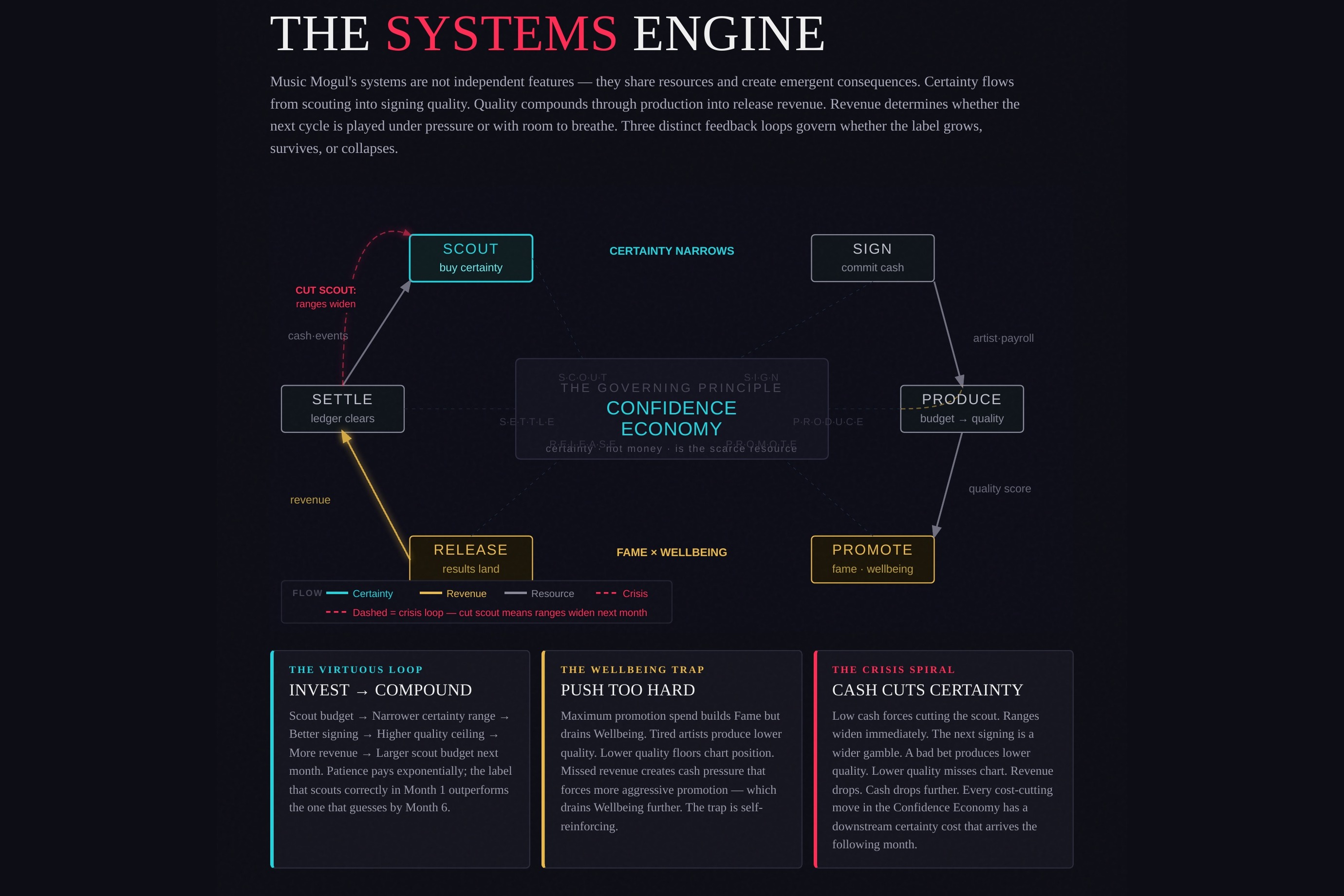
Three named feedback loops drive the game: invest and compound, push too hard, or let cash cut your certainty. Systems are interconnected.
-
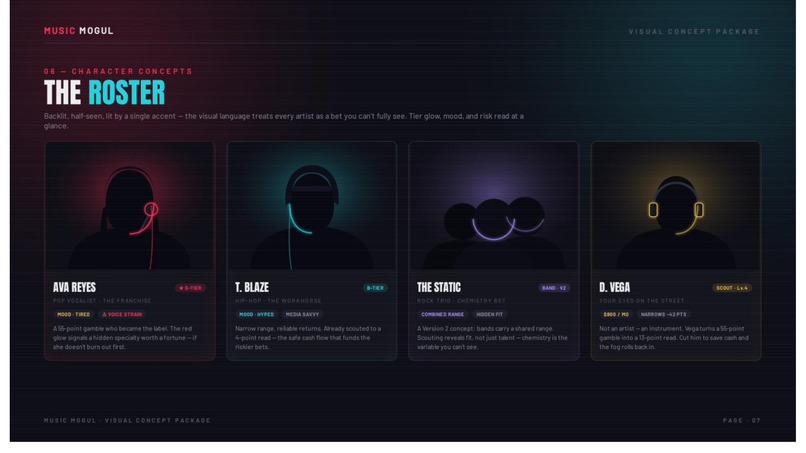
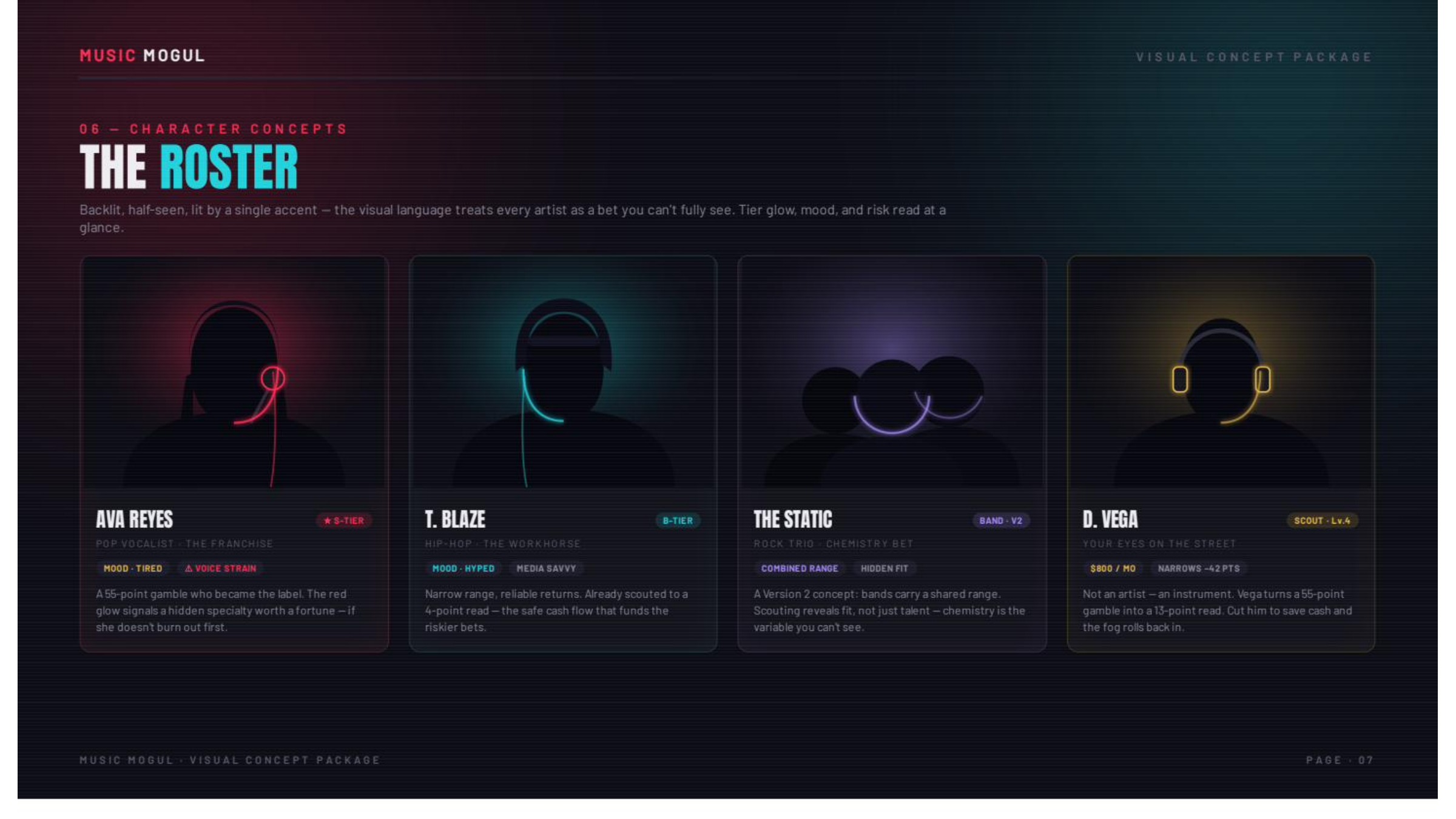
The roster: Ava Reyes (S-tier, Voice Strain), T. Blaze, The Static. Each artist is a face with a mood and a risk flag — not rows in a table.
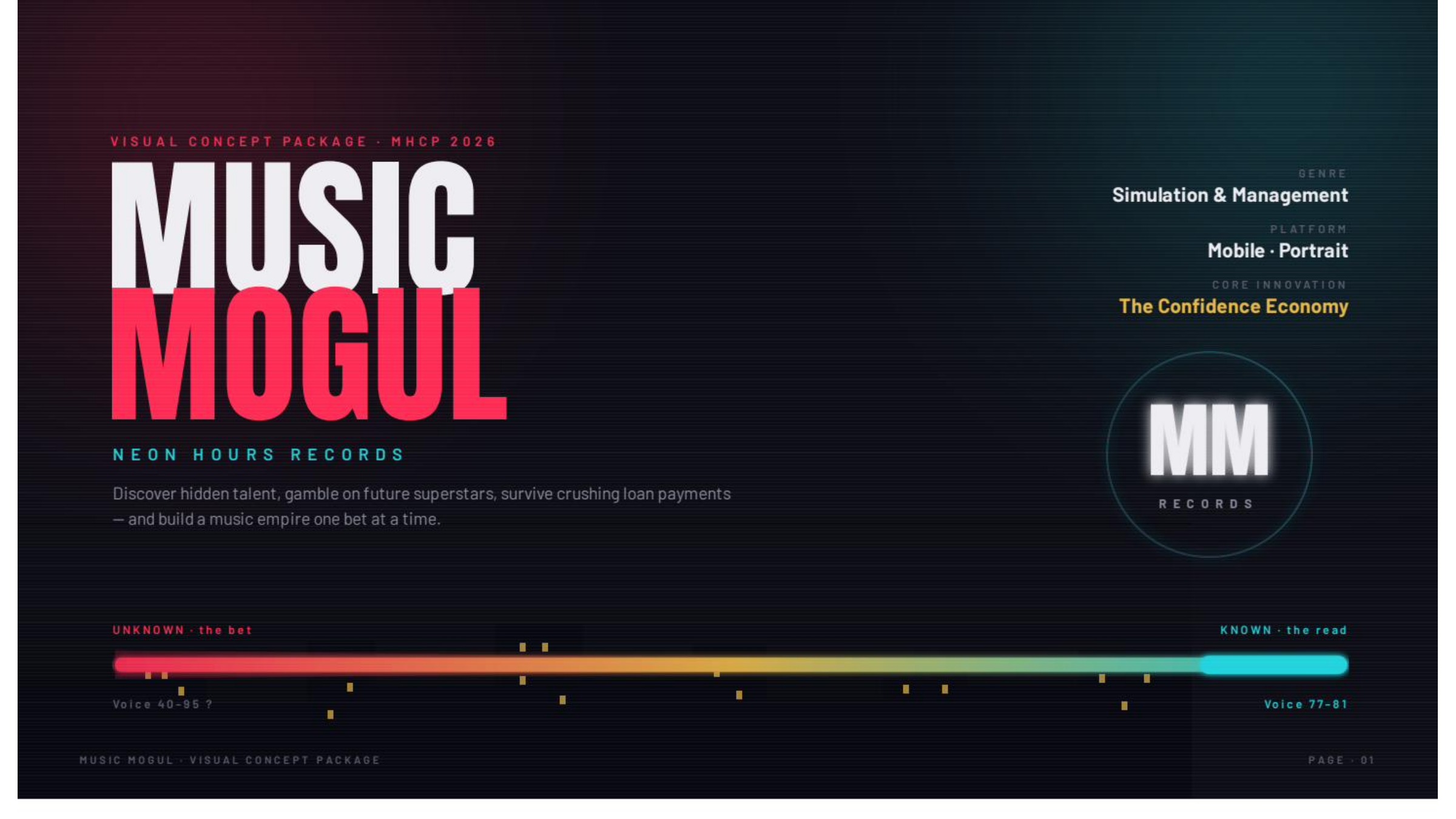
Music Mogul
A record-label management sim where certainty, not money, is the scarce resource.
Inspiration
Most management games show you exactly what you're buying. Music Mogul asks what you'd pay to know.
The idea came from a single question: what if scouting didn't reveal a stat -- it narrowed a range of possible values, and you had to decide whether the certainty was worth more than the cash? That's a meaningfully different game from the stat-optimization pattern, and it produces a meaningfully different kind of tension.
What It Is
Music Mogul is a portrait-first mobile management sim. Players run Neon Hours Records, scouting artists whose true abilities are hidden inside a Confidence Range -- a band of uncertainty that only narrows when you invest scout budget to investigate:
$$\text{band} = \text{center} \pm \frac{\text{spread}}{2}, \quad \text{clamped to } [0, 100]$$
Sign without scouting and you might be betting on a 40 or a 95. Spend to narrow the range and that money doesn't go to payroll. Every month ends in a settlement: payroll clears, loan payments hit, and the ledger forces a real choice.
In Month 6, with \$4,200 on hand and \$7,000 owed, Ava Reyes -- an S-tier anchor artist -- is tired, half-finished, and flagged for Voice Strain. Three options appear, each a complete escape, each costing something different:
- A. Credit Line -- \$3,000 at 18% APR. Survive the month. Debt compounds. (Sacrifice future cash.)
- B. Release Early -- \$3,400 revenue. Album quality drops from A to C+. Fan trust falls 15%. (Sacrifice artist quality and trust.)
- C. Liquidate Scout Network -- Sell D. Vega's prospect list for \$2,800. Lose D. Vega permanently. Future ranges widen. (Sacrifice future certainty.)
Three choices. One survival. One sacrifice each. That moment is the game.
Music is the only setting where this uncertainty is native, not engineered. No scout, no algorithm, and no label has ever predicted which song would define a generation until it already had. Each genre imposes genuinely different stakes: Pop lives or dies on timing, Hip-Hop requires community authenticity, Country builds through regional loyalty, Rock rewards live performance, EDM runs on the festival cycle. The Confidence Economy isn't a simulation of music. It describes how music actually works.
How I Built It
This is a pre-production design package -- Game Design Document, Player Journey Map, Visual Concept Package, and Production Plan -- developed as a solo designer. The visual identity is neon-noir, portrait-first, color as mechanic: red for uncertainty, cyan for certainty earned, gold for reward. The production plan targets Unity 2D LTS 6.x with a ScriptableObject data model and a 12-week solo build schedule, first-playable at Week 8-9.
Release quality is determined by:
$$Q = (\text{talent} \times \text{genreFit}) + \text{budgetTier} + \text{producerBonus} - \text{moodPenalty}(\text{wellbeing}) - \text{genreMismatch}$$
A tired S-tier can forecast lower than a hyped B-tier. Wellbeing is a quality input, not a side stat.
The Hard Part
The challenge was separating the Confidence Economy from a hidden-stat system. The distinction matters:
| Hidden Stat Systems | Confidence Economy |
|---|---|
| Scout enough and the mystery ends | The range never fully closes before release |
| Information has a ceiling | Every dollar on certainty costs payroll or talent |
| The only question is when to look | The question is how much fog you can afford to sign into |
Getting that distinction to read clearly in a mobile UI -- without a tutorial longer than 60 seconds -- required the most iteration.
What I Learned
Uncertainty is only interesting when reducing it costs something real. The Confidence Range works because scout budget competes directly with payroll and production. If certainty were free, the tension disappears. Every system in this game exists to make that cost visible and personal.
The settlement screen is where the Confidence Economy collects its debts. "I burned out my own star to make rent" isn't a scripted cutscene -- it's a consequence that emerges from the player's own decisions under pressure.
What's Next
The MVP scopes to one fully authored anchor artist, one scout, one recording slot, and the month-end settlement loop. Version Two adds touring with market confidence ranges, rival label AI with distinct strategies, and band chemistry as a hidden variable.
The portrait-first UI and one-thumb HUD are designed for mobile and extend to Meta Horizon Worlds without redesign.



Log in or sign up for Devpost to join the conversation.