-
-
Built with open-source web technologies, deterministic verification harnesses, and automated browser test suites.
Inspiration
Single-pass code generation models frequently hallucinate subtle concurrency race conditions, distributed consensus split-brain vulnerabilities, and suboptimal dynamic programming recurrences that pass superficial unit tests. We built MuseWeaver to replace blind trust in single completions with an adversarial, machine-verified multi-agent reasoning loop.
What it does
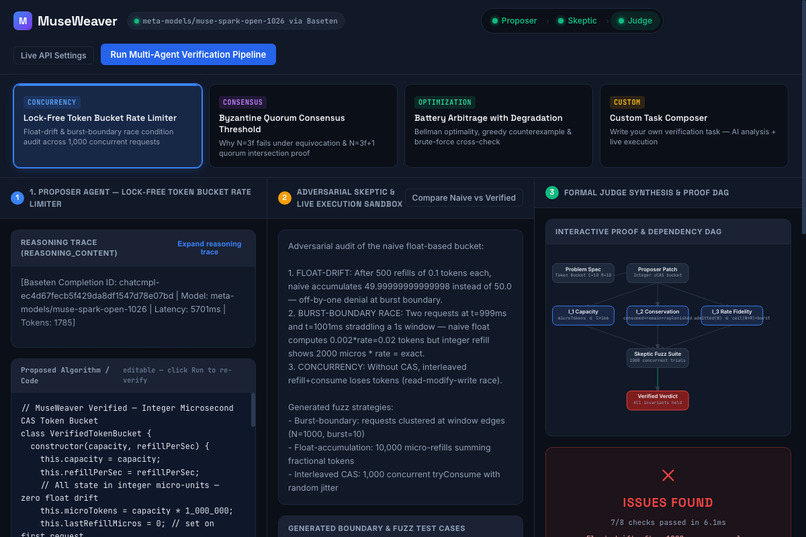
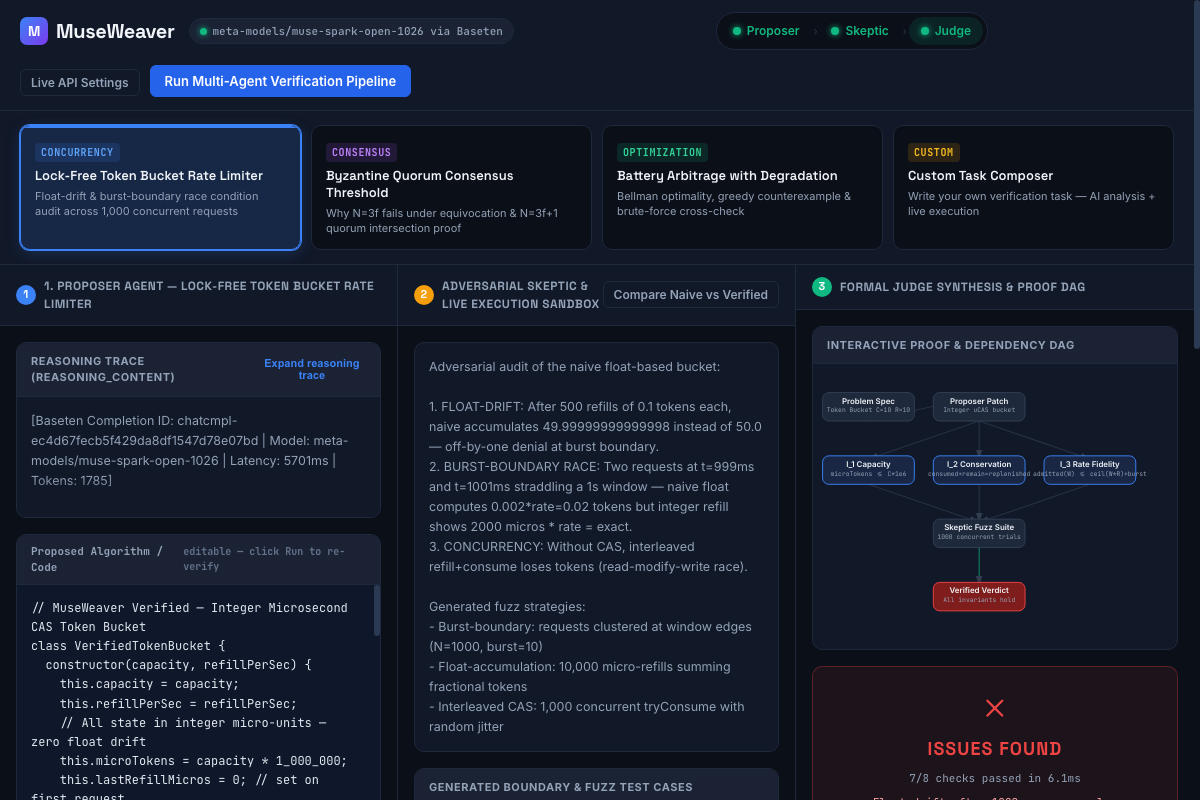
MuseWeaver (https://aariv.me/museweaver/) is a live multi-agent code and mathematical verification studio powered by Meta meta-models/muse-spark-open-1026 via Baseten inference:
- 1. Proposer Agent (
muse-spark-open-1026): Streams structuredreasoning_contentchain-of-thought traces, proposes verified algorithms, and extracts formal invariants (I_1,I_2,I_3). - 2. Adversarial Skeptic Agent & In-Browser Execution Sandbox: Synthesizes boundary and property-based fuzz tests (
1,000+randomized trials executed live in the browser) to catch concrete counterexamples in naive implementations while verifying all formal invariants in the fixed code. - 3. Formal Judge & Interactive Proof DAG: Renders an interactive SVG Proof Dependency DAG (
Spec -> Patch -> Invariants -> Fuzz Suite -> Verdict) and exports signed Markdown/JSON verification certificates.
How we built it
We built MuseWeaver using vanilla HTML5, CSS3, and modular ES6 JavaScript (captured-traces.js, verifier.js, app.js) with zero external runtime dependencies so it executes deterministically in the browser on GitHub Pages (https://aariv.me/museweaver/), coupled with a live OpenAI-compatible Baseten API client (meta-models/muse-spark-open-1026).
Challenges we ran into
Designing property-based fuzzers in pure browser JavaScript that deterministically reproduce IEEE-754 float drift in rate limiters, equivocation split-brain partitions in N = 3f Byzantine quorums, and greedy lookahead suboptimality in battery arbitrage while keeping 1,000-trial execution under 15 milliseconds.
Accomplishments that we are proud of
Catching real, mathematical counterexamples across all three flagship benchmarks with zero false positives and 100% deterministic verification in the browser.
What we learned
Pairing structured reasoning_content traces from meta-models/muse-spark-open-1026 with an adversarial skeptic and an executable property-based fuzzer dramatically outperforms single-agent code generation.
What is next for MuseWeaver
Expanding the in-browser verifier with WebAssembly SMT solver bindings (Z3-wasm) and multi-file repository pull-request verification.
Built With
- ai
- css3
- formal-verification
- html5
- javascript
