-
-
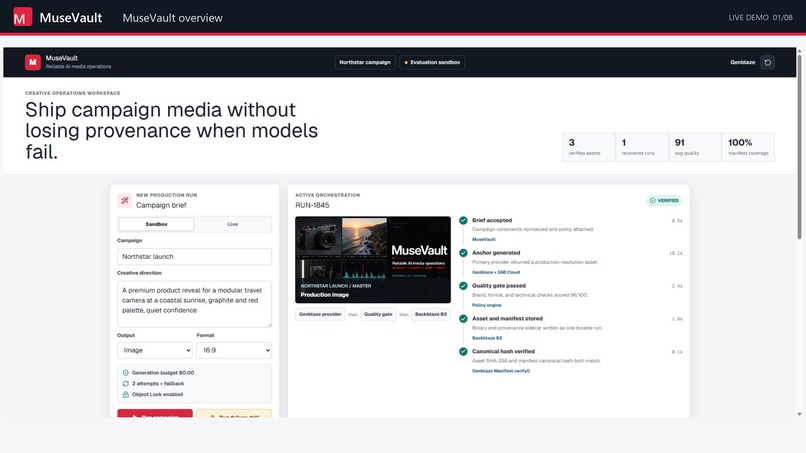
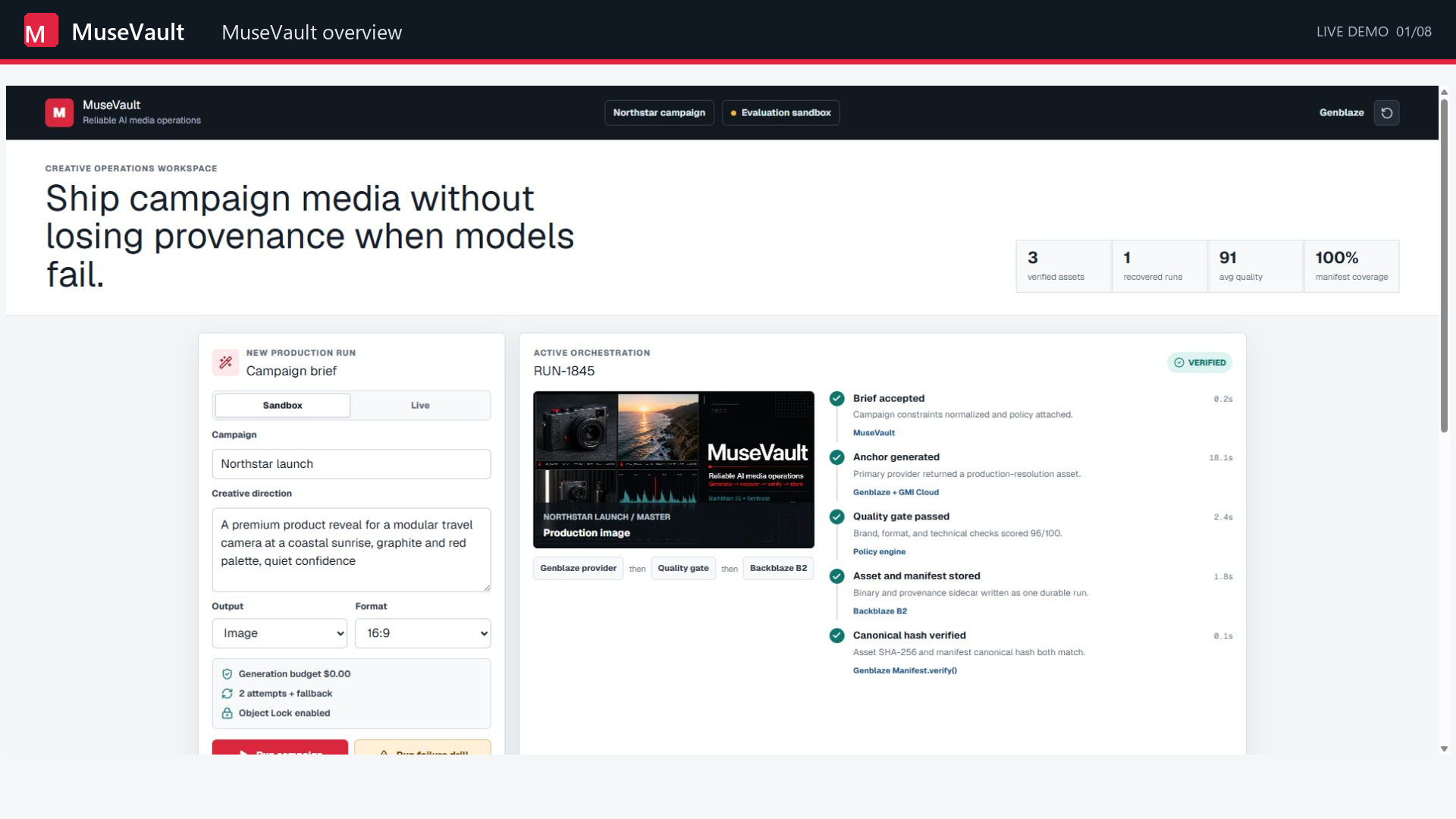
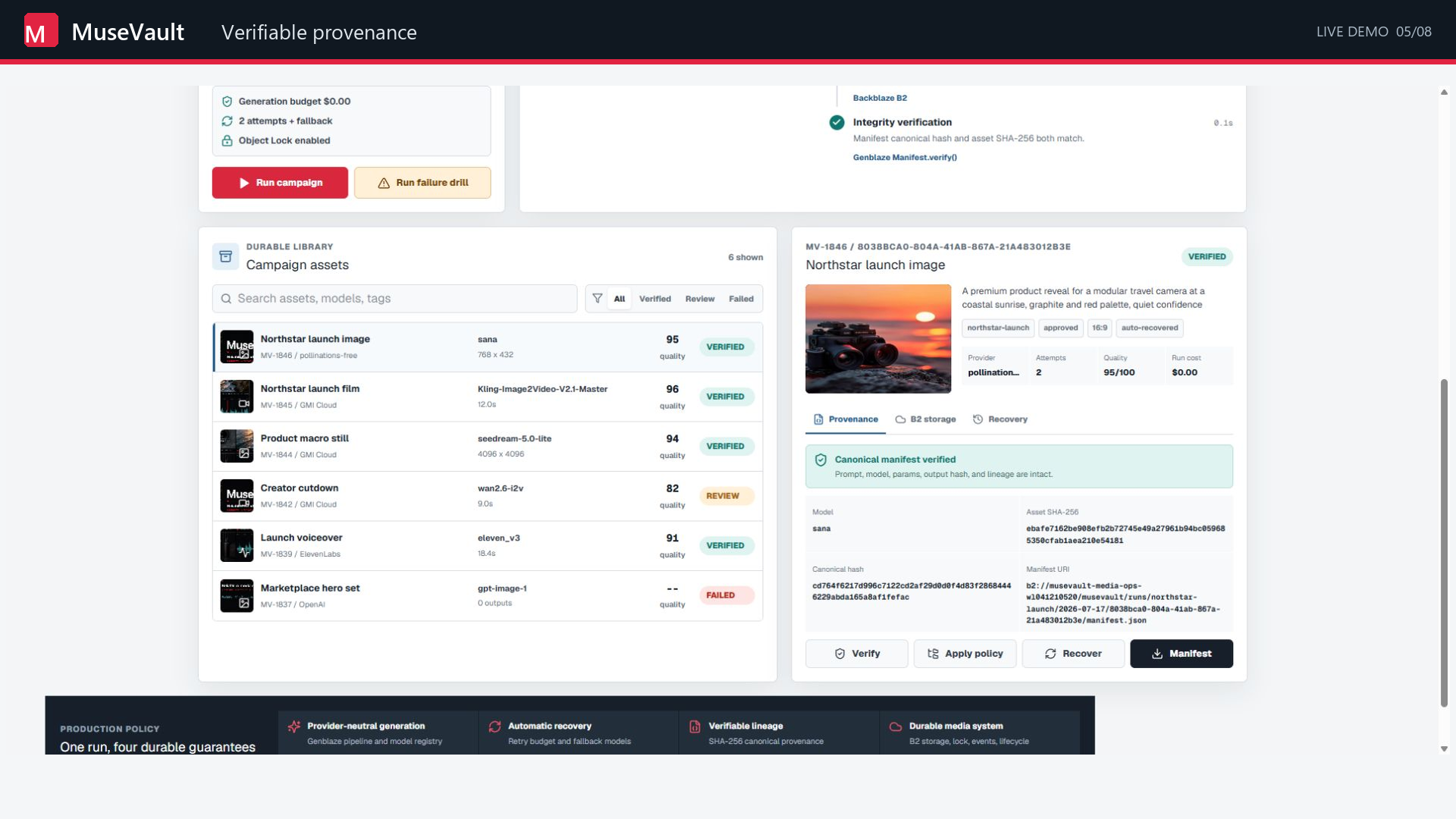
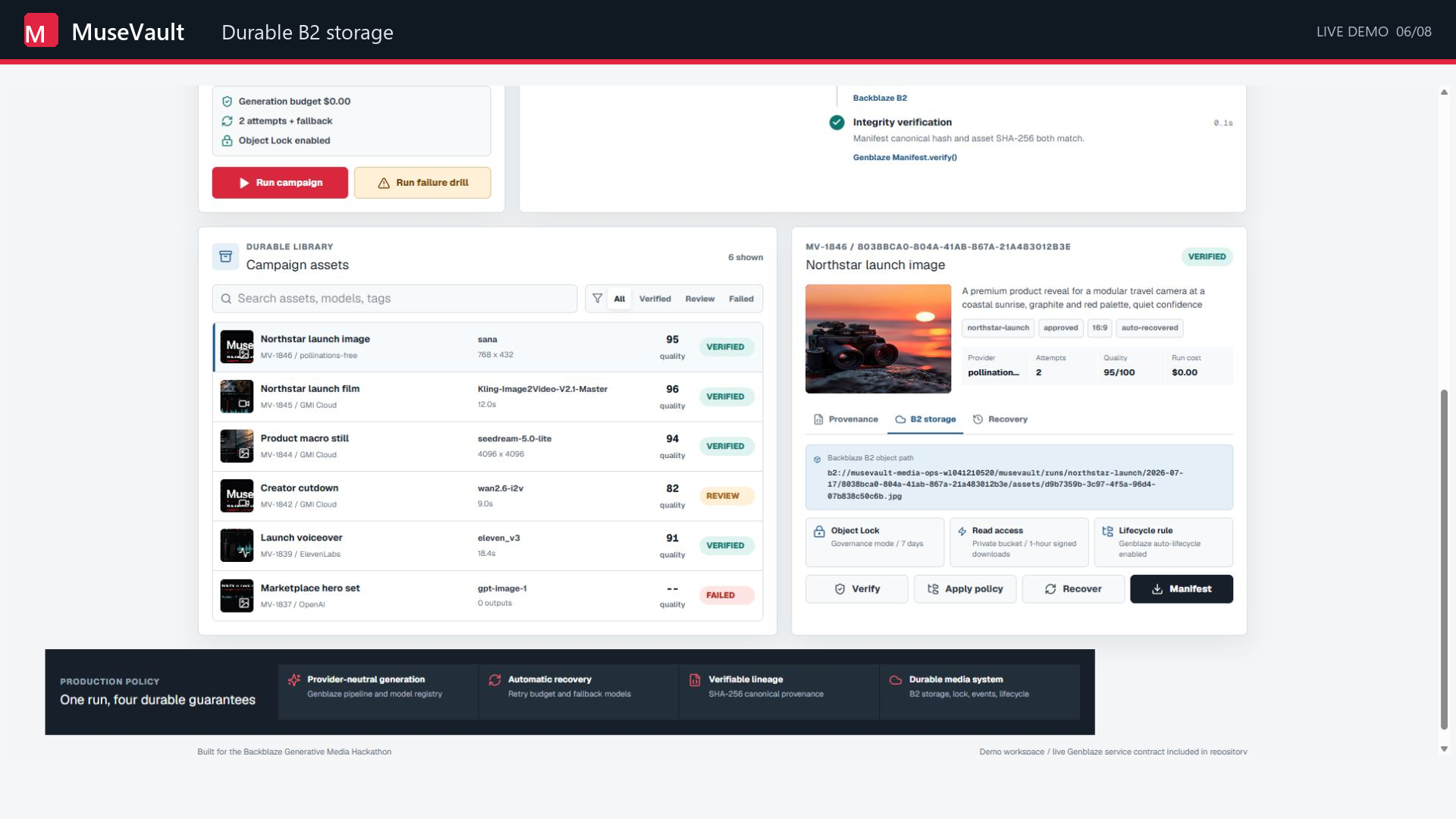
MuseVault campaign workspace and AI media asset library.
-
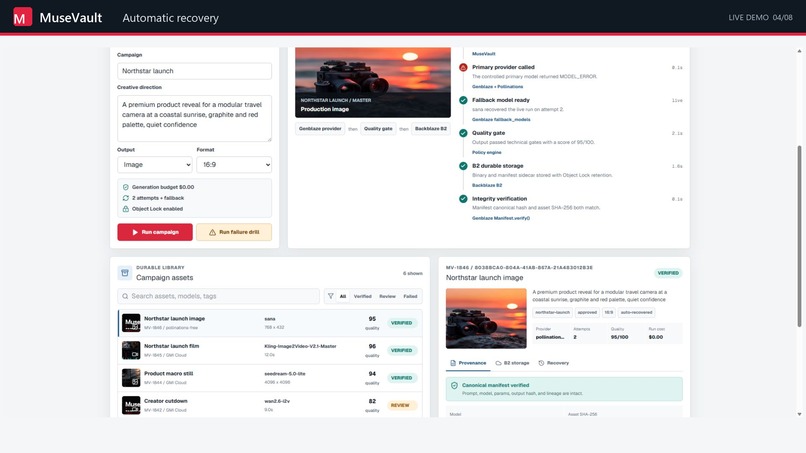
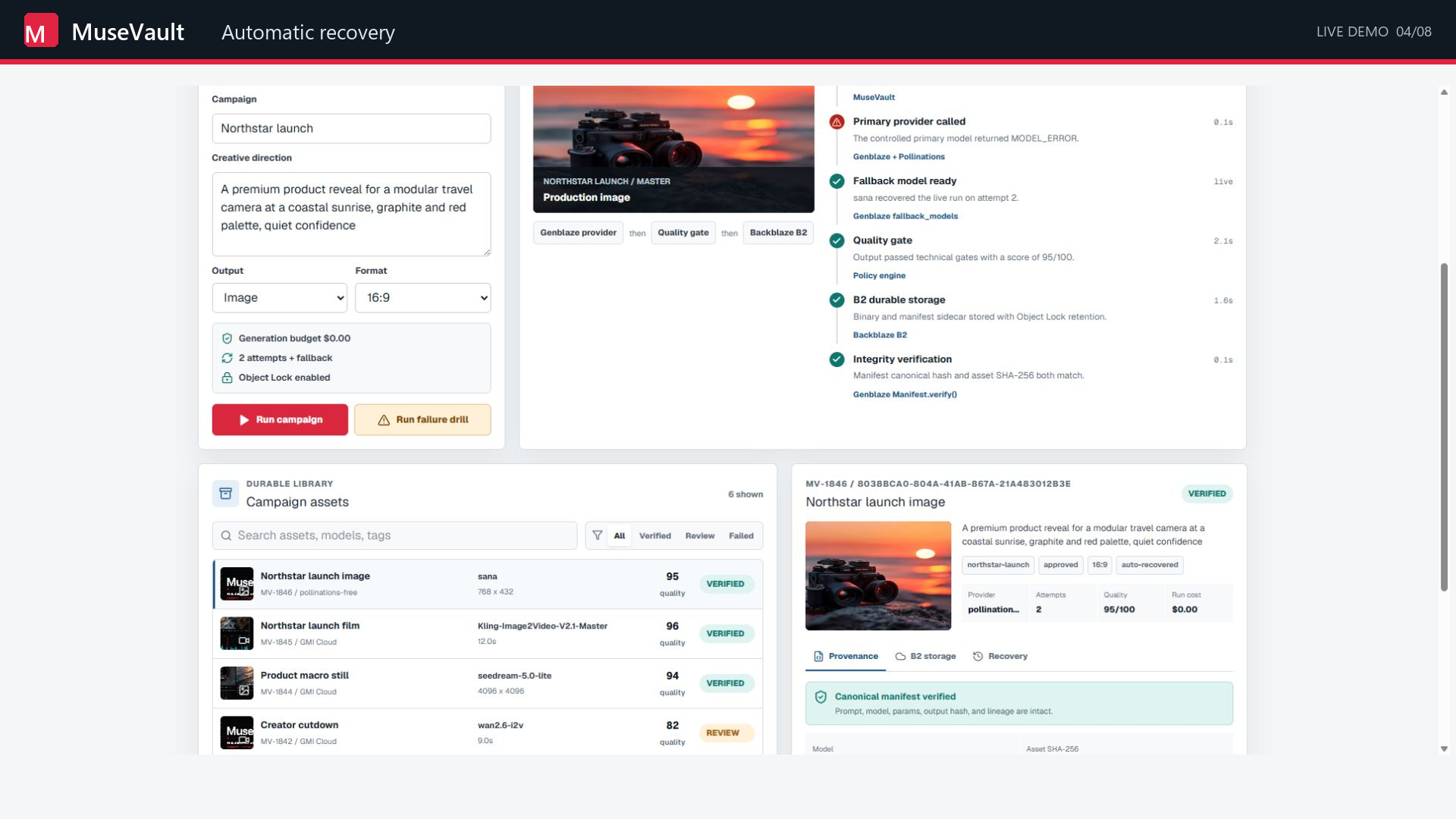
Controlled MODEL_ERROR triggers Genblaze fallback to Pollinations sana.
-
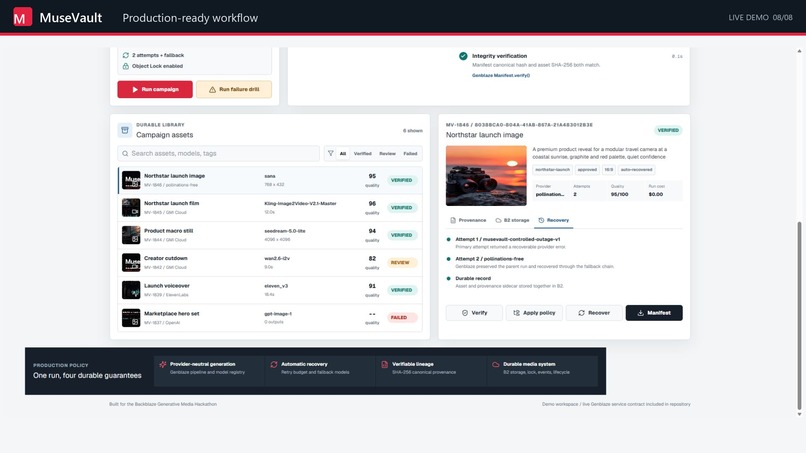
Quality gate accepts the fallback output before durable storage.
-
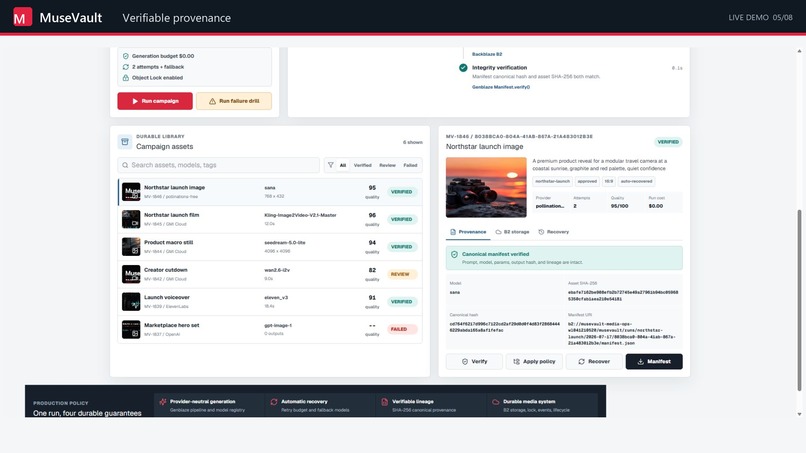
Backblaze B2 stores the asset and provenance manifest together.
-
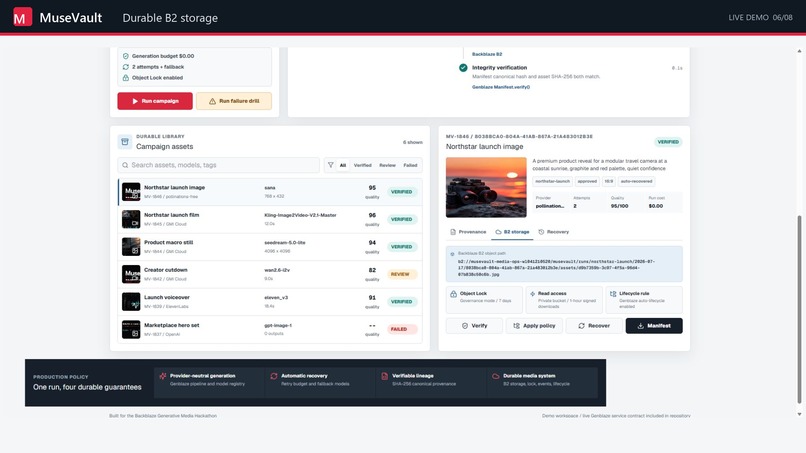
Independent SHA-256 verification confirms the B2 asset and manifest.
Inspiration
What it does
How we built it
Challenges we ran into
Accomplishments that we're proud of
What we learned
What's next for MuseVault
MuseVault
Inspiration
Generative media teams do not have a generation problem; they have an operations problem. A campaign may use several video, image, and audio models, but prompts, retry history, approved outputs, and provenance records often end up scattered across tools. When a provider times out, teams restart manually and lose lineage. When a final asset is approved, they cannot always prove which model, parameters, or source run produced it.
MuseVault turns that fragile process into a reliable production pipeline.
What It Does
MuseVault is an AI media operations workspace for creative teams. A user enters
a campaign brief and starts a production run. Genblaze orchestrates the selected
media model, applies a fallback chain when a model returns MODEL_ERROR, and
preserves the run lineage. A quality policy checks the output before Genblaze's
ObjectStorageSink writes the asset and canonical provenance manifest to
Backblaze B2.
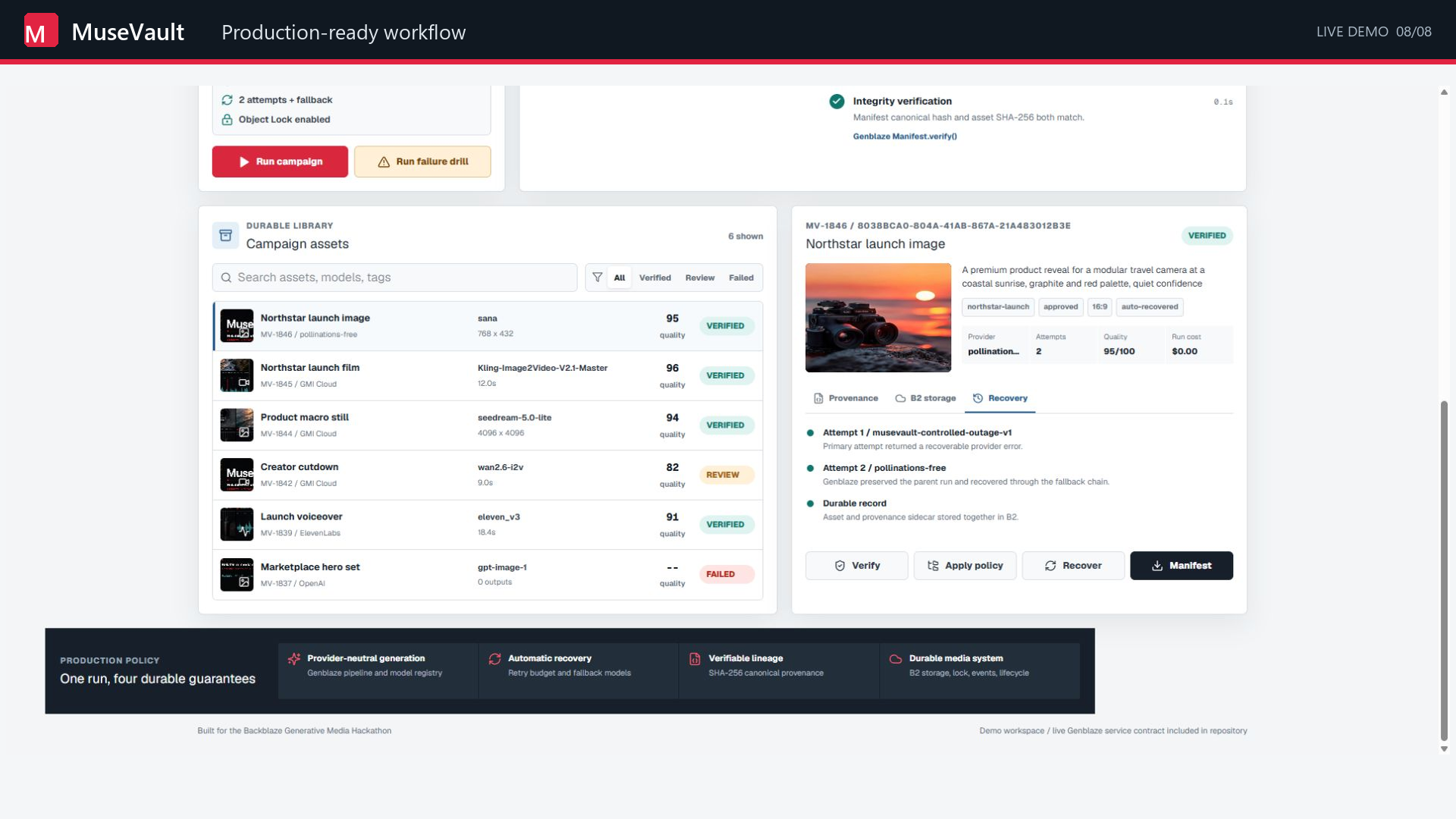
The workspace makes the result operational: teams can search assets, see quality scores, inspect provider recovery history, verify SHA-256 integrity, apply B2 organization policy, and download the provenance manifest.
MuseVault also treats generation cost as an operational policy. Its default
live image route uses the open-source Pollinations API at a $0.00 application
budget, while keeping the provider boundary replaceable through Genblaze.
How We Built It
- Next.js and React for the judge-facing operations workspace.
- FastAPI for a stateless orchestration service.
- Genblaze Core for pipelines, fallback models, manifests, and verification.
- A custom Genblaze
SyncProvideradapter for zero-cost Pollinationssanaimage generation, with optionalgenblaze-gmicloudsupport retained. genblaze-s3for Backblaze B2 storage throughObjectStorageSink.- Backblaze B2 hierarchical run paths for assets and sidecar manifests.
- Optional B2 Object Lock Governance retention for provenance manifests.
- B2 lifecycle defaults for incomplete multipart uploads and old versions.
How MuseVault Uses Backblaze B2
Backblaze B2 is the durable system of record, not a final export target. Each
run writes the generated media and its canonical manifest.json together.
The UI exposes the B2 object path, manifest URI, asset checksum, and canonical
hash. Hierarchical paths keep campaign assets browsable, lifecycle policy
controls intermediates, and optional Object Lock prevents provenance records
from being overwritten during the retention window.
The production design uses B2 Event Notifications to trigger indexing and thumbnail work after an object is created, avoiding a polling loop.
How MuseVault Uses Genblaze
Genblaze performs the core product work:
- One pipeline API across image and video models.
fallback_modelsfor model-level recovery.- Provider metadata and retry lineage in every run.
ObjectStorageSinkfor B2 transfer and URL rewriting.- SHA-256 asset coverage and canonical provenance manifests.
Manifest.verify()before an asset is marked production-ready.
Challenges
The main design challenge was making reliability visible. A normal successful
generation does not show why an orchestration system matters, so MuseVault
includes an evaluation-safe failure drill. It intentionally injects a primary
model MODEL_ERROR at the provider boundary. Genblaze then runs its real
fallback_models path against the live Pollinations sana route, followed by
the B2 write and manifest verification. The image generation, SHA-256
calculation, manifest write, and independent re-download are real and require
no paid model credits. This keeps the demonstration repeatable without
pretending that an unpredictable third-party outage happened on cue.
Accomplishments
- A judge-accessible sandbox plus an explicitly labeled live execution path.
- A live Genblaze service that writes generated media and manifests to B2.
- Independent re-download and SHA-256 verification of the stored asset.
- Downloadable provenance records and a clear recovery audit trail.
- Production-minded B2 policies surfaced directly in the product.
What We Learned
Provenance is only useful when it stays attached to the operational workflow. A manifest hidden in a bucket is technically correct but easy to ignore. Putting verification, recovery, organization, and storage policy next to the asset changes provenance from compliance paperwork into a daily production tool.
What's Next
- Add B2 Event Notification consumers for thumbnailing and search indexing.
- Add C2PA signing as an optional adversarial-verification layer.
- Add human approval roles and campaign-level retention policies.
- Add cost and latency comparison across Genblaze provider routes.
Built With
- amazon
- backblaze
- fastapi
- genblaze
- next.js
- pollinations
- react
- render
- sha-256
- typescript

Log in or sign up for Devpost to join the conversation.