-
-
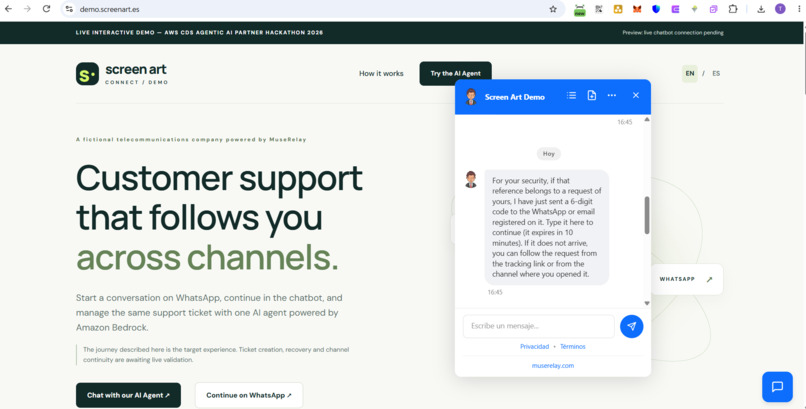
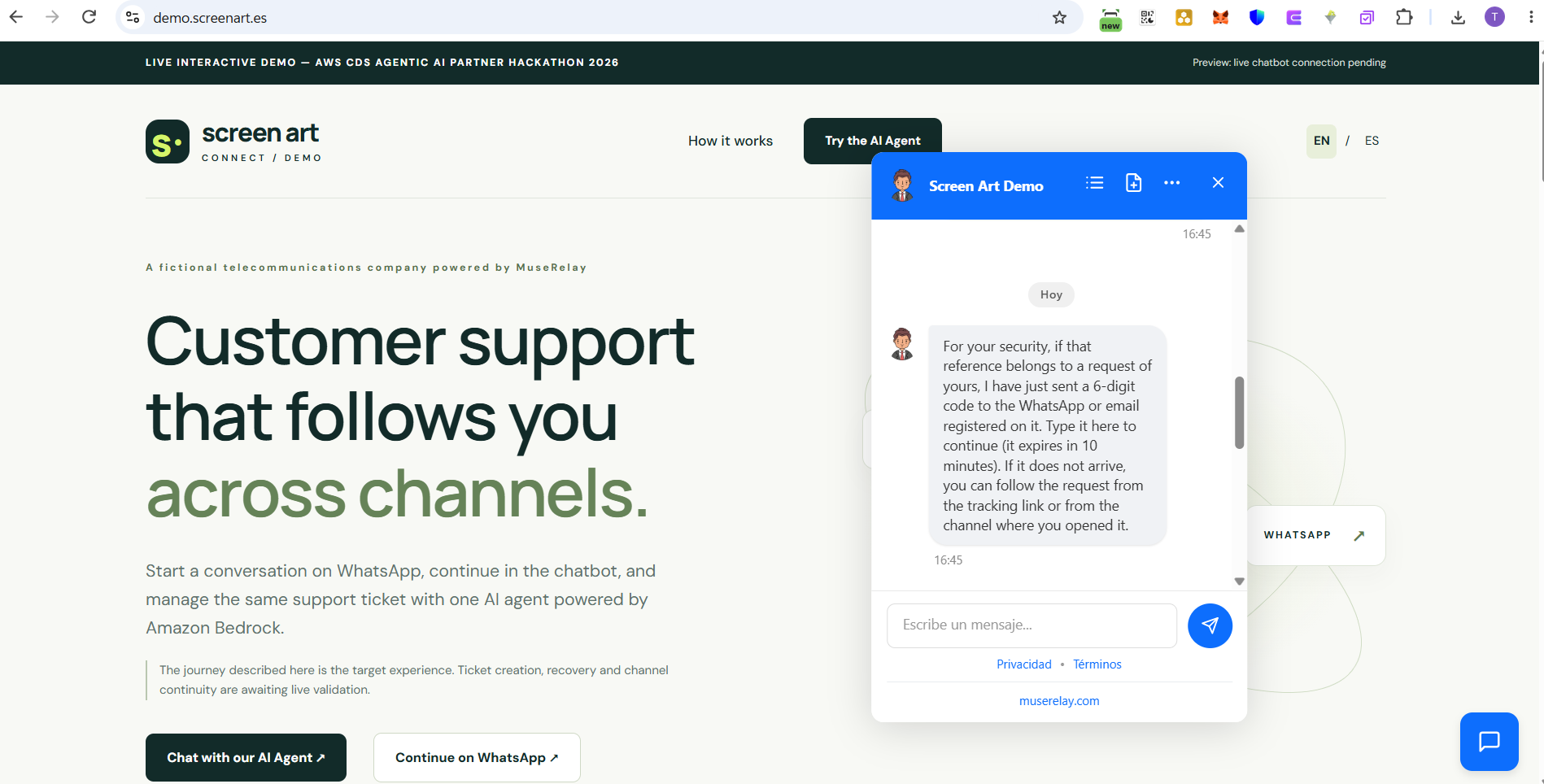
Live demo: Screen Art Connect, a fictional telecom company powered by MuseRelay, with an AI agent connected to Amazon Bedrock.
-
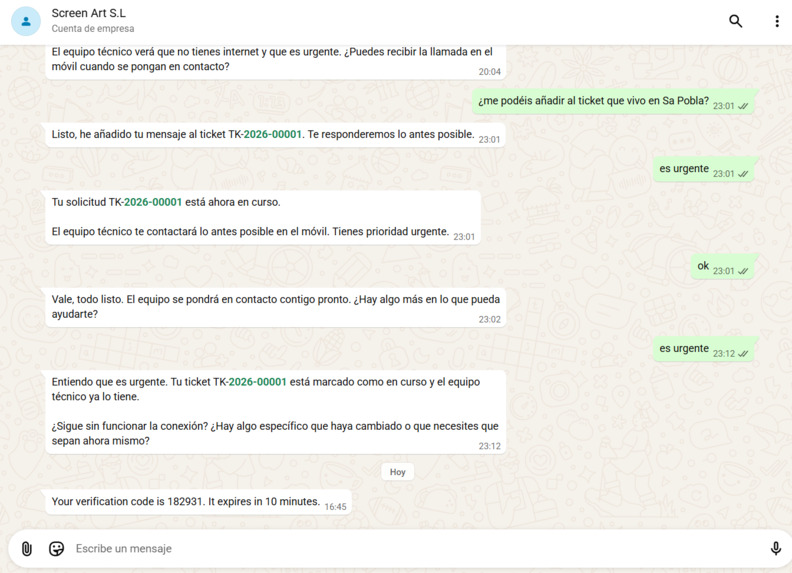
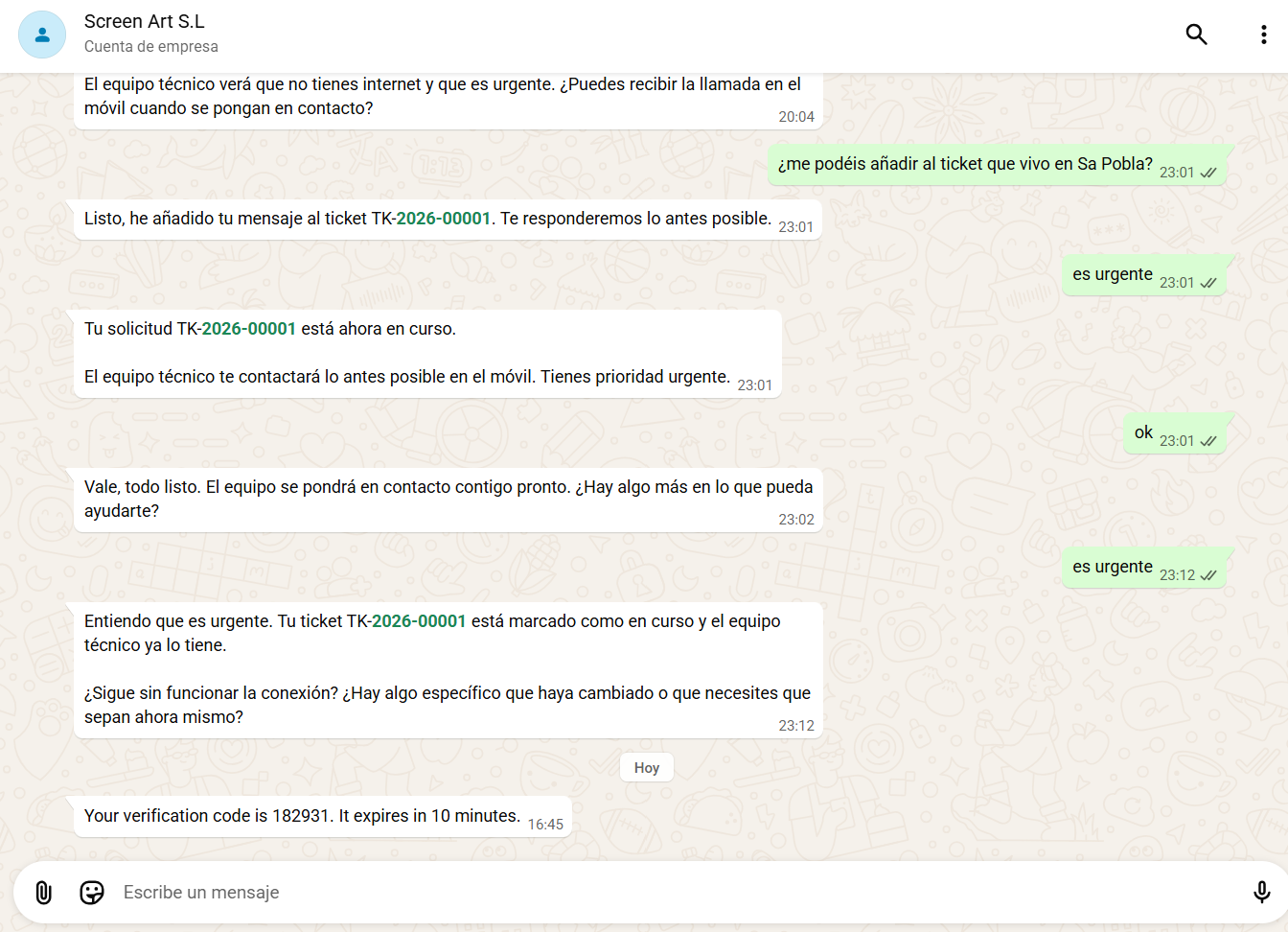
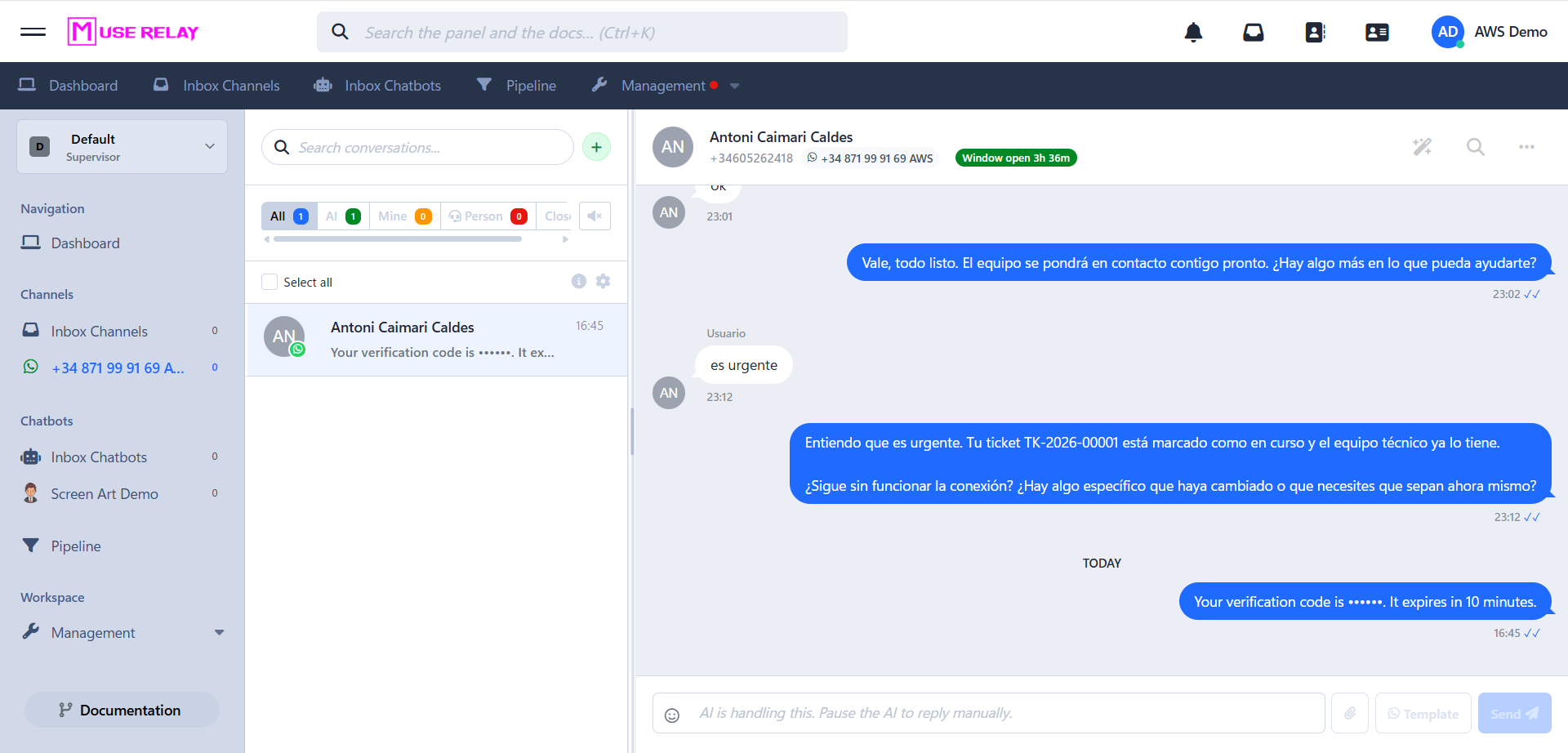
Real WhatsApp conversation through AWS End User Messaging Social, with AI-powered ticket creation and updates.
-
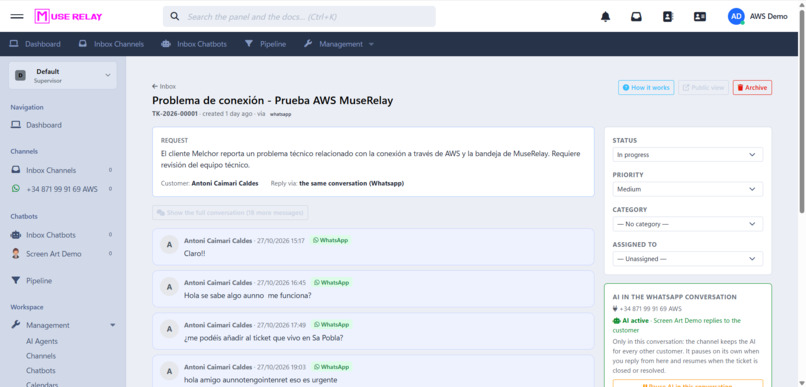
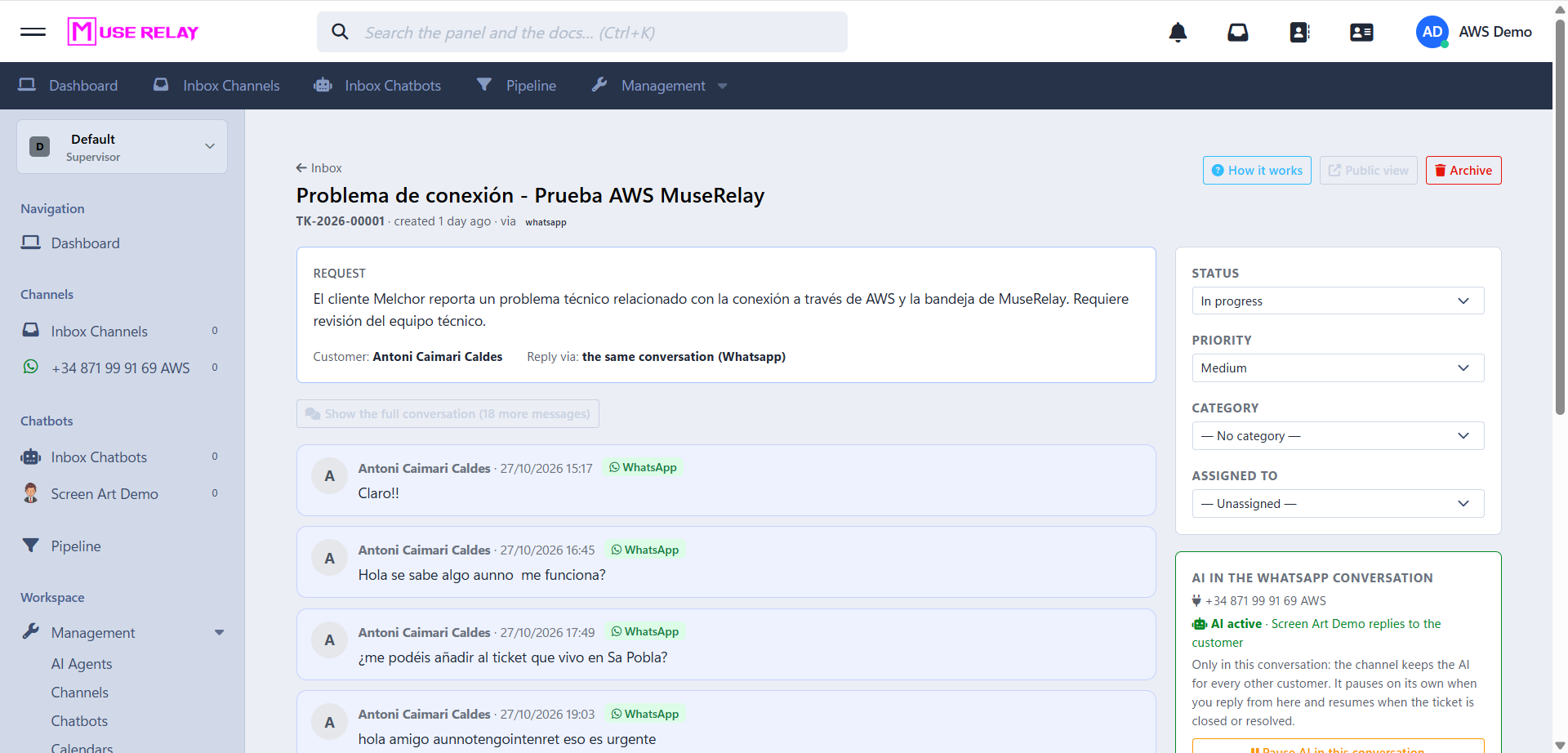
MuseRelay ticket TK-2026-00001: customer messages, status, priority and human supervision in one workspace.
-
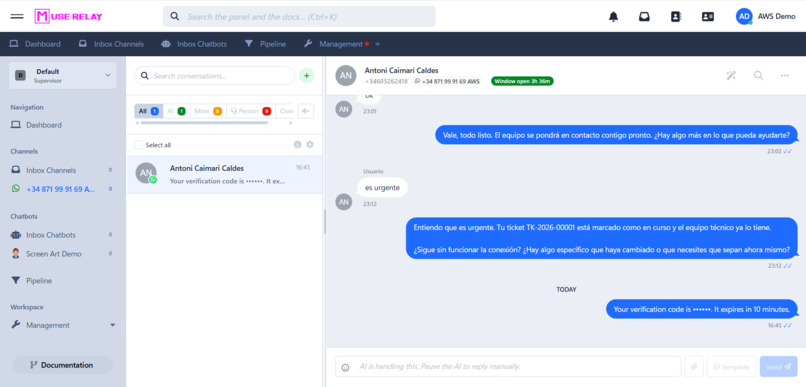
Unified inbox showing real WhatsApp messages through AWS, AI responses and delivery status tracking.
-
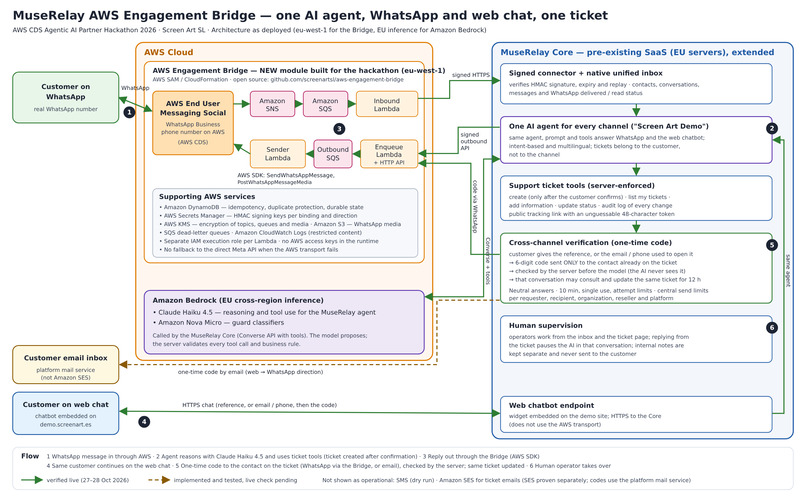
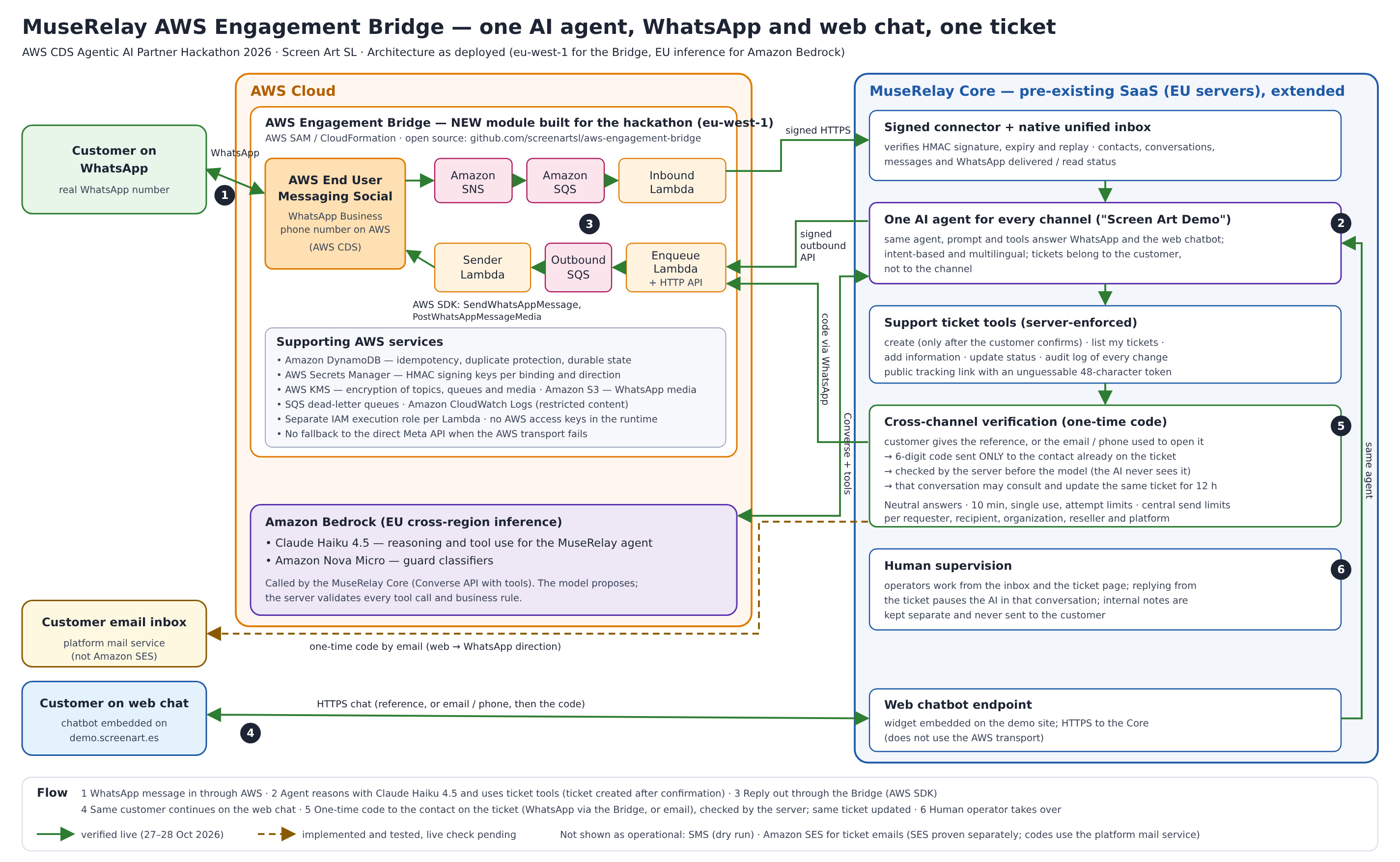
AWS architecture: End User Messaging Social, Lambda, SNS, SQS and Bedrock connected to MuseRelay's modular AI agent platform.
Inspiration
Businesses increasingly communicate with customers through WhatsApp, email, web chat, Telegram, Instagram, Messenger, and other messaging platforms. Yet these conversations often remain fragmented.
A customer may report an issue on WhatsApp, return through a website, and have to explain everything again. Support teams lose context, requests become duplicated, and customers experience unnecessary friction.
Meanwhile, many traditional chatbots still rely on rigid scripts or predefined responses. They can answer questions, but they often struggle to understand complex requests, execute business operations, and collaborate with human operators.
At MuseRelay, we started with a different question:
What if every business had a single AI brain connected to all its communication channels and business tools?
An AI agent that belongs to the business itself, rather than to WhatsApp, email, or a website.
An agent capable of understanding customer intent, using business tools, maintaining request context, and delivering a continuous experience even when customers switch channels.
This idea became the foundation of MuseRelay.
A SaaS Platform in Beta
MuseRelay is a SaaS platform for customer engagement, automation, and AI-powered business agents.
The platform is currently in beta. It has not yet undergone a general commercial launch or public marketing campaign.
Approximately one month ago, we began onboarding our first beta resellers and a small number of beta customers to validate the platform in real-world scenarios.
From its inception, MuseRelay was conceived as a modular platform. Its existing core already included conversation management, contacts, support tickets, calendars, appointments, automation workflows, AI agents, permissions, and white-label capabilities for resellers.
The platform also supported or contemplated several communication channels, including WhatsApp, email, Telegram, Instagram, Messenger, and web chat, with different levels of integration and availability.
Our philosophy is simple:
Communication channels are entry points. The AI agent is the shared intelligence of the business.
The same agent can access business tools regardless of which channel the customer uses.
Discovering AWS Communication Developer Services
Participating in the AWS Communication Developer Services (CDS) Agentic AI Partner Hackathon introduced us to the broader potential of AWS CDS.
We discovered an opportunity to connect our existing modular platform with AWS communication infrastructure and Amazon Bedrock.
Rather than creating an isolated chatbot, we decided to build a reusable integration module that could eventually connect multiple AWS communication services to the same business intelligence and operational tools.
That decision led to MuseRelay AWS Engagement Bridge.
What it does
MuseRelay AWS Engagement Bridge is an agentic integration module connecting AWS Communication Developer Services with the operational core of MuseRelay.
Its purpose is to transform customer messages into secure, traceable business operations while maintaining continuity across communication channels.
Real WhatsApp Integration Through AWS
Our hackathon demonstration uses an operational WhatsApp number connected through AWS End User Messaging Social.
Messages are received and sent through AWS and processed by an AI agent configured within MuseRelay.
The agent uses Claude Haiku 4.5 through Amazon Bedrock, with an inference configuration focused on European AWS regions.
This integration supports bidirectional WhatsApp communication, natural-language understanding, and the execution of business tools.
One AI Agent Across Multiple Channels
At MuseRelay, we call AI agents the brains behind the communication channels.
Each business configures its own agent with instructions, context, and tools adapted to its operations.
That agent can serve WhatsApp, web chat, and other compatible channels without duplicating its business logic.
For example, the same agent can answer support questions, manage requests, interact with scheduling tools, and coordinate human intervention.
We are not building a separate chatbot for every channel. We are building shared business intelligence that can be accessed through multiple channels.
A Customer Journey That Continues Across Channels
For our demonstration, we created Screen Art Connect, a fictional telecommunications company.
A customer sends a WhatsApp message:
"My internet connection stopped working this morning."
The message enters through AWS End User Messaging Social and reaches the MuseRelay agent powered by Amazon Bedrock.
The AI interprets the problem and offers to create a support request.
Before the ticket can be created, a server-side business rule requires explicit customer confirmation.
Once confirmed, MuseRelay creates the ticket and generates its reference number.
The system can also provide a tracking link through which the customer can check the request and submit additional information.
Later, the customer can open the web chatbot and ask to continue the same support request.
MuseRelay uses one-time verification codes sent to a contact method already associated with the ticket.
After successful identity verification, the customer can consult the request and add information through the web chatbot.
The architecture also supports the reverse journey: a ticket created through web chat can be recovered through WhatsApp.
The ticket belongs to the customer and the business, not to the channel where it originated.
This bidirectional continuity is one of the central capabilities developed for the hackathon.
Business Tools Beyond Ticket Management
Our demonstration focuses on tickets because they provide a clear example of a complete business operation.
However, MuseRelay is not limited to technical support.
Its ticketing system can be adapted to complaints, returns, commercial inquiries, warranty requests, and other processes requiring structured follow-up.
The platform also includes native tools for calendars, scheduling, and appointment management.
AWS Engagement Bridge is designed to allow compatible AWS communication channels to access these business capabilities through the same AI agent.
Ticket management is therefore our first demonstrated use case, not the limit of the architecture.
Security and Human Supervision
In MuseRelay, AI interprets customer requests, while server-side tools enforce business rules and permissions.
Sensitive operations do not depend solely on the language model's decisions.
For cross-channel ticket recovery, the platform uses one-time verification codes with expiration periods, attempt limits, and temporary authorization.
The AI model never needs to receive the verification code.
The server validates it before invoking the model and passes only the verification outcome. Sensitive values are masked in conversation history and excluded from tool logs.
The platform also uses neutral responses and response-time controls to avoid revealing whether a ticket reference exists.
Centralized safeguards limit verification-code requests and help protect against enumeration and messaging abuse.
Isolation between organizations, customers, and resellers is enforced through server-side authorization.
When a human operator responds from a ticket, the AI is paused to prevent simultaneous replies.
Internal notes are kept separate from customer-facing messages.
Operators can review customer attachments, including photographs, audio recordings, videos, and documents, directly within the ticket interface.
The system also displays message delivery states such as Sent, Delivered, and Read, where supported.
The agent can provide the appropriate privacy-policy link for the business, including a business-specific page or the relevant reseller-managed privacy page.
Our objective is to combine intelligent automation with human control, traceability, and privacy.
A Module Designed for the Broader AWS CDS Ecosystem
Although our operational hackathon demonstration focuses on WhatsApp through AWS End User Messaging Social, AWS Engagement Bridge has been designed with a broader vision.
The module is intended to progressively incorporate:
- AWS End User Messaging Social: WhatsApp.
- AWS End User Messaging: bidirectional SMS and additional supported messaging formats.
- Amazon Simple Email Service (SES): email communication and notifications.
- Amazon Bedrock: AI-powered agents connected to business tools.
SMS and AWS SES capabilities are part of our planned expansion and are not presented as fully operational components of this demonstration while the required authorizations and validations remain pending.
The goal is to reuse the same agents, tools, and business processes as new communication services become available.
How we built it
Building on an Existing Modular Platform
MuseRelay existed before the hackathon as a beta SaaS platform.
The work submitted to this hackathon is the new AWS Engagement Bridge integration module and the supporting architectural improvements developed during the competition period.
We do not claim that the entire pre-existing MuseRelay platform was created during the hackathon.
Instead, we used the development of the AWS module as an opportunity to strengthen the platform's modular architecture.
We improved the separation between communication channels, AI agents, business tools, and operational processes.
This made it possible to connect AWS services without rebuilding the entire platform or duplicating business logic for every channel.
AWS Communication Layer
We integrated AWS End User Messaging Social to handle real bidirectional WhatsApp communication.
Incoming customer messages reach MuseRelay through the AWS integration.
Outgoing messages are sent through the corresponding AWS communication service.
The platform tracks message identifiers, delivery outcomes, and errors, connecting them to the appropriate conversations and tickets.
AI and Business Logic
We integrated Amazon Bedrock with MuseRelay's agent execution system.
Our demonstration agent uses Claude Haiku 4.5.
The platform provides the model with relevant context, business instructions, and descriptions of the tools available to that agent.
The agent interprets customer intent and selects appropriate tools.
The tools themselves enforce business rules, permissions, and confirmation requirements.
This separation between AI reasoning and deterministic server-side execution is fundamental to our architecture.
Cross-Channel Identity and Ticket Continuity
We extended the existing ticket system to support secure continuity between WhatsApp and web chat.
Customers can request access to an existing ticket from another conversation or channel.
The system verifies their identity using one-time codes delivered to an associated contact method.
After successful verification, temporary access is granted to the authorized ticket.
The same ticket can then be consulted and updated without creating duplicates or merging unrelated contact records.
We also developed safeguards to reduce ticket enumeration, excessive verification requests, and information leakage.
Human Operations and Reliability
We reinforced the coordination between AI agents and human operators.
When a person takes over a ticket, the AI can be paused to avoid conflicting responses.
We improved the handling of message delivery failures, ticket updates, internal notes, and customer attachments.
These improvements help ensure that the AI agent operates as part of a real customer-service workflow rather than as an isolated conversational interface.
Multi-Tenant and White-Label Architecture
MuseRelay already included reseller and white-label capabilities.
During the hackathon, we reinforced security boundaries and permissions across organizations and operational roles.
AWS Engagement Bridge is designed as a reusable module that could eventually be offered to multiple businesses through the same platform while preserving their individual configurations and data isolation.
European AWS Architecture
We prioritize European AWS regions and regional inference profiles wherever technically feasible.
Our goal is to support European businesses with greater visibility and control over data processing and residency.
We recognize that European infrastructure alone does not guarantee GDPR compliance. Appropriate contractual, organizational, and technical safeguards are also required.
Challenges we ran into
1. Integrating AWS CDS with an Existing Platform
Our first challenge was connecting AWS communication services to an operational SaaS platform without creating a separate application or duplicating its business logic.
We addressed this by strengthening the modular separation between communication infrastructure, AI execution, and business operations.
2. Maintaining Context Across Channels
A conversation that begins on WhatsApp must be able to continue through web chat without losing the underlying business request.
This required secure identity verification, temporary authorization, and consistent ticket management across conversations.
3. Keeping Sensitive Verification Data Away from the AI
During testing, we identified an issue in the interaction between verification codes and the AI agent.
We improved the architecture so that OTP validation takes place on the server before the model is invoked.
The AI receives the verification result rather than the secret itself.
4. Preventing Ticket Enumeration and OTP Abuse
Publicly accessible conversational agents introduce additional security challenges.
We implemented neutral responses, centralized request limits, verification-code reuse controls, and security auditing to reduce abuse.
These controls are particularly important for a multi-tenant SaaS platform with resellers and multiple customer organizations.
5. Coordinating Human and AI Responses
We needed to ensure that automated responses did not conflict with human operators.
We improved the mechanisms that pause AI participation when an operator responds from a ticket, while preserving the state of the customer request.
6. Messaging Reliability
Messaging platforms have delivery restrictions, asynchronous acknowledgements, and different message identifiers.
We worked on correctly linking outgoing messages to tickets and displaying delivery states and failures.
7. Model and Service Availability
Some newer AI models and additional communication services were not fully available or authorized for our AWS account during development.
Rather than making the demonstration dependent on unavailable services, we focused on an operational integration using Claude Haiku 4.5 through Amazon Bedrock and WhatsApp through AWS End User Messaging Social.
8. Building Securely While Still in Beta
MuseRelay is an evolving beta platform.
The hackathon accelerated our work on permissions, multi-tenant isolation, modularity, verification mechanisms, and operational reliability.
These improvements have value beyond the submitted module and will support future development.
Accomplishments that we're proud of
A Real AWS-Powered WhatsApp Integration
We implemented and tested real bidirectional WhatsApp communication through AWS End User Messaging Social.
The integration is connected to a working AI agent using Amazon Bedrock.
One AI Brain, Multiple Channels
The same configured agent can serve WhatsApp and web chat, using shared business tools and operational rules.
This demonstrates our core philosophy of separating business intelligence from communication channels.
Secure Cross-Channel Ticket Continuity
We implemented bidirectional ticket recovery between WhatsApp and web chat, supported by one-time verification codes and server-side authorization.
The architecture allows customers to continue working with the same business request across channels without duplicating tickets.
AI That Performs Real Business Operations
Our agent does more than generate conversational responses.
It can interpret customer needs and use tools to create and manage structured business requests, subject to confirmation and authorization rules.
Security Beyond Prompt Instructions
We implemented controls that operate independently of the AI model.
These include server-side OTP validation, neutral responses that protect ticket existence, rate limits, audit trails, and multi-tenant authorization.
The AI reasons about customer intent. The platform enforces the rules.
Human Supervision Built into the Workflow
Operators can intervene in conversations, manage ticket priorities, inspect attachments, add internal notes, and respond to customers.
The system coordinates human participation with automated responses.
A Stronger Modular Core
Developing AWS Engagement Bridge helped us improve the architecture of MuseRelay itself.
We strengthened the separation of channels, agents, tools, and business operations, creating a more flexible foundation for future integrations.
A Reusable Commercial Opportunity
We are proud that this is not simply a single-purpose demonstration.
MuseRelay is in beta, with early resellers and customers helping validate the platform.
AWS Engagement Bridge is intended to become a reusable module that can be distributed to multiple businesses through our white-label and reseller model.
What we learned
This hackathon introduced us to the broader potential of AWS Communication Developer Services.
Although we were already developing a business communications platform, we had not fully appreciated how AWS CDS could support our long-term architecture.
We learned that communication infrastructure becomes significantly more valuable when combined with AI agents capable of executing real business operations.
We also learned that true omnichannel continuity is not simply about connecting multiple messaging platforms.
It is about preserving the state of a business process while allowing customers to interact through different channels.
Another important lesson was that enterprise AI requires much more than a powerful language model.
Reliable agentic systems need context, tools, authorization, identity verification, delivery tracking, error handling, and human supervision.
Security cannot depend on asking the model to behave correctly.
Sensitive operations must be enforced by deterministic server-side controls.
We also learned the importance of modular architecture.
By separating communication channels from AI agents and business tools, we can introduce new services without rebuilding the entire system.
The hackathon did more than help us develop a new AWS integration. It helped us improve the foundation on which MuseRelay will continue to evolve.
What's next for MuseRelay AWS Engagement Bridge
Our next objective is to expand AWS Engagement Bridge beyond its initial WhatsApp demonstration.
Expanding AWS Communication Developer Services
We plan to progressively incorporate:
- Bidirectional SMS messaging through AWS.
- Amazon SES for email communication and notifications.
- Additional supported AWS messaging capabilities.
- More advanced notification and customer-engagement workflows.
These integrations will be introduced as the necessary service authorizations and technical validations become available.
More Business Tools
Ticket management is only our first demonstrated use case.
We intend to extend AWS-powered agents to additional native MuseRelay capabilities, including calendars, appointment scheduling, customer management, and business automation.
Voice and Telephony
We also plan to introduce voice and telephony integrations.
A customer could eventually call a business and interact with the same AI agent already configured for WhatsApp or web chat.
The agent would reuse its business context, tools, and permissions instead of requiring a separate AI system for every communication channel.
Stronger Security and Privacy
We will continue improving identity verification, abuse prevention, security auditing, and cross-channel continuity.
We also intend to strengthen our European infrastructure strategy, prioritizing appropriate AWS regions and data-governance controls.
White-Label Distribution Through Resellers
MuseRelay is currently in beta, and our reseller model is an important part of our long-term strategy.
We envision AWS Engagement Bridge as a reusable module that resellers can offer to multiple businesses, with independent branding, configuration, permissions, and data isolation.
Measuring Real Business Impact
As our beta program progresses, we intend to measure outcomes such as response times, request resolution, customer satisfaction, operational efficiency, and cost per interaction.
Our goal is to validate the value of agentic communication through real customer deployments.
Our Vision
MuseRelay AWS Engagement Bridge represents an important milestone in the evolution of our beta platform.
We used this hackathon to develop a real AWS CDS integration, strengthen our modular architecture, and demonstrate how a shared AI agent can connect customer conversations with business operations.
Our proposal is not simply about adding artificial intelligence to WhatsApp.
It is about giving every business a shared AI brain capable of serving multiple channels, using business tools, and delivering a continuous, secure, and human-supervised customer experience.
We are still at the beginning of this journey.
And that is precisely why we believe AWS Communication Developer Services can play a fundamental role in the future of MuseRelay.
One AI Brain. Multiple Channels. Endless Possibilities for Business Engagement.


Log in or sign up for Devpost to join the conversation.