-
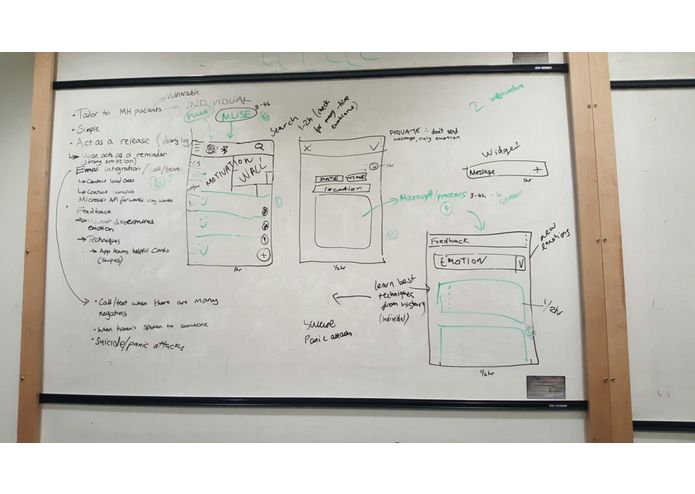
Our whiteboard plan
Inspiration
We are studying medicine, biomedical sciences, economics and computer science. As a multidisciplinary team, we wanted to incorporate all 4 areas to create an app which helps mental health patients. Depression and anxiety disorder cost $1 trillion per year (WHO), so this app could have medical and financial implications.
Our research indicated that mood diary apps currently on the market require individuals to input their own emotional state. Research has shown that patients with mental health difficulties may not perceive their own emotional state accurately. As a result, we wanted to use software to analyse this instead.
What it does
The app is a mood diary to monitor emotional states, allowing people to record their daily feelings and difficulties. This feeds into Microsoft API to analyse text to check whether the sentiment was negative or positive, and offers advice for specific treatment goals. For example, it will direct patients displaying suicidal tendencies to the Samaritans hotline, provide patients with panic attacks management advice.
If patients have 7 negatives in a row, they are prompted to call their psychiatrist or a close family member/friend via the Dialler. If patients input positive entries, only these will be listed on the front page.
How we built it
We planned on a white board for 2 hours to determine our main goals: a simple and accessible app. We built an Android app using Android Studio, and used Material Design combined with many libraries. This allowed us to use web Microsoft API (Text Analysis) for cognitive services.
Using retrofit (a library for android development), we were able to send requests to the API, which gave us a sentiment score. This enabled us to know how positive/negative the user is feeling, as well as keywords to determine possible reasons for these extreme emotions. This prompted users with tailored advice.
We used this to display all positive stories on the front page, whilst hiding negative messages from sight. However, if the user entered a large number of negative messages over a long period of time, this could indicate deteriorating mental health. The Dialler would then be launched to contact a friend/doctor.
We used support libraries to make our application backward compatible, whilst still giving the material design to older phones. Libraries called RXJava and RXAndroid gave us cleaner code when developing.
We used Adobe Illustrator to design a Material Design inspired app icon, and generated multiple different pixel densities. This allows for the icon to be viewed on a greater number of devies.
Challenges we ran into
Timing was very difficult, as we had created an ambitious project with many goals. Furthermore, some of us had never coded before. We intended to use Muse, but we could not access the technology for the 24 hours. The Pebble watches did not have pulse detection so we could not incorporate this.
We tried to augment the new Microsoft API with IBM Watson Tone Analyser API, to give us a larger variety of emotions to select from. Potentially, this would have allowed us to assign percentages to measure the weighting of specific emotional states. However, due to the 24 hours time constraints, IBM were unable to accept our request for the beta trial in time.
Accomplishments that we're proud of
Three of us learnt how to code for the first time in only 24 hours at our very first hackathon. Our computer scientist learnt how to use the Microsoft API having never used it before. Also, he had never coded on Ubuntu Linux before during a hackathon.
What we learned
Those who had never coded before learnt basic programming skills, and our computer scientist learnt aspects of medicine and psychiatry.
What's next for Museful
Incorporate Muse technology to analyse strong emotions via brain activity, or measuring pulse via a smartwatch. These would prompt patients to open their diary and log a new entry via a notification.
Furthermore, we would have liked to incorporate location features with SkyScanner API to allow individuals to recommend hotels, restaurants, doctors etc. for people with similar mental health conditions. Also, location features with Esri could allow individuals to form local support groups, which has been shown to be beneficial.
We would have liked to incorporate the Microsoft API more closely to pick up specific keywords, and offer even more specific tips to patients. This could be further improved with IBM Watson's API.
A final touch would be to add a customisable personalised motivational wall on the front page. Patients could submit their own images, including motivational quotes and their favourite photos. This would aim to improve mental wellbeing over the long term.
Built With
- android
- material-design
- microsoft-project-oxford


Log in or sign up for Devpost to join the conversation.