



Inspiration
Most AI products give learners an answer in a box. We wanted to build an experience that helps them develop an interpretation of their own.
For centuries, people have explored questions too large for a search bar through art and philosophy. But those perspectives remain scattered across continents, separated by centuries, and often reduced to slides, textbook paragraphs, or a single authoritative museum label.
We asked: What if a learner’s real question could become a museum they could walk through?
What MUSE∞ does
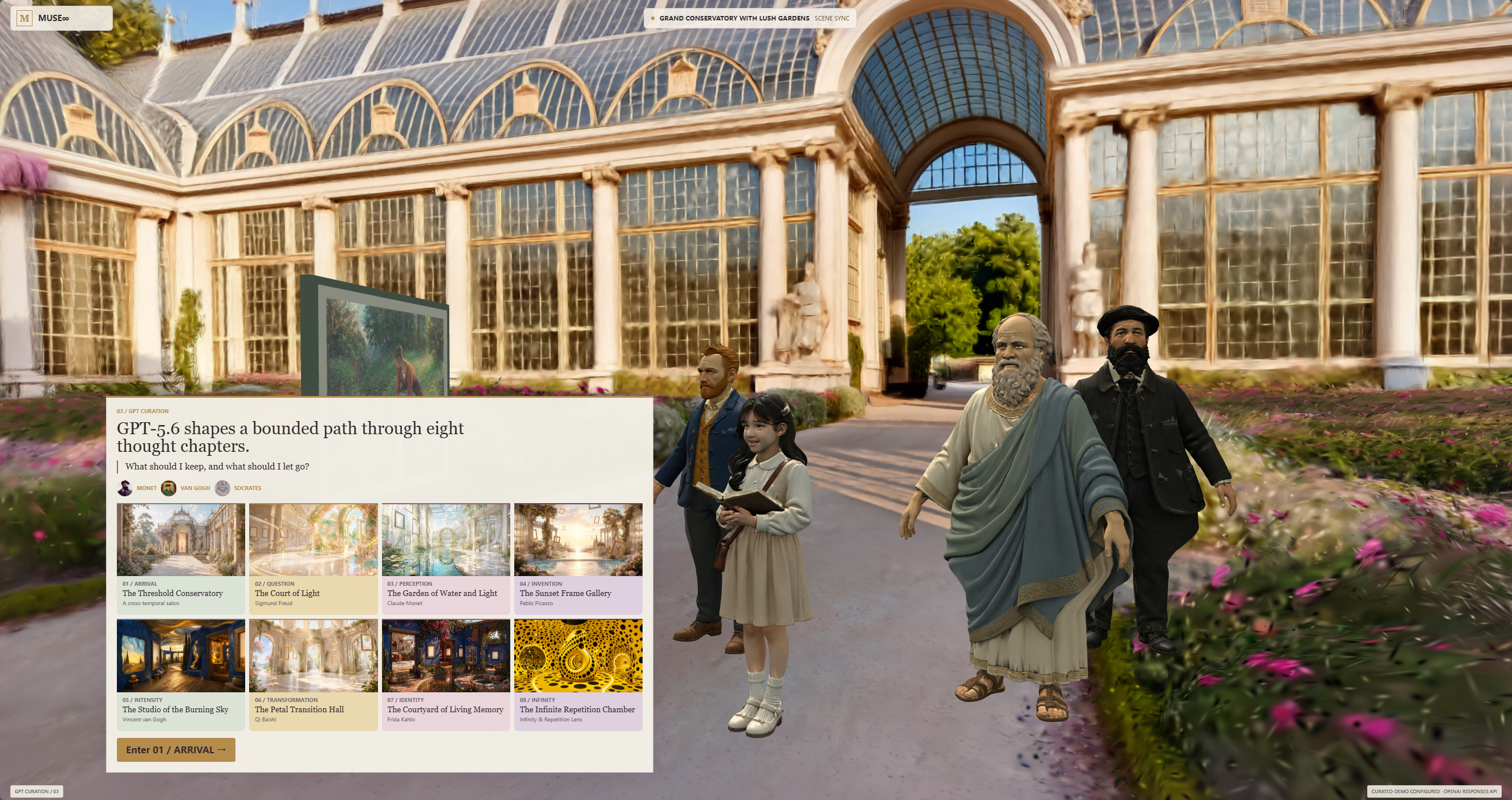
MUSE∞ turns one question the learner genuinely carries into a walkable Impossible Museum.
A learner begins with a question such as:
What makes a life meaningful?
They then choose up to three AI interpretive lenses inspired by artists and thinkers across time. These are AI-authored perspectives—not authentic quotations, endorsements, impersonations, or cloned voices.
GPT-5.6 connects the learner’s question to a bounded curatorial journey through eight prepared spatial worlds containing 36 real open-access artworks from the Art Institute of Chicago.
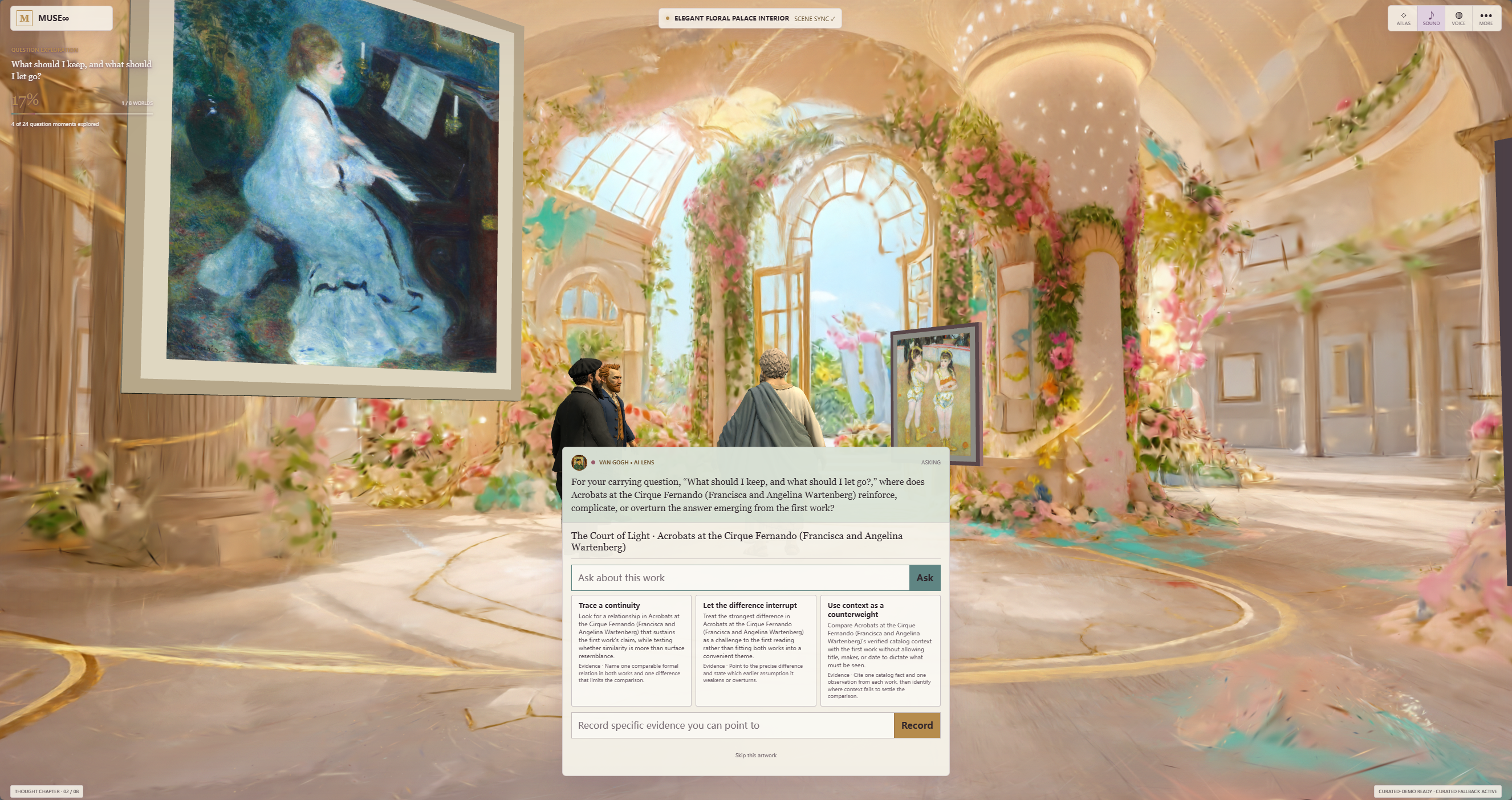
At each guided artwork encounter, the learner must:
- Observe specific visual evidence before interpreting it.
- Compare different perspectives examining the same work.
- Question or challenge an AI-generated interpretation.
- Record a choice or written observation as evidence.
- Reflect on how the encounter changed the original question.
The interpretive lenses may disagree. That disagreement is intentional: MUSE∞ treats disagreement as the beginning of critical thinking, not a failure to produce the correct answer.
After all eight chapters, the Roundtable reads only the observations, choices, and reflections created during that learner’s journey. GPT-5.6 produces a provisional synthesis grounded in this evidence.
The learner then makes one final decision between three unresolved axes: perception, emotion, or invention. That decision triggers a second GPT-5.6 transformation that materially revises the concept.
Only then does the ninth answer world open.
GPT-5.6 personalizes the concept carried into the finale. The ninth world is a prepared spatial realization—not geometry generated live.
Why it matters for education
MUSE∞ is an inquiry-based learning experience for students, teachers, museum educators, and cultural education programs.
Its learning loop is:
Observe → Compare → Cite evidence → Reflect → Revise
Through this process, learners practice:
- Visual literacy
- Comparative reasoning
- Evidence-based interpretation
- Metacognition
- Source awareness
- AI literacy
MUSE∞ treats GPT-5.6 as a perspective generator, not an authority. The goal is not to manufacture the correct interpretation of an artwork. It is to help learners ask better questions, examine disagreement, support their ideas with evidence, and revise a conclusion of their own.
Teachers can use the experience as a question-led seminar, interdisciplinary art-and-philosophy activity, discussion starter, or reflective writing assignment.
How we built it
MUSE∞ combines bounded GPT-5.6 reasoning with a deterministic spatial system.
GPT-5.6 is used through the Responses API with strict Structured Outputs for:
- Connecting the learner’s question to the eight-chapter inquiry spine
- Generating artwork-grounded interpretive dialogue
- Producing distinct AI perspectives
- Synthesizing the learner’s eight-scene evidence trail
- Performing the second, decision-locked transformation
GPT-5.6 can generate prompts, interpretations, choices, gestures, and bounded visual effects. It cannot invent canonical scenes, change artwork identities, provide coordinates, or bypass progression requirements.
The browser experience is built with JavaScript, Three.js, WebGL, and Spark. A framework-free Node.js server provides the GPT-5.6 endpoints, local asset delivery, byte-range support, narration, and optional shared-session features.
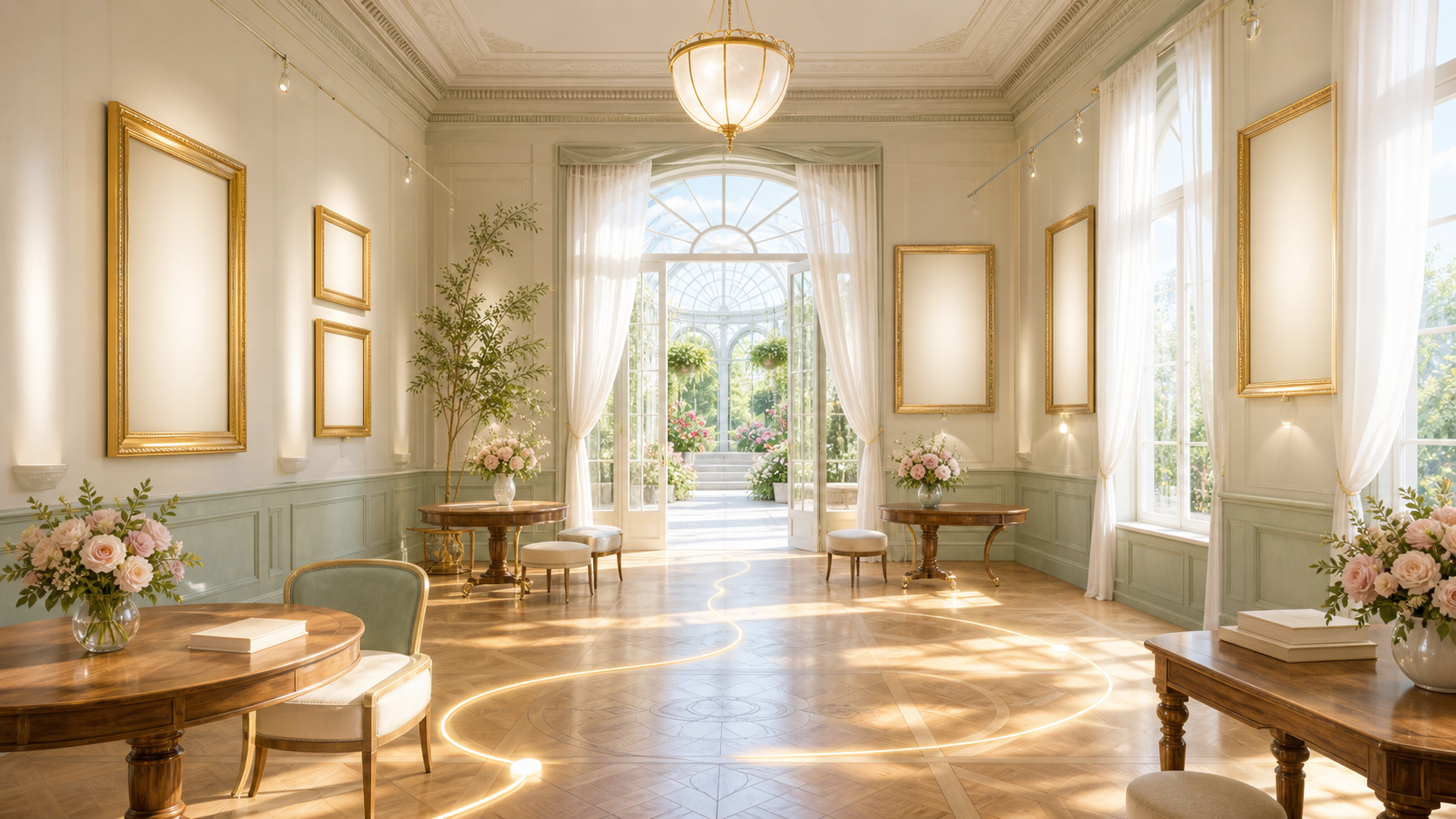
World Labs supported production of the nine prepared spatial environments. Tripo was used offline for character and ambient 3D assets. GPT Image 2 was used for selected two-dimensional production references before those references entered a separate Tripo 3D workflow.
The complete curated journey also works without paid credentials. Live GPT-5.6 and curated fallback states are labeled separately so the experience never presents fallback content as a live model response.
How Codex helped
Codex accelerated implementation and verification across:
- The Three.js spatial client
- GPT-5.6 Structured Output contracts
- The three-station evidence system
- Independent interpretive-lens movement
- Artwork correspondence and collider grounding
- Provider and fallback boundaries
- Responsive and accessible interaction
- Asset optimization and browser delivery
- Contract, integration, and end-to-end testing
Human decisions defined the learning thesis, companion perspectives, collection strategy, artistic direction, representation boundaries, and final product experience. Codex helped translate those decisions into testable implementation, reproduce failures, propose bounded fixes, and verify the complete journey.
Challenges we faced
Grounding AI in real evidence
We did not want generic commentary that could apply to any painting. Dialogue and synthesis therefore had to be bounded by trusted artwork metadata, visible facts, the active scene, and the learner’s recorded evidence.
Connecting dialogue to physical space
An AI lens should not discuss an artwork while standing somewhere unrelated. The system verifies that the active lens has reached and faced the correct work—and that the learner is close enough to participate—before evidence can be recorded.
Delivering high-fidelity worlds in a browser
The spatial assets are large. We implemented byte-range delivery, quality tiers, loading boundaries, explicit disposal, and readiness transitions that remain visible until the correct world and selected company are prepared.
Keeping generative claims honest
GPT-5.6 generates the personalized concept, while deterministic code owns scene identities, coordinates, assets, movement, and progression. Optional narration uses generic system voices, and the prepared ninth world is never described as geometry generated live.
What we learned
We learned that AI becomes more educational when it generates perspectives instead of authority.
Disagreement can be a learning interface. Spatial movement can make comparison more memorable. Requiring learners to record evidence changes the experience from passive consumption into active interpretation.
Most importantly, a personalized conclusion becomes more meaningful when the learner can see which observations and decisions produced it.
What's next
We want to develop MUSE∞ into a reusable platform for teachers, schools, museums, and cultural education organizations.
Future directions include teacher-authored inquiry questions, shorter classroom journeys, curriculum-aligned modules, student reflection exports, and institution-specific open-access collections.
Our long-term vision is not an AI tutor that gives students the right answer. It is a learning world that helps them build an interpretation they can explain, support, and revise.
Build Week development disclosure
The original MUSE∞ concept and prepared spatial assets existed before the Submission Period.
During OpenAI Build Week, Codex and GPT-5.6 were used to meaningfully extend the project with the strict 8+1 journey, three-station evidence system, GPT-5.6 Structured Outputs, evidence-grounded dialogue, two-stage synthesis, independent interpretive-lens movement, readiness transitions, provider boundaries, responsive presentation, and automated verification.
Built With
- art-institute-chicago
- codex
- glb
- gpt-5.6
- gpt-image-2
- javascript
- minimax
- node.js
- open-access
- openai
- particle
- playwright
- realtime-api
- responses-api
- spz
- structured-outputs
- three.js
- tripo
- webgl
- world-labs

Log in or sign up for Devpost to join the conversation.