-
-
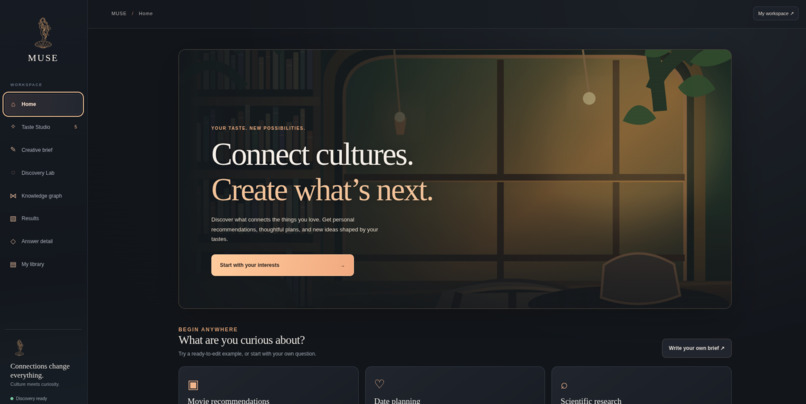
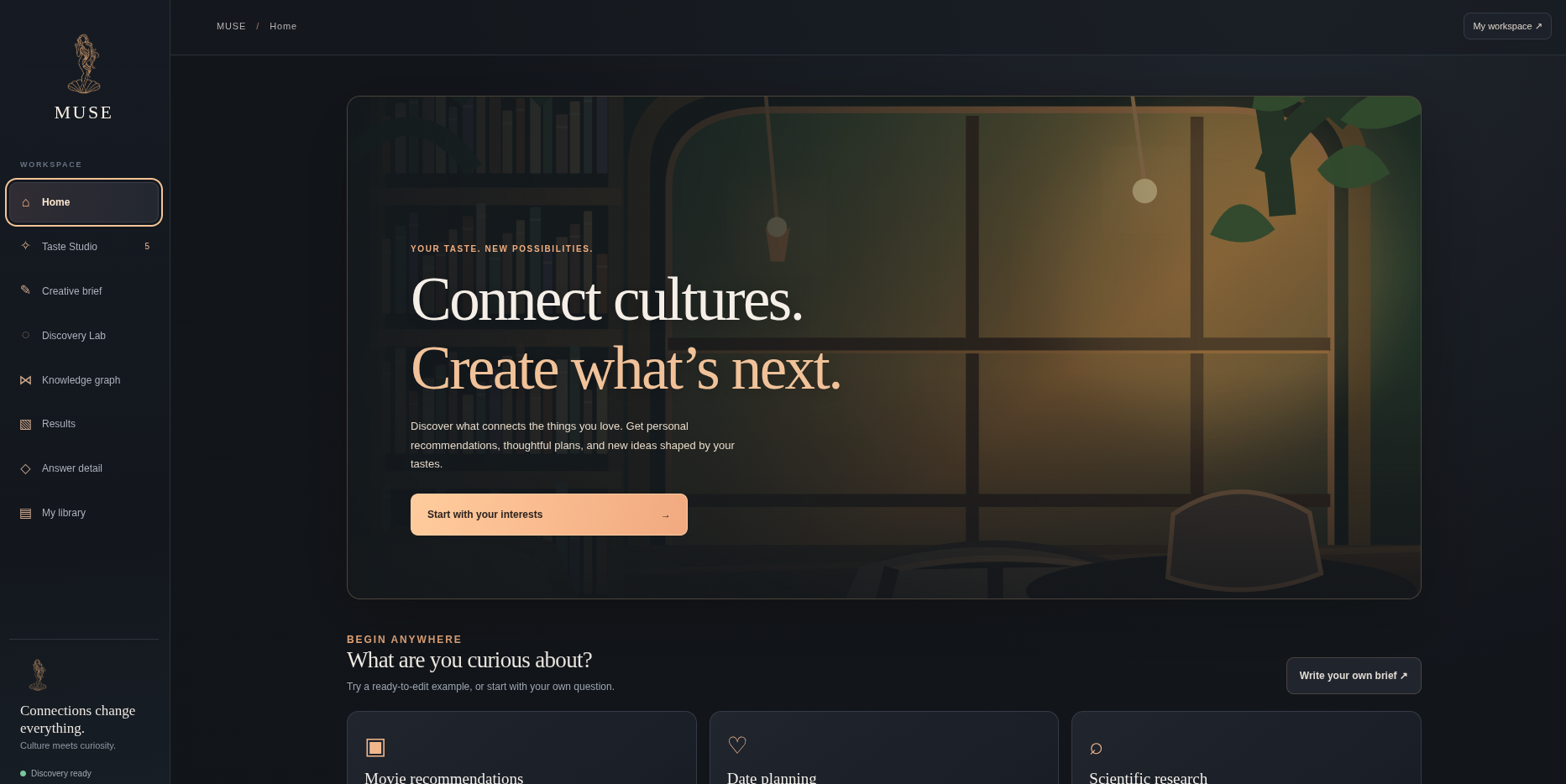
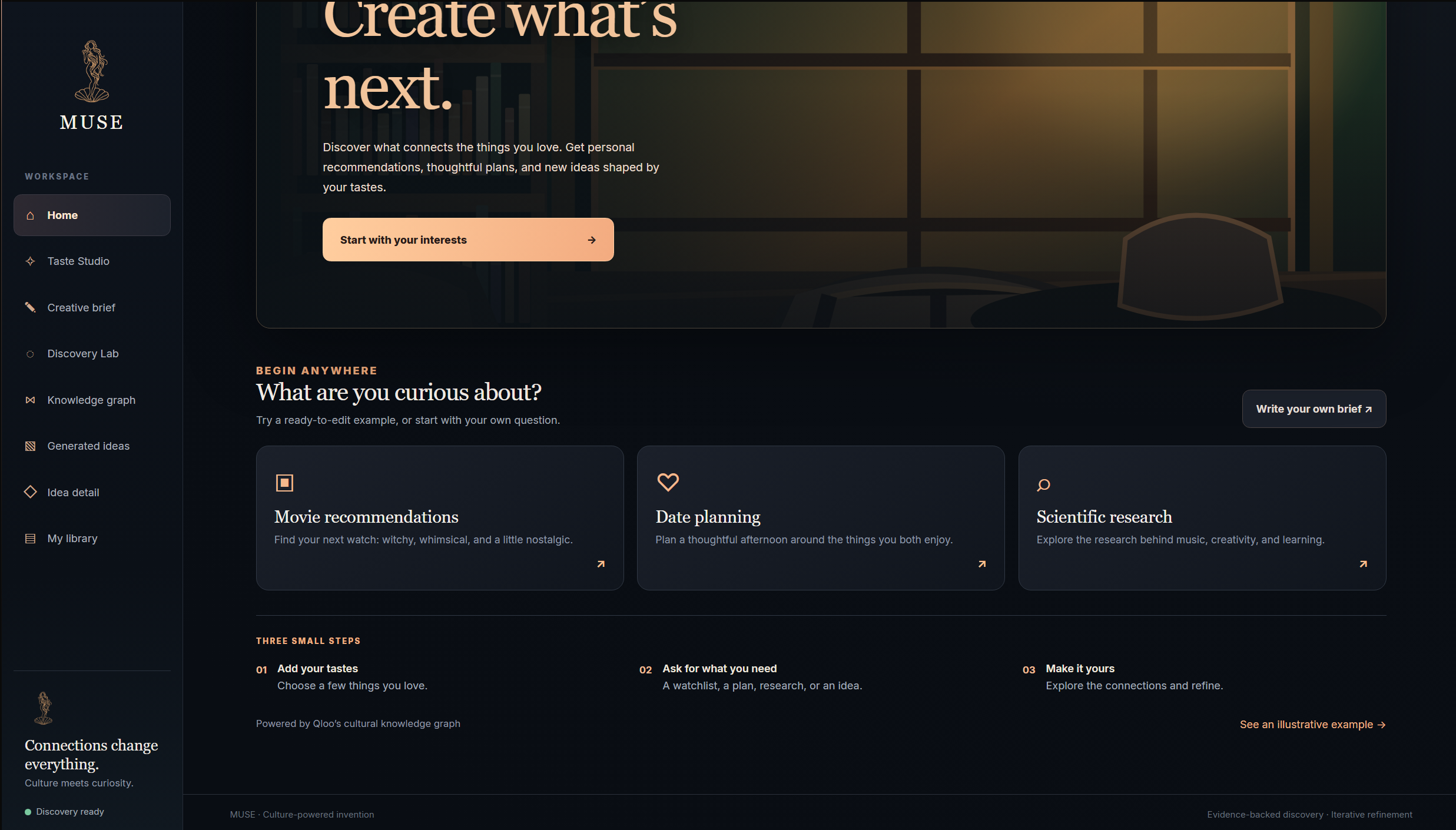
Home page
-
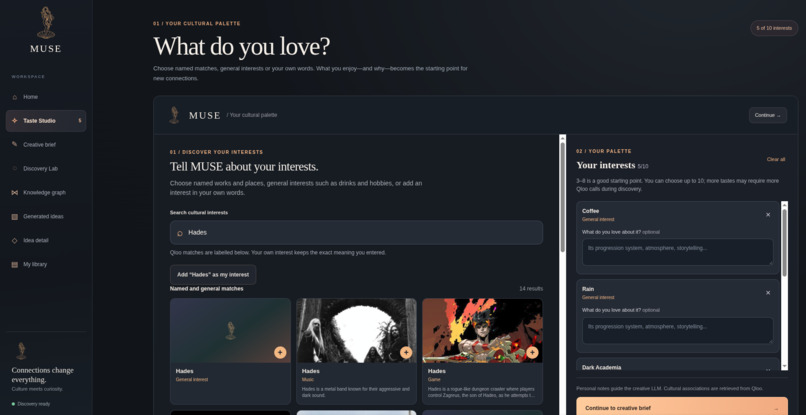
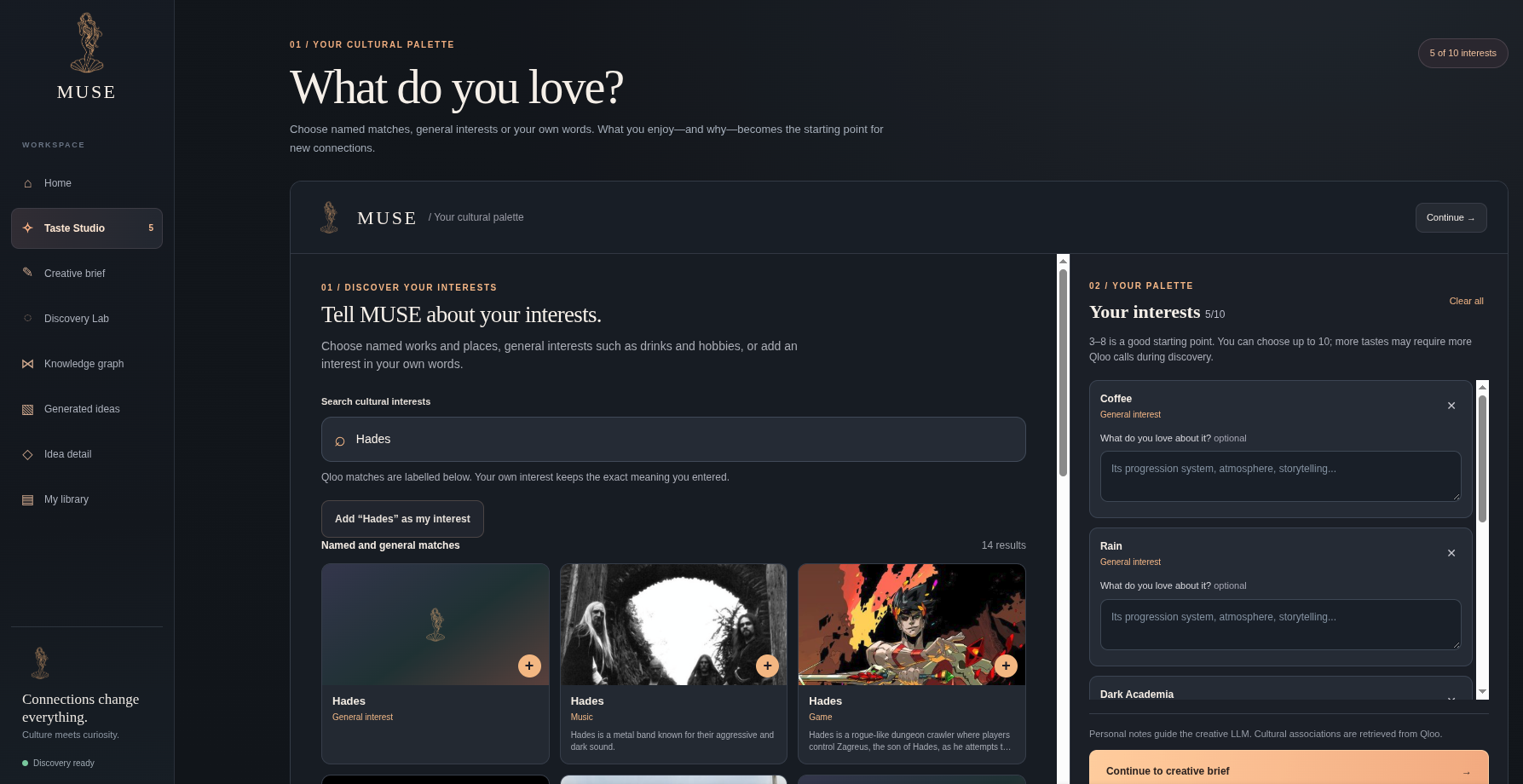
Taste curation
-
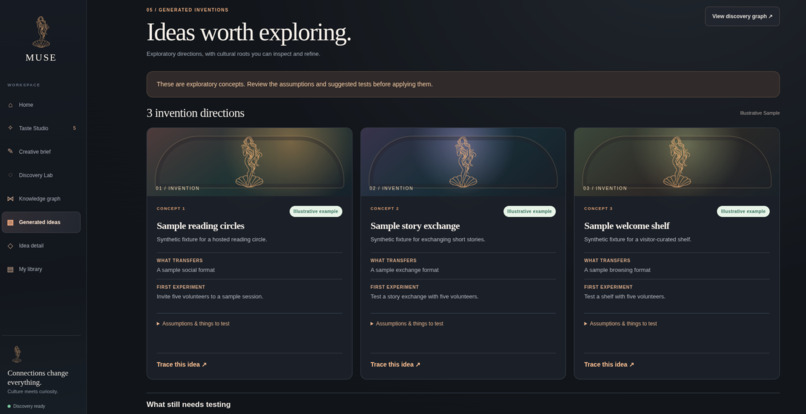
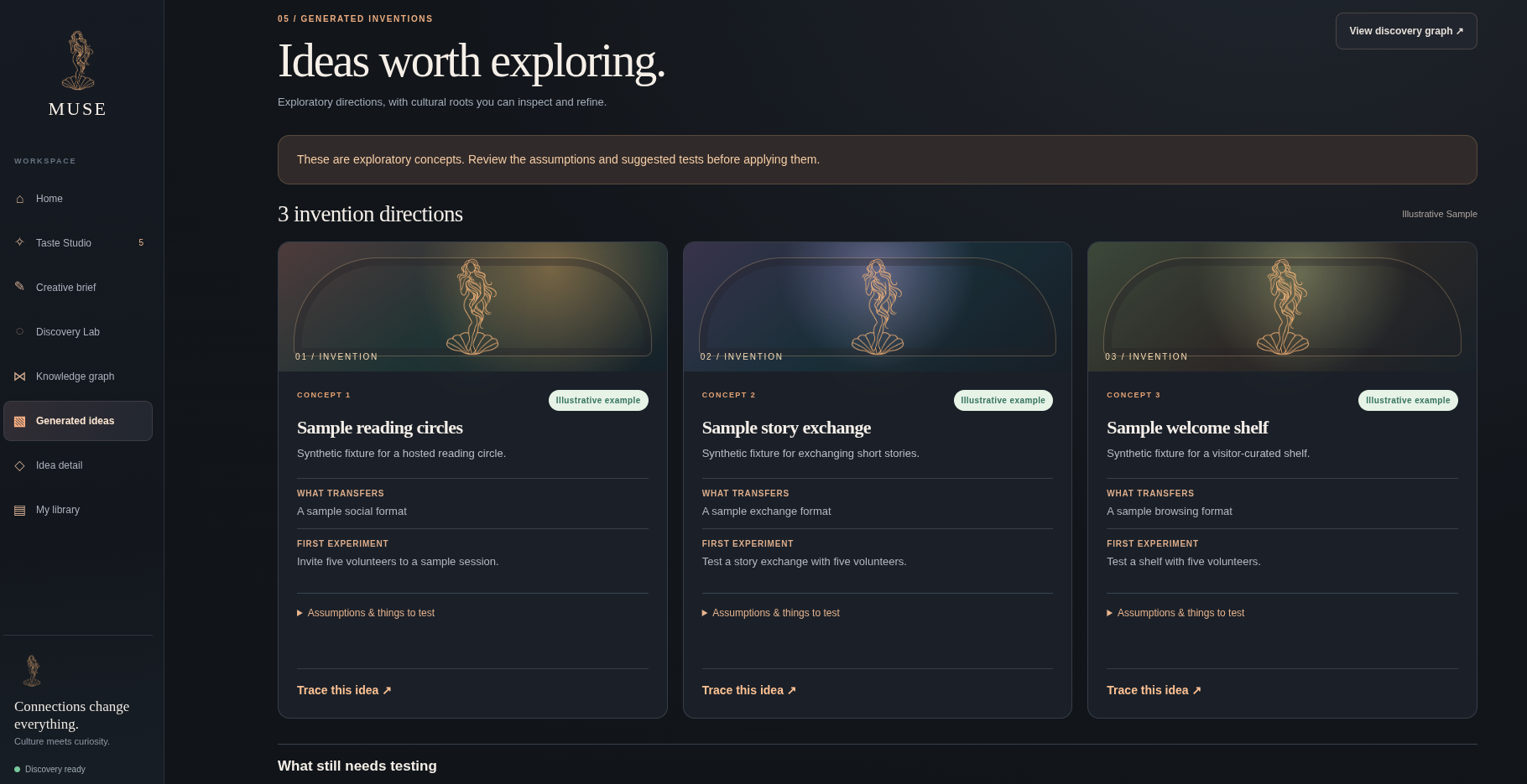
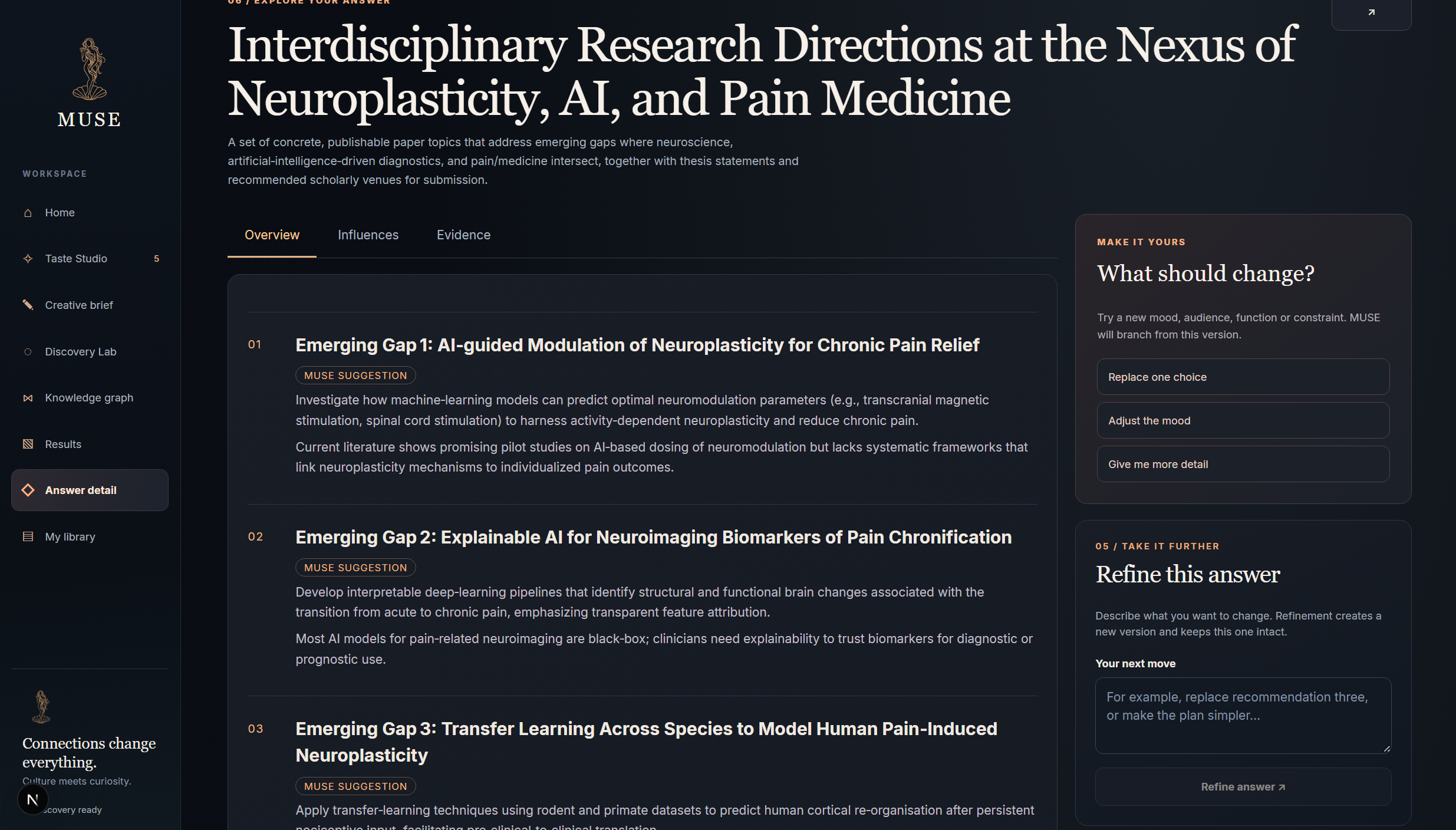
Ideas generated
-
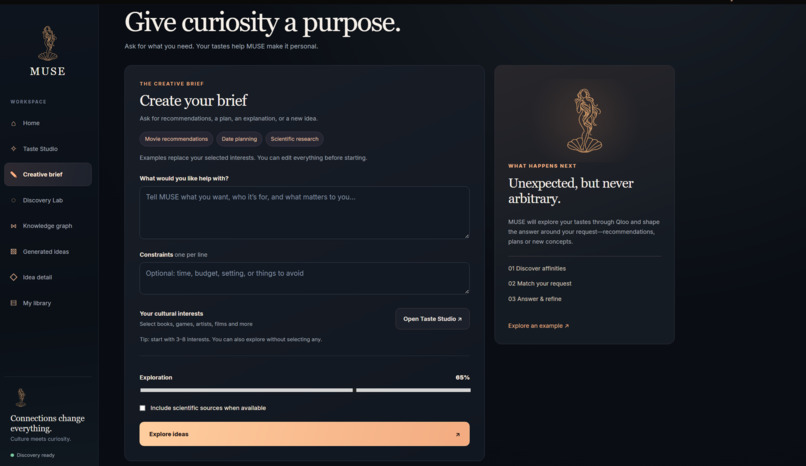
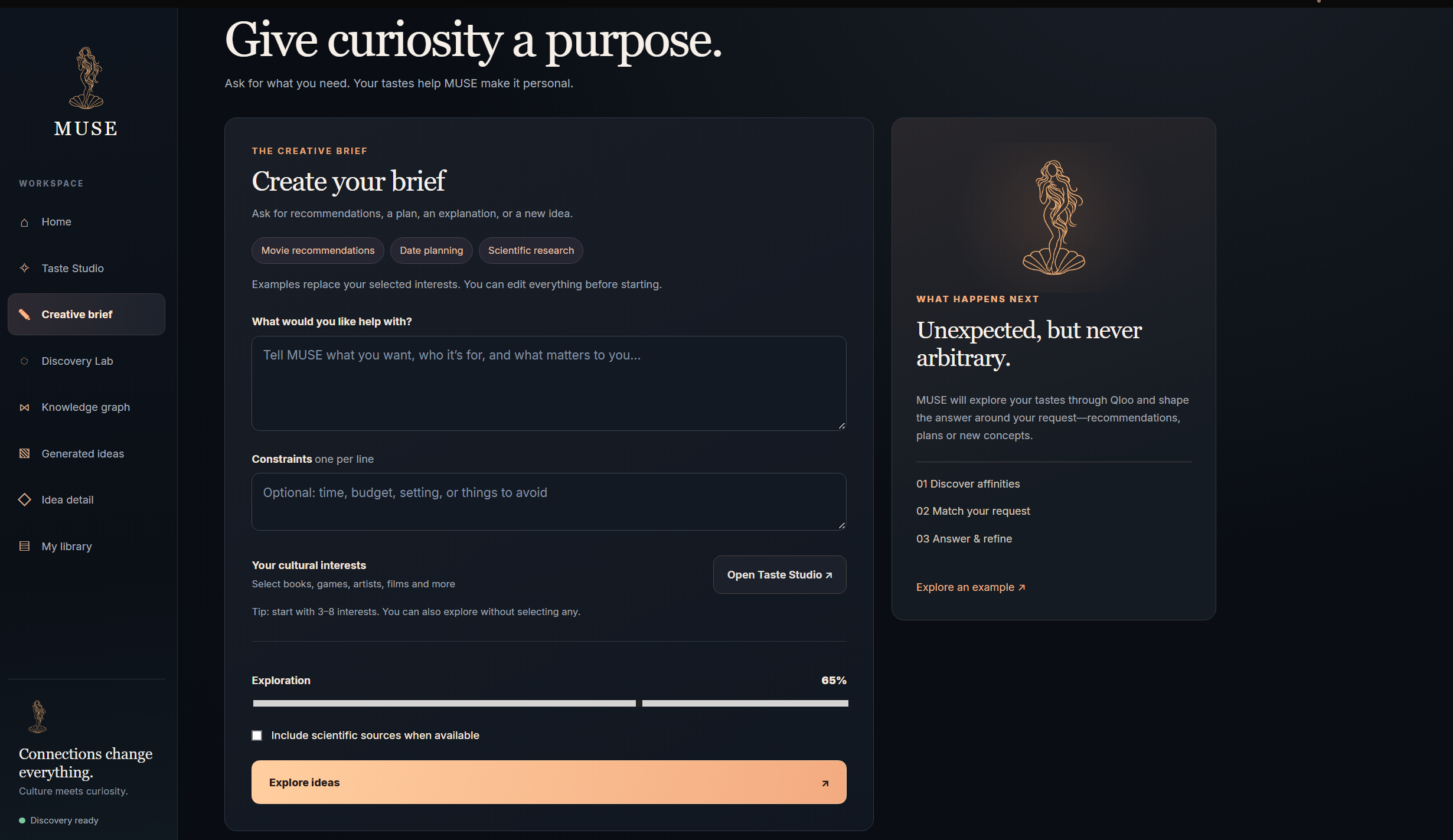
Ask for recommendations, a plan, an explanation, or a new idea.
-
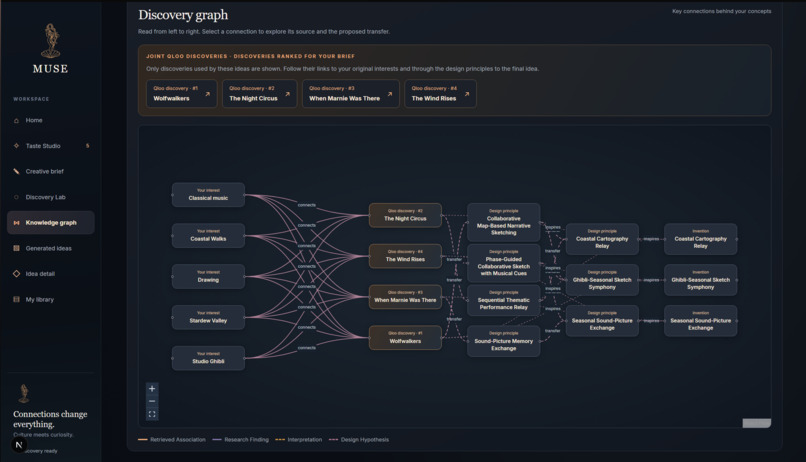
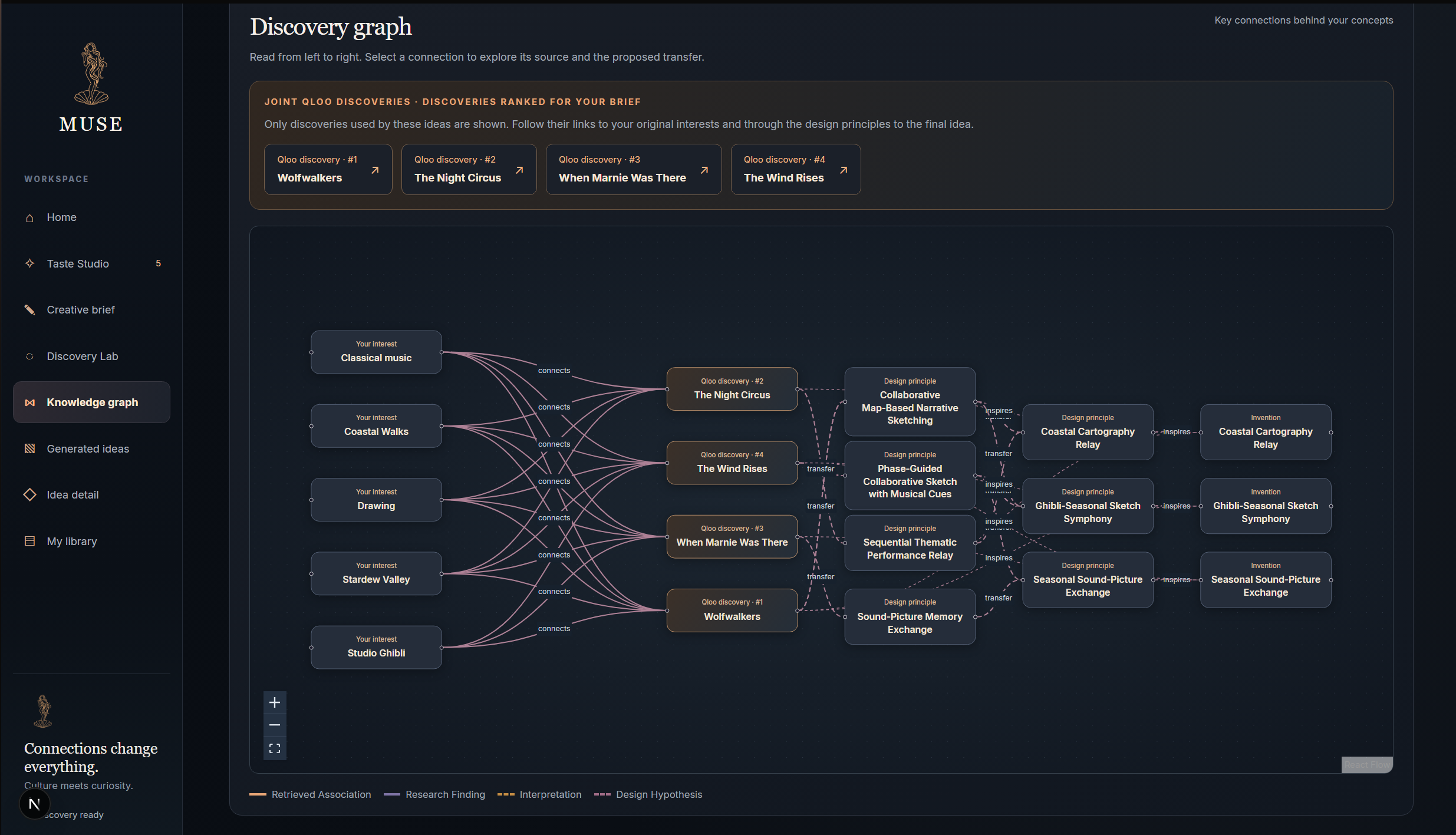
Generated graph with relationships example 1
-
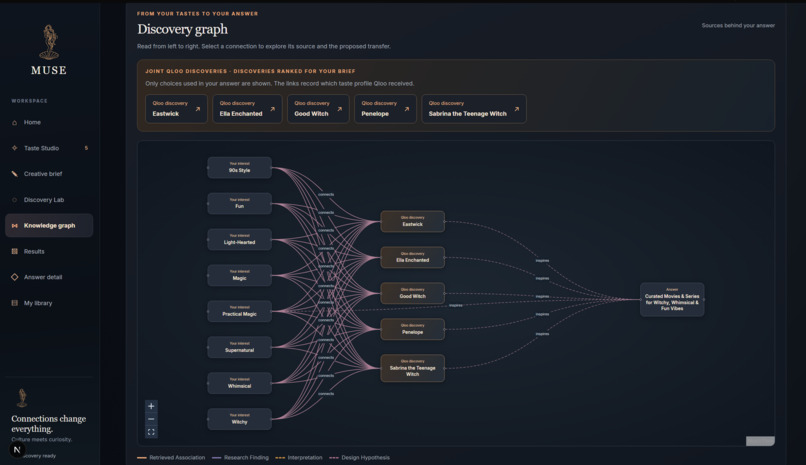
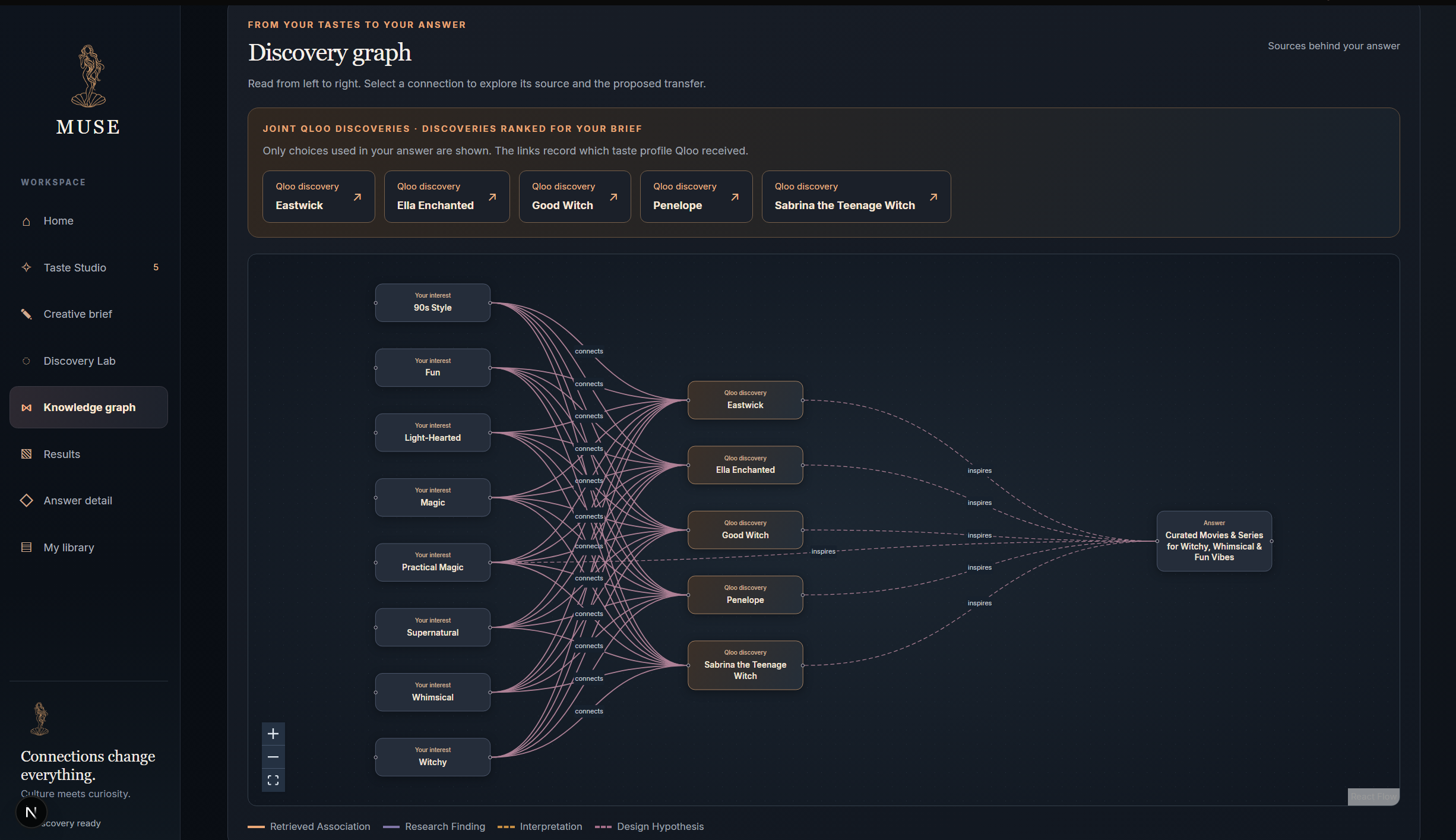
Generated graph with relationships example 2
-
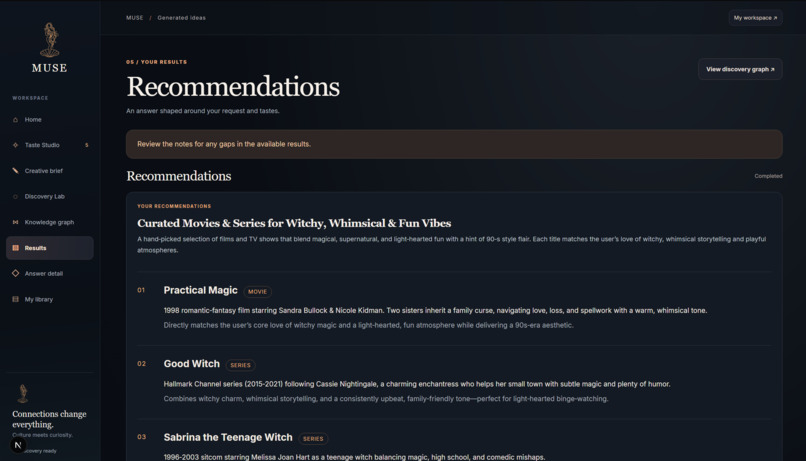
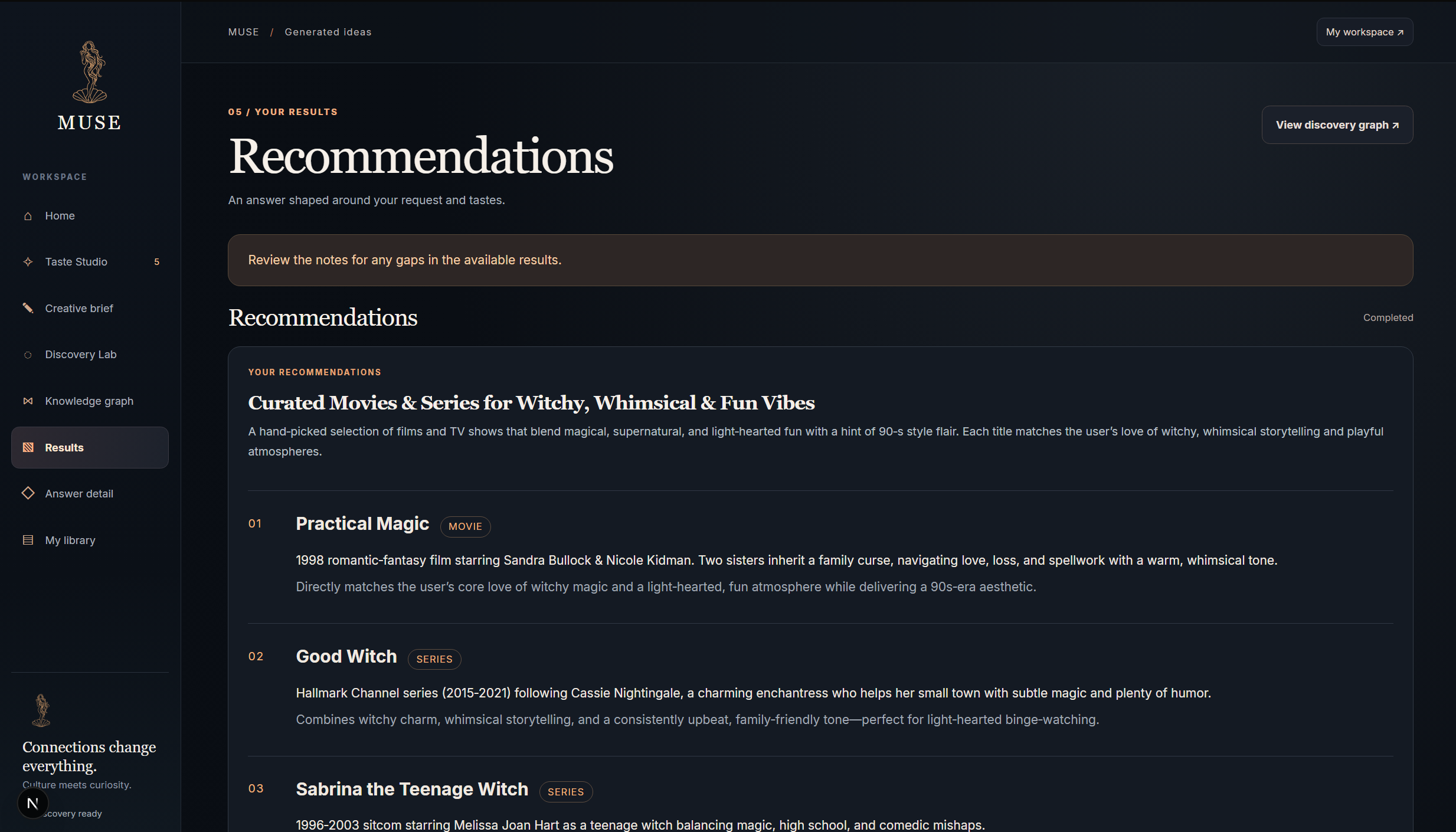
Delivers what you ask for based on your interests
-
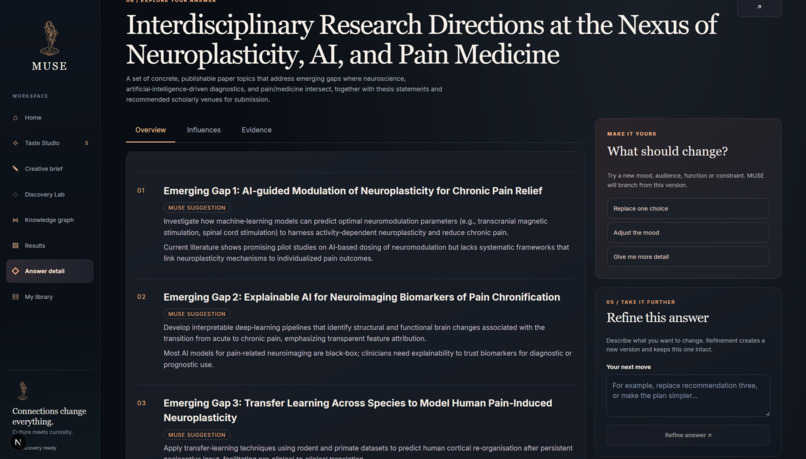
Curate your ideas further to your imagination
-
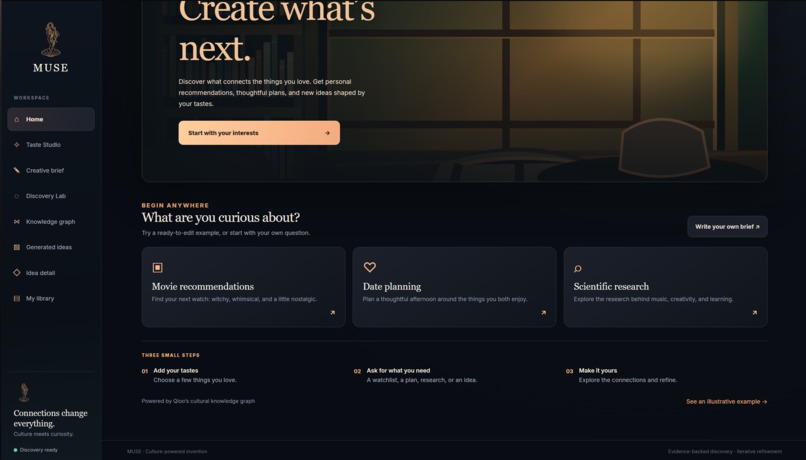
Examples are provided to help users ease into using Muse
MUSE — Creativity Is Just Connecting the Dots.
💡 Inspiration
What if AI's biggest creative limitation isn't its ability to connect ideas, but its ability to find the right ideas to connect?
LLMs are incredible at generating content. But they tend to generalize, producing answers influenced by the most common patterns in their training data. And we thought: isn't that almost the opposite of creativity?
Think about how human creativity works.
You don't really invent something out of nothing. You connect things you already know, sometimes things that seem completely unrelated, and suddenly something new emerges.
The more dots you have, and the further apart those dots are, the more unexpected and creative the connections can become.
That's why, when someone is stuck in a creative block, they're often encouraged to step away and explore something completely different. Read a book outside your field. Visit a museum. Watch a film. Learn something new.
A great graphic designer doesn't just look at other graphic designs for inspiration. They might borrow composition from architecture, atmosphere from cinema, colors from nature, or storytelling from literature.
Creativity isn't just about thinking differently. It's about having different things to think with.
And that's where MUSE comes in.
We wanted to build an AI that doesn't just generate answers from what it already knows. We wanted to give it more dots to connect, and not just random dots, but ones that are meaningful to you.
Here's how we imagined it:
- You provide the first dots. Through our Taste Studio, you tell MUSE what you love, what interests you, what inspires you.
- Qloo finds more dots. Using cultural intelligence, it discovers relationships, affinities, and unexpected connections extending beyond your original interests.
- The LLM connects them. Given your request, your tastes, and Qloo's discoveries, it combines these influences into an answer shaped around you.
Think of Qloo as a magical library for creative block. You walk in with a handful of ideas, and it opens doors to shelves you didn't even know existed.
And MUSE helps you make something out of what you discover.
Even our logo tells this story. It's inspired by Venus de Milo, reimagined as the personification of our muse: a figure representing inspiration, curiosity, and the endless discovery of new knowledge. A muse that doesn't simply hand you an answer, but gives you more and more dots until you can see connections you couldn't see before.
MUSE originally started as a cultural invention engine, designed to bring distant influences together into entirely new concepts. But as we experimented, we realized this approach could go much further.
Why limit creativity to inventions?
What if the same system could help you discover a movie you'd never have searched for, plan a date that feels uniquely yours, design a room, create a recipe, or approach an ordinary question from a completely different perspective?
That's how MUSE evolved into what it is today.
Not just an AI that answers your questions. An AI that expands the possibilities behind its answers.
✨ What It Does
MUSE turns your taste into a starting point for discovery.
You begin in Taste Studio, where you build a collection of things that interest you. These might be films, music, food, aesthetics, places, or cultural themes.
Then you ask MUSE anything.
Maybe you want:
- 🎬 A movie recommendation that actually matches your taste.
- ☕ A cozy date plan inspired by the things you both love.
- 🎨 A room concept combining seemingly unrelated aesthetics.
- 🍜 A recipe influenced by your favorite cultures and flavors.
- 🚀 A completely new product, experience, or creative concept.
Instead of immediately generating a response, MUSE first explores your cultural universe.
It uses Qloo's cultural intelligence to discover related entities, tastes, and affinities that you might never have thought to mention.
Imagine someone who loves coffee and rainy weather. Maybe those interests lead toward autumnal atmospheres, intimate cafés, warm interiors, or slow-living experiences.
That's an illustrative example, not a claim about a specific Qloo result. The important part is the discovery process: finding additional influences that make sense for the person and the question.
MUSE then selects the discoveries most relevant to your request and gives them, together with your original interests, to the LLM.
The result isn't simply an answer to your question. It's an answer informed by a broader world of things you might love.
And importantly, MUSE understands what you're actually asking for.
If you ask for movie recommendations, you get real movies. If you ask for a date plan, you get an actual plan. If you ask for an invention, MUSE explores new combinations and explains how they might work.
You can also:
- Explore the Connection Graph to see the cultural influences and relationships behind your result.
- Refine your answers by changing the mood, setting, audience, or direction without starting over.
- Follow your creative history through saved results and their different versions.
It isn't about replacing your taste with AI's taste.
It's about using what you already love to discover what you might love next.
🛠️ How We Built It
We built MUSE as a full-stack AI application, with cultural discovery at the center of its architecture.
Our tech stack:
| Component | Technology |
|---|---|
| Frontend | Next.js, React |
| Backend | Python, FastAPI |
| Cultural intelligence | Qloo API |
| LLM inference | Cerebras |
| Scientific research (optional) | OpenAlex |
| Connection visualization | React Flow |
| Persistence | SQLite |
| Deployment | Docker |
The Creative Pipeline
Our core challenge was figuring out how to turn cultural affinities into useful creative context rather than simply stuffing more information into an LLM prompt.
We designed a multi-stage workflow:
1. Understand the request
First, MUSE interprets what the user actually wants, including the task, constraints, and expected output.
A recommendation request shouldn't be treated like an invention request.
2. Start with the user's tastes
Interests selected in Taste Studio are resolved into supported Qloo entities or tags.
These become the starting points for exploration.
3. Discover new connections with Qloo
MUSE queries Qloo for related cultural entities and affinities, expanding beyond what the user explicitly provided.
This is where we find more dots.
4. Select the right dots
Not every discovered connection is useful for every question.
MUSE evaluates discoveries in the context of the user's request, selecting a compact set of relevant influences, with up to ten additional discoveries available to guide generation.
5. Connect the dots with Cerebras
The original interests, Qloo discoveries, and user request are assembled into structured context for the language model.
The LLM uses these influences to generate an answer that is both relevant to the task and personalized to the user's tastes.
6. Explore and refine
React Flow visualizes the connections contributing to the result.
Users can then refine the response, generating new versions while preserving their creative history.
Going Beyond Recommendations: The Invention Pipeline
For requests involving genuinely new concepts, MUSE uses a more explicit creative workflow.
It extracts possible principles from different influences, explores how those principles might interact, and develops them into concepts.
For example, instead of merely combining the appearance of two unrelated objects, the system might consider how a mechanism from one field could inspire a solution in another.
When scientific context is needed, MUSE can also use OpenAlex to incorporate research into the exploration process.
We wanted the system to go beyond superficial combinations and at least begin asking the more interesting question:
What can one field teach us about another?
All API keys remain server-side, and Docker packages the application for deployment.
🧠 What Makes It Qloo-Powered
Qloo isn't just an additional data source. It's what makes MUSE's discovery process possible.
Without Qloo, the model would have to rely on the user's explicitly stated interests and the associations already represented in its training.
With Qloo, we introduce a separate cultural discovery layer.
The user provides a starting point. Qloo expands that starting point into related interests, entities, and cultural affinities. MUSE then selects the discoveries that make sense for the actual question.
This distinction matters.
We're not randomly adding unrelated ideas to a prompt and hoping something creative happens.
We're expanding the space of possible connections in a direction guided by the user's taste.
Qloo helps us answer: What else might this person find interesting?
MUSE answers: What can we do with those discoveries?
And there's an important boundary: a cultural affinity is not scientific proof, and an interesting creative combination isn't automatically a feasible invention.
MUSE treats retrieved affinities as discovery signals, while its generated interpretations remain ideas to explore.
⚡ Challenges We Faced
Building MUSE taught us that giving an LLM more information doesn't automatically make it more creative.
In fact, sometimes it makes things worse.
1. Finding connections that actually matter
Our first major challenge was relevance.
Just because two things have a strong cultural affinity doesn't mean that relationship is useful for every question.
An interesting connection for a restaurant recommendation might be completely irrelevant to a room design or product idea.
We had to make discovery selection dependent on the user's actual request, rather than simply using the strongest affinities.
The goal wasn't to find the most dots. It was to find the right dots.
2. Teaching MUSE when not to invent
This one was particularly interesting.
MUSE started as an invention engine, so our early approach leaned heavily toward creative concept generation.
But creativity doesn't always mean inventing something entirely new.
If someone asks for films, they want films. They don't want an elaborate concept for a new film-watching experience.
We refined the workflow to distinguish between recommendations, practical plans, and open-ended invention requests.
Being creative also means knowing when to be practical.
3. Balancing creativity with feasibility
We experimented with more elaborate invention workflows, including research, development, and evaluation stages.
But we ran into an unexpected problem: the system could become too demanding too early.
An exploratory idea might be rejected because we couldn't establish its full implementation details, costs, or feasibility.
That raised an interesting design question.
Should an idea-stage creative assistant behave like an engineering review committee?
We learned to distinguish between generating a promising hypothesis and claiming that something is ready to build.
Creative exploration needs room for uncertainty, while still being honest about assumptions.
4. Managing token budgets, latency, and complex workflows
Multiple discovery and generation stages can quickly become expensive in tokens and execution time.
We encountered oversized prompts, model output limits, and workflow failures while testing different approaches.
We improved the system by reducing unnecessary context, keeping discoveries compact, and focusing each stage on the information it actually needed.
The connection graph also became difficult to navigate as the number of relationships increased, so we focused the visualization on the influences relevant to the final result.
5. Refining ideas without losing their identity
We didn't want users to have to restart every time they wanted a small change.
What if you liked a concept but wanted it to feel cozier? More futuristic? More suitable for children?
The challenge was allowing MUSE to change the requested dimension while maintaining the parts of the idea that still worked.
We introduced version history and context-aware refinement so users could continue exploring rather than repeatedly starting from zero.
📚 What We Learned
The biggest lesson was that cultural affinity, relevance, and creativity are three different things.
A connection can be statistically interesting but irrelevant to the question.
An influence can be relevant but not particularly imaginative.
And a creative answer can be exciting without being practical.
Building MUSE meant figuring out how these three things could work together.
We also learned that more context isn't always better context.
The value of discovery comes from introducing useful new perspectives, not overwhelming the model with hundreds of loosely related entities.
And perhaps most importantly, we learned that creativity needs space to explore.
Not every idea needs to be a finished product. Sometimes the most useful result is an unexpected connection that makes someone think:
Wait, I never thought about it that way.
That's exactly the experience we want MUSE to create.
🔮 What's Next
We want to take MUSE further, especially in understanding what makes an AI-generated answer genuinely creative.
Our next steps include improving how discoveries are ranked, making the connection graph more interactive, and giving users greater control over how far MUSE explores beyond their existing interests.
We're also interested in a bigger experiment:
How much more creative does an LLM become when it has access to culturally relevant discoveries it wouldn't otherwise receive?
We want to compare Qloo-guided answers against an LLM-only baseline and evaluate novelty, relevance, personalization, and usefulness.
Because the original question behind MUSE is still the one we're most curious about:
What if creativity isn't about building a model that thinks more creatively, but giving it a richer world of ideas to connect?
MUSE is our attempt to find out.
And hopefully, to help people discover things they didn't even know they were looking for.
Built With
- cerebras
- docker
- fastapi
- next.js
- openalex
- python
- qloo
- react
- react-flow
- render
- sqlite
- typescript


Log in or sign up for Devpost to join the conversation.