-
-
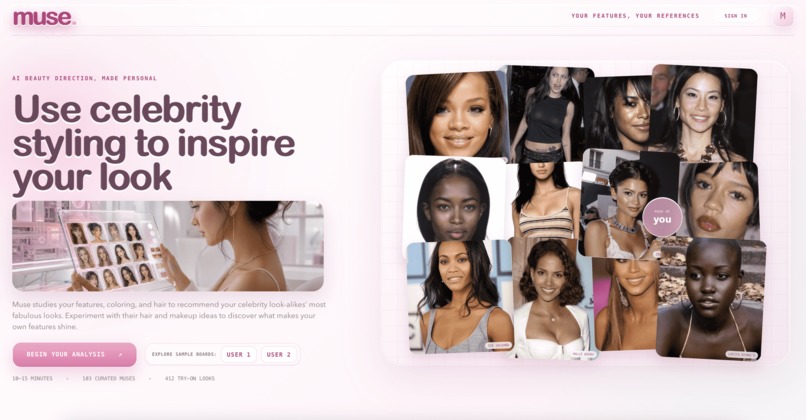
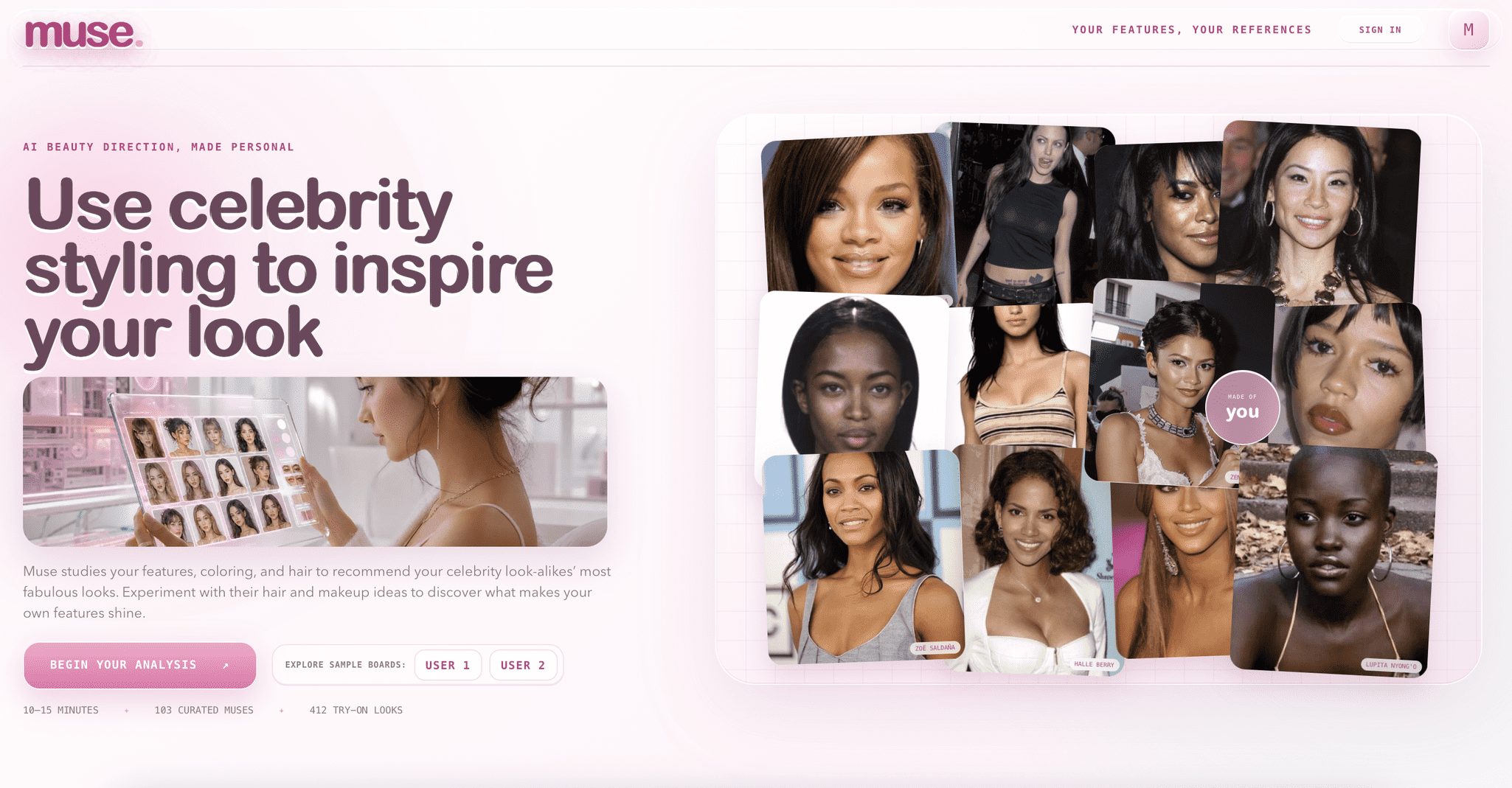
Muse's home page - where you can browse sample boards or begin your inspiration journey.
-
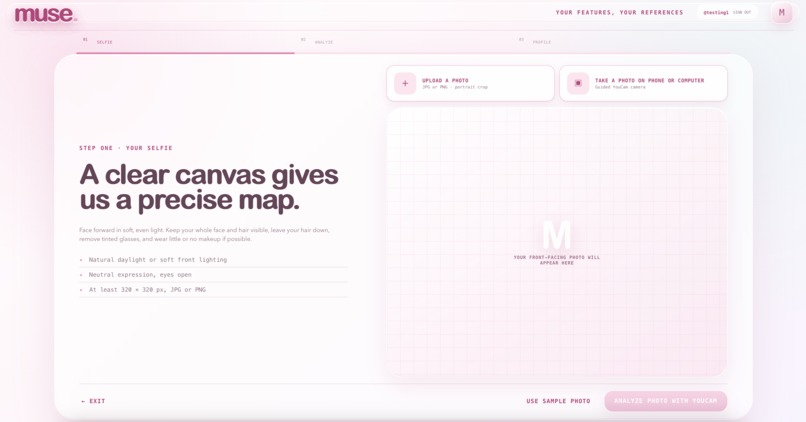
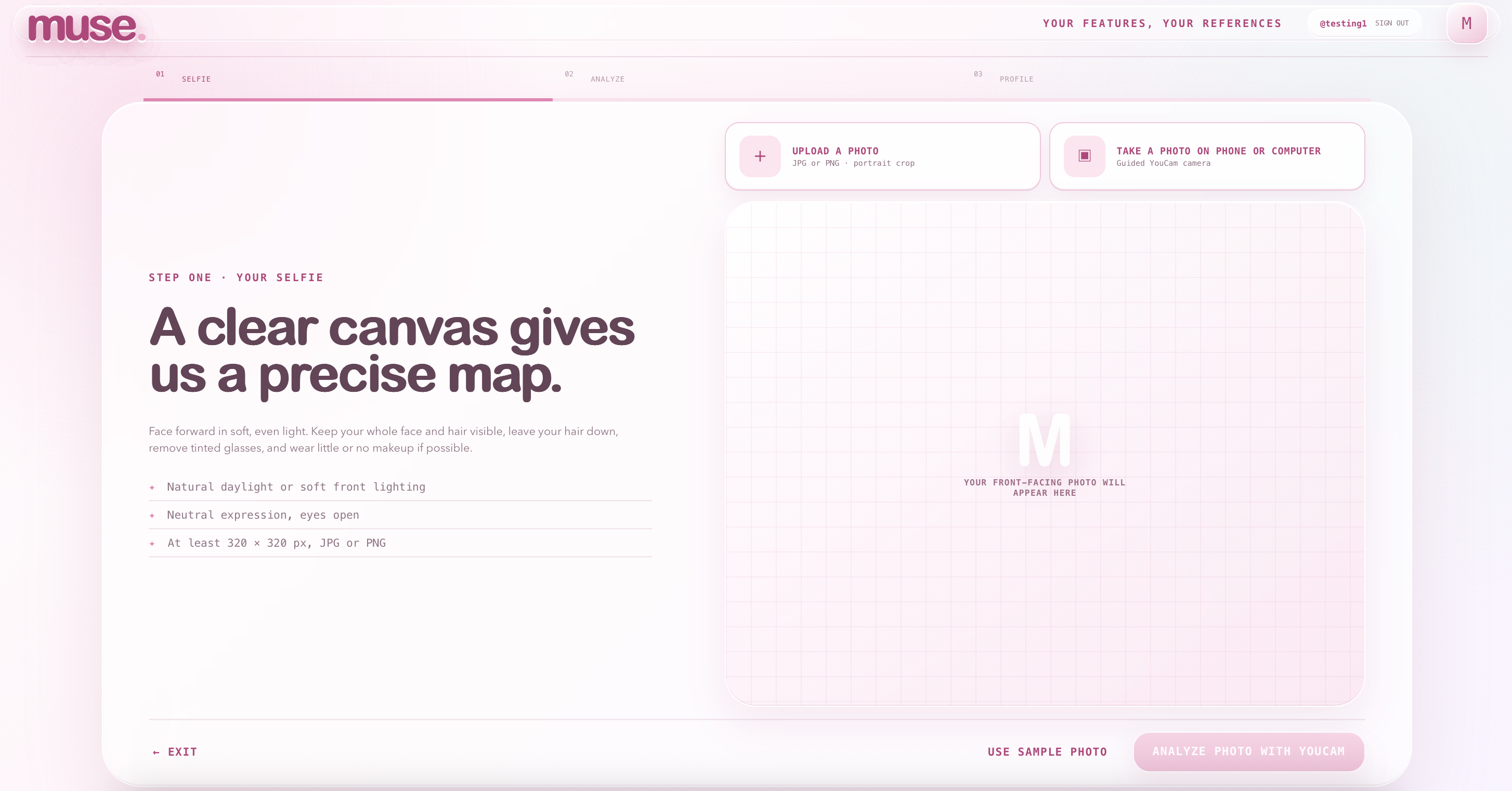
Users submit a selfie for feature and coloring analysis.
-
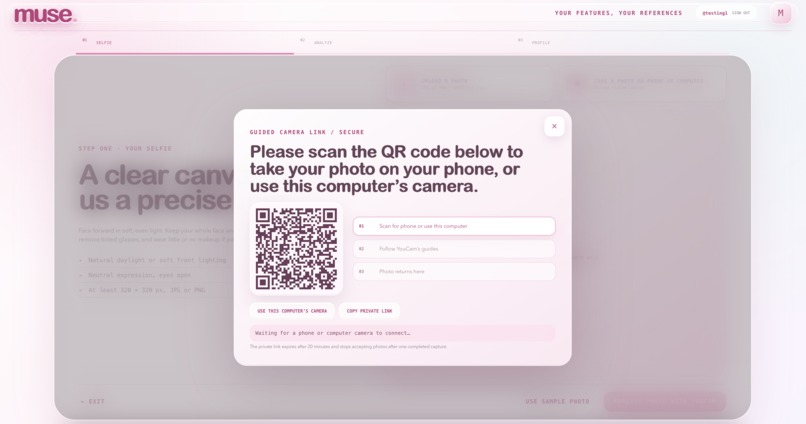
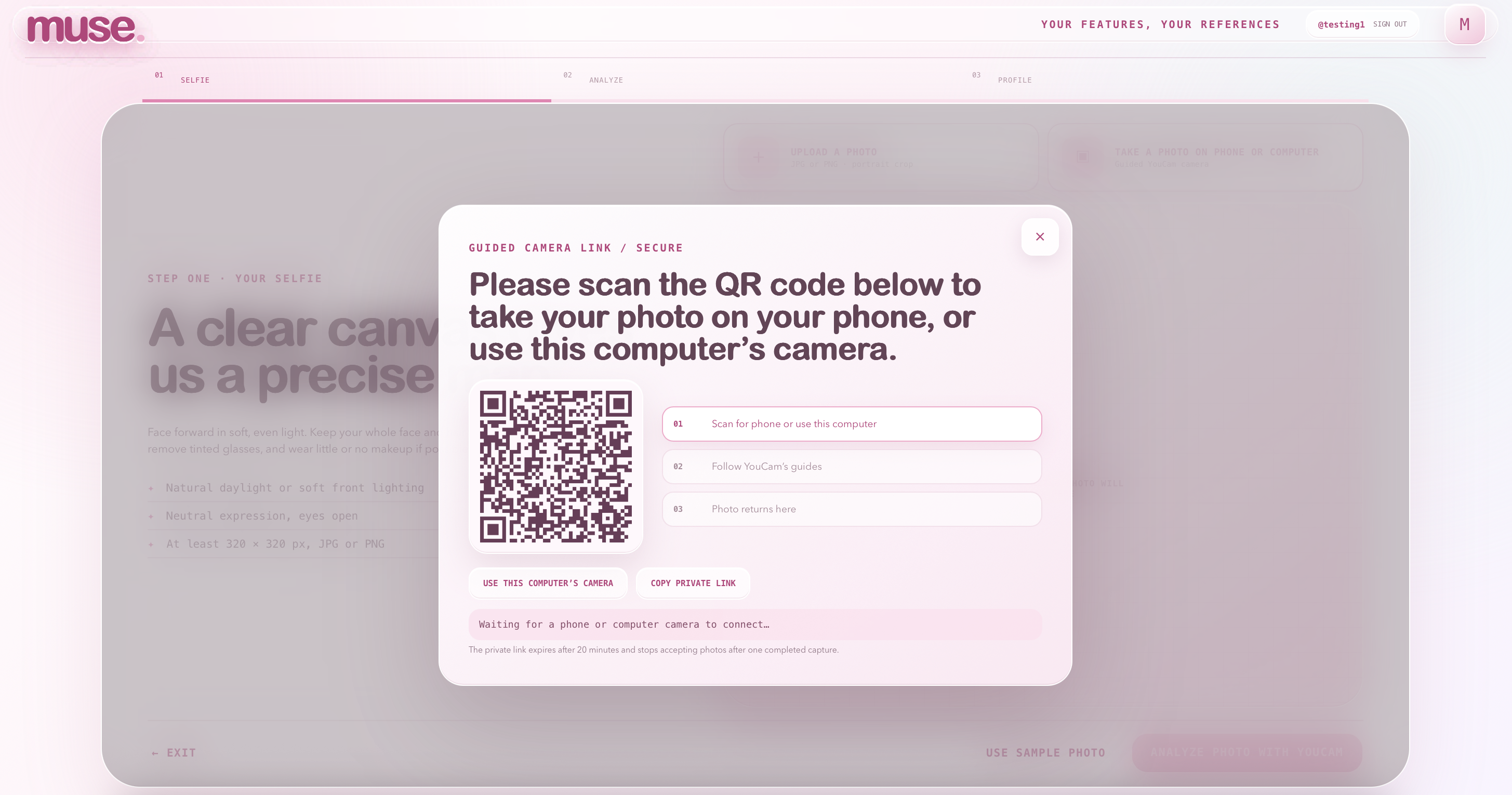
Photos can be uploaded, or taken using a mobile phone or computer camera.
-
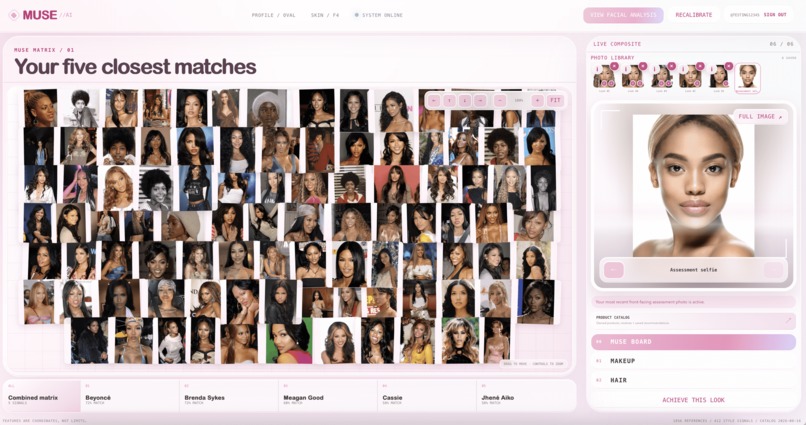
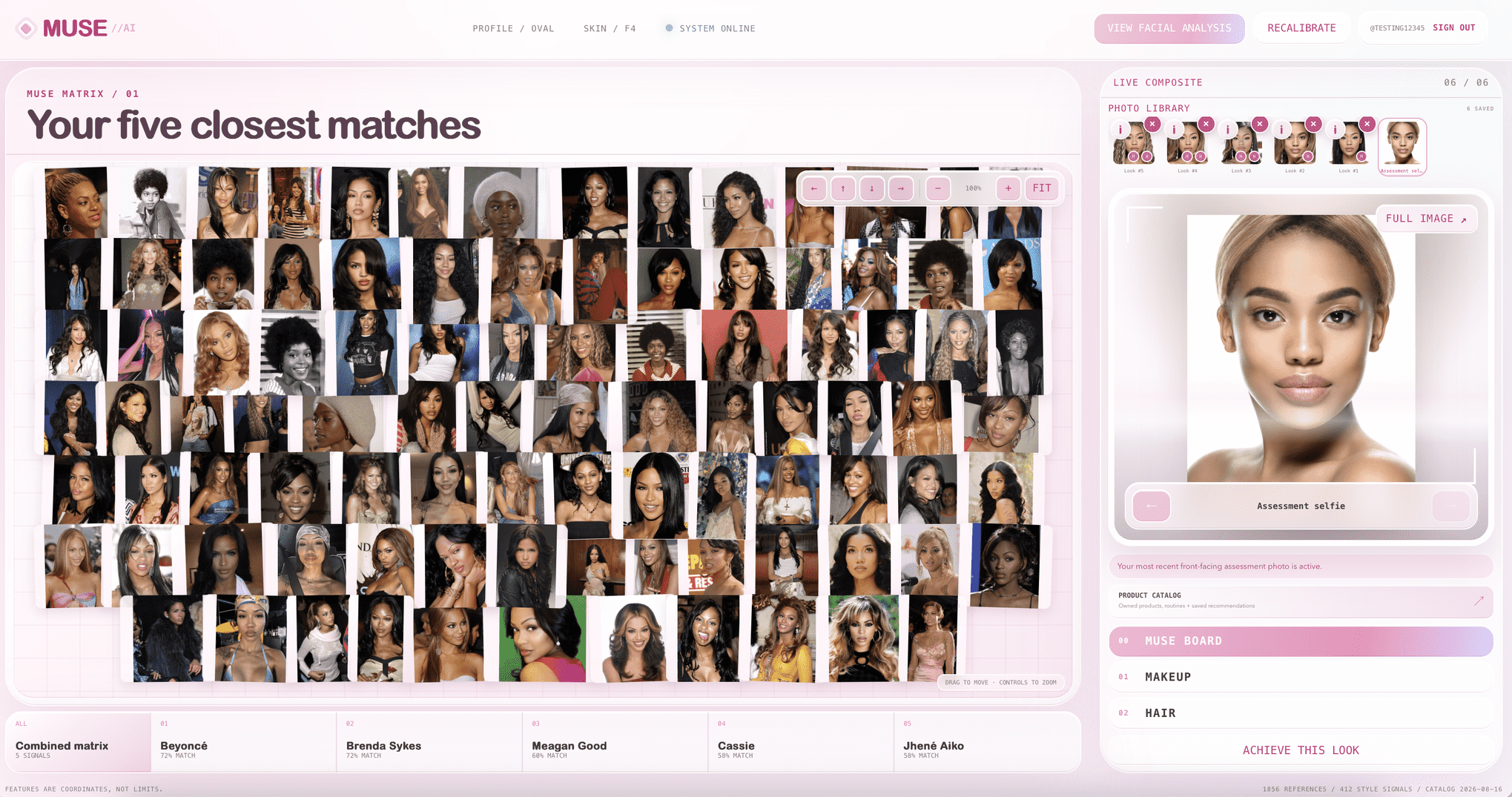
Muse finds the user's top five celebrity matches, showcasing a collage of their looks and a selection of hair and makeup inspo.
-
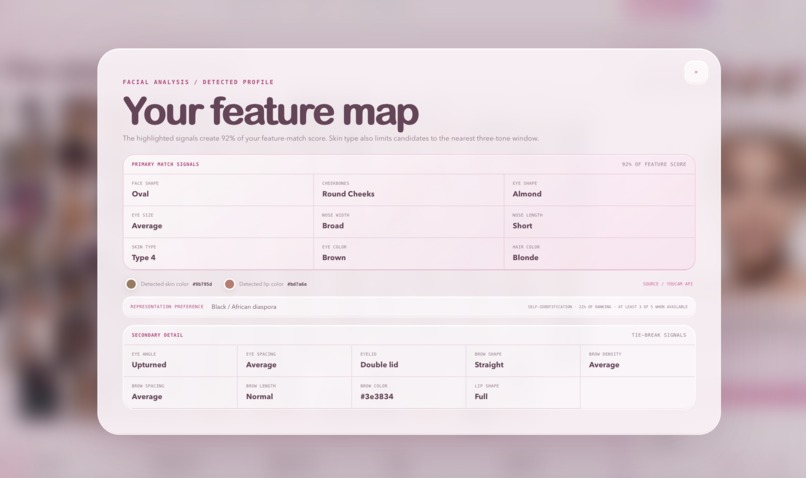
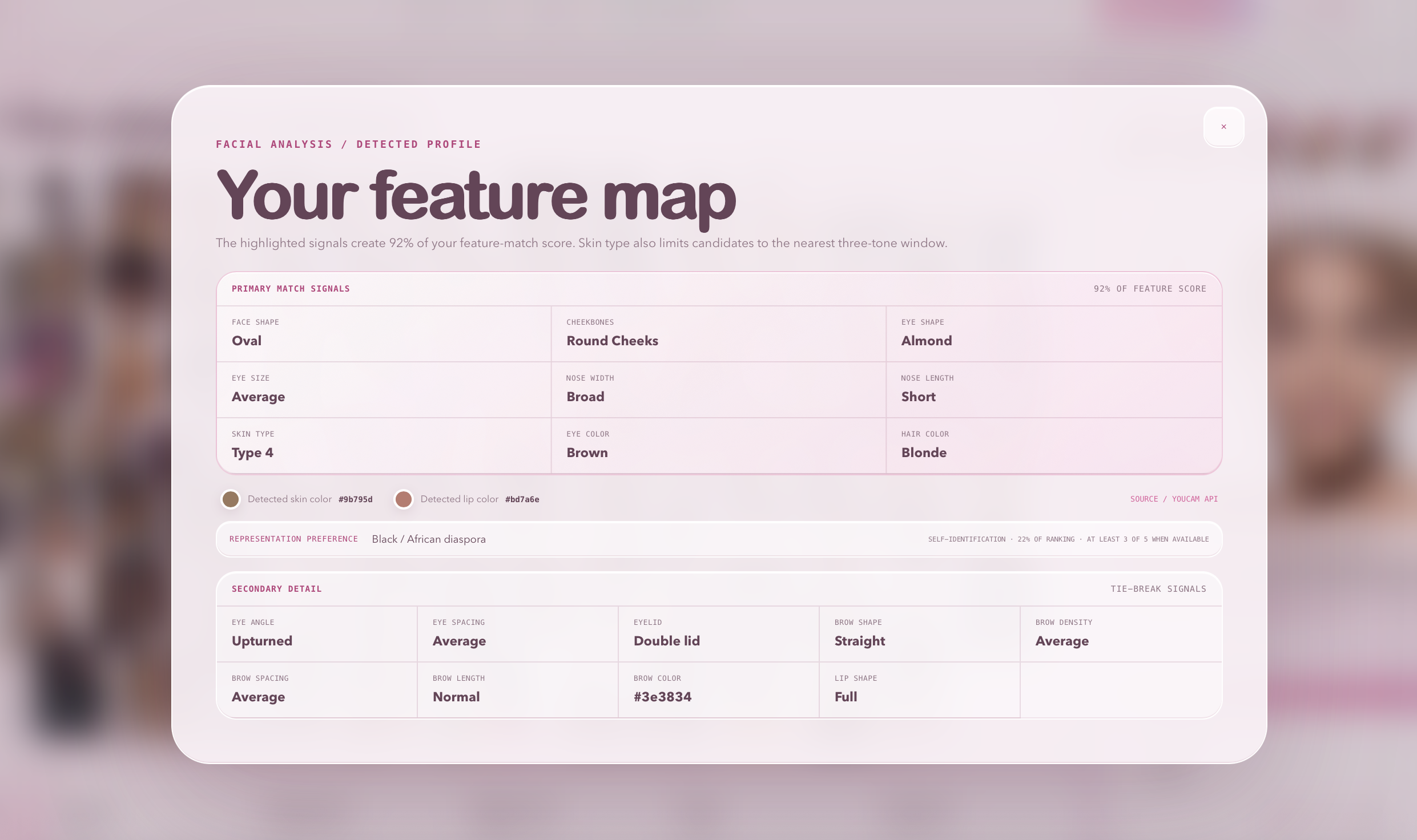
View your feature analysis
-

Makeup and hair looks are sorted by celebrity and features of the looks, for accessible browsing.
-
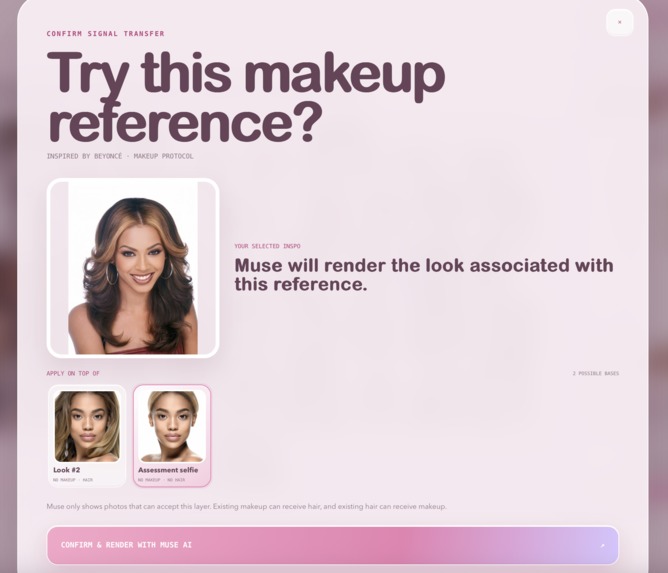
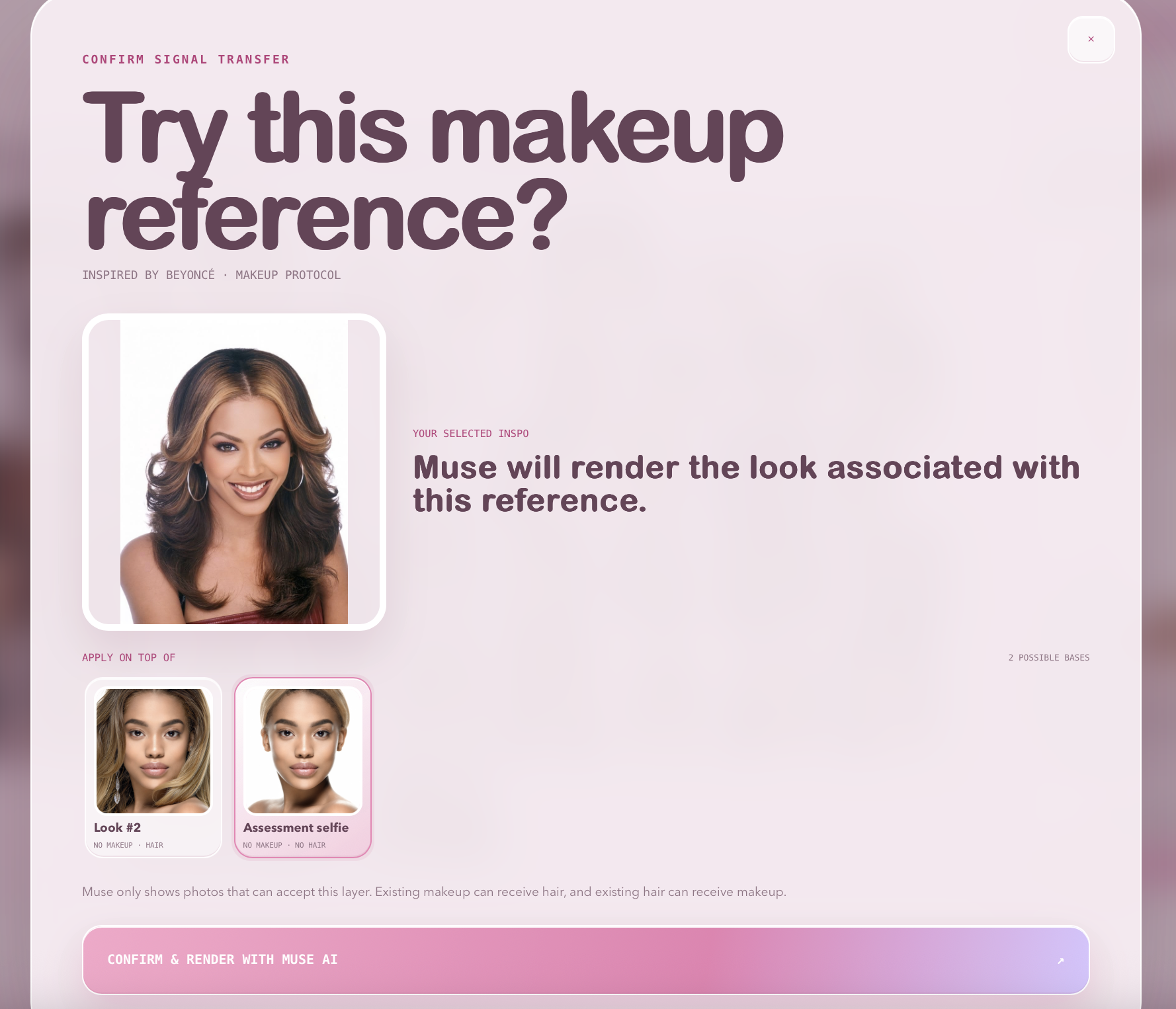
Users can select a photo as hair/makeup inspo and mix and match it with other previously created looks.
-
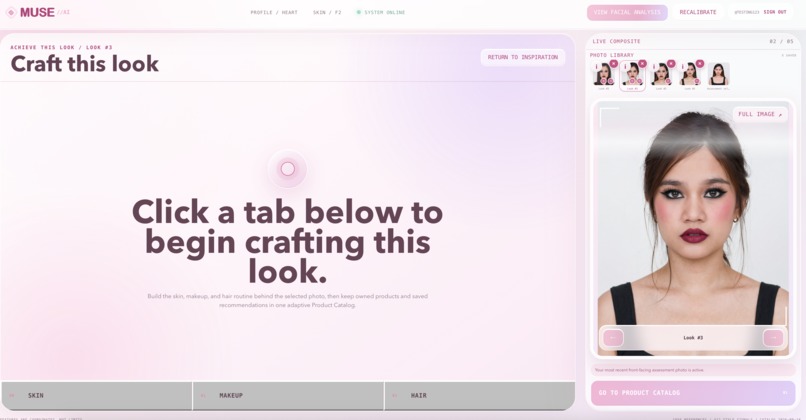
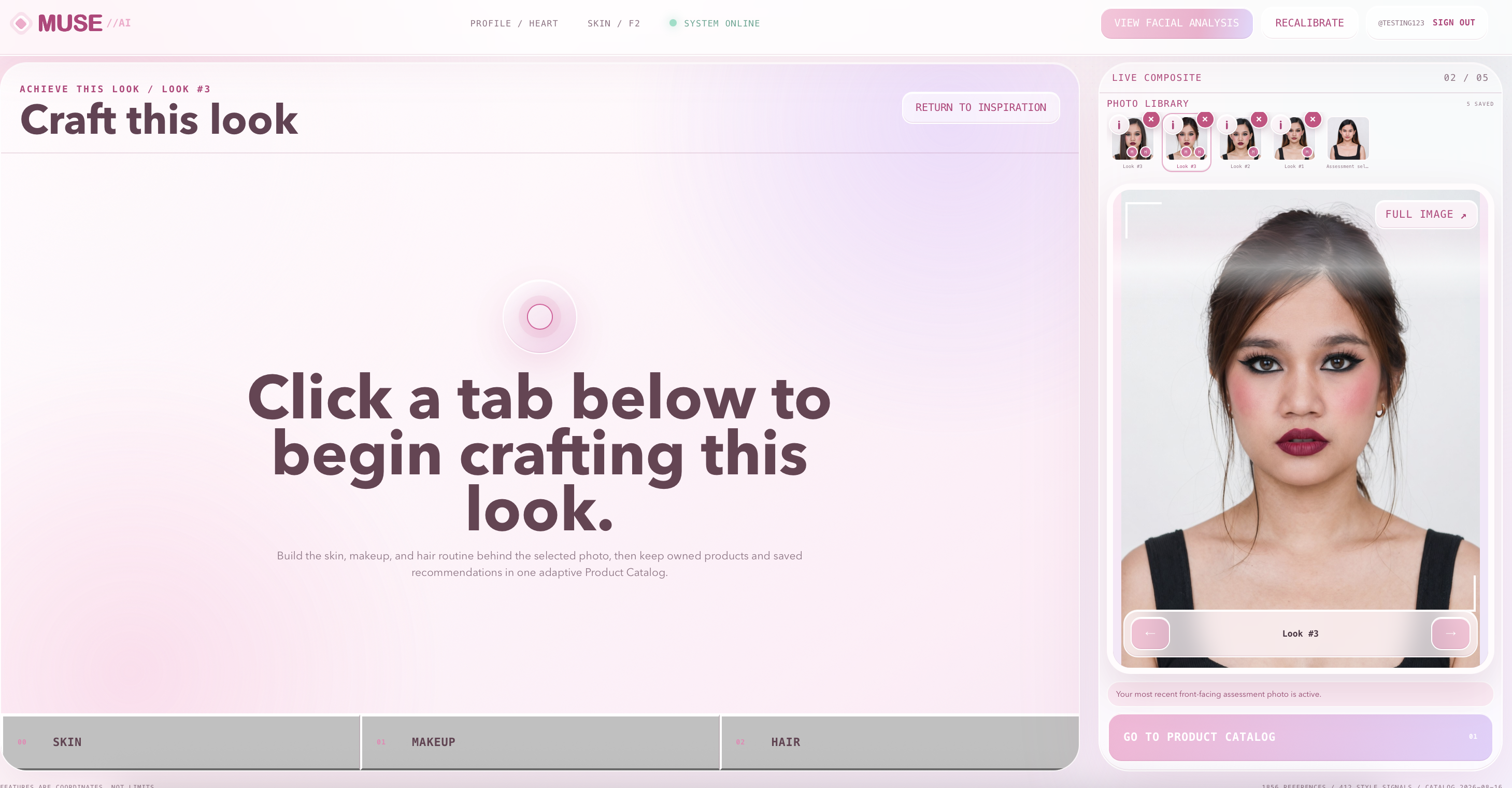
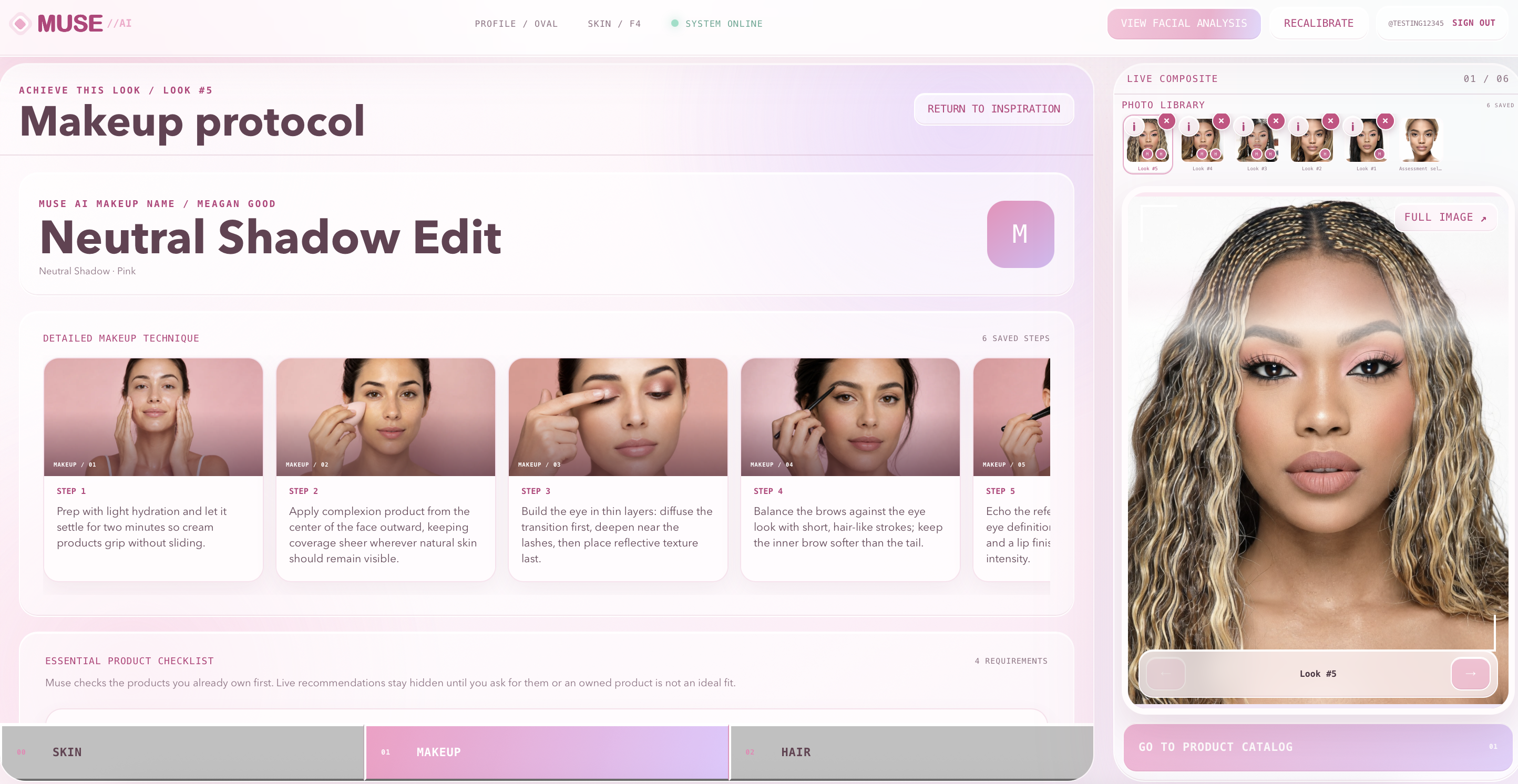
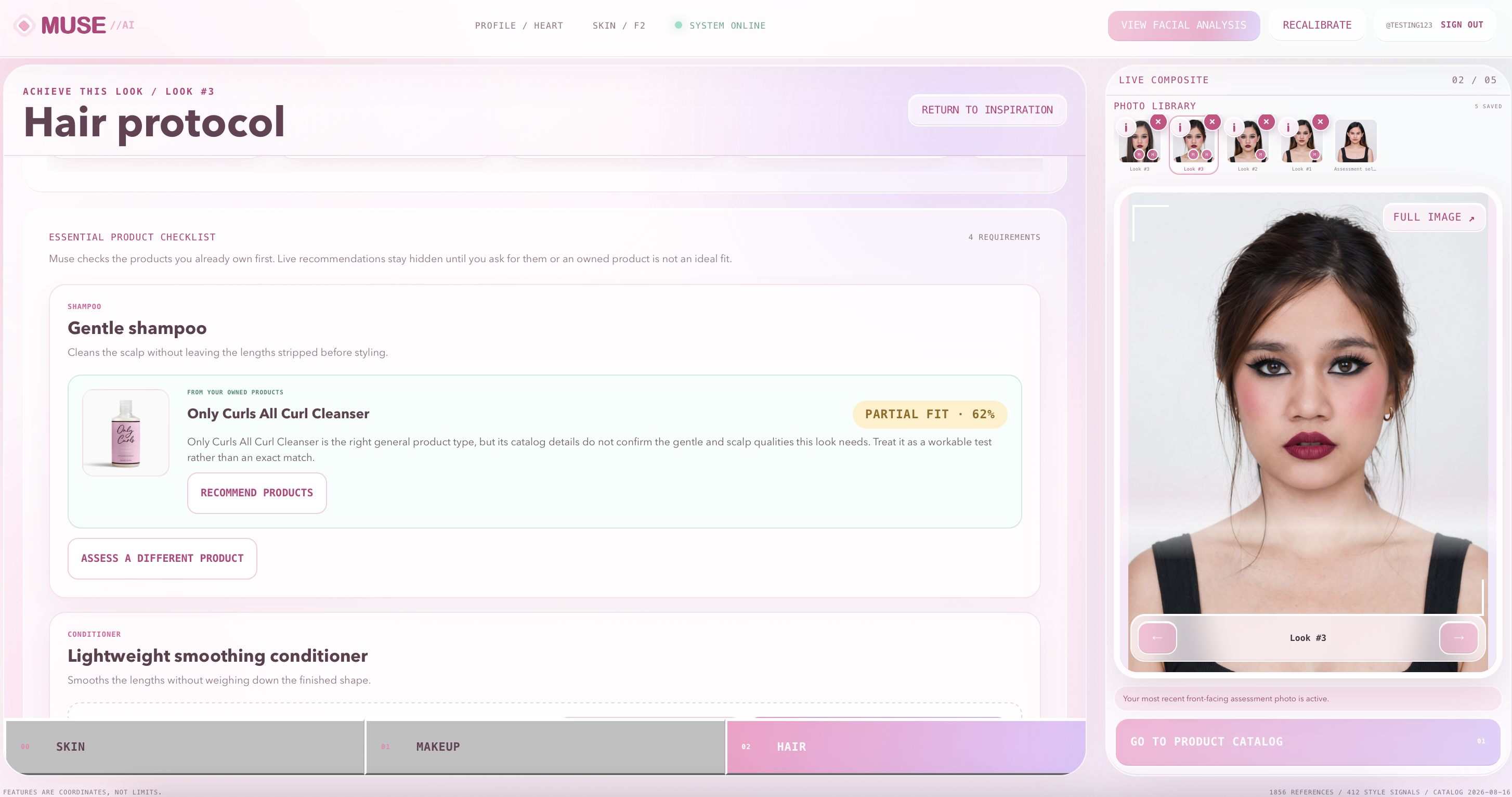
When a user finds a look they like, they click "Achieve this look" to find instructions and types of products needed to bring it to life.
-
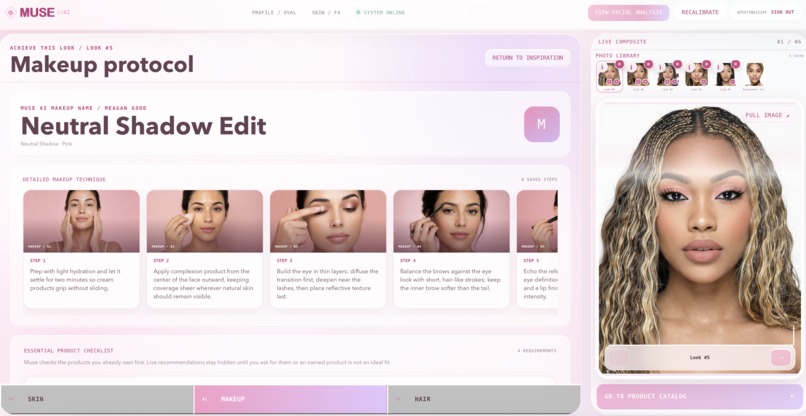
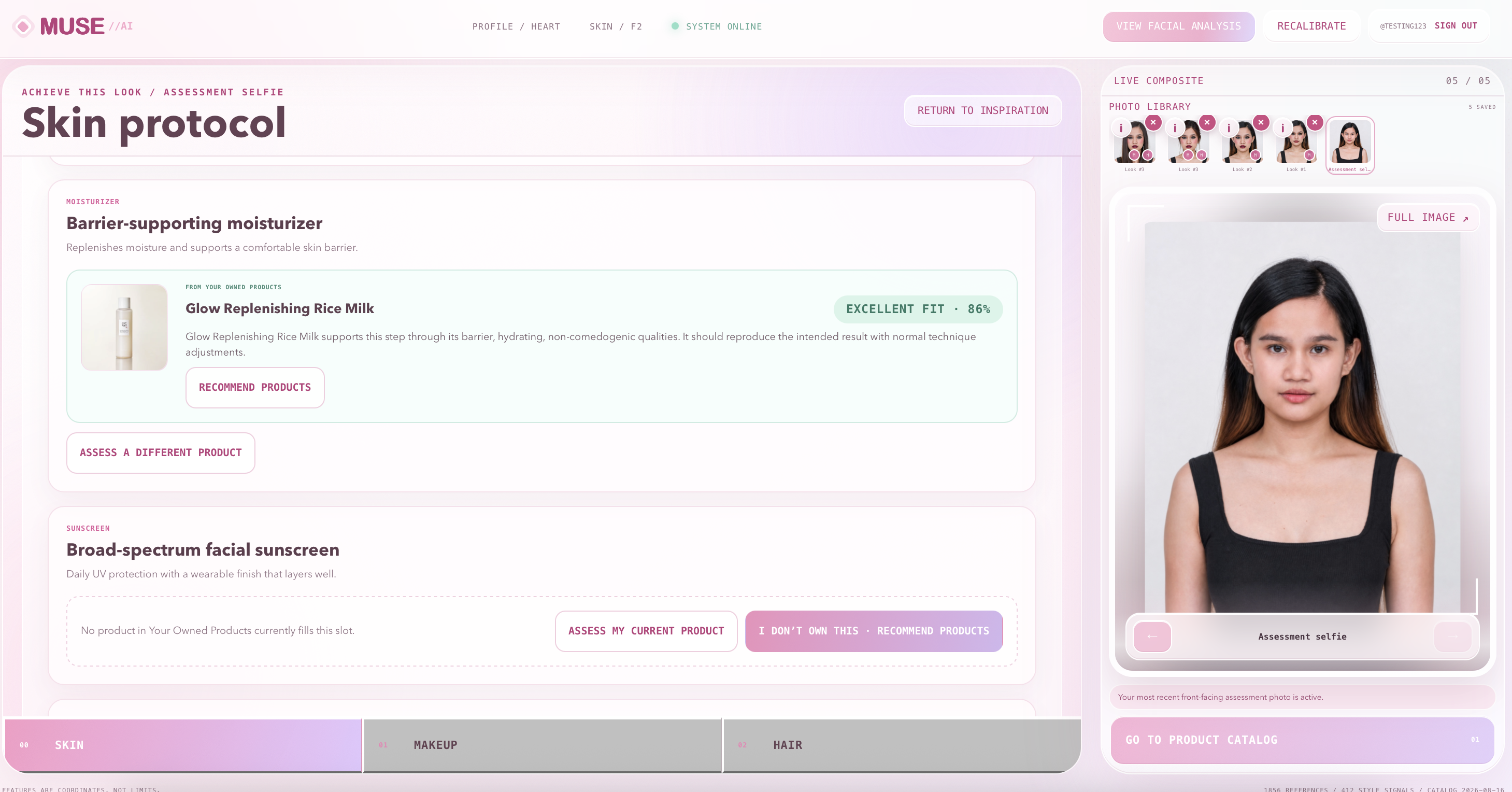
Makeup/hair instructions and products change depending on the look. Skin care recommendations stay the same unless a new selfie is shared.
-
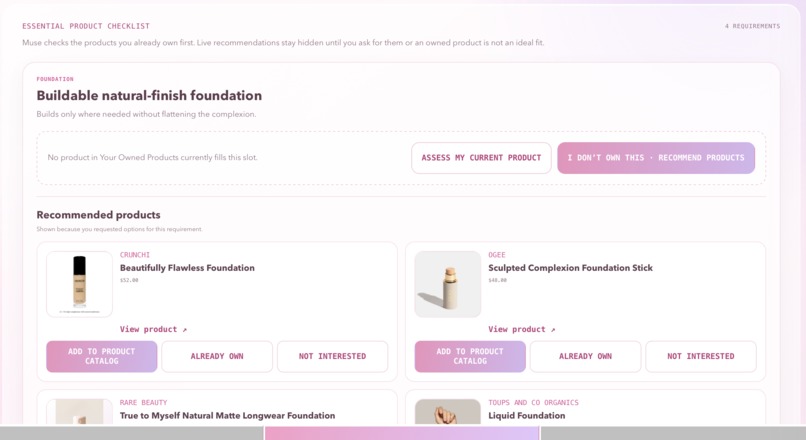
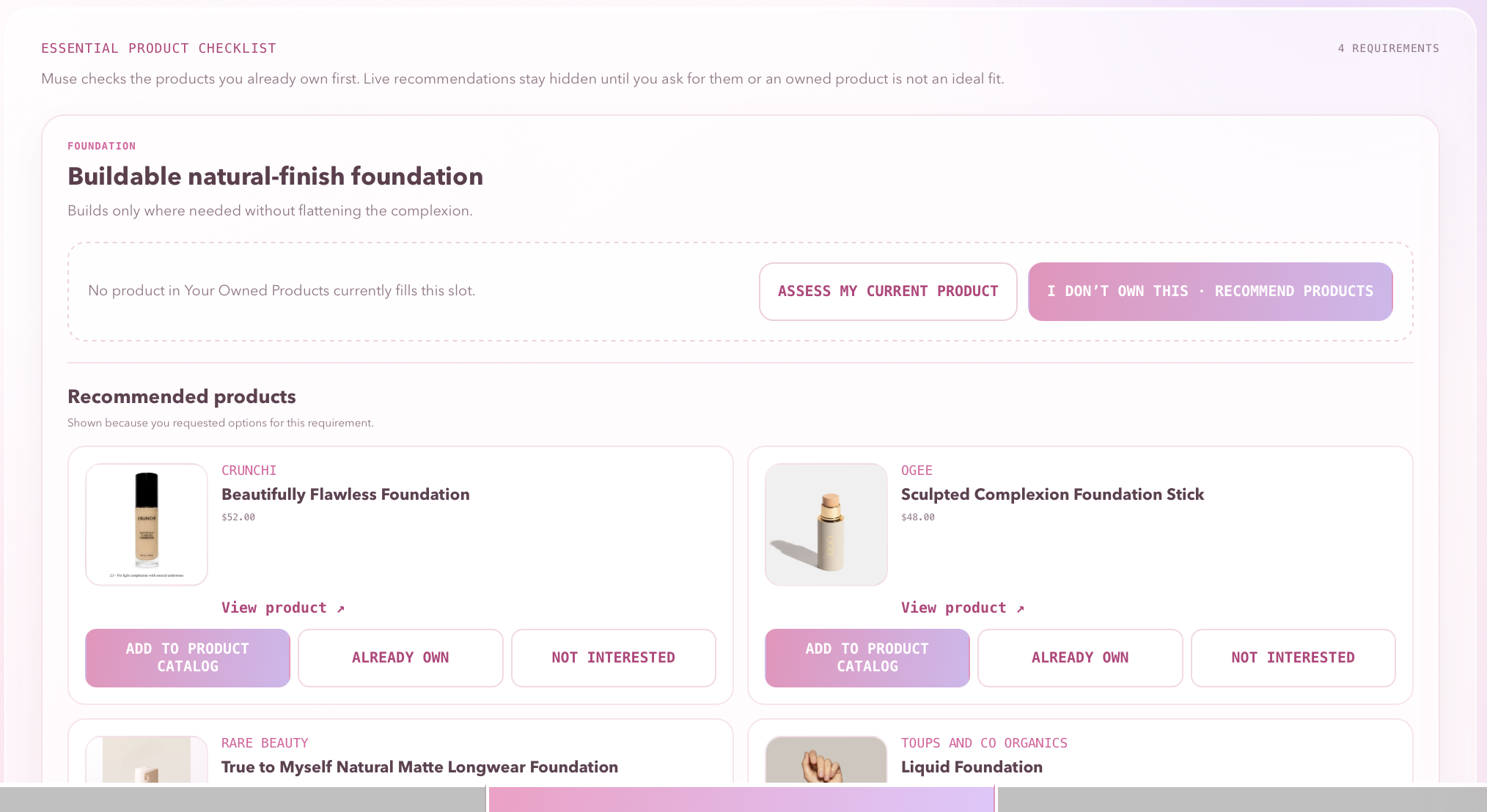
Users can check to see if a skincare/makeup/hair product they already own fits a look's requirements; or they can receive recommendations.
-
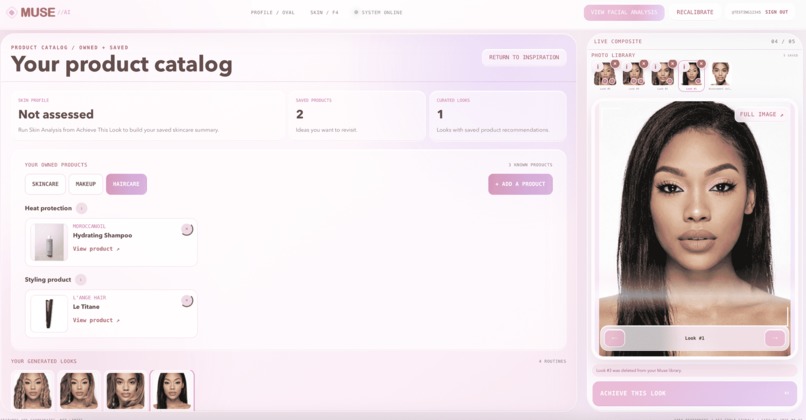
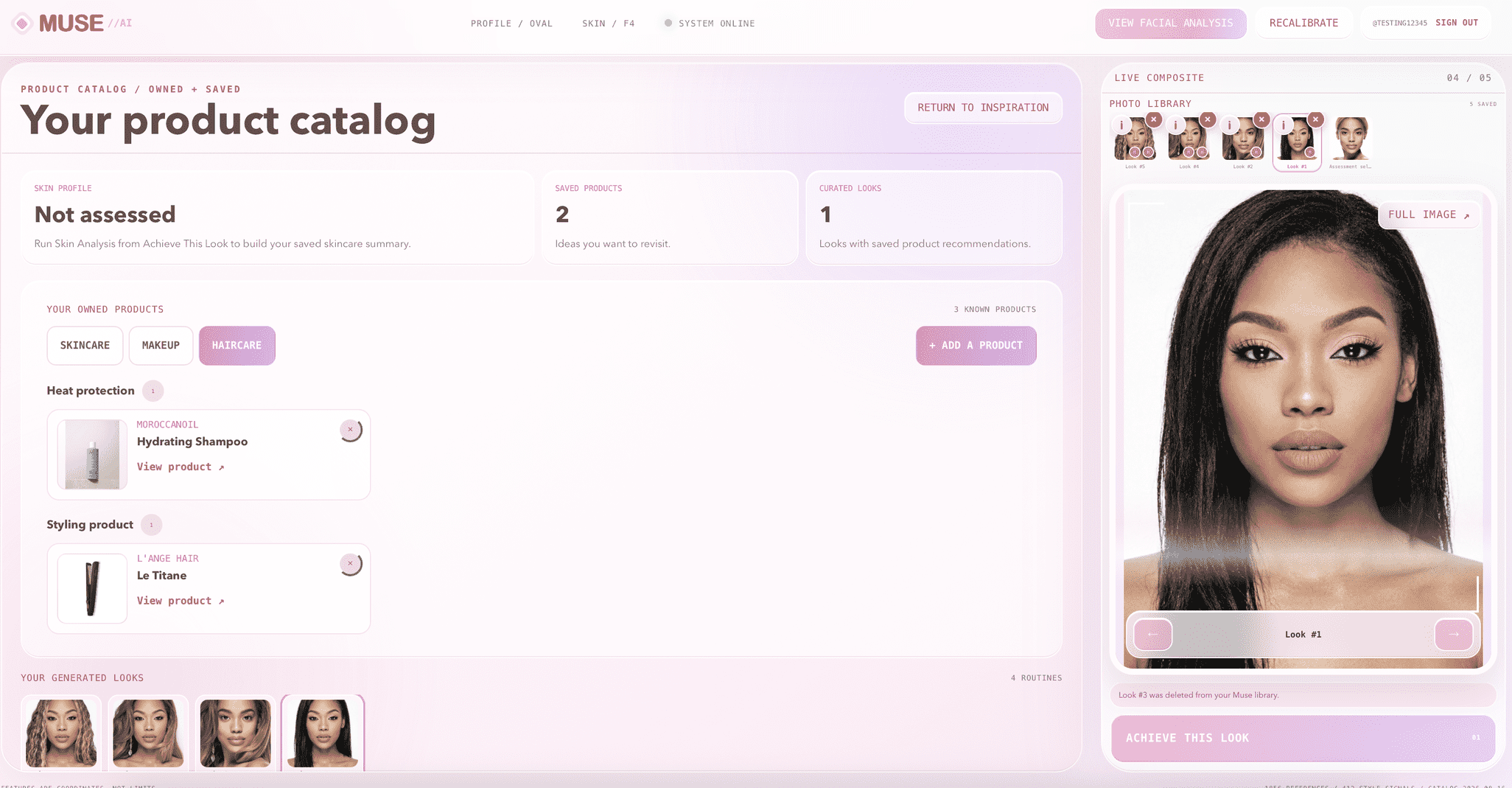
On the product catalog page, a user can edit/add products they already own, and view product recommendations to help achieve future looks.
-
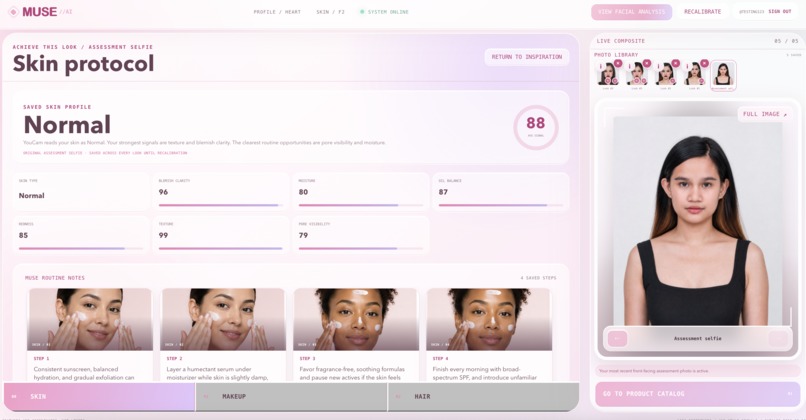
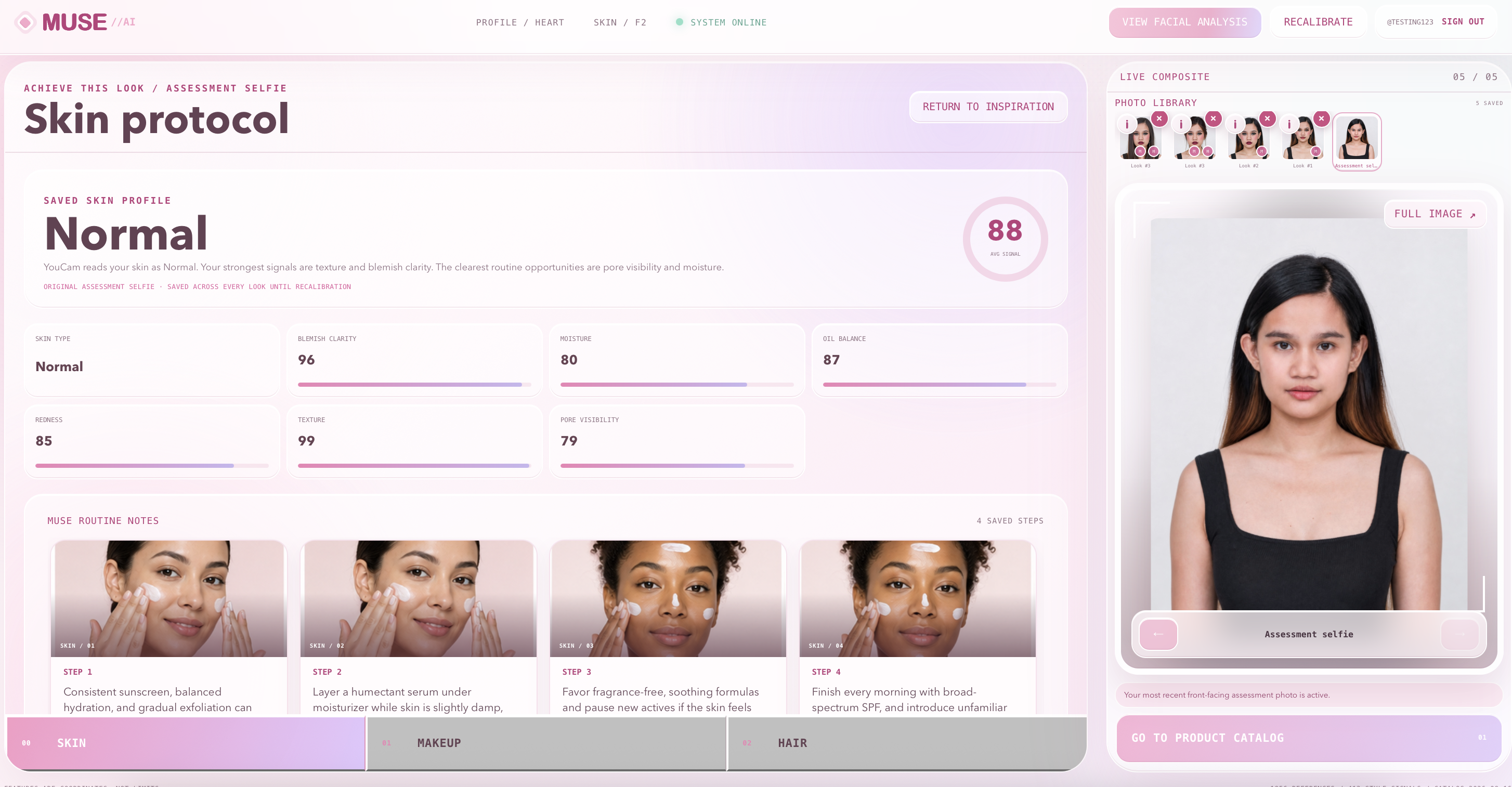
The skin care assessment provides a detailed analysis of the user's skin concerns and recommends a routine and list of products.
-
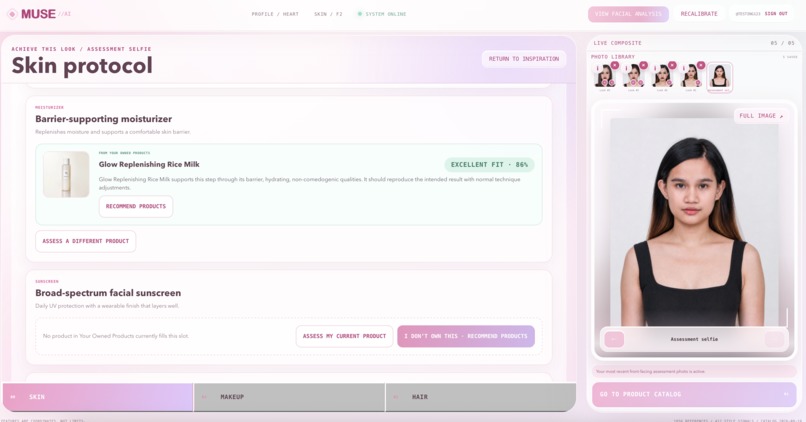
Beneath the skin care assessment and routine, the user can view product recommendations, comparing what they already have to what they need.
-
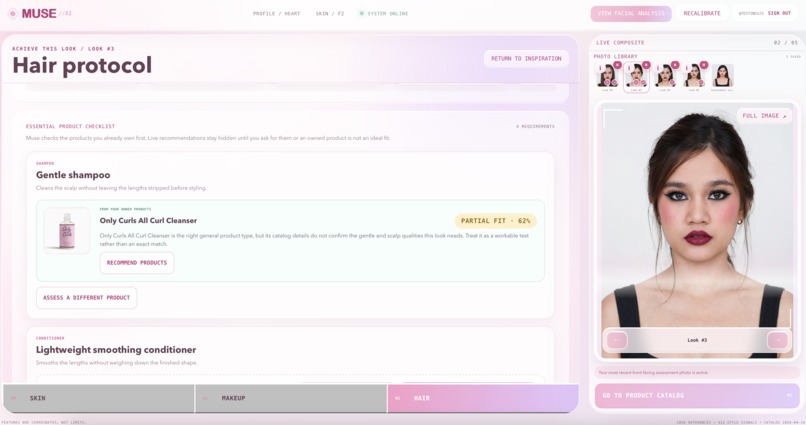
Not all already owned products might fit a particular look/ style - Muse explains why a product might not work and shares recommendations.

Inspiration
Muse was inspired by a familiar piece of beauty advice: instead obsessing over trends that constantly change and cater to specific features, look to people who share your coloring, facial structure, or hair characteristics and learn from the styling choices that flatter them.
Platforms such as Pinterest are excellent for discovering beautiful images, but they rarely explain whether a look will translate well to a particular person. Users are left to sort through thousands of references without knowing which colors, makeup placements, or hairstyles might complement their own features.
Muse transforms beauty inspiration from passive browsing into personalized experimentation.
Muse is not an attractiveness score, and its goal is not to make users look like celebrities. It helps users find relevant references, borrow techniques, experiment safely, and better appreciate their own features.
What it does
Muse turns a guided selfie into a personalized beauty-inspiration workspace.
YouCam’s AI Fitzpatrick Skin Type Analysis, AI Facial Color Tones Analyzer, and AI Face Attributes & Ratio Analyzer create a structured profile of the user’s coloring and facial features.
Muse evaluates characteristics including:
- Face shape
- Eye shape, size, angle, spacing, and eyelid type
- Eyebrow shape, thickness, spacing, and length
- Lip shape
- Nose width and length
- Cheekbone structure
- Skin tone
- Hair color
- Eye color
- Fitzpatrick skin type
A weighted matching system compares this profile against a curated catalog of 103 celebrities and creators. Detailed facial structure is the primary matching signal, while coloring, skin-tone neighborhoods, and user-provided representation context help prevent implausible recommendations.
The five closest matches become an interactive, Pinterest-inspired Muse Board containing curated editorial, hair, and makeup references. The full catalog currently includes:
- 103 curated muses
- 1,856 unique reference images
- 412 hair and makeup looks
Users can filter the board by muse or styling characteristics, select any inspiration image, and virtually apply its associated makeup or hairstyle to their own selfie through YouCam.
Muse also allows users to:
- Layer compatible hair and makeup transformations
- Preserve every generated result in a private photo library
- See which references were used to create each result
- Return to the same profile and matches across devices
- Recalibrate only when they want to submit a new assessment
- Receive a YouCam skin assessment based on the untouched original selfie
- Turn a generated result into a visual, step-by-step tutorial
- Compare products they already own against the needs of a look
- Save relevant products in a persistent Product Catalog
- Search live products and open independent Shopify merchant pages
The two public sample boards are read-only, allowing judges to explore completed Muse experiences without creating an account or consuming YouCam credits.
How we built it
Muse is built with Next.js 16 and React 19 and deployed on Vercel.
YouCam APIs power the central experience:
- AI Fitzpatrick Skin Type Analysis classifies the original assessment selfie.
- AI Facial Color Tones Analyzer identifies skin, eye, lip, eyebrow, and hair colors.
- AI Face Attributes & Ratio Analyzer returns detailed structural information about the face.
- AI Skin Analysis V2.1 generates a persistent skin profile from a dedicated close crop of the original selfie.
- AI Hair Style Virtual Try-On V2.1 applies selected hairstyle references.
- AI Makeup Transfer applies curated makeup templates.
- AI Image Generator V2.0 rebuilds standardized transfer references when an editorial template is incompatible.
- YouCam Camera Kit provides framing, lighting, positioning, and face-detection guidance during browser capture.
I transformed a large collection of celebrity images and styling information into a normalized catalog. Every visible inspiration image is connected to structured metadata and, where applicable, an internal YouCam transfer template.
This allows users to select the most artistic or inspiring photograph while Muse privately resolves the technically appropriate template for that look.
The matching engine normalizes YouCam’s categorical outputs and calculates weighted similarity across detailed facial features, color distance, Fitzpatrick neighborhoods, hair information, and representation context. The result is deterministic and explainable rather than being generated randomly.
The supporting architecture includes:
- Better Auth for username-and-password accounts
- Neon Postgres for profiles, analyses, matches, generated-look provenance, and product interactions
- Vercel Blob for persistent selfie and result storage
- Vercel Workflow for long-running try-ons, polling, retries, and durable results
- Sharp for portrait preparation and API-compatible image processing
- Shopify Global Catalog for product search and merchant links
The YouCam API key remains server-side and is never exposed to the browser.
View the Muse source code on GitHub
Challenges we ran into
One challenge was turning several independent AI endpoints into one coherent product experience.
Different YouCam APIs have different requirements for image dimensions, face size, head angle, lighting, cropping, and file preparation. A photograph could pass camera guidance but still be rejected by a later detector. I developed portrait preparation, advisory quality feedback, readable error messages, and recalibration tools so users could understand what happened instead of receiving an unexplained API error.
By far the most challenging aspect was collecting, categorizing, and filtering the celebrity data. The vast majority of the project time was spent finding suitable photos, manually analyzing celebrity features so that they can be compared to a user's analysis, covering a diverse range of features/styles, and categorizing looks so that their similarities could make the user experience more accessible. If Muse were to be adopted at a larger scale (which would be amazing!), this process would absolutely require the most energy and precision. Originally I had chosen 200 celebrities to create the database - and quickly halved this amount when I realized how time consuming the database construction was becoming.
Editorial celebrity photographs created another challenge. They are visually compelling, but they are not always suitable transfer templates. I built a reusable template-rebuilding system that can standardize incompatible references and cache the result for future users.
I also learned that a technically completed AI image is not necessarily a correct image. During development, a whole-image makeup fallback could unintentionally alter an existing hairstyle. I changed the workflow so makeup must preserve the selected source portrait and hairstyle. If the transfer cannot do that safely, Muse stops instead of saving a misleading result.
Other challenges included:
- Cleaning and joining large spreadsheet datasets
- Maintaining accurate feature labels across 103 muses
- Preventing data from appearing in the wrong user account
- Preserving matches, analyses, and generated looks across devices
- Maintaining the original proportions of differently sized reference images
- Rendering a large overlapping collage without making the interface slow
- Layering hair and makeup while preserving the provenance of each branch
- Creating recommendations that were both structurally relevant and representative
- Handling API timeouts, credit limits, template failures, and inconsistent error formats
Recommendation quality required particular care. Pure visual similarity was not enough. I added skin-tone neighborhoods and meaningful representation context while ensuring that detailed facial measurements remained the primary matching signals.
Accomplishments that we're proud of
I am proud that Muse became a complete consumer experience rather than a collection of disconnected API demonstrations.
A user can move from guided capture to facial analysis, receive explainable celebrity matches, browse a personalized visual world, experiment with virtual hair and makeup, layer transformations, examine the provenance of each result, learn how to recreate it, and save relevant products—all within one connected system.
I think the complete user experience is really cool and addresses the problem I aimed to solve. Users can see appreciate the unique features they share with beauty icons, and view high-quality renderings of their face combined with expertly styled hair and makeup combinations, all thanks to YouCam's incredible technology. I loved experimenting with the technology on myself, and even purchased more credits with my own money to explore makeup and hairstyles I have never tried before.
I am especially proud of:
- The detailed facial-feature matching model
- The interactive, overlapping Muse Board
- The persistent branching photo library
- The reusable transfer-template pipeline
- The ability to combine compatible makeup and hairstyles
- The preservation of every result’s source and styling references
- The skin assessment remaining tied to the untouched original selfie
- The visual technique tutorials
- The owned-product assessment and Product Catalog
- The public, read-only sample experiences
- The polished single-screen interface
Most importantly, Muse uses celebrity inspiration without presenting celebrities as standards users must become. The experience encourages users to borrow techniques while retaining their own identity.
What we learned
I learned that integrating an AI API is as much an experience-design challenge as it is a technical challenge.
Users need to understand:
- What the system detected
- Why a photograph was rejected
- Which selfie is currently active
- Which attributes a transformation will change
- How long an operation may take
- Whether a result was saved
- Which references produced a generated image
I also learned that curated data remains incredibly valuable alongside generative AI. The quality of Muse’s recommendations depends on thoughtful feature labeling, image selection, reference preparation, and consistent metadata—not simply on calling a model.
Building the try-on pipeline taught me to distinguish between a completed image and a correct image. A successful API response is not useful if it changes attributes the user expected to preserve. Reliable AI products need explicit constraints, provenance, transparent failure states, and the willingness to stop instead of returning a misleading result.
Finally, I learned that personalization must include representation. Users are more likely to trust a recommendation system when its results feel visually and culturally plausible while remaining grounded in explainable feature overlap.
What's next for Muse
Next, I want to greatly expand the celebrity database with more celebrities and looks, and sharpen the accuracy of recommendations by thoroughly reviewing the analysis of celebrity features. I would also like to make the product recommendation engine more robust and potentially profitable via products bought through the website's recommendation. I also created very clear user behavior tracking and feedback so that an ML recommendation model could be built out to more accurately tailor product recommendations.
I plan to develop a learning-to-rank model using privacy-conscious interaction signals such as:
- Saved and rejected looks
- Frequently selected muses
- Owned products
- Product-fit assessments
- Saved recommendations
- Product ratings
- Styling preferences
This would allow Muse to learn not only which people resemble a user, but which techniques, products, and styling directions they genuinely prefer over time.
I also want to expand the Product Catalog into a true shopping agent that compares relevant products across merchants, budgets, ingredients, shades, availability, and user preferences.
Additional goals include:
- Stronger mobile capture and photo-quality validation
- More reliable transformation-template generation
- Additional visual tutorial assets
- Improved product-fit analysis
- Stylist, creator, and retailer partnerships
- More user control over recommendation weighting
- Clearer explanations for every match
- Stronger privacy and account-management controls
- Professional testing across more devices, skin tones, and hair types
My long-term vision is for Muse to become a personal beauty operating system: a place where inspiration, experimentation, education, and shopping all begin with the user’s own features.
Built With
- better-auth
- neon-postgres
- next.js
- python
- react
- sharp
- shopify-global-catalog
- typescript
- vercel
- vercel-blob
- vercel-workflow
- youcam-api

Log in or sign up for Devpost to join the conversation.