-
-
Game Page
Inspiration
Reddit's brief for this hackathon was blunt about what it didn't want: reskinned space shooters, trivia apps, obvious AI-slop templates, and games that are "Reddit-y" only because they're literally about karma or Snoo. That constraint became the actual inspiration — we wanted a mechanic that couldn't have been built by just reskinning a common genre. We landed on the tension between confidence and memory: you think you remember the track, and the only way to find out is to watch a car drive exactly what you drew, with zero forgiveness.
What it does
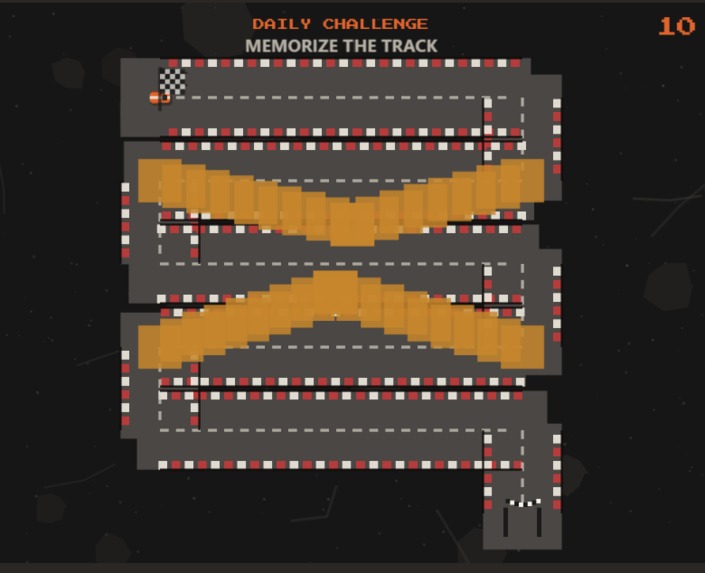
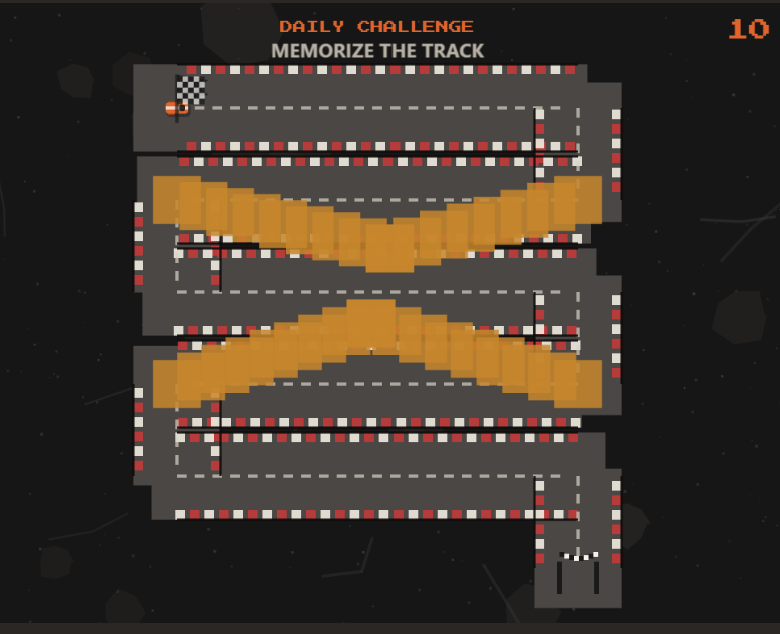
Every day, everyone on the post gets the same track. It's revealed for a few seconds — memorize it — then it fades to just a start flag and a finish gate. You draw your best-guess path freehand from memory. Then the track reappears and a car drives exactly the path you drew, no smoothing, no auto-correction. Crash into a wall or fall short of the gate and that run's over; make it and your score depends on how closely you tracked the true centerline, how close you cut it to a wall without crossing, and whether you correctly remembered either of the two fog-of-war "bonus route" forks. There's a real Redis-backed leaderboard, a personal streak for playing daily, and an opt-in button to share your run as an actual Reddit comment on the post, so the comments become a running record of who remembered right.
How we built it
Devvit Web (Reddit's official developer platform) end to end, with Phaser driving the client-side rendering and interaction — real-time freehand path capture during the draw phase, then a scripted playback that replays the recorded path with velocity-based rotation and a live pass/fail evaluation against the track geometry. The server is Hono, using Devvit's built-in Redis for player state, streaks, and a genuine sorted-set leaderboard, and Devvit's Reddit API for the comment-sharing feature. Track generation is a deterministic seeded algorithm so every player gets the pixel-identical daily track without any server round-trip. No external services, no paid APIs, no CDNs — even the fonts are self-hosted.
Challenges we ran into
The concept went through several complete pivots before landing here — we started with a life-sim, then a shape-tracing game, then a live-steering maze racer — before arriving at the memorize-and-draw mechanic, and each pivot meant rethinking the core interaction while trying to keep the reusable parts (leaderboard, streak logic, rendering pipeline) intact. On the platform side, we hit a few undocumented walls: posting a comment "as the user" needs an explicit permissions.reddit.asUser grant in devvit.json that only surfaces as a runtime error if you don't know to add it up front; Devvit's media upload API requires an already-publicly-hosted URL rather than accepting a client-rendered image directly, which ruled out a visual screenshot-based share and pushed us toward a text-based one instead; and we learned the hard way that an existing Reddit post's title and cached splash content can't be edited after creation, so renaming the app mid-hackathon meant creating a fresh post rather than patching the old one.
Accomplishments that we're proud of
A core loop we're confident is genuinely novel on the platform — not a shape tracer, not a steering game, but a pure "trust your memory, then face the replay" mechanic. All three sub-challenge categories are earned through real mechanics rather than bolted on: Phaser genuinely drives the physics-style playback, retention comes from an actual shared daily challenge with streaks, and user contributions come from a real opt-in comment-sharing feature, not a gimmick. And it's all running on zero external cost — Devvit's own Redis and Reddit APIs, nothing else.
What we learned
How much a good "hook" depends on the gap between confidence and accuracy rather than raw difficulty — the fun isn't the drawing, it's the moment the replay proves you wrong. I also learned a lot about Devvit Web's real capabilities and boundaries around permissions, media handling, and post lifecycle that aren't obvious from the docs alone. And I learned the value of pivoting hard on the mechanic before investing in polish — several early full-concept changes saved us from over-polishing an idea with a shallow long-term hook.
What's next for Muscle Memory
Multiple daily difficulty tiers instead of one fixed track, letting players design and submit their own tracks for others to memorize (pushing the user-generated-content angle further), visual replay sharing if a lightweight image-hosting path becomes available in Devvit's ecosystem, and richer streak rewards with weekly/monthly leaderboard resets.


Log in or sign up for Devpost to join the conversation.