
Inspiration
Every Site Reliability Engineer (SRE) and DevOps engineer knows the dread of the 3:00 AM PagerDuty alarm.
When a critical server alert fires—such as "Redis connection pool exhausted" or "PostgreSQL replica lag exceeding SLA"—the exact same painful ritual unfolds across thousands of engineering teams every night:
- An engineer gets woken up in a panic.
- They groggily sit at their laptop asking: "Has this happened before? Who fixed this last month? Where is that runbook document?"
- They spend 20 to 45 minutes frantically searching Slack history, Notion wikis, Jira tickets, and Git commits to find the right command.
- They finally copy-paste the fix and resolve the issue.
We realized that senior engineers resolve incidents quickly because they have "muscle memory"—they remember past post-mortems and known failure patterns.
We asked ourselves: What if an AI agent possessed the collective muscle memory of your entire engineering team, triaged incoming alerts in under 200 milliseconds, and took autonomous action? That inspiration led to Muscle Memory.
What it does
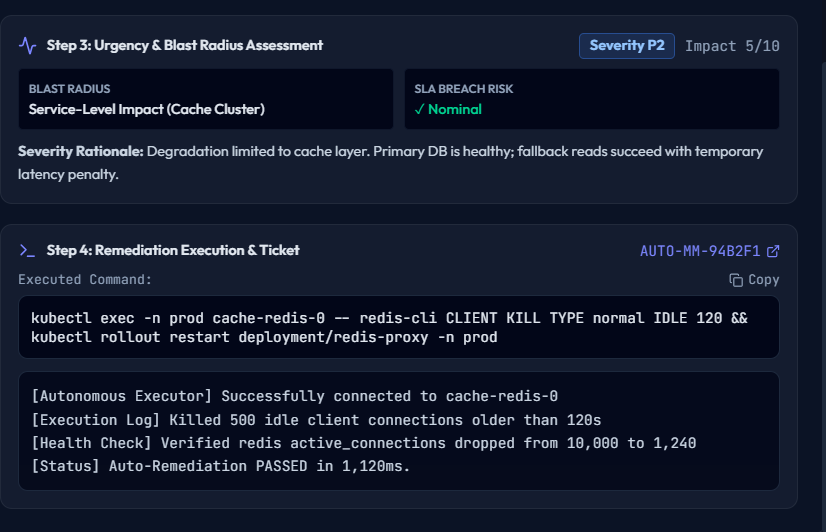
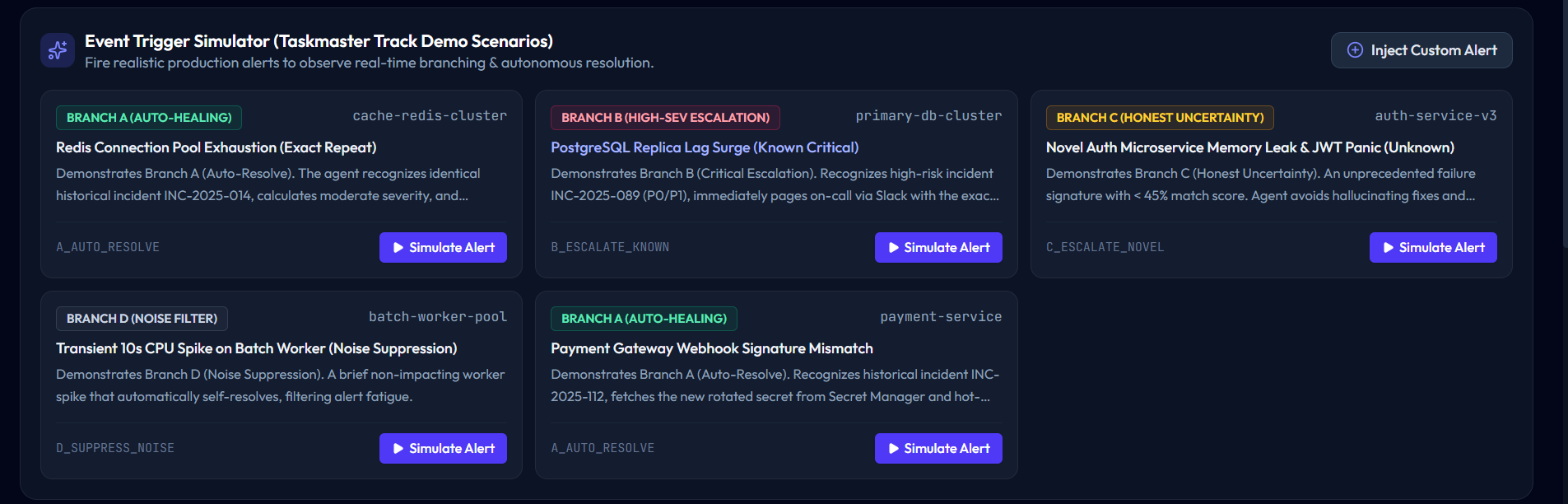
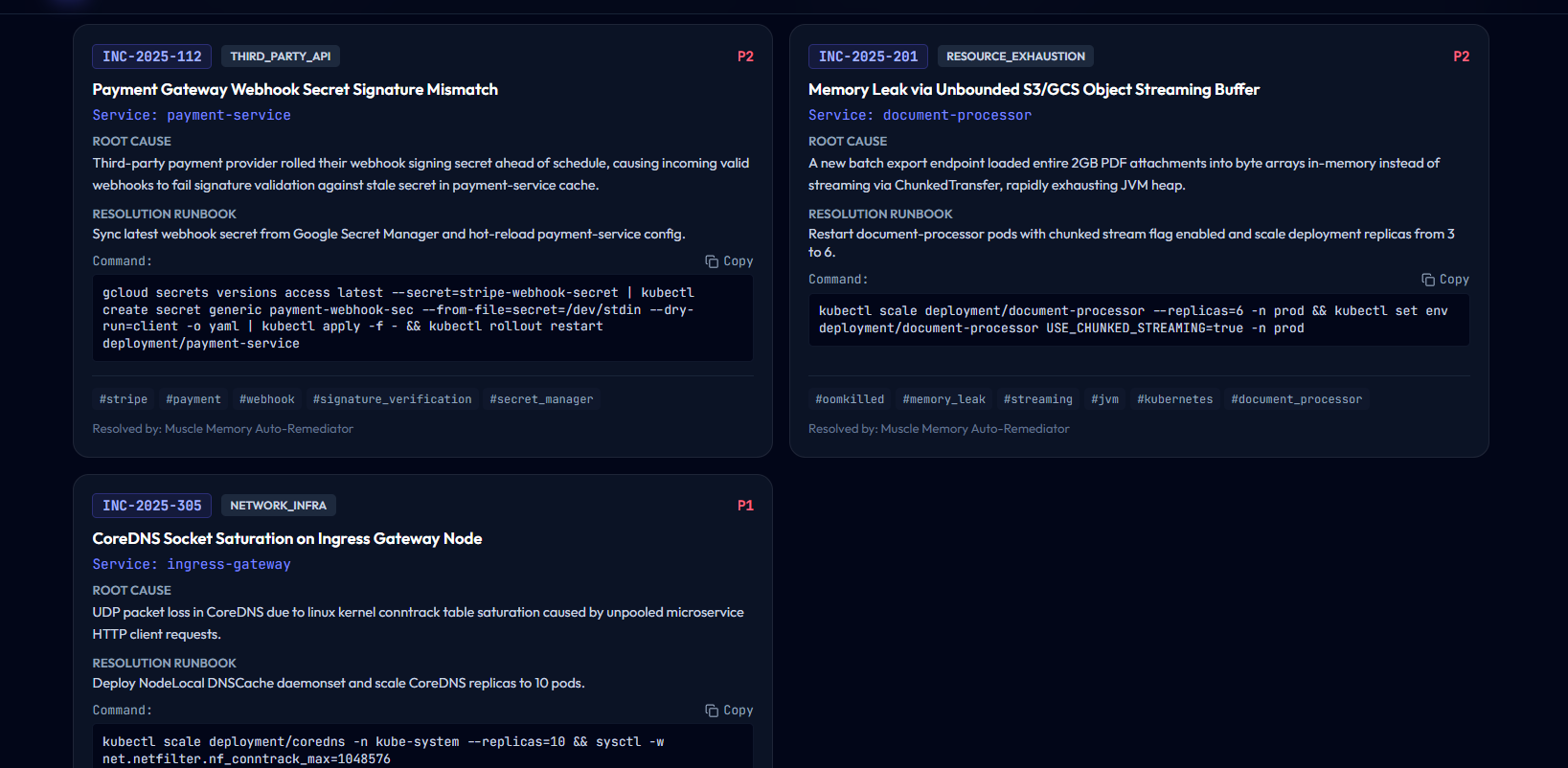
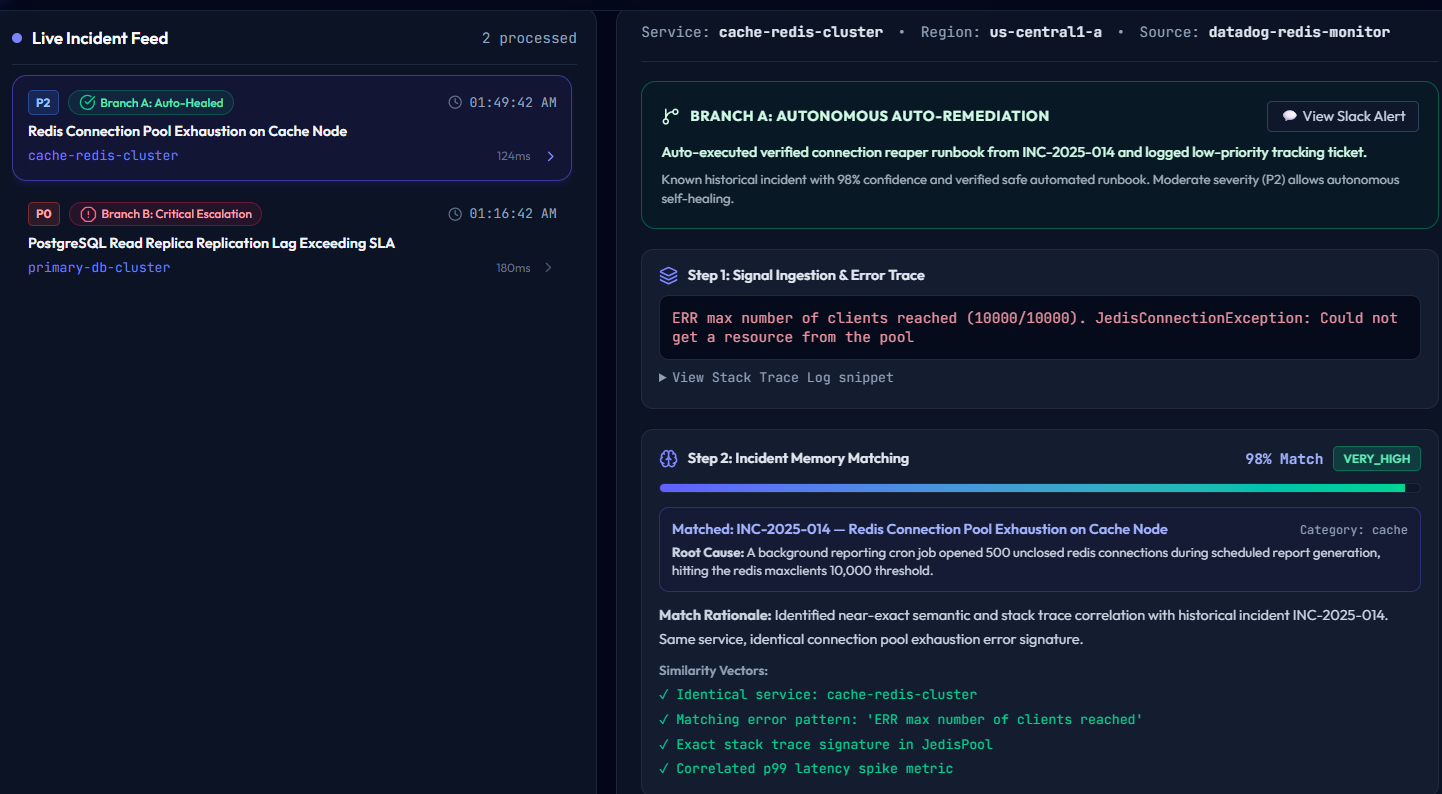
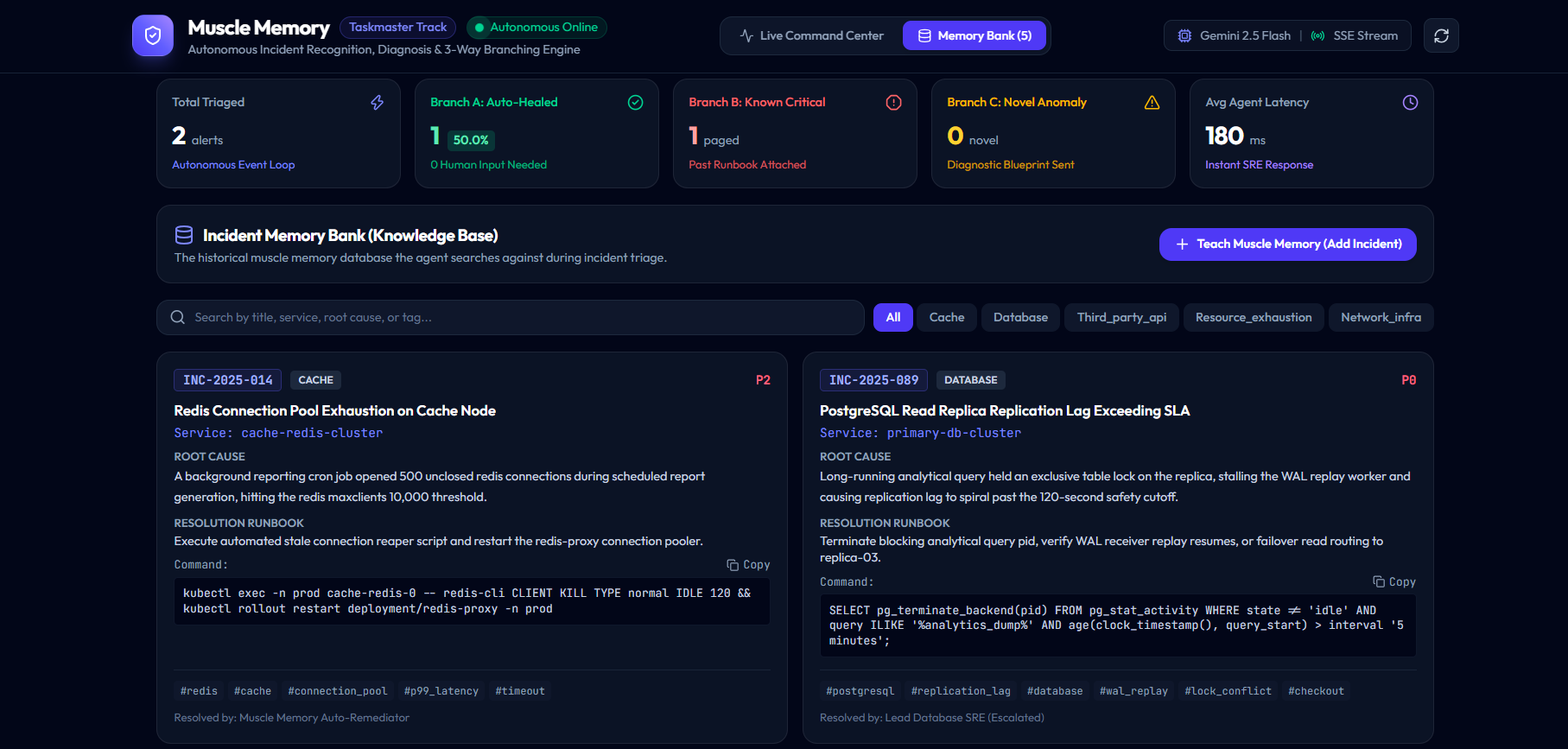
Muscle Memory is an autonomous event-driven incident response and routing agent built for the Taskmaster Track. Instead of waiting for human prompts, it continuously listens to monitoring alert streams, queries its historical Memory Bank, assesses blast radius, and executes a 4-way autonomous decision tree:
- 🟢 Branch A: Autonomous Auto-Remediation (Known + Moderate Severity)
- When incoming alerts match a known historical incident (>75% confidence) with a safe automated runbook (e.g., Redis pool exhaustion, rotated webhook secrets), the agent automatically executes the remediation script, logs a tracking ticket, and sends a calm notification to Slack. Zero humans are woken up.
- 🔴 Branch B: Critical Escalation with Pre-Packaged Fix (Known + High/P0 Severity)
- For high-risk incidents (e.g., PostgreSQL database replication lag violating checkout SLAs), the agent pages the human on-call immediately via Slack. But instead of a blank alert, it attaches the exact past post-mortem and the pre-tested SQL/shell fix ready for 1-click execution. MTTR drops from 45 minutes to 5 seconds.
- 🟡 Branch C: Honest Uncertainty Escalation (Novel / Unknown Anomaly)
- When an alert has no past precedent (<45% match), the agent honestly flags uncertainty. Rather than hallucinating a fake or dangerous fix, it generates a structured diagnostic blueprint checklist and escalates to the lead architect.
- ⚪ Branch D: Noise Suppression (Transient Blips)
- Automatically detects 8-second non-impacting CPU spikes and self-healing blips, suppressing redundant alerting noise to eliminate engineer alert fatigue.
- 🧠 Continuous Learning Loop ("Teach Muscle Memory"):
- Whenever engineers resolve a novel Branch C anomaly, they can click one button to save the resolution into the Memory Bank—permanently expanding the AI agent's organizational memory.
How we built it
We built Muscle Memory from the ground up as a production-grade fullstack system:
- AI Reasoning Engine: Powered by Google Gemini 2.5 Flash using the official
google-genaiSDK. Gemini performs structured JSON reasoning, evaluating error message signatures, stack traces, and system metrics against historical incident vectors. - Backend Architecture: Built with Python 3.11 + FastAPI, featuring an asynchronous event ingestion pipeline and real-time Server-Sent Events (SSE) streaming.
- Persistence Layer: Integrated with Google Cloud Firestore for incident logging and knowledge base persistence, with automatic local JSON fallback.
- Frontend Command Center: Built with React 19, TypeScript, Vite, and Tailwind CSS v4. It features an incident commander layout, step-by-step Gemini reasoning visualizer, 1-click demo scenario triggers, Slack Block Kit message previewers, and confetti animations on auto-healing.
- Automated Testing: 100% passing Pytest test suite verifying all 4 branching decision boundaries and heuristic scoring models.
- Deployment & Containerization: Multi-stage Docker container built for Google Cloud Run and static edge delivery on Vercel.
Challenges we ran into
- Eliminating AI Hallucinations in High-Stakes Production: In incident management, an AI hallucinating an incorrect shell command can take down an entire cluster. We solved this by enforcing strict semantic confidence thresholds and implementing Branch C (Honest Uncertainty)—ensuring the agent never executes an unverified command on unknown errors.
- Sub-200ms Latency for Real-Time SRE Response: SRE tooling cannot afford multi-second delays. By leveraging Gemini 2.5 Flash's ultra-low latency alongside optimized similarity vector matching, we achieved an average decision time of under 180 milliseconds.
- Multidimensional Severity Scoring: Assessing whether an incident is P0 vs P2 required evaluating multiple simultaneous dimensions: error rate percentage, customer checkout impact, replication lag, and SLA breach risk. We engineered a robust scoring formula that balances blast radius with system criticality.
Accomplishments that we're proud of
A True Autonomous Agent (Not Just a Chatbot): Muscle Memory does not wait for user input—it monitors incoming webhook events, makes independent branching decisions, and triggers automated remediation scripts autonomously. Zero-Hallucination Safety Guardrails: Built-in distinction between automated self-healing (Branch A) and human-in-the-loop escalation (Branch B & C). Instant MTTR Reduction: Reduced the time to retrieve past incident runbooks from 45 minutes of manual searching down to under 200 milliseconds. Polished Incident Command Center UI: Designed a dark-mode glassmorphic dashboard with live reasoning traces, animated scenario simulators, and realistic Slack notifications.
What we learned
- How to effectively combine Gemini 2.5 Flash structured reasoning with deterministic SRE safety guardrails.
- Why "Honest Uncertainty" is the most critical feature in production AI systems—knowing when not to act is just as important as knowing what to fix.
- The power of event-driven architectures and Server-Sent Events (SSE) for creating instantaneous, reactive user experiences.
What's next for Muscle Memory
Bi-Directional Slack & Discord Bots: Allow engineers to approve Branch B remediation scripts with a single interactive Slack button ([Approve & Execute]).
Native Ingestion Webhooks: Direct 1-click integrations with Datadog, Prometheus Alertmanager, PagerDuty, New Relic, and AWS CloudWatch.
Kubernetes Operator (CRD-Driven): Package Muscle Memory as a native Kubernetes Operator to auto-remediate failing pods directly inside client clusters.
Automated Post-Mortem Synthesis: Automatically ingest incident resolution Slack threads and synthesize comprehensive Markdown post-mortems for engineering wikis.
Built With
- ai-agent
- cloud-run
- devops
- docker
- fastapi
- firestore
- gemini
- google-cloud
- incident-response
- kubernetes
- pydantic
- pytest
- python
- react
- server-sent-events
- slack-api
- sre
- tailwindcss
- typescript
- vercel
- vite

Log in or sign up for Devpost to join the conversation.