-
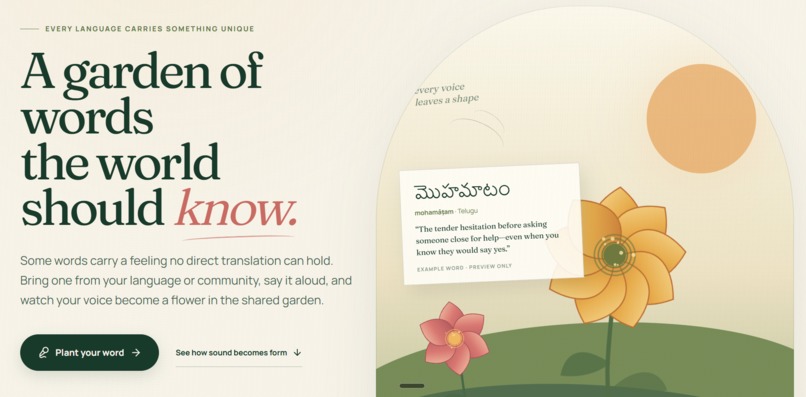
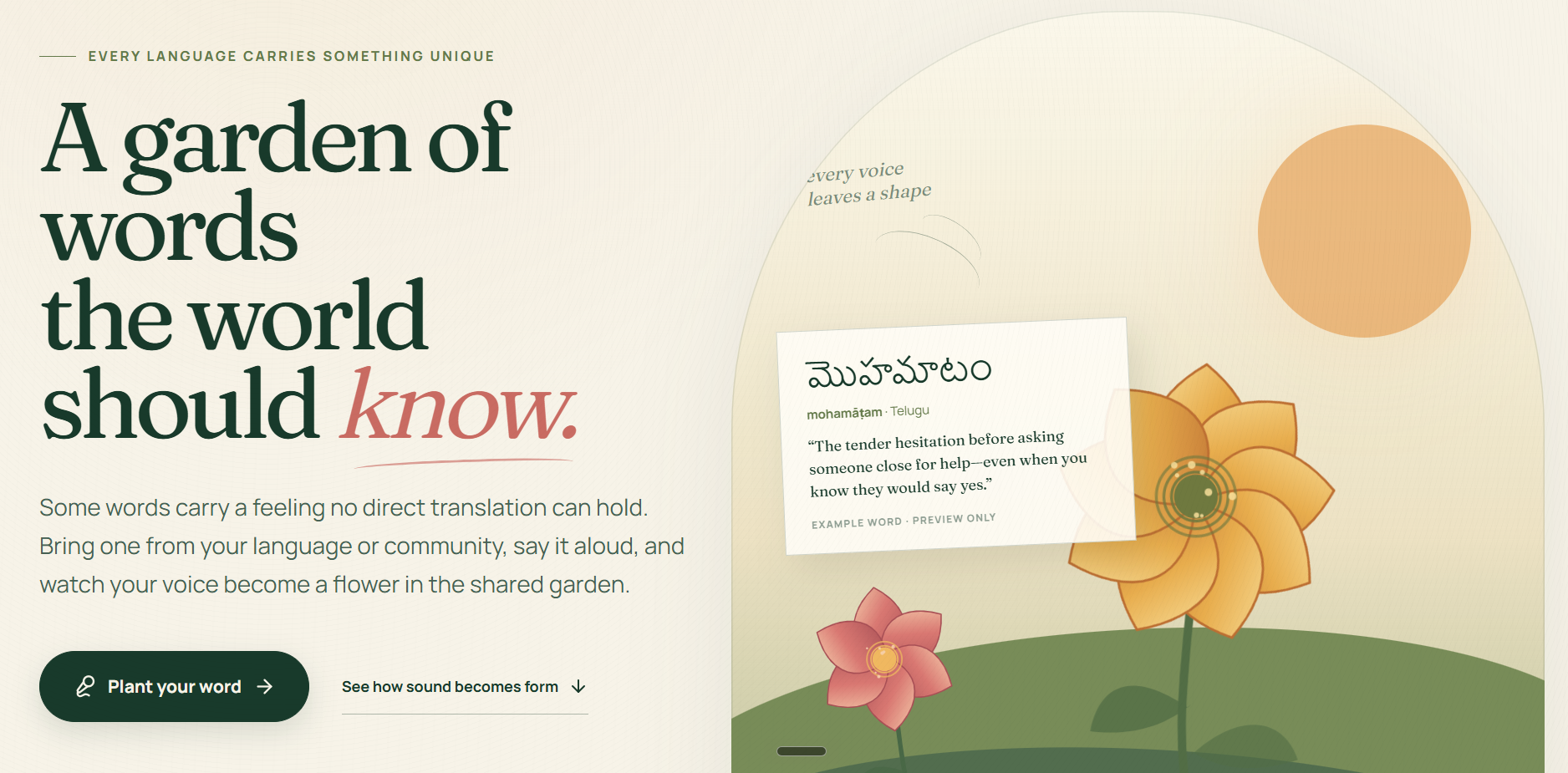
A spoken word becoming a flower in Murmur Garden
-
Section
Inspiration
A dictionary can translate a word, but it cannot always carry the life inside it. Some words hold a feeling, relationship, memory, or way of seeing the world that becomes smaller when reduced to a direct definition.
Murmur Garden began with a simple question: what if people could share not only a word, but also the personal meaning and human voice behind it? We wanted to create a place where language feels alive, where someone can offer a small part of their world and another person can pause, listen, and understand it.
What it does
Murmur Garden turns a meaningful spoken word into a unique flower.
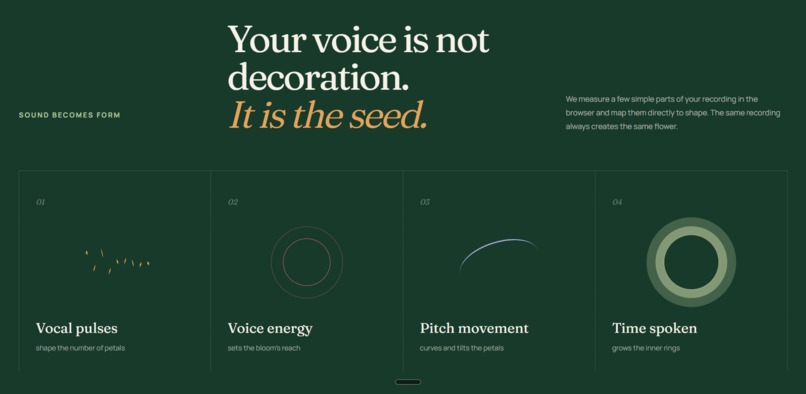
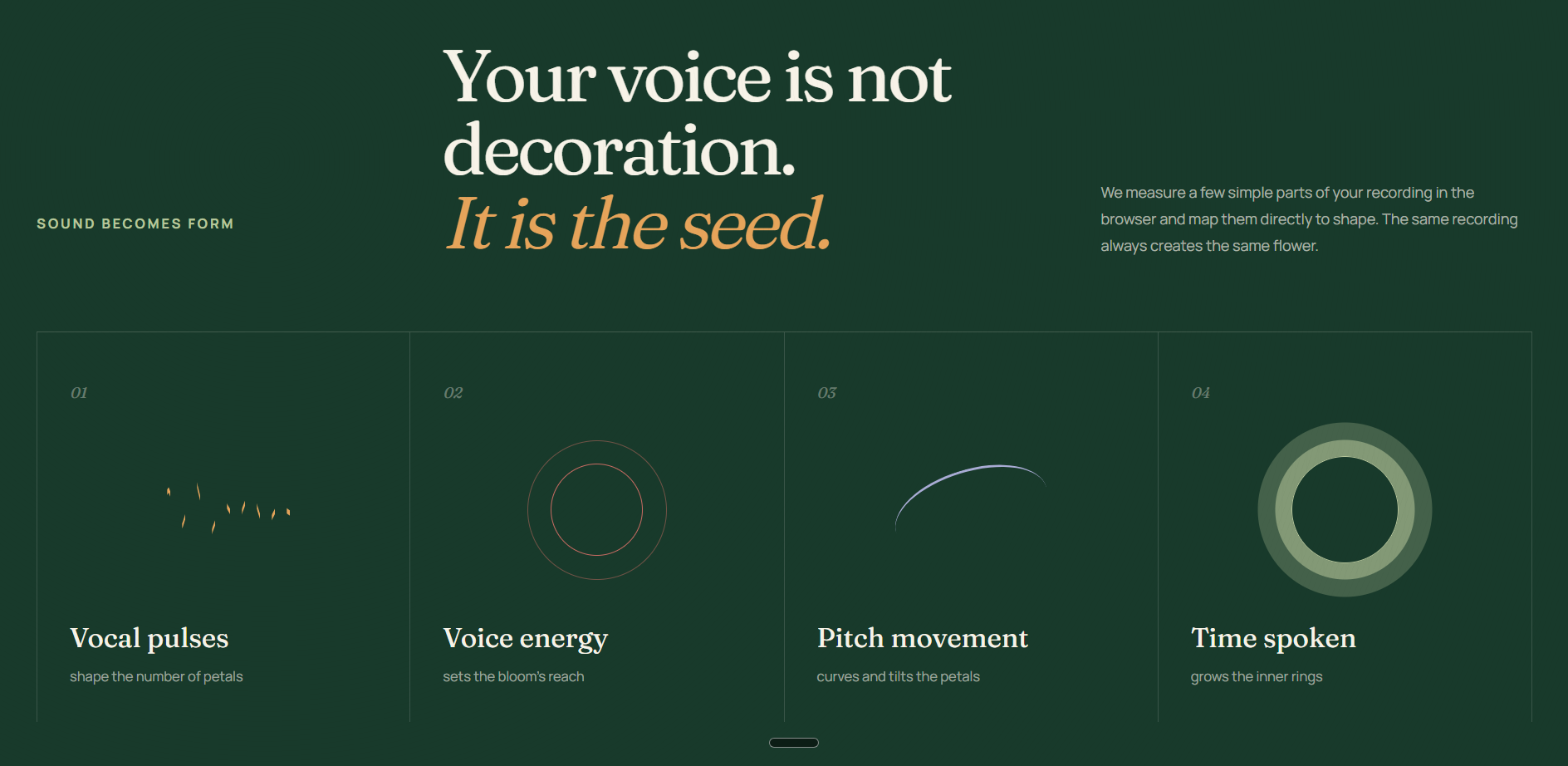
A visitor chooses a word from their language or community, explains what it means to them, and records themselves saying it. The application measures simple qualities in the recording, including vocal pulses, energy, pitch movement, brightness, and duration. These qualities shape the petals, size, curves, texture, and inner rings of the flower.
The word, its personal meaning, the voice recording, and the generated flower are then planted in a shared public garden. Other visitors can explore the flowers, hear the original voices, read the meanings, share individual words, and leave an echo when something connects with them.
The garden also changes as genuine contributions grow. Its landscape moves from Quiet Seed to First Murmurs and finally to Shared Chorus. No accounts, names, emails, or locations are required.
How we built it
We built Murmur Garden with Next.js, React, TypeScript, the Web Audio API, Supabase, and Reve.
Audio analysis happens in the browser. We extract a small set of measurable features from each recording and map them directly to a deterministic SVG flower. This means the same recording always creates the same flower. We do not use audio to guess a person's identity, personality, or emotions.
Supabase provides the live Postgres database, private audio storage, and realtime updates. Server routes validate every contribution before publishing it. Recordings remain private in storage and are played through short-lived signed links. Row level security, reporting, rate limits, and private deletion controls help protect the shared garden.
Reve was used to create and transform three connected botanical landscapes. These scenes represent the garden at different stages of real community growth. Reve shapes the world behind the flowers, while every foreground flower is generated directly from a person's voice.
Challenges we ran into
Our biggest challenge was making the idea understandable without explaining it to death. The experience needed to feel emotional and inviting, but a new visitor also had to understand the complete journey within seconds: bring a meaningful word, say it aloud, watch it bloom, and add it to the garden.
Recording audio in the browser also brought practical challenges. We had to handle microphone permissions, quiet recordings, different browser formats, the recording time limit, re-recording, playback, and reliable microphone cleanup.
Privacy and honesty shaped many decisions. We did not want to invent community activity just to make the garden look full. An empty garden needed to remain genuinely empty while still feeling beautiful and ready for its first voice. We also needed to preserve recordings without collecting personal accounts or exposing private storage.
Accomplishments that we're proud of
We are proud that the central idea became a complete, working experience instead of remaining only a visual concept. A person can move from a private memory or feeling to a living flower in a few simple steps.
Every flower is meaningfully connected to its recording rather than being randomly generated. The shared garden updates in realtime, audio remains protected, interactions are counted honestly, and contributors can privately remove their own recordings.
We are also proud of how the final experience balances technology with restraint. The interface is responsive, accessible, and visually expressive, but the word and the person behind it remain more important than the technology.
Most importantly, Murmur Garden starts truthfully. It does not pretend to have a community before real people begin contributing.
What we learned
We learned that originality does not come from adding more features. It comes from creating a clear relationship between an idea, an interaction, and the feeling someone takes away from it.
We also learned that privacy cannot be treated as a paragraph added at the end. It has to influence the architecture, the interface, the language, and what the product chooses not to collect.
Small wording and design decisions mattered as much as difficult technical work. When people are sharing something personal, clarity creates trust.
What's next for Murmur Garden
The next step is to let the garden grow through genuine voices. We want to invite people from different languages and communities to share words that matter to them, especially words connected to family, belonging, care, courage, and memory.
In the future, we would like to improve moderation, add more accessibility options, support richer pronunciation context, and work with cultural and language communities that can guide the garden responsibly.
We do not want Murmur Garden to become large by filling it with empty content. We want it to grow slowly, honestly, and one meaningful voice at a time.
Built With
- audio
- lucide
- next.js
- node.js
- postgresql
- reve
- typescript
- vercel
- vitest

Log in or sign up for Devpost to join the conversation.