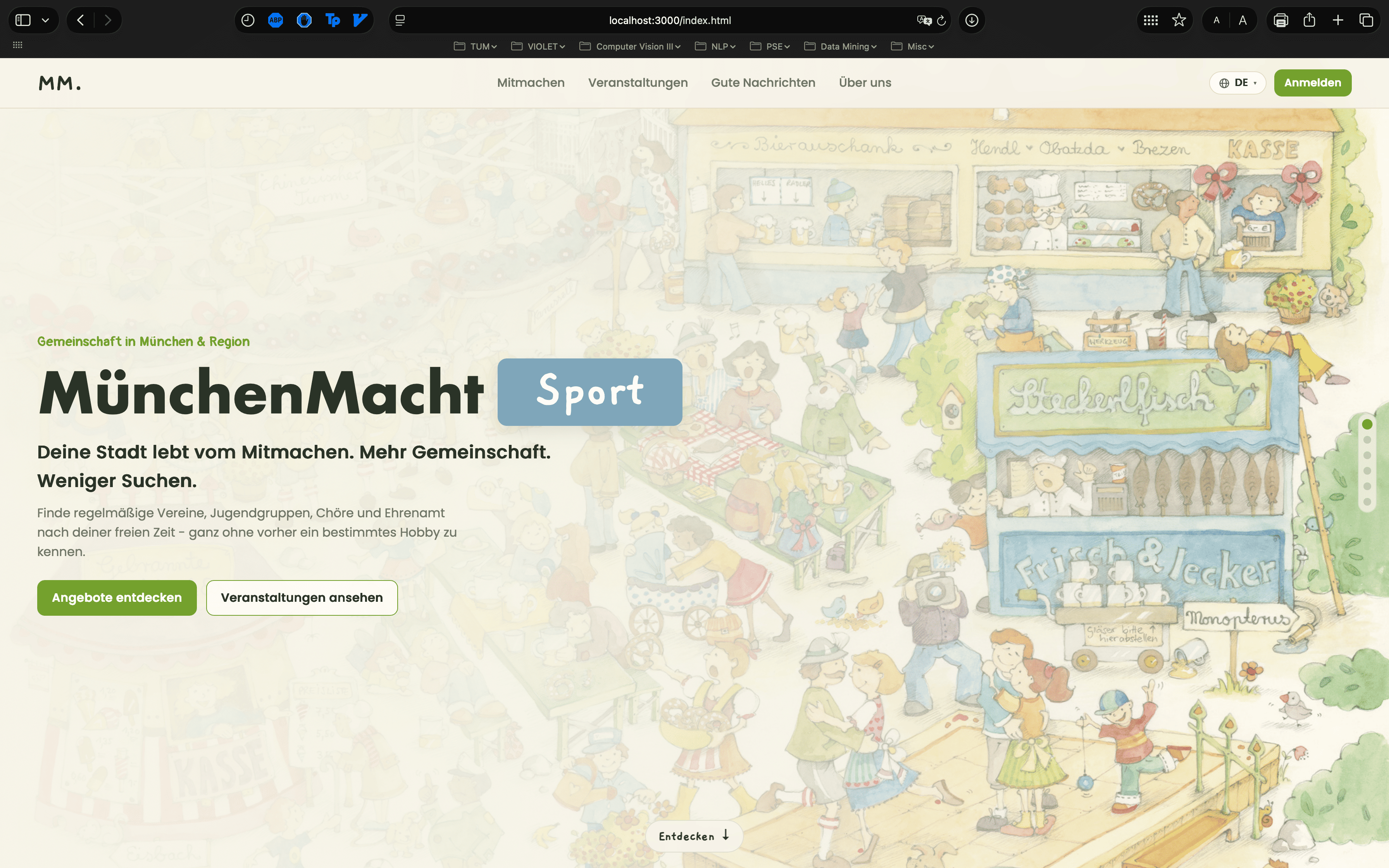
"Deine Stadt lebt vom Mitmachen. Mehr Gemeinschaft. Weniger Suchen."
Your city thrives on participation. More community. Less searching.
Inspiration
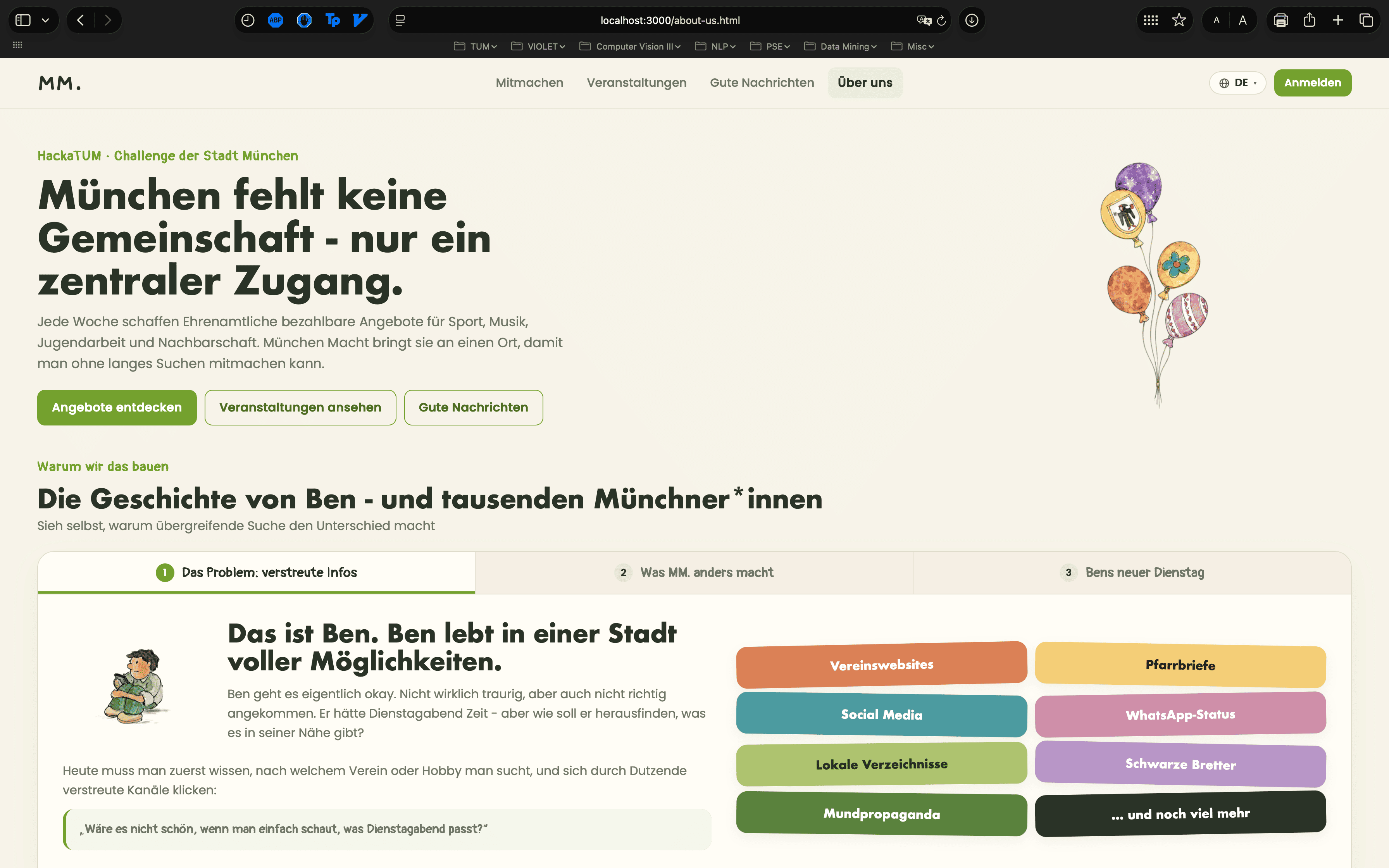
Meet Ben. Ben is fine. He is not exactly sad - but you know ... he is not really connected either. He lives in Munich, a city packed with amateur sports clubs, choirs, youth groups, volunteer fire brigades, repair cafes, and neighborhood gardens.
So why is Ben still sitting on his couch every Tuesday evening?
Because Munich does not lack community - it lacks one central place to discover it. Today, finding a local group means already knowing which hobby or club name to search for, then digging through club websites, parish newsletters, WhatsApp statuses, noticeboards, and word of mouth. Existing platforms only solve narrow slices (nightlife events, youth-only sports, or single directories).
We built MünchenMacht (MM.) for the City of Munich HackaTUM challenge to flip discovery around: start from your real everyday schedule, lower the barrier to showing up, and celebrate the volunteers who keep this city alive.
What it does
MünchenMacht brings citizen-led, noncommercial community life across Munich and surrounding municipalities into one bilingual (DE / EN) platform structured around four pillars:
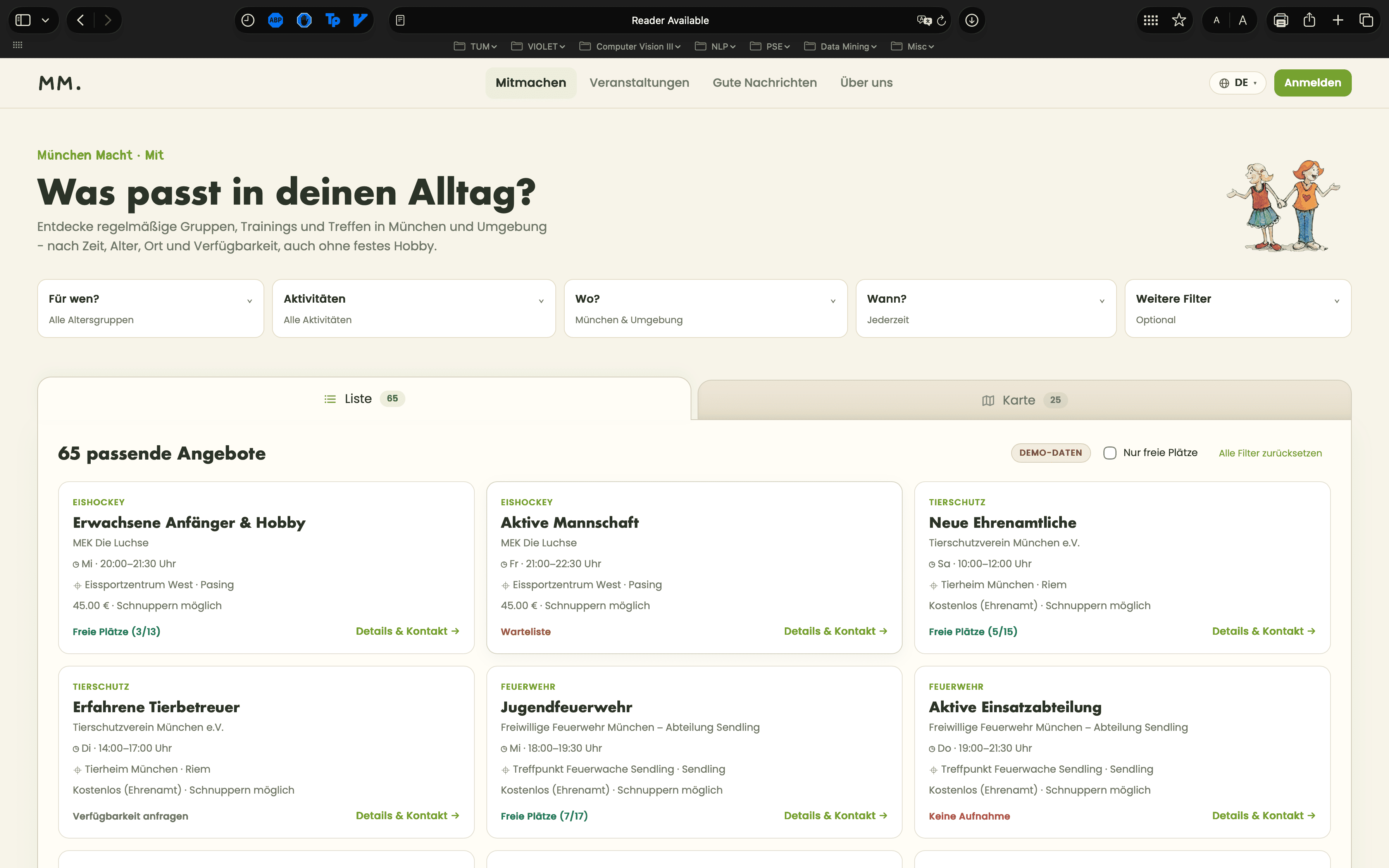
Mitmachen (Schedule/Interest/... Activity Discovery)
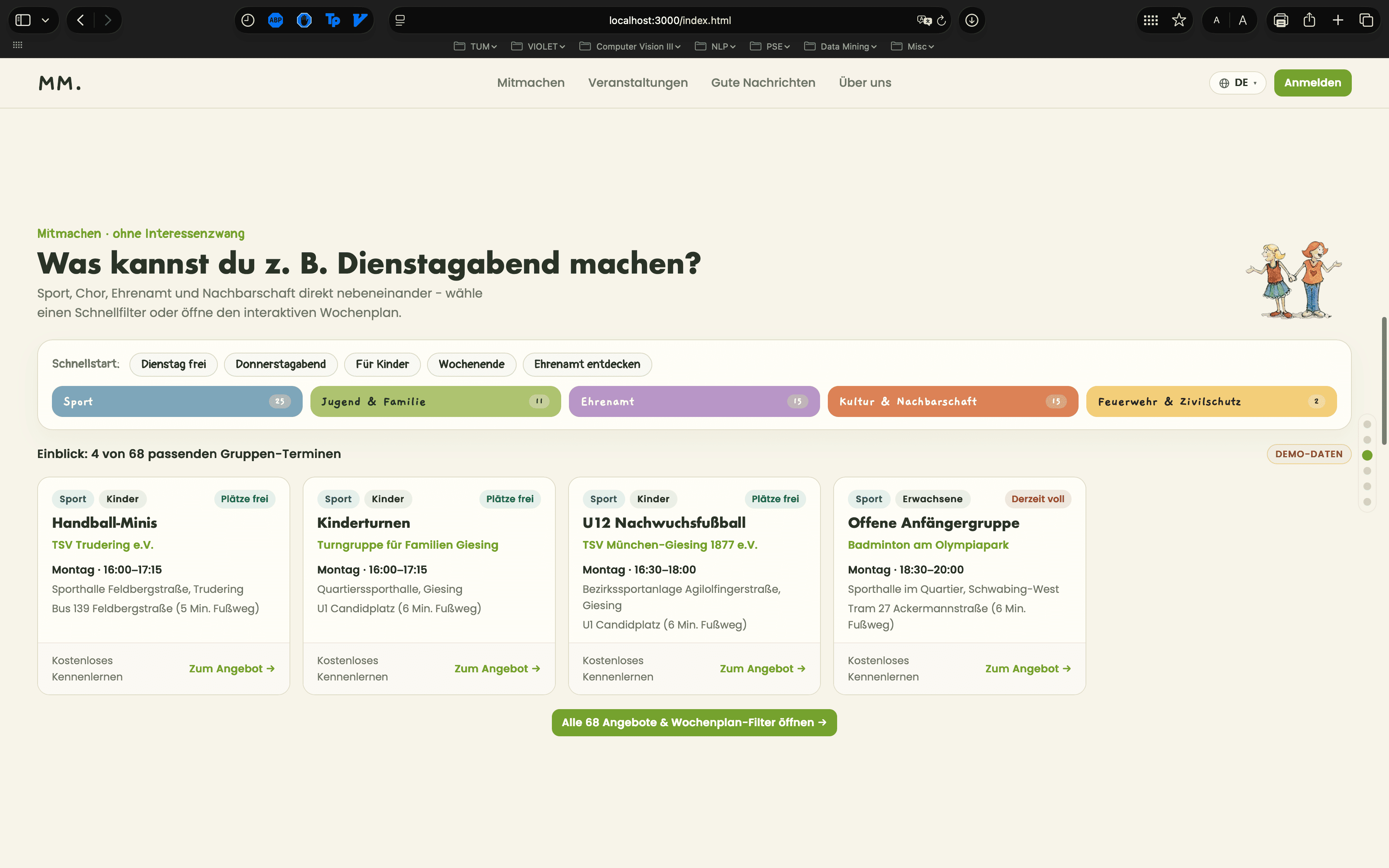
- Find recurring weekly groups without needing to pick a hobby first. Someone with Tuesday evenings free sees beginner Karate, an open neighborhood choir, and local volunteering side by side.
- Features a drag-to-paint 30-minute weekly timetable grid (mouse & touch), hierarchical activity & Munich/region location trees, age & fee filters, and honest group-level availability (
Open spots,Waitlist,Closed, orCheck availability— unknown availability is never falsely counted as open). - Switch seamlessly between a List view and an interactive Map view to find out which classes you kid can take after school, close to home.
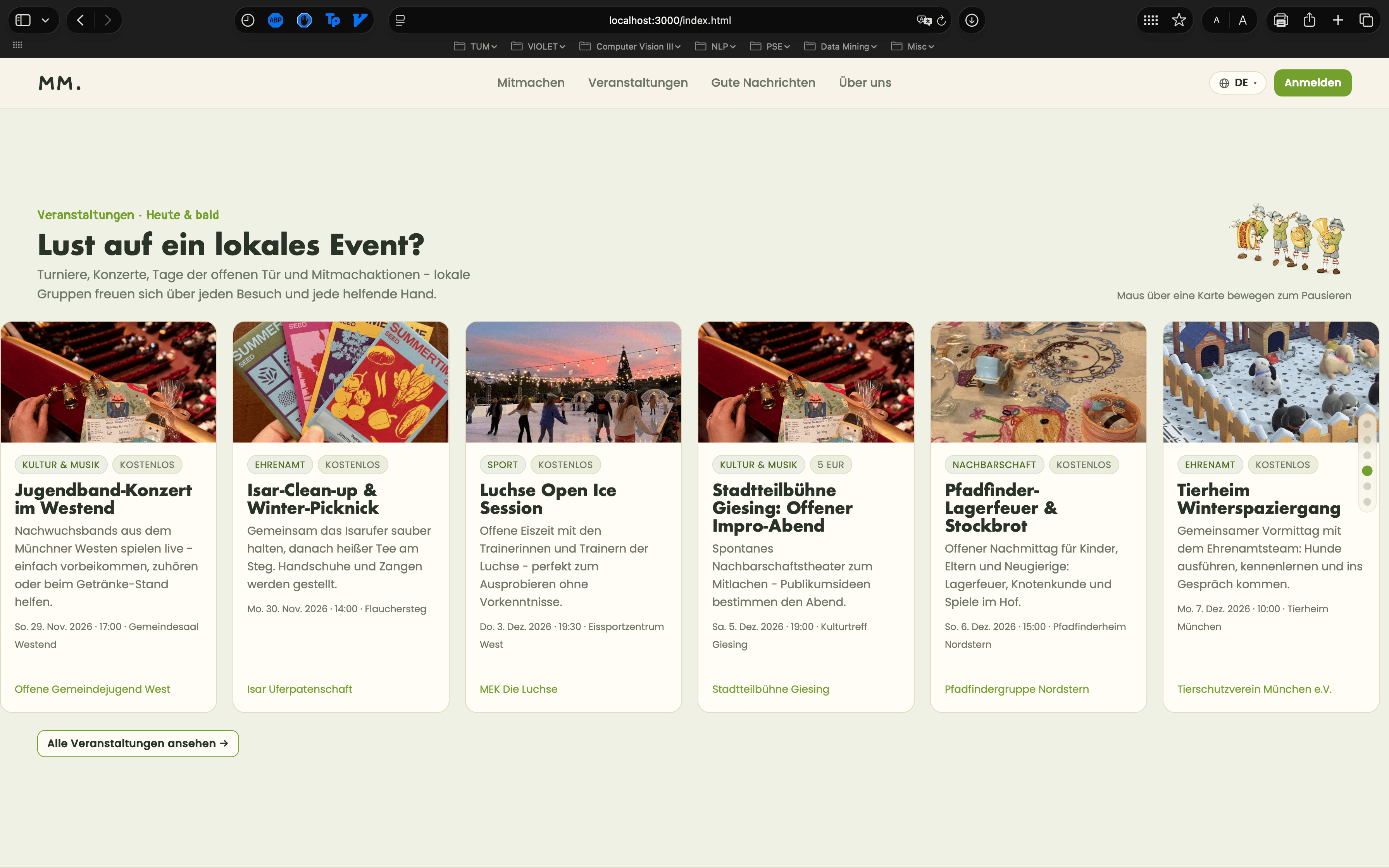
Veranstaltungen (Community Events)
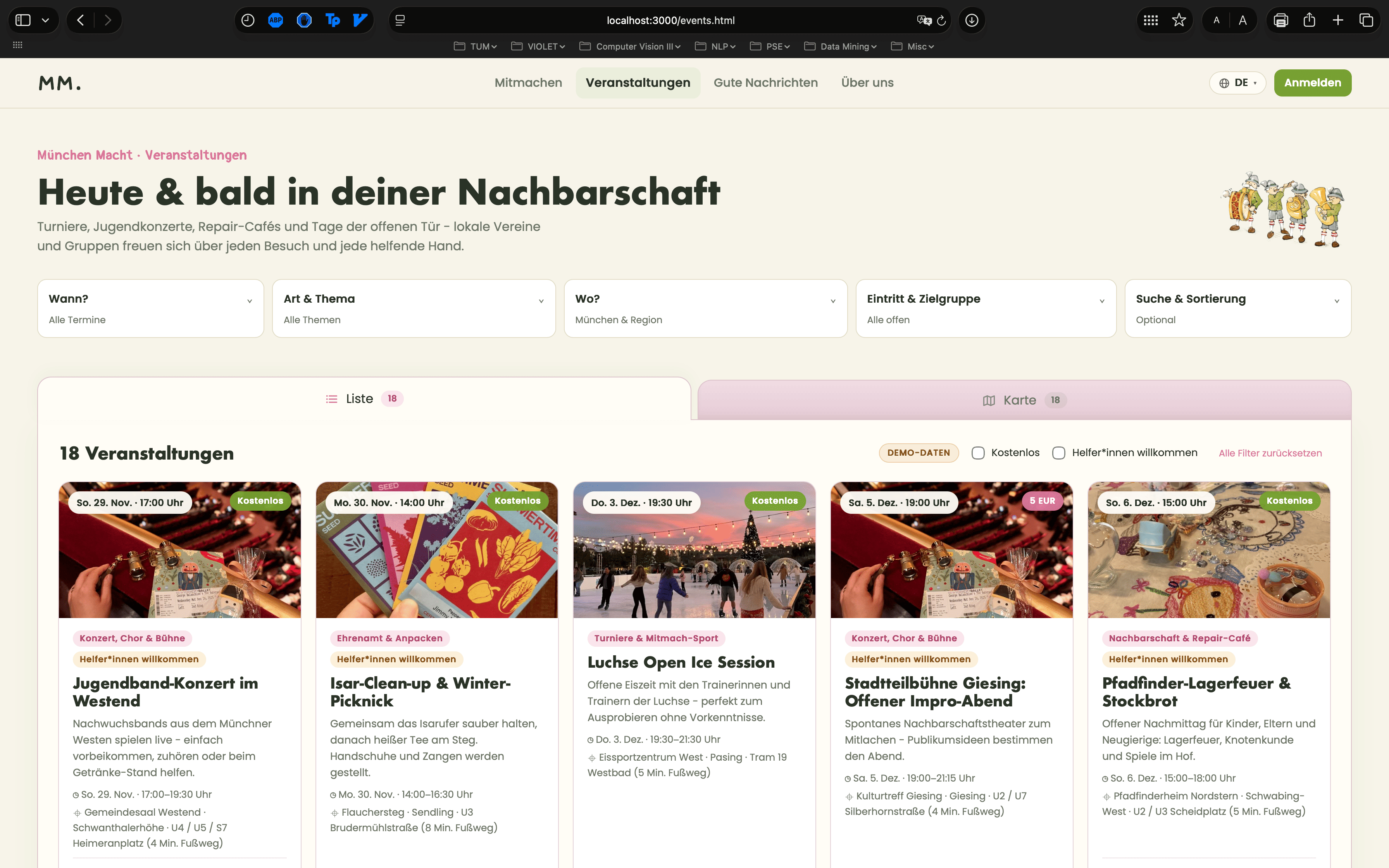
- "Bored tonight?" A dedicated sister view for one-off tournaments, youth band concerts, repair cafes, open days, and volunteering actions - complete with a "Helpers welcome" filter and synchronized List/Map folder.
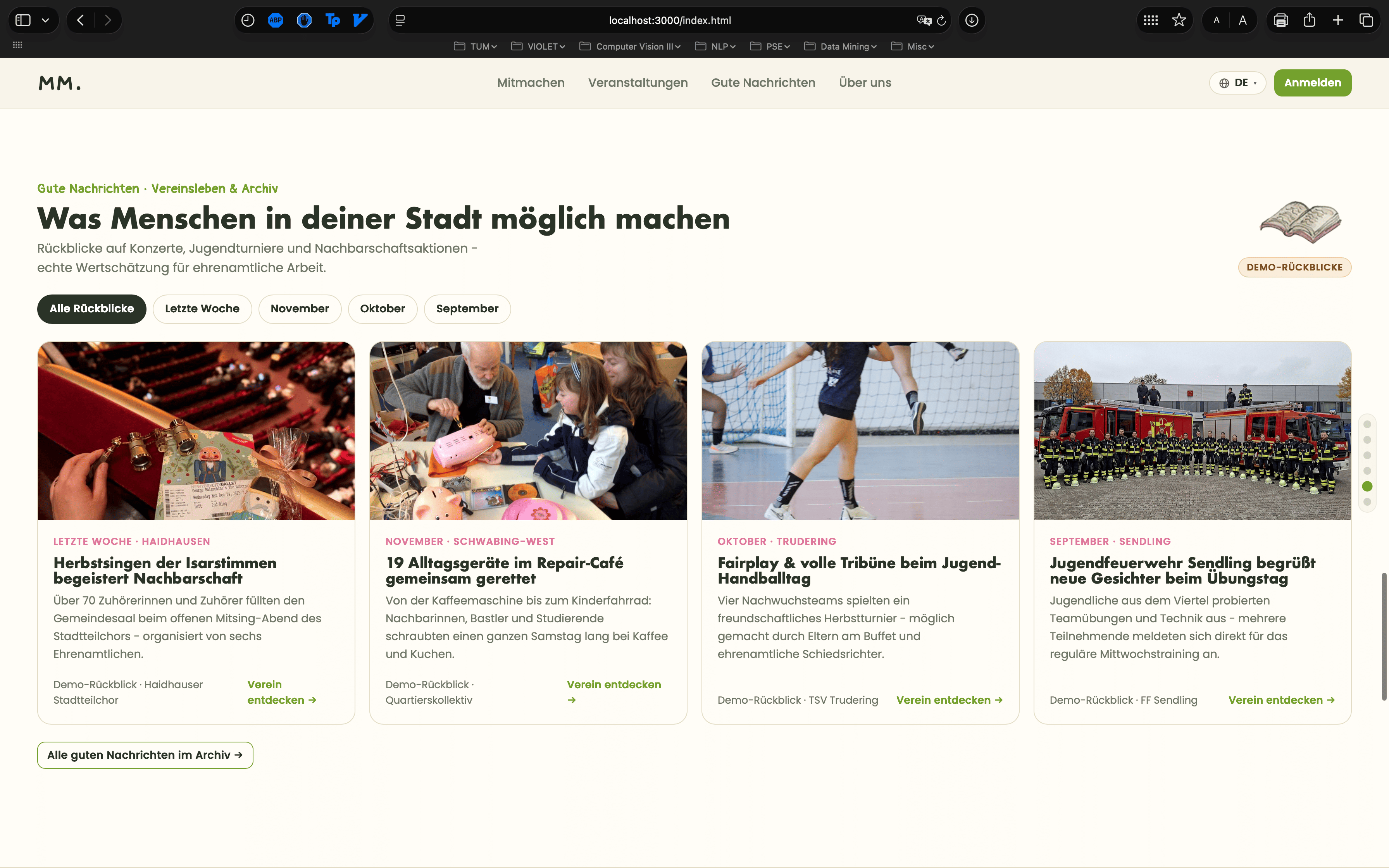
Gute Nachrichten (Good News Archive)
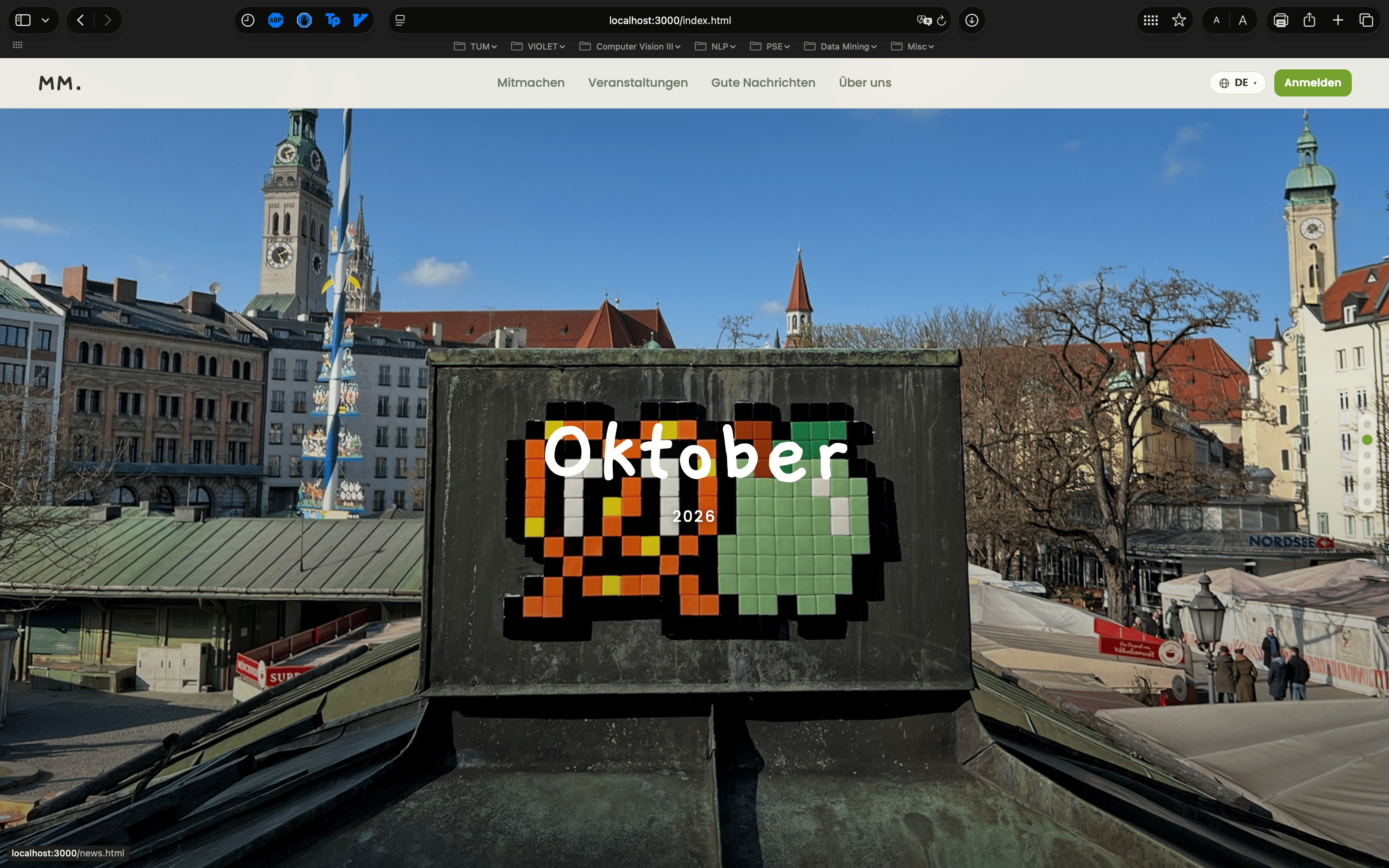
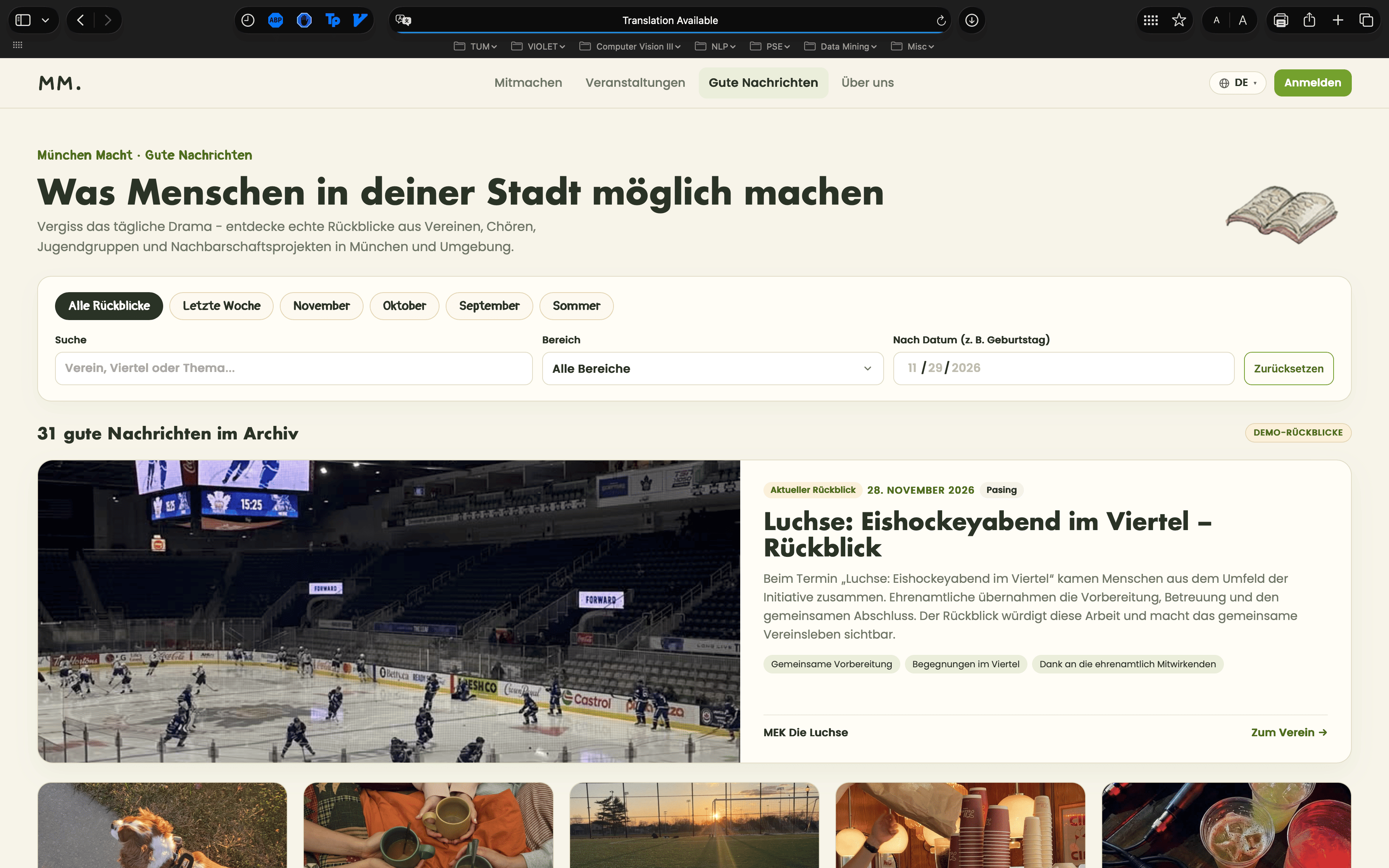
- A break from daily news doomscrolling: community recaps honoring the volunteers behind local concerts, youth tournaments, and neighborhood days. Browse by timeframe (Last week, September, Summer) or pick a date to see what Munich made happen on your birthday for all we care.
Club Profiles, Organizer Flow & City Insights
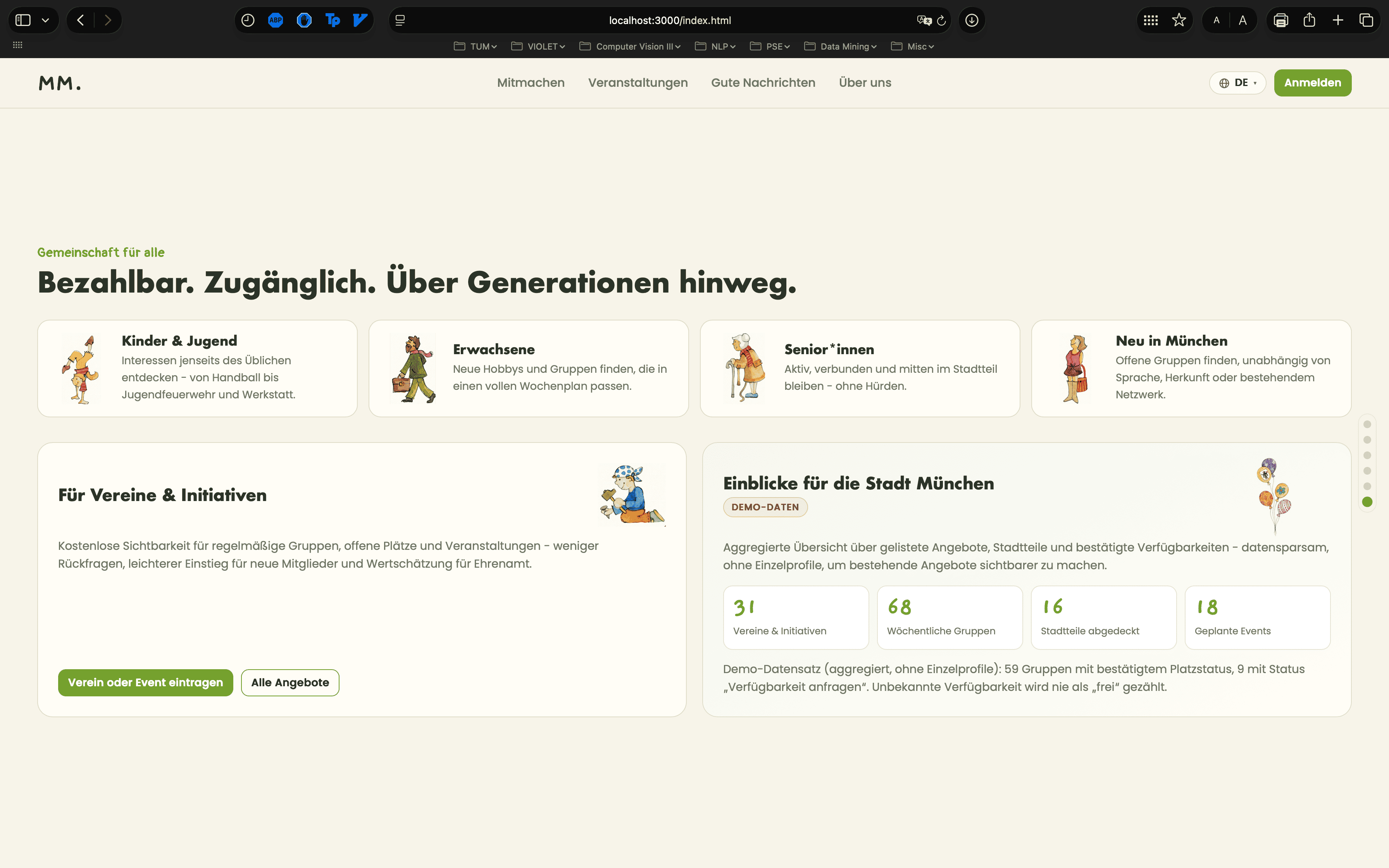
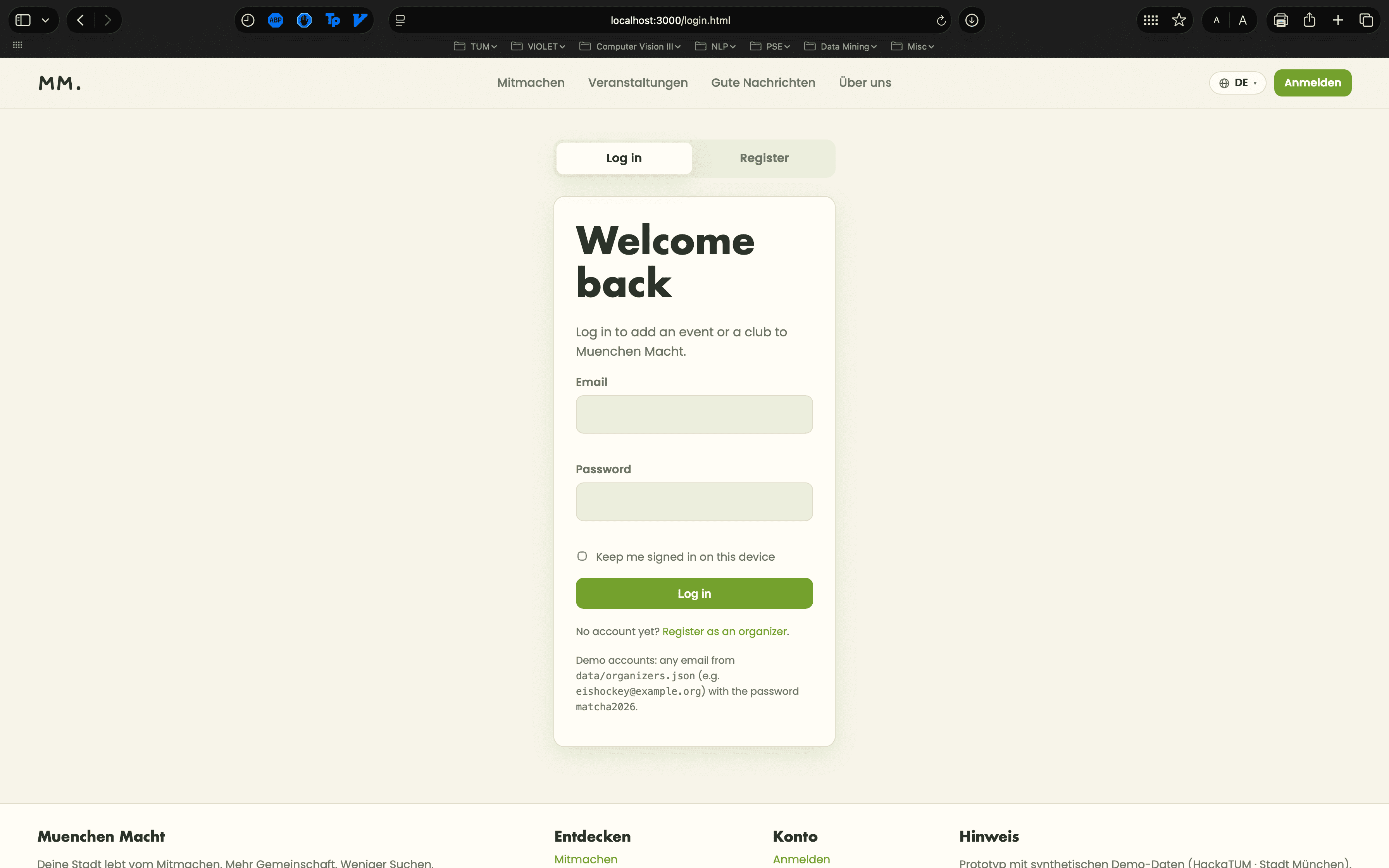
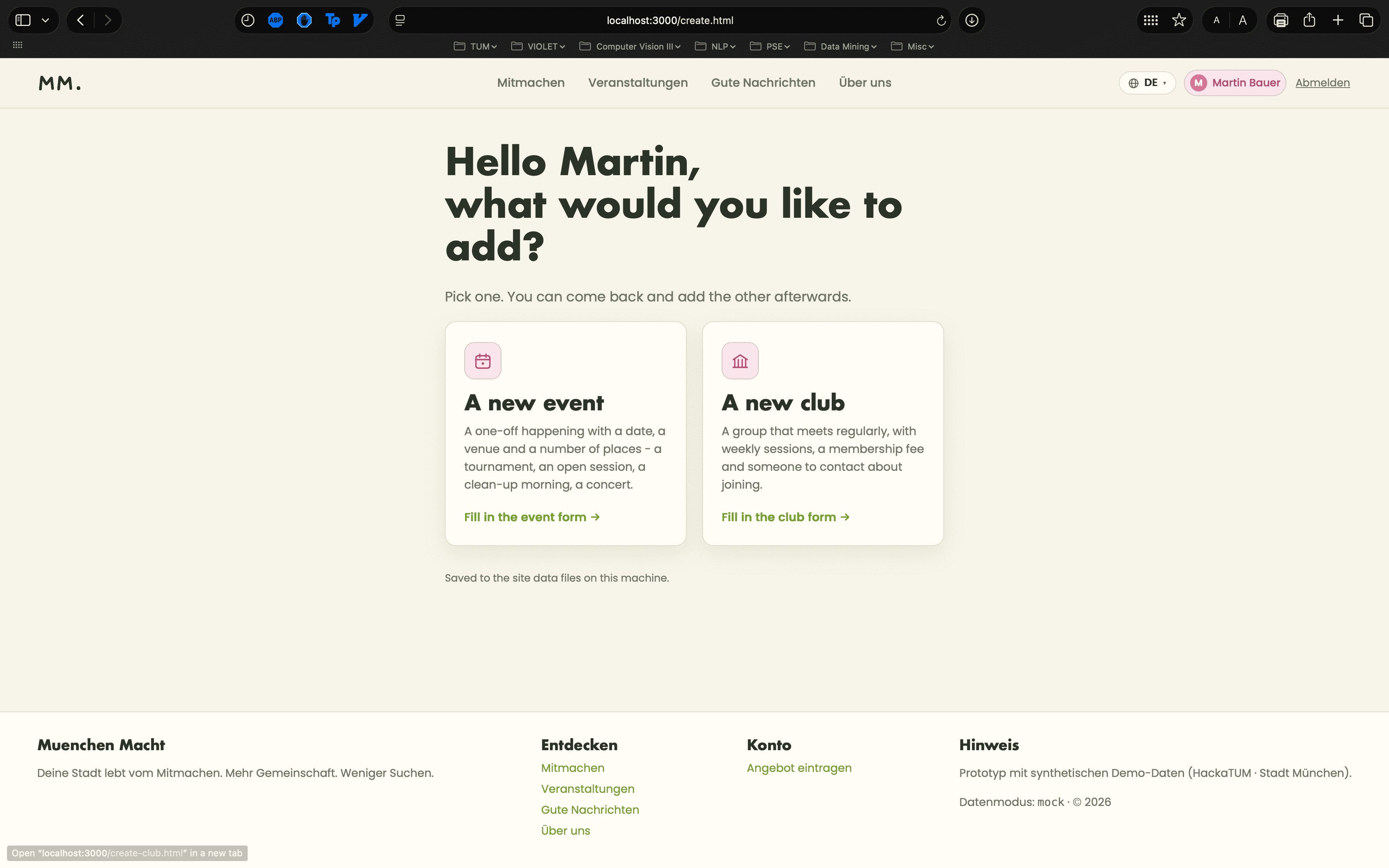
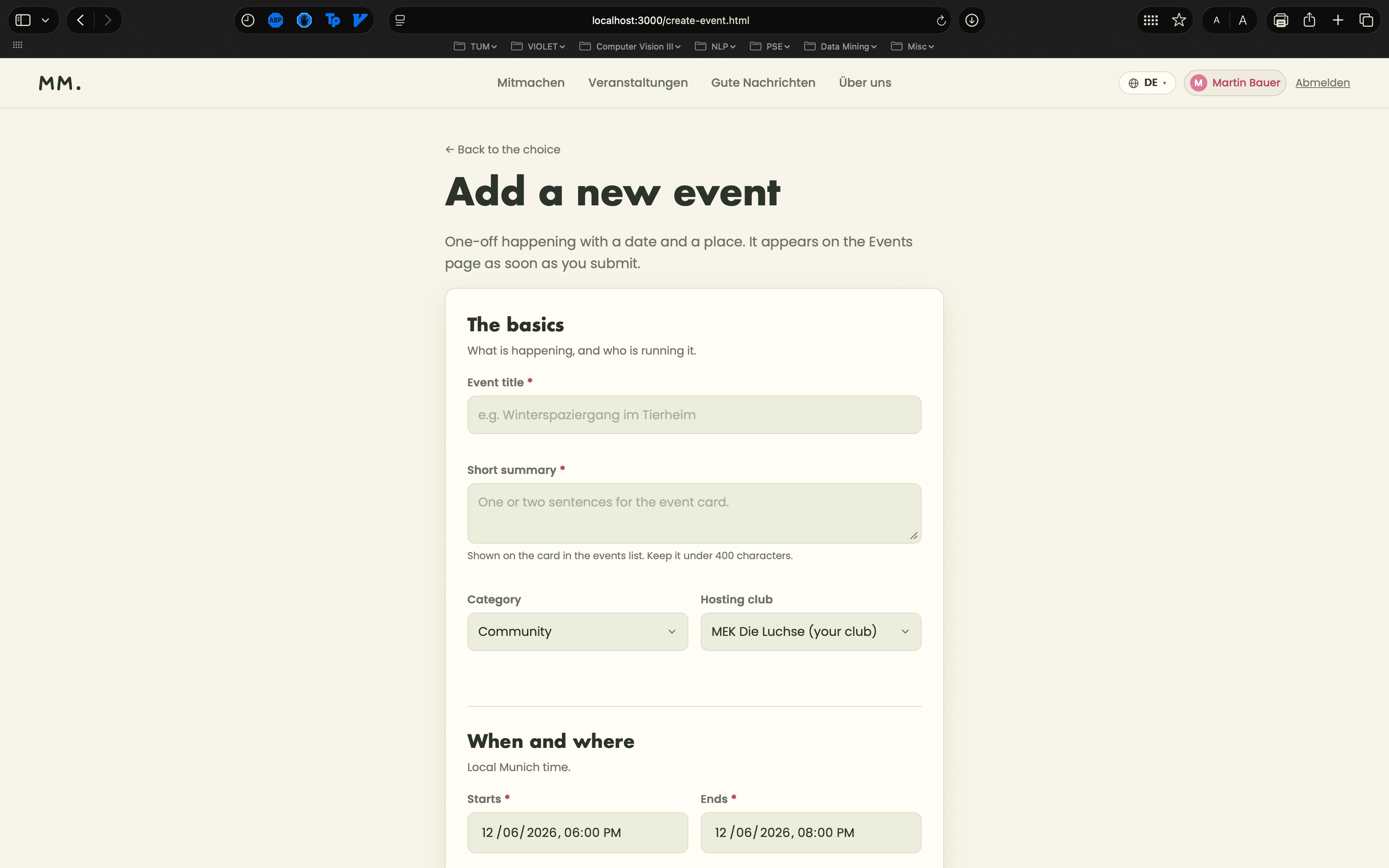
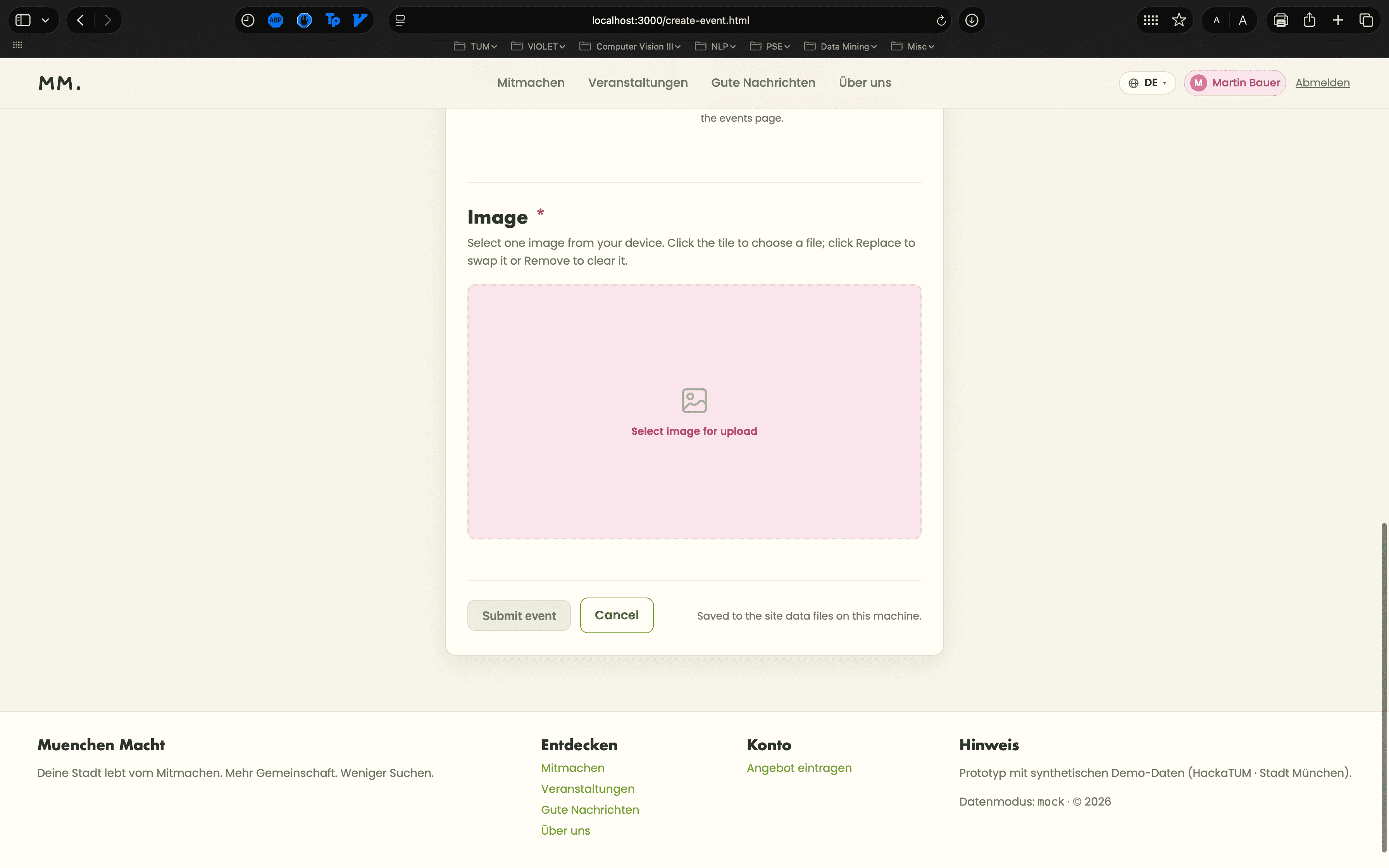
- Dedicated club profiles with clear next steps (trial info, fees, contact details, events, and recaps) and a prototype organizer flow for publishing new clubs and events.
- Privacy-preserving, aggregated demo metrics (listed groups, open vs. waitlisted vs. unconfirmed spots, districts covered) showing how the City of Munich can understand community reach without collecting personal profiles.
How we built it
We intentionally kept the stack lightweight, fast, and maintainable for a real civic deployment:
- Frontend: Pure HTML5, CSS3, and modular ES JavaScript (no heavy framework lock-in), with a unified design system, Munich watercolor illustrations, full-viewport scroll-snapping on the landing page, and a live
DE/ENlanguage switcher persisted inlocalStorage. - Schedule-Level Matching Engine: Rather than only filtering at the club level (which causes false positives when a club has an open adult group on Tuesday and a full kids group on Thursday), we flatten organizations into individual recurring schedules and evaluate every constraint on the same session.
- Backend & Data Layer: Lightweight Node.js server (
server.js) backed by structured JSON datasets (clubs.json,events.json,recaps.json,organizers.json) with consistent foreign keys (clubId,eventId,recapId) and an automaticlocalStorageoffline store for static hosting. - Automated Verification: Regression test suite (
scripts/test-activity-filters.mjs) verifying all 7 core invariants across our synthetic 31-club / 68-schedule demo dataset.
(Note: All seeded clubs, schedules, events, recaps, and organizer logins in this hackathon prototype are clearly labeled as synthetic demo data and simulated authentication.)
Challenges we ran into
- Preventing cross-schedule filter leakage: Early club-level filtering matched clubs that had the right age group on one day and the right time on another. Refactoring discovery around individual schedule rows solved this cleanly and became one of our core automated tests.
- Honest availability semantics: Missing data is common in real volunteer directories. Treating missing availability as "open" destroys citizen trust on their very first visit, so we enforced strict
unknownhandling across every filter, card, and city metric. - Visual cohesion across distinct user journeys: Balancing a shared Munich storybook identity while visually distinguishing recurring groups (Mitmachen in teal), one-off happenings (Veranstaltungen in coral), and recaps (Gute Nachrichten in ochre) took careful CSS design-token unification.
- Real-world polish at 3 AM: Swapping Map tiles, fixing (ugly) macOS Safari native
<select>styling, handling missing German umlauts (ä, ö, ü) in display fonts under hackathon time pressure ...
Accomplishments that we're proud of
- Zero-hobby, time-first discovery that actually feels fun to use - painting your free Tuesday evening on the weekly grid and immediately seeing Karate and a neighborhood choir side by side makes the product vision click in seconds.
- A warming a bit cutesy interface - replacing sterile directory tables with Munich Wimmelbild watercolor art, tactile paper-folder tabs, and zero stock emojis - art by Mo Büdinger instead of using inconsistent AI art - we even edited Ben ourselves (in Powerpoint, our photoshop skills are limited tbh).
- Full
DE/ENlive switching — making Munich’s community life accessible to newcomers right from day one.
What we learned
- Discovery is an emotional problem, not just a search problem. People like Ben do not wake up knowing they want "e.V. Verein #412" - they just have two free hours on Tuesday and want to feel welcome.
- Respect volunteers' time. Clubs will only maintain listings if updates take seconds and if the platform gives something back: visibility for their events, better-fitting inquiries, and recognition through Good News recaps.
- Everyday life ignores city borders. People live in Munich and train in Garching, or commute from Dachau and Freising - designing region-ready data from the start costs almost nothing and makes the platform far more useful.
What's next for MünchenMacht
- Partner, don't duplicate: Import and sync with existing municipal and regional directories (e.g., sport associations and volunteering portals) so volunteers never have to maintain duplicate profiles.
- One-click availability check-ins: Lightweight monthly confirmation pings for club leads so availability statuses stay fresh with real timestamps.
- Privacy-preserving City Insights dashboard: Expand our demo aggregates into a dedicated municipal view highlighting district-level supply, waitlists, and volunteer needs (with small-cell suppression and zero personal tracking).
- Real pilot in 2–3 Munich neighborhoods: Onboard real local sports clubs, choirs, repair cafes, and youth groups, and measure what actually matters: real-world trial visits and lasting community connections.
