-
-
App Banner
-
App interface
-
App UI
Mum Mum Help — Submission
Inspiration
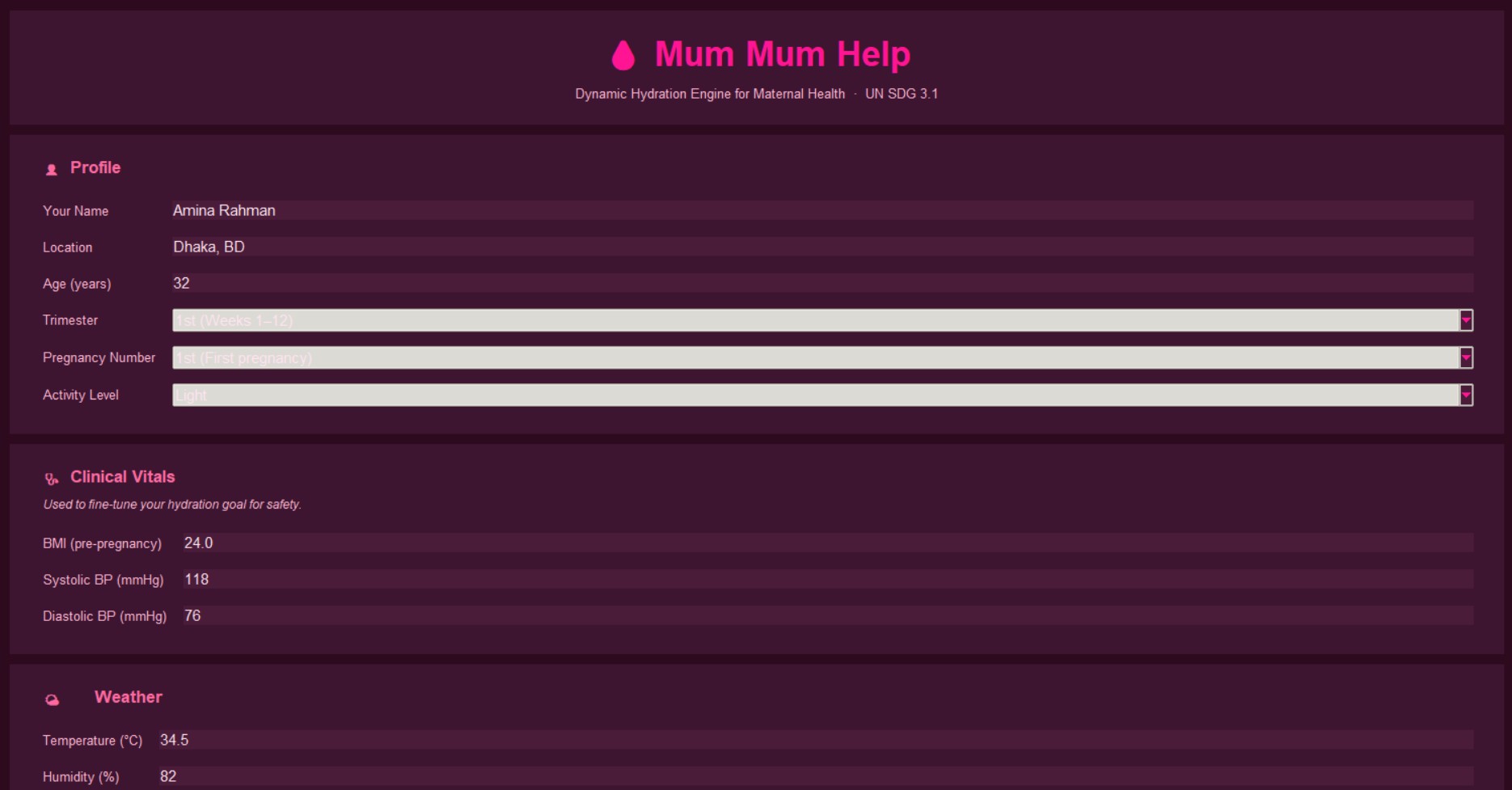
Mum Mum Help is a preventative health-tech application designed to optimize water intake for expecting mothers, directly advancing UN SDG 3.1 (Maternal Health) by actively mitigating dehydration-linked pregnancy risks. Rather than relying on generic advice like "drink 8 glasses a day," the app uses a personalized algorithmic engine that dynamically adjusts a mother's daily fluid target based on eight real inputs: her current trimester, physical activity level, real-time local weather, blood pressure, BMI, maternal age, and pregnancy number (parity). Powered by a rolling 24-hour tracking structure, it intelligently monitors consumption and triggers context-aware daytime alerts while strictly suppressing nighttime notifications to protect maternal sleep. By serving as a proactive digital defense against dehydration-linked complications — such as maternal infections (UTIs), low amniotic fluid, and premature contractions — Mum Mum Help directly supports SDG 3.1's core targets to decrease maternal mortality, promote healthy fetal development, and ensure safer pregnancy outcomes globally.
What it does
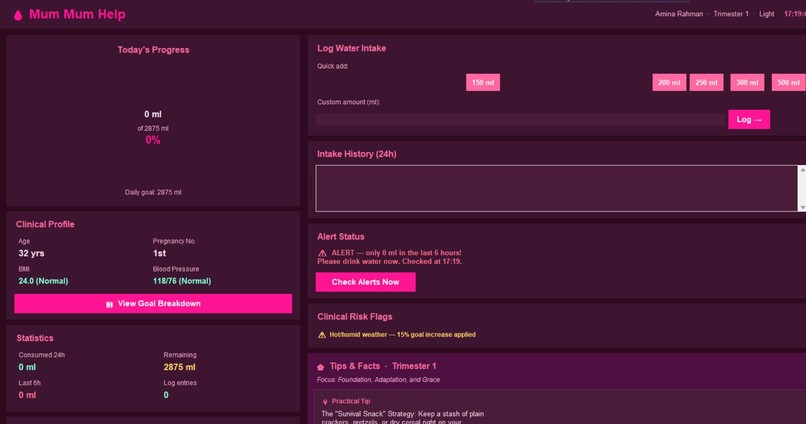
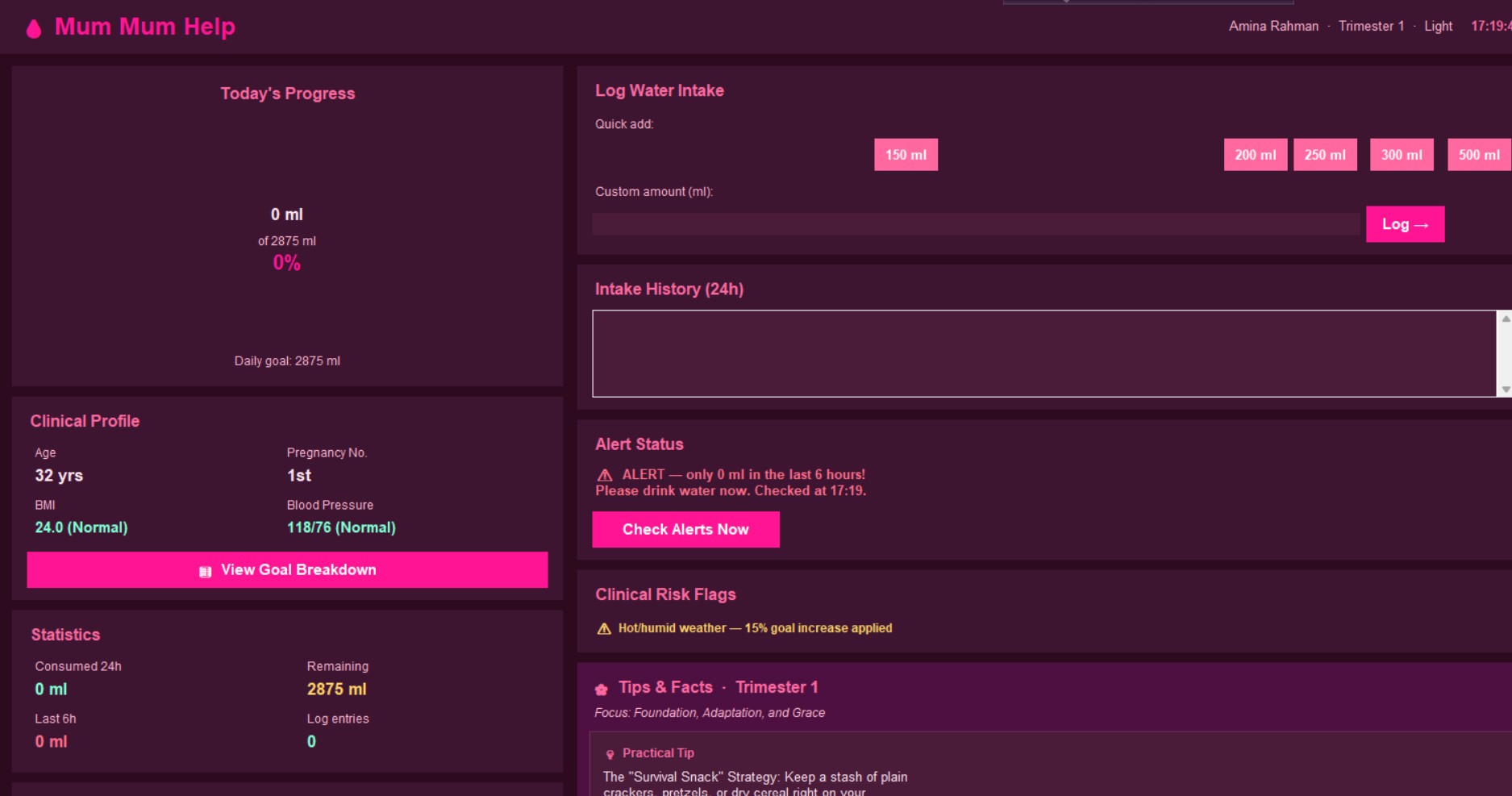
Mum Mum Help is a dynamic, algorithmic hydration engine specifically designed to safeguard maternal and fetal health during pregnancy. Directly aligned with UN SDG 3.1, it replaces generic hydration advice with a highly personalized fluid intake goal computed through an 8-step calculation: baseline need, trimester, activity level, real-time weather (increasing the goal by 15% during high heat or humidity), blood pressure, BMI, maternal age, and pregnancy number. Each of these clinical inputs is classified into a real category (e.g. Elevated blood pressure, Overweight BMI, Advanced maternal age) and surfaced as a clinical risk flag directly in the dashboard — so the reasoning behind the number is never a black box.
The app uses a rolling 24-hour tracking system to intelligently monitor intake and triggers a context-aware "Intelligent Alert" only when a genuine dry spell is detected — less than 200 ml consumed in the preceding 6 hours — and only during waking hours (8:00 AM–8:00 PM), preventing dehydration-linked complications like UTIs, low amniotic fluid, and premature contractions while never disturbing the mother's sleep. Alongside tracking, the app surfaces trimester-specific practical tips and morale-boosting facts, turning hydration tracking and maternal health education into a single, mutually reinforcing experience.
How we built it
We built Mum Mum Help as a single, self-contained Python desktop application — deliberately avoiding a client-server architecture so the tool runs fully offline, with zero external dependencies beyond the Python standard library, and zero cost to deploy.
The Core Engine (Pure Python, OOP): hydration_engine.py implements the entire algorithmic model as a set of dataclasses (User, BloodPressure, WeatherData, IntakeEntry) and enums (Trimester, ActivityLevel, BPCategory, BMICategory, ClinicalFlag) feeding into a central HydrationEngine class. To handle the rolling 24-hour intake window efficiently, we used Python's collections.deque, giving us O(1) time complexity for both appending new water logs and pruning expired records — critical for a tool meant to track intake continuously across 9 months without ever needing a database.
The Frontend (Tkinter): hydration_app.py is a fully custom, hand-built desktop UI in a soft "hot pink / dark plum" palette. The dashboard features a hand-drawn circular progress ring rendered with Tkinter Canvas arcs, soft pill-shaped quick-add buttons, a color-coded Clinical Profile card (BMI/BP badges shift green → amber → red by risk category), and an on-demand "Goal Breakdown" popup that shows exactly how every milliliter of the target was calculated.
Knowledge Base Integration: pregnancy_tips.py parses a plain-text, trimester-by-trimester tips-and-facts file into structured data at runtime, which is then surfaced directly inside the dashboard next to the live tracker — no separate app, no context switching.
The Logic: Alert evaluation sums intake over a rolling 6-hour window and cross-references it against local time, firing only between 8:00 AM and 8:00 PM so notifications stay helpful, never intrusive.
Challenges we ran into
Alert Fatigue vs. Medical Necessity: A major challenge was ensuring the app didn't annoy the user or induce unnecessary anxiety. Standard hydration apps ping users every hour regardless of context. We designed an "Intelligent Alert" system that only triggers if the user genuinely falls behind their optimal intake pace within a real 6-hour window, and explicitly time-gated it so it never wakes an expecting mother at 3:00 AM.
Memory Management: Tracking every single sip of water a user takes over 9 months can lead to unbounded data growth. We solved this with a lightweight rolling queue (deque) that automatically drops entries older than 24 hours, keeping computational overhead — and memory footprint — incredibly low.
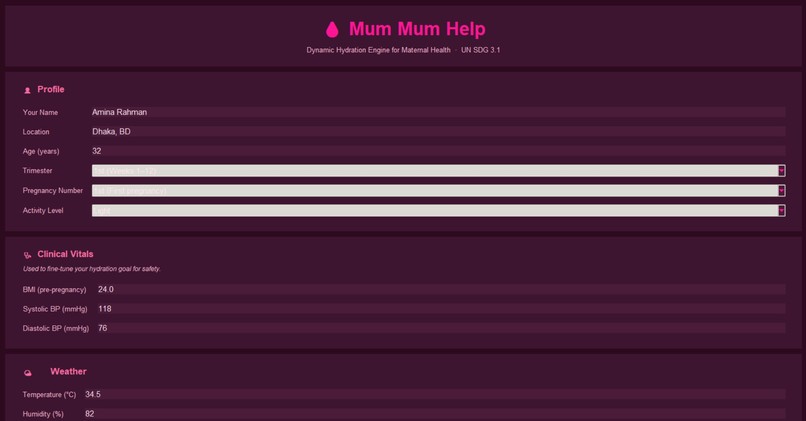
Personalization Without Overwhelm: As we expanded the engine from 4 inputs (baseline, trimester, activity, weather) to 8 (adding blood pressure, BMI, age, and pregnancy number), the risk was turning a simple setup form into an intimidating clinical intake questionnaire. We addressed this by splitting the setup screen into three clearly labeled, scrollable sections — Profile, Clinical Vitals, and Weather — so the added depth never feels like friction.
Striking the Right Tone in UI: It was challenging to build an app that handles serious medical tracking (SDG 3.1) without looking like a stressful, clinical hospital dashboard — and equally challenging to surface real risk flags (like "Hypertensive") supportively rather than alarmingly. We iterated on plain-language flag descriptions and a soft amber/red color system, rather than harsh clinical jargon, so the app feels like a calm, supportive companion even when it's telling you something important.
Accomplishments that we're proud of
Creating True SDG Impact: We're proud to have translated a global initiative (UN SDG 3.1 — Maternal Health) into a tangible, accessible software solution. By preventing dehydration, the app actively defends against real physiological pregnancy risks.
Algorithmic Depth Without Complexity: Successfully designing the HydrationEngine to handle eight dynamic, interacting variables — weather, trimester, activity, blood pressure, BMI, age, and parity — in real time, while keeping the rolling-window tracking queue at strict O(1) memory efficiency.
Radical Transparency: Rather than handing the user an opaque number, we built a full "Goal Breakdown" view that traces every milliliter of the daily target back to its source. We believe a health recommendation someone can actually understand is one they're far more likely to trust and follow.
Empathetic Engineering: Building a product that genuinely respects the end-user's physical and emotional state — proving that healthcare apps can be beautiful, fast, gentle, and clinically meaningful all at once.
What we learned
This was a complete vibe coding experience — we learned how a full-scale, real-world health app comes together end to end, from raw domain research (clinical hydration thresholds, BMI categories, blood pressure classifications, parity risk bands) all the way to a polished, working UI. We learned how to translate messy, real medical guidance into clean, tunable constants inside a rule-based engine — and just as importantly, we learned how to design a health interface that informs without alarming, and personalizes without overwhelming.
What's next for Mum Mum Help
- Live weather integration — replacing the current mock weather service with a real weather API (e.g. OpenWeatherMap), while keeping the offline mock as a fallback for low-connectivity environments.
- Persistent history — saving user profiles and intake history across sessions (local file or lightweight database), so progress isn't lost when the app closes.
- Shareable health reports — exporting daily/weekly hydration summaries as a PDF a mother can bring to her prenatal checkup.
- Multi-language support — translating the tips & facts content so the app can serve non-English-speaking communities.
- Community health worker deployment — a mobile-friendly build to help health workers support patients in low-resource settings between clinic visits.
- Regionally-tunable clinical thresholds — making the BP/BMI/age/parity modifiers configurable so the engine can align with local medical guidelines rather than a single fixed standard.
Built With
- python
- tkinter


Log in or sign up for Devpost to join the conversation.