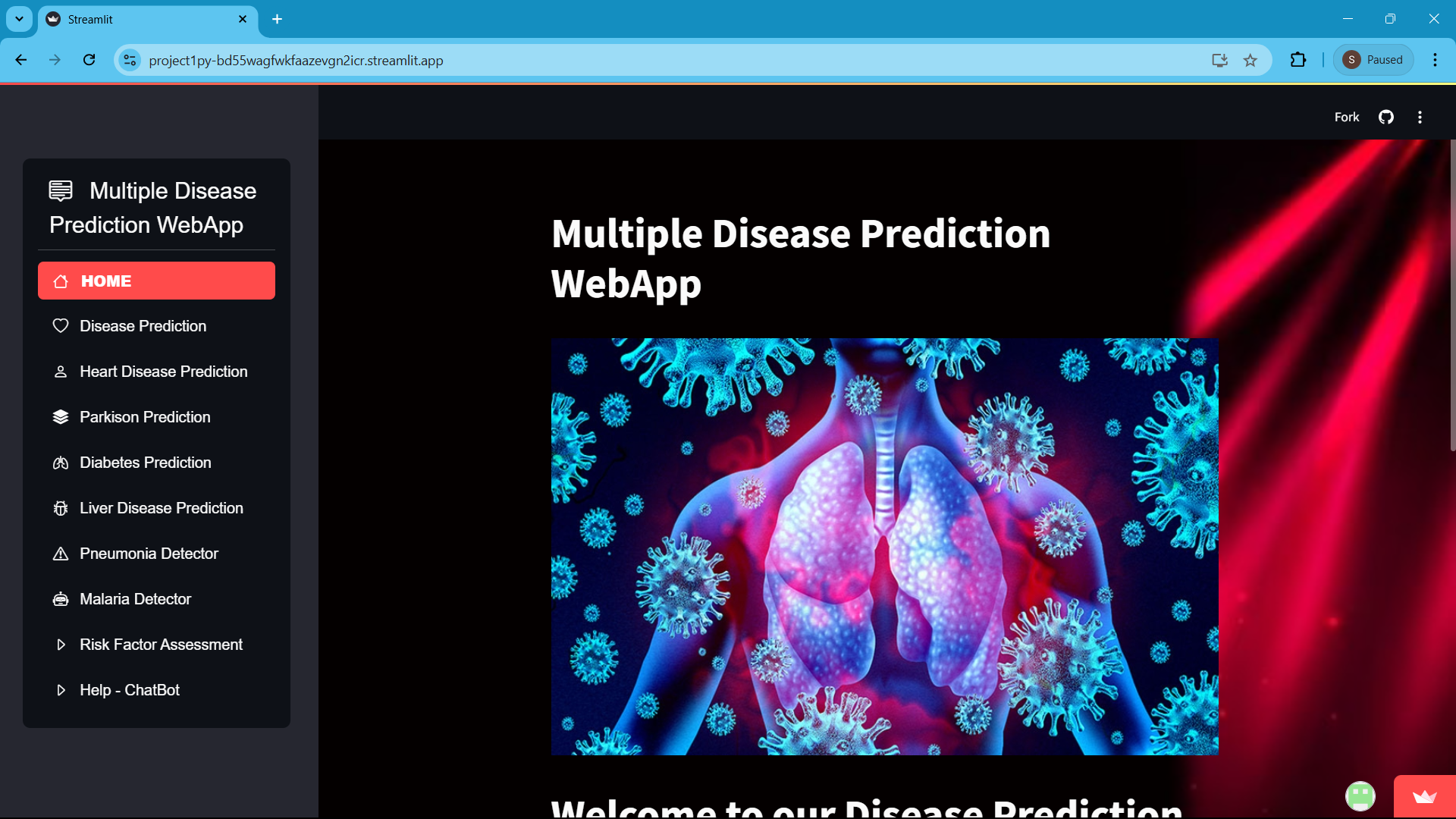
Inspiration The inspiration for this project came from the growing need for efficient and accurate systems in healthcare to aid in the early detection of diseases. Medical professionals often face challenges in diagnosing diseases due to overlapping symptoms and a lack of comprehensive tools to analyze patient data quickly. By leveraging machine learning (ML) algorithms, I wanted to create a system that could assist doctors in diagnosing multiple diseases based on symptoms, ultimately aiding in quicker decision-making and improving patient outcomes.
What I Learned Throughout this project, I learned about various aspects of machine learning, including:
Data Preprocessing: Handling missing data, encoding categorical variables, and normalizing features to prepare the data for ML models. Feature Selection: Identifying the most relevant features that contribute to accurate disease prediction. Model Evaluation: Understanding how to evaluate models using metrics such as accuracy, precision, recall, and F1 score to assess the performance of the system. Ensemble Methods: How combining different machine learning models can improve prediction accuracy (e.g., Random Forest, XGBoost). Cross-validation: Ensuring that the model generalizes well to unseen data by using techniques like k-fold cross-validation. How I Built the Project
Data Collection The dataset used for this project was sourced from publicly available medical datasets, such as the UCI Machine Learning Repository and Kaggle. The dataset contains information about various diseases and the symptoms associated with them.
Data Preprocessing Data Cleaning: I handled missing data by either imputing values or removing rows/columns with too many missing values. Feature Engineering: I created new features where necessary and encoded categorical variables like symptoms (e.g., "fever", "headache") into numerical values. Normalization: Features were scaled to ensure that the model wasn’t biased by larger numerical values (e.g., age, blood pressure).
Model Selection I experimented with several machine learning algorithms, including:
Logistic Regression Random Forest Support Vector Machines (SVM) K-Nearest Neighbors (KNN) XGBoost I compared their performance using cross-validation and selected the best-performing model based on accuracy and other evaluation metrics.
Training the Model After selecting the model, I trained it using the training dataset and evaluated its performance on the test dataset. I also performed hyperparameter tuning to optimize the model’s performance.
Deployment I created a simple Flask web application where users can input symptoms, and the system predicts the most likely diseases. The web app takes user inputs, processes the data, and displays the predicted disease(s) based on the trained machine learning model.
Results and Accuracy After tuning the model, the best-performing model achieved an accuracy of 88%, with high precision and recall, ensuring that the predictions were both accurate and reliable.
Challenges Faced
Data Imbalance One of the challenges I encountered was the imbalance in the dataset, with certain diseases being more prevalent than others. To mitigate this issue, I employed techniques such as oversampling and SMOTE (Synthetic Minority Over-sampling Technique) to balance the dataset.
Overfitting Initially, some models were overfitting the training data, which resulted in poor performance on the test set. To combat overfitting, I used techniques like cross-validation, regularization (L1 and L2), and pruning for decision tree-based models.
Feature Selection Another challenge was selecting the right features. Some symptoms were highly correlated with each other, and it took several iterations to find the most relevant features that improved the model's accuracy without introducing redundancy.
Integration into a Web App Integrating the machine learning model into a web application was a new experience for me. I used Flask for the back-end and HTML/CSS for the front-end, ensuring the user interface was simple and intuitive. The challenge was ensuring that the machine learning model could predict in real-time without latency.
Conclusion This project helped me gain practical experience in building machine learning models and deploying them into real-world applications. It also provided insights into the healthcare domain and how technology can improve diagnostic accuracy and decision-making. I am excited about the potential to enhance this system with more advanced techniques, such as deep learning, or expanding it to include more diseases and symptoms.

Log in or sign up for Devpost to join the conversation.