-
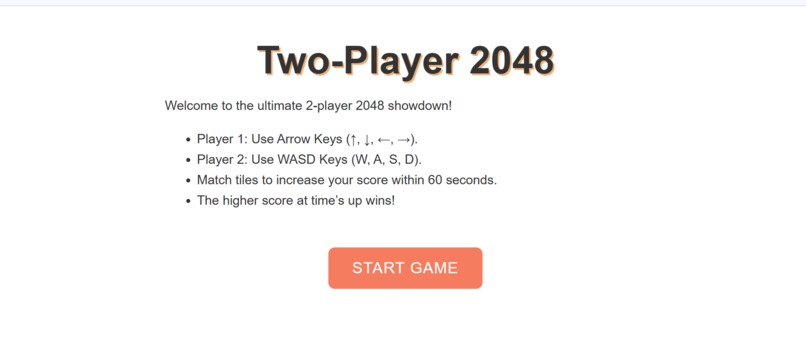
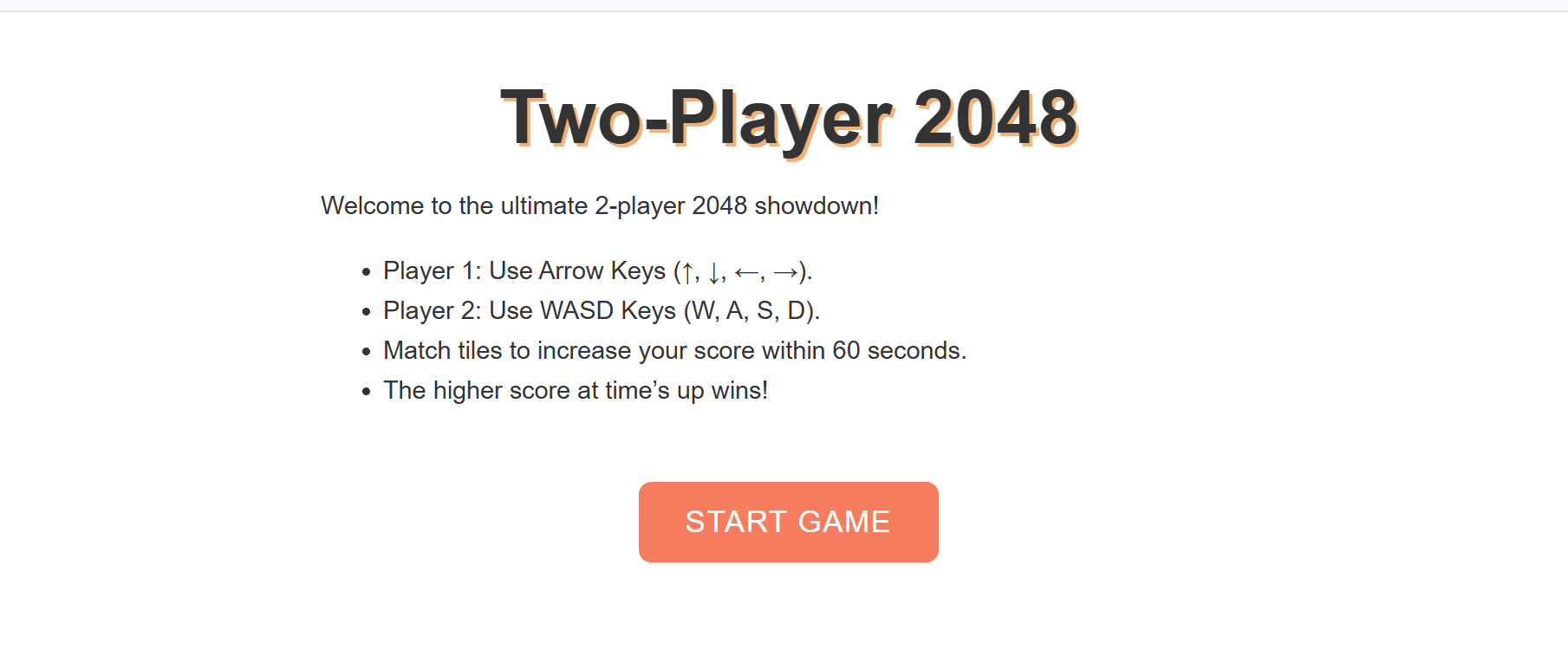
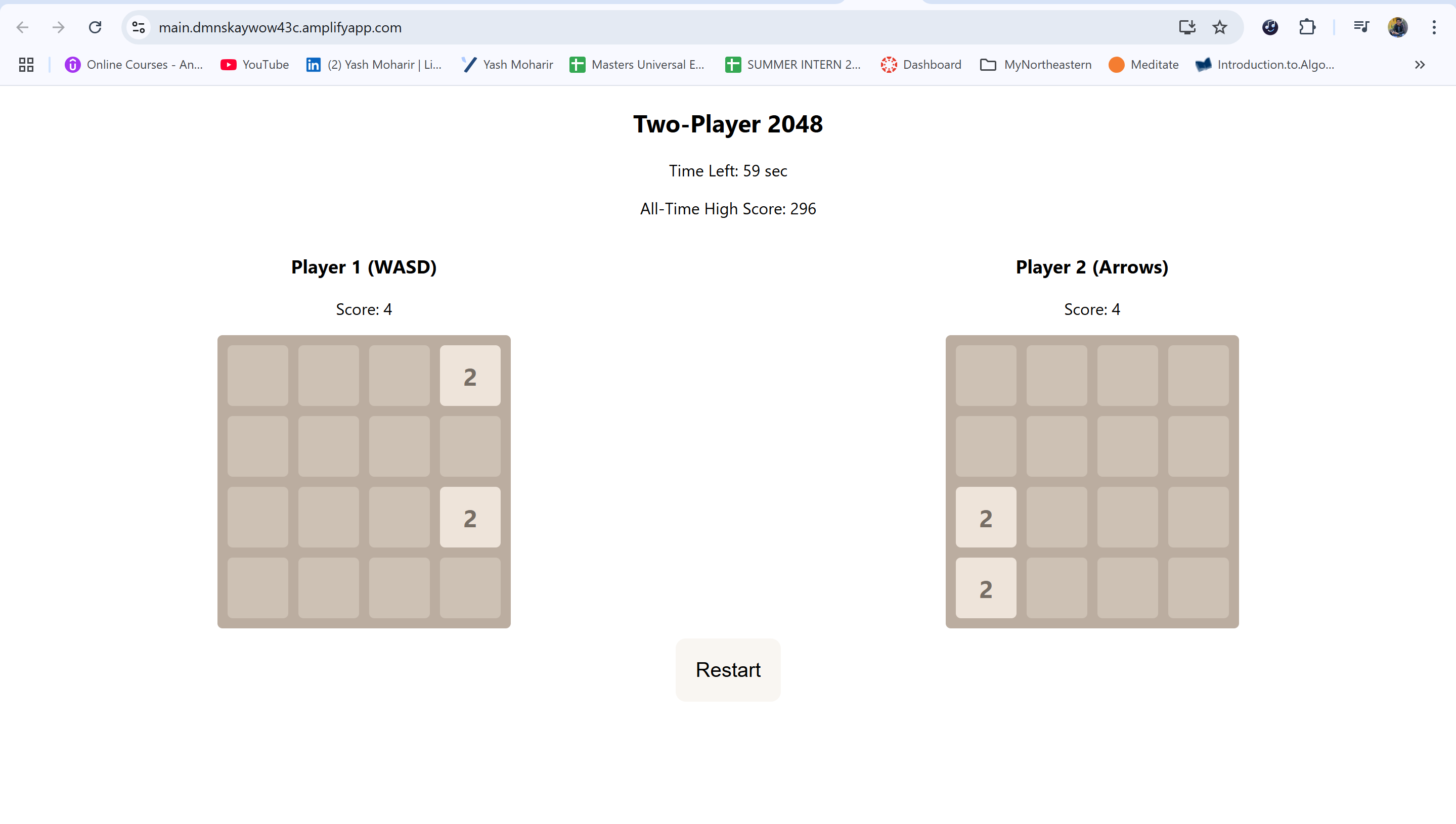
Start Menu
-
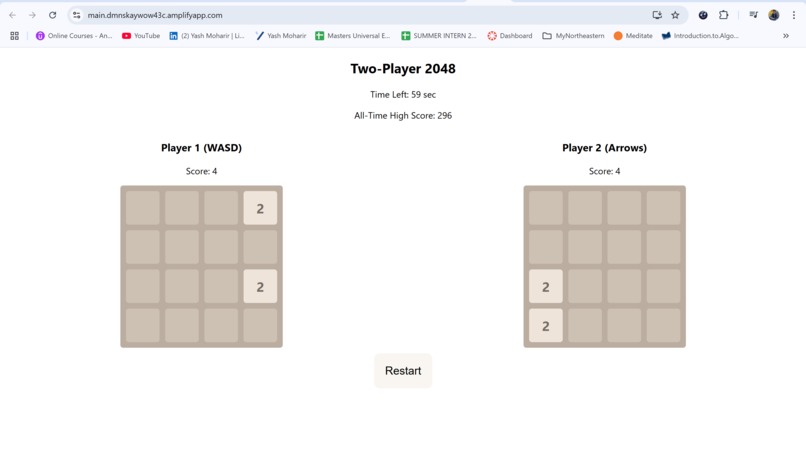
Start State
-
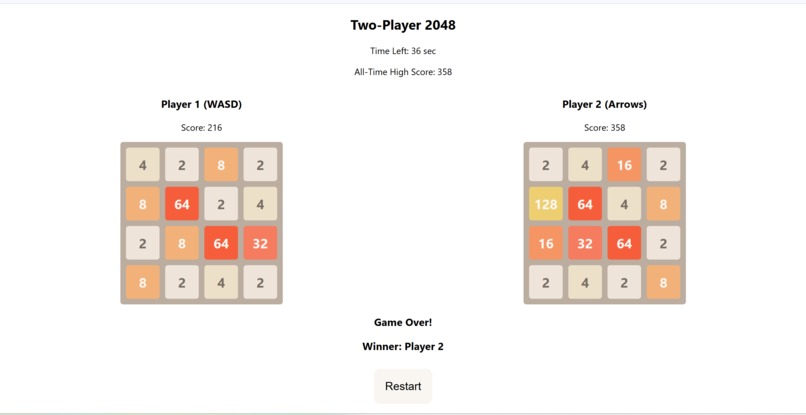
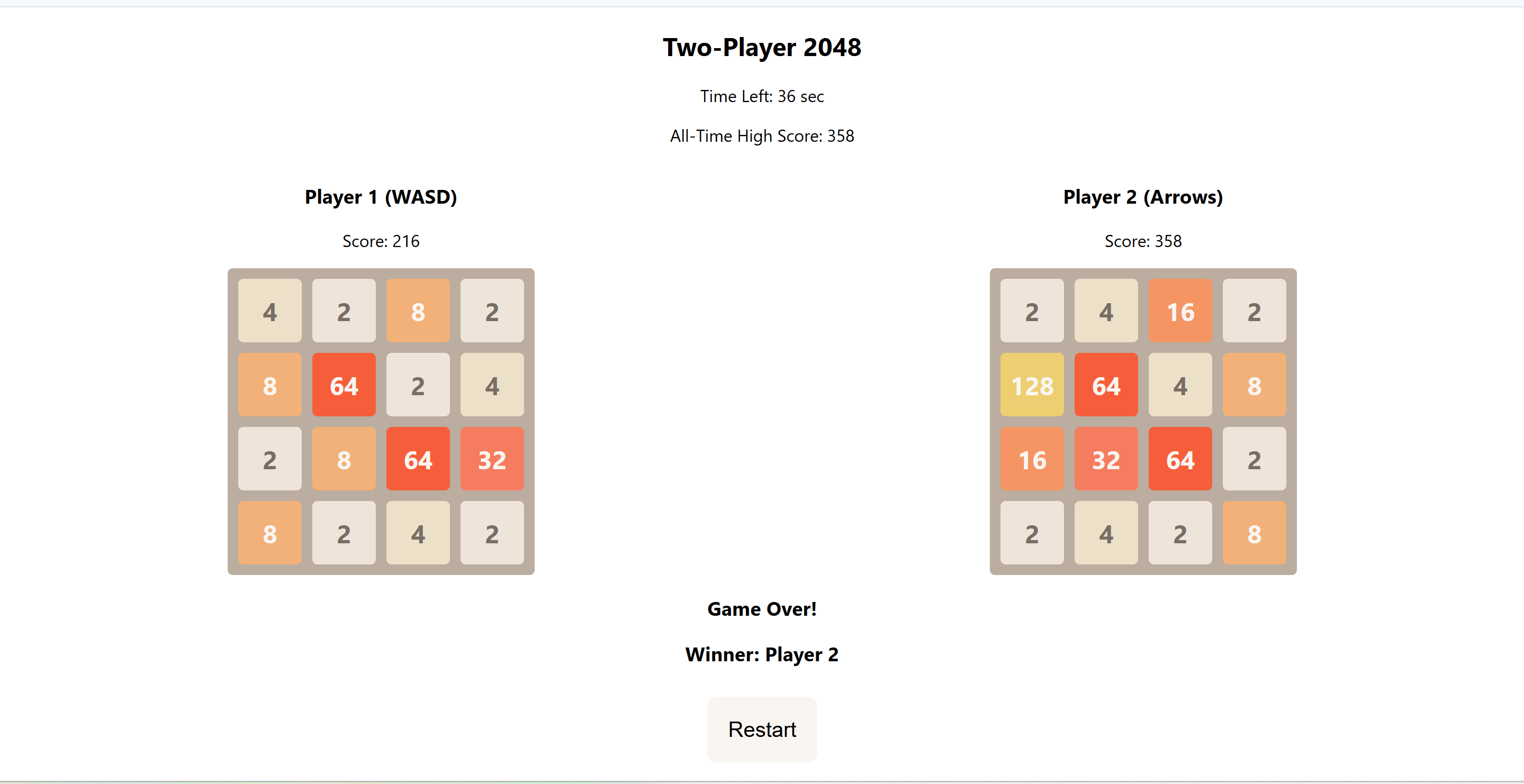
Game Completion
Inspiration
This was built and fully hosted in 2 hours !! with the help and incredible power of Amazon Q. I wanted to test the power of AWS, especially Amazon Q through this project. I wanted to create a basic but fun and challenging game for multi player. I have always loved 2048 as solo player game, but I thought making it multiplayer would add to the fun and make it more competitive. 2048 is a great brain teaser game, which combines strategy with math and puzzles which puts this game in a perfect quick gameplay.
What it does
This is a 2-player 2048 game. Both players can play on the same PC, one player uses 'WASD' while the other uses the arrow keys to control their respective boards. The game has a 1-minute timer, before which both the players must try to score maximum points. The game ends when either the time has run out or both the players have reached a state where no further movements are possible (game over).
How we built it
AWS Services:
- Hosting: Our React app is hosted on Amplify. I also hosted with S3 and CloudFront as a CDN.
- Serverless Backend: We leveraged AWS Lambda + Amazon API Gateway to create an API for storing and retrieving high scores.
- Hosting: Our React app is hosted on Amplify. I also hosted with S3 and CloudFront as a CDN.
Front-End (React): We used React to create a 2-player version of 2048, managing two separate boards. Player 1 controls the board with WASD, while Player 2 controls theirs with arrow keys. We added a timer to limit each round and used local state management (React Hooks) to track each board, score, and game status.
- Database: High scores and game data are persisted in Amazon DynamoDB.
- Additional Integrations: We used IAM roles to manage permissions, potentially adding Amplify for an easier CI/CD flow in the future.
- Database: High scores and game data are persisted in Amazon DynamoDB.
Game Logic: The 2048 mechanics (merging tiles, detecting game over, etc.) were adapted to run on separate boards. We introduced a “time left” counter that stops both players’ boards when it hits zero and determines the winner.
Use of Amazon Q
- Amazon Q made it possible to make this app within 2 hours. It suggested to me the steps and possible Amazon services that can be used in this app to optimize the function of the app.
- It suggested on how to host this app online and various options AWS offers and which is best suited. This made it very simple for me to host the app.
- Q helped me document the app by adding comments which improved readability and made it extremely easy to update the code.
- It was easy to write prompts, Q understood the task pretty accurately.
Challenges we ran into
- Synchronizing Two Boards: Managing separate board states for two players in one React component introduced complexity, especially around event handling (WASD vs. arrow keys).
- Detecting Simultaneous Game Over: Ensuring that if both boards ran out of moves, the game would immediately end (instead of waiting for another key press) required careful state checks.
- AWS Configurations:
- Setting up the correct IAM permissions for Lambda to access DynamoDB.
- Ensuring CloudFront and S3 were correctly configured for static hosting and SSL.
- Setting up the correct IAM permissions for Lambda to access DynamoDB.
- Time Constraints: Implementing features like real-time updates or advanced animations were deprioritized in favor of core functionality and AWS integration.
Accomplishments that we're proud of
- Complete 2-Player Mode: Successfully adapted the single-player logic into two independent boards, each with distinct controls and score tracking.
- Persistent High Scores: Building out a serverless architecture (API Gateway + Lambda + DynamoDB) so players’ best scores are stored indefinitely in the cloud.
- AWS Integration: We managed to incorporate multiple AWS services—S3, CloudFront, Lambda, API Gateway, DynamoDB—in a cohesive way, demonstrating a scalable, serverless approach.
- User-Friendly Interface: Even with the complexity of two boards and a timer, the interface remains straightforward, allowing for easy gameplay and immediate feedback on winners.
What we learned
- React Hooks & State Management: Handling multiple states (two boards, timer, high scores) in a single application reinforced our understanding of React Hooks.
- Serverless Best Practices: We gained hands-on experience configuring a Lambda-based API, hooking it to DynamoDB, and managing cross-service permissions via IAM.
- AWS Architecture: The interplay between S3 static hosting, CloudFront caching, and the benefits of a serverless database taught us how to design a modern, scalable architecture.
- Game Logic Adaptation: Converting 2048 to a real-time, 2-player model with separate inputs was a valuable exercise in modularizing and reusing core logic.
What's next for Multiplayer 2048 Game
- More Difficulty levels: adding difficulty configuration like changing the board size, or adding more tiles after each move to increase variations.
- User Authentication: Implement Amazon Cognito for user sign-in, so high scores and player identities persist across sessions more securely.
- Real-Time Mode: Integrate WebSocket APIs or AWS AppSync (GraphQL subscriptions) for truly live competition, which would open up new possibilities (e.g., spectating matches).
- Cross-Device Support & Swipe Controls: Add mobile swipe gestures, letting users play on touch devices.
- Deeper Analytics: Stream event data through Kinesis or Pinpoint to track usage trends, average game duration, and user engagement.
These improvements will keep the gameplay fresh, scale with new users, and provide a richer experience overall.


Log in or sign up for Devpost to join the conversation.