

Inspiration
Humans think in parallel, not in a single linear chain. When we make decisions, multiple “voices” in our mind contribute—logic, creativity, ethics, risk awareness, and intuition. Most AI tools today mimic a single, monolithic thought process.
But an octopus doesn’t work that way: each arm has its own intelligence, yet they coordinate seamlessly. We were inspired by that biological model and asked: What if AI could think like an octopus—multiple specialized brains working together toward a single goal?
That question led to Multi_Brain_AI_Assistant, a multi-agent reasoning engine where different AI “brains” evaluate a problem from unique angles, then collaborate to produce a well-balanced answer.
What it does
Multi_Brain_AI_Assistant is an AI system composed of eight specialized reasoning agents, each acting like a distinct “cognitive arm.” When given any task—planning, strategy, problem-solving, decision-making—the system:
Splits the prompt across multiple brains, each with a unique role:
Logical Planner
Creative Generator
Risk Analyst
Ethical Advisor
Data Verifier
Budget Optimizer
Constraint Checker
Simplifier/Communicator
Runs them in parallel to generate diverse perspectives.
Aggregates their outputs using a consensus layer that:
identifies contradictions
resolves conflicts
balances creativity with realism
highlights risks or blind spots
Returns a unified, multi-perspective answer with a rationale for each cognitive dimension.
The result is an AI that thinks—not just responds.
How we built it
We built Multi_Brain_AI_Assistant as a modular software system with:
- A Multi-Agent Architecture
Each agent is an LLM instance initialized with a rigorous system prompt to enforce cognitive specialization.
- Parallel Orchestration Layer
We used asynchronous execution (e.g., Python asyncio / Node workers) to run all agents simultaneously, reducing latency and enabling true “parallel thinking.”
- Consensus Engine
A custom aggregation kernel:
merges outputs
detects conflicts
ranks recommendations
generates final combined reasoning
explains how each agent contributed
- Lightweight Frontend
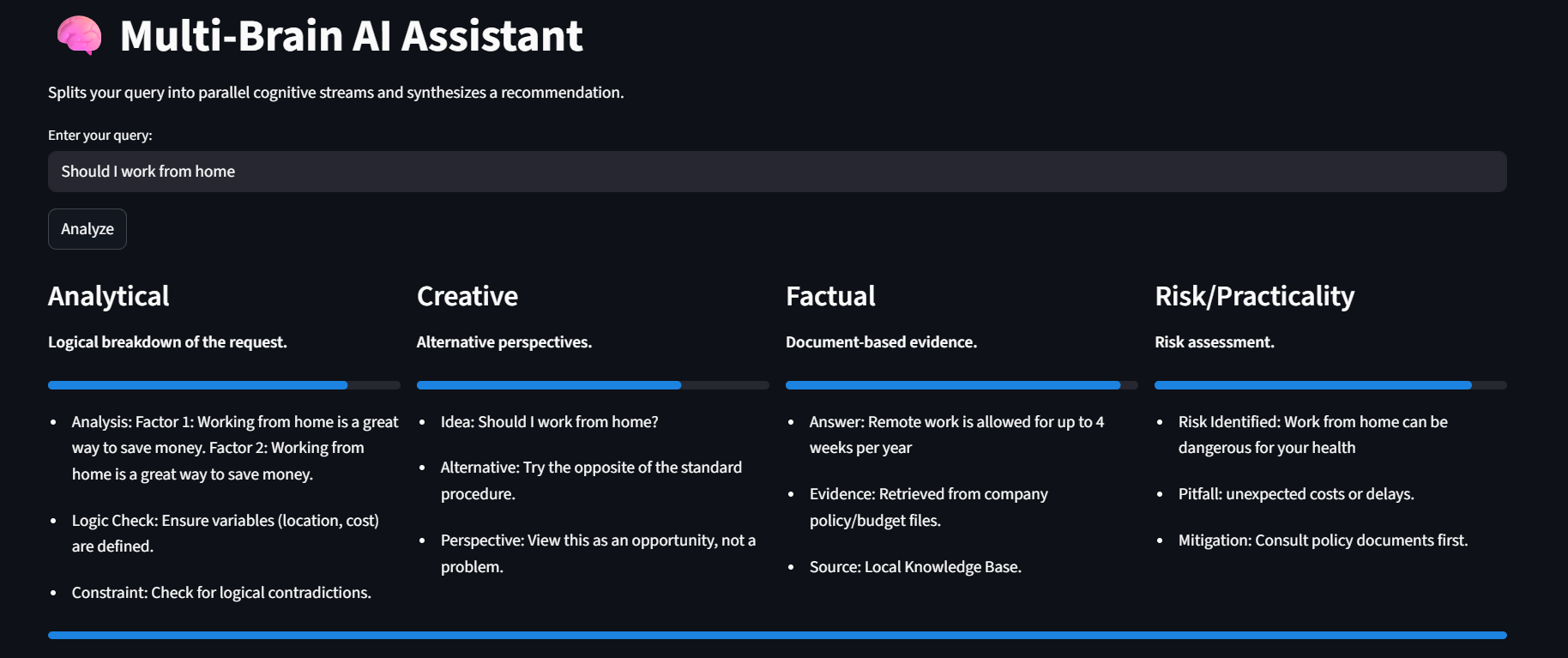
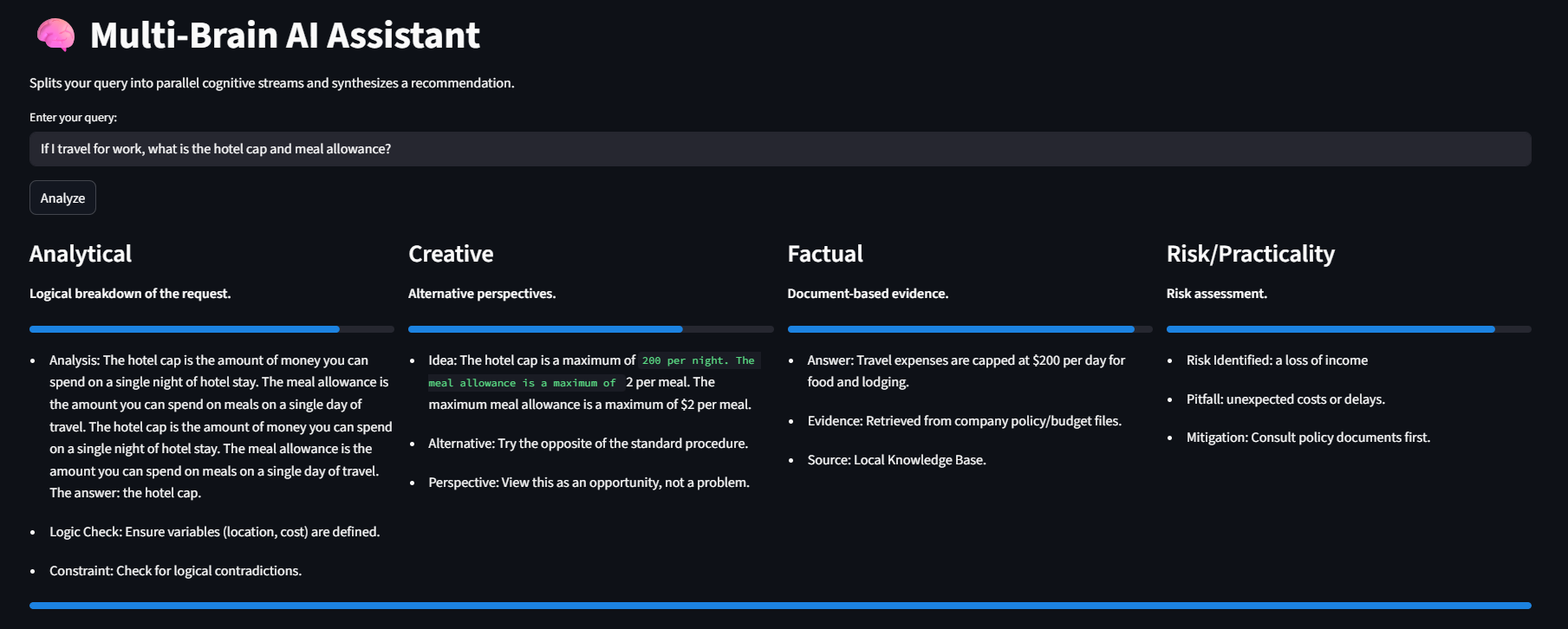
A simple web interface that shows:
the user prompt
individual agent responses
final merged output
visual “octopus brain map” of contributions
- Optional Memory + Context Layer
For more complex tasks, we retain short-term memory to allow agents to refine their outputs in multiple rounds.
Challenges we ran into
- Getting the agents to truly specialize
LLMs tend to converge on similar tones. We had to carefully craft distinct personas + constraints so each brain produced meaningfully different reasoning.
- Aggregation is surprisingly hard
Merging eight different reasoning styles without losing nuance required creating a custom scoring + summarization system.
- Maintaining speed
Parallelism helps, but coordinating multiple LLM calls and merging them without timeout issues was a real challenge.
- Preventing agents from contradicting each other uncontrollably
We had to tune the system so:
risk analysis stayed realistic
creativity didn’t go unbounded
ethics didn’t overrule practical constraints
Balancing the “voices” was like designing an internal government.
Accomplishments that we're proud of
Built a true multi-agent reasoning system, not just an LLM wrapper
Achieved agent specialization where each brain added unique value
Created a visual interface that makes parallel reasoning understandable
Handled complex real-world tasks like:
business strategy
product roadmaps
multi-criteria decision making
risk-balanced planning
Delivered outputs measurably better than a single AI instance
Captured the octopus-inspired spirit of distributed intelligence
What we learned
Multi-agent AI is more powerful than single-model prompting, but requires careful coordination.
Parallel cognitive diversity creates insights that a single model would never propose.
Specialized system prompts can reliably produce distinct cognitive styles.
Real-world problems benefit from multiple perspectives, especially when risk, ethics, creativity, and data must all align.
Users value transparency—showing how each agent contributes increases trust.
What's next for Multi_Brain_AI_Assistant
Add more agent types (legal analysis, emotional intelligence, growth hacking, scientific reasoning)
Enable multi-round debate between agents for deeper reasoning
Incorporate small ML models (sentiment, numerical estimators, retrieval) as “micro-brains”
Train lightweight custom models to enhance specialization
Build an API so developers can integrate multi-brain reasoning into their apps
Develop mobile + plugin versions for email, docs, and coding
Open-source the architecture to encourage further research in multi-agent AI
Ultimately, Multi_Brain_AI_Assistant aims to become the standard interface for complex decision-making, powered by many minds working as one—just like the octopus.
Built With
- asyncio
- docker
- figma
- flask/fastapi
- github-actions
- html/css
- huggingface-inference
- javascript
- node.js
- openai-api-(or-other-llm-apis)
- python
- react
- redis-(for-caching)
- tailwindcss
- typescript
- ui/ux)
- vector-stores-(chromadb-/-pinecone)
- vercel
- vite
- websockets

Log in or sign up for Devpost to join the conversation.