-
-
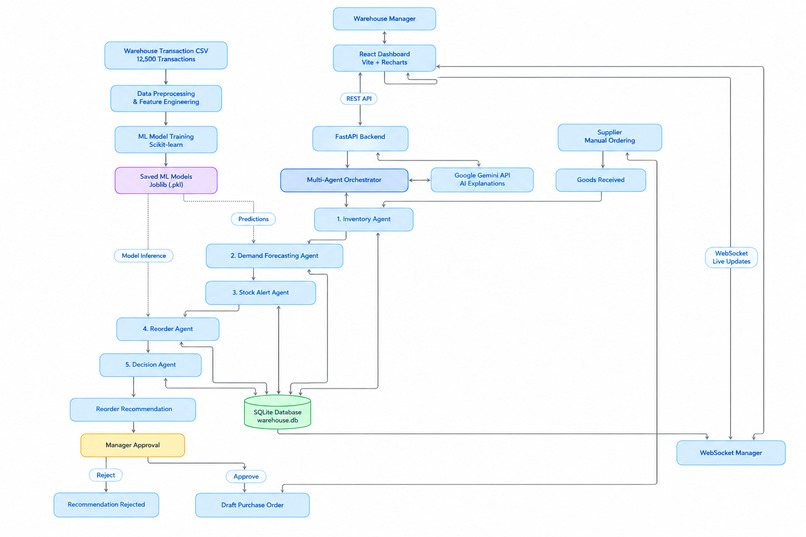
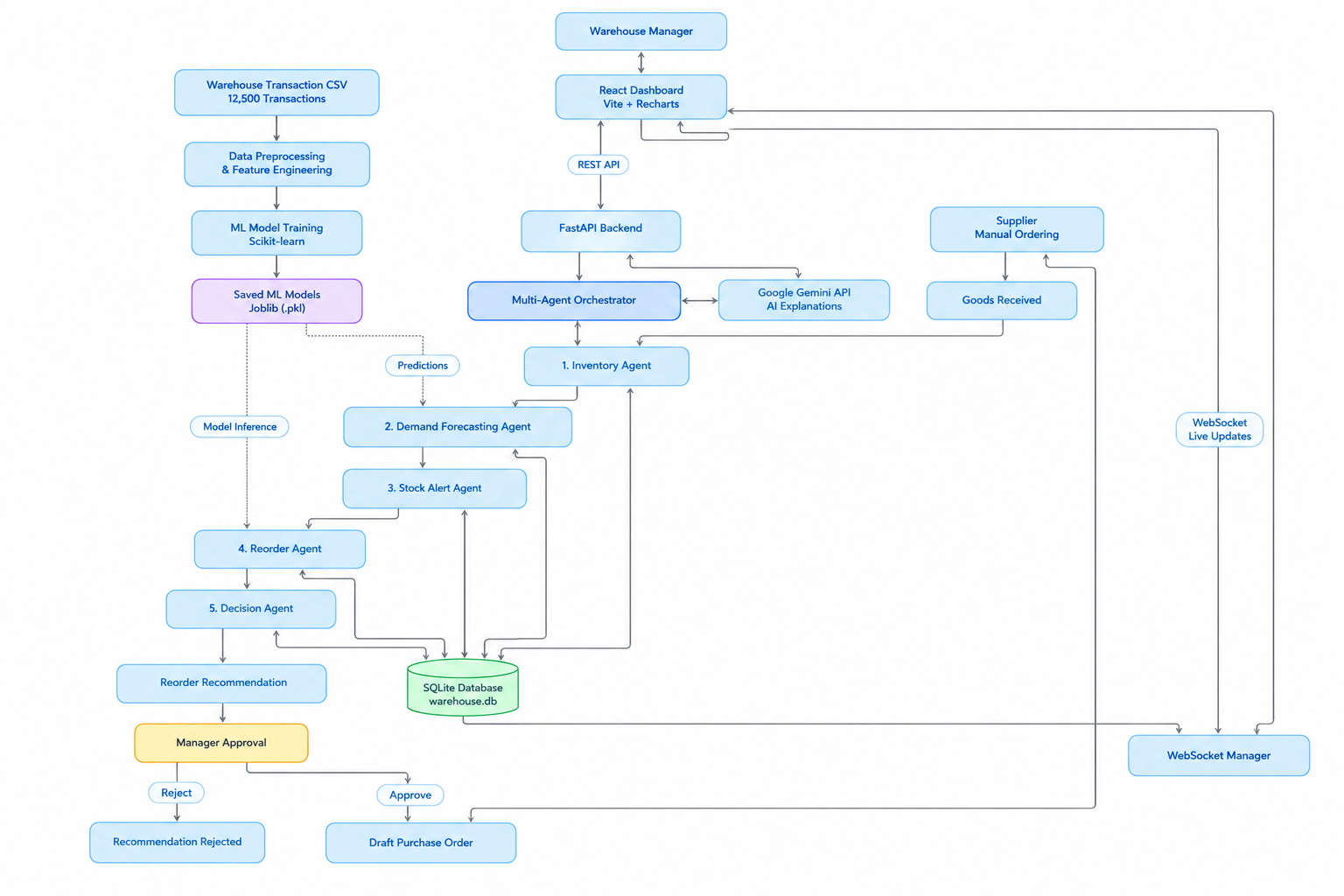
Project Architecture Diagram
-
-
-
Inspiration
Traditional warehouse management often depends on manual stock checking and fixed reorder levels, leading to stockouts, overstocking, and delayed purchasing decisions. We wanted to develop a smarter solution that helps warehouse managers monitor inventory, predict future demand, and make timely reordering decisions using Al and machine learning. This inspired us to build a multi-agent warehouse inventory management system.
What it does
Our project uses five specialized agents that collaborate to improve warehouse operations:
- ** Inventory Agent :** Tracks stock levels and processes inventory transactions across multiple warehouse locations.
- ** Demand Prediction Agent :** Forecasts product demand for the next 7 and 30 days using machine learning.
- ** Stock Alert Agent :** Detects low-stock conditions and potential stockout risks.
- ** Reorder Planning Agent :** Calculates recommended reorder quantities based on demand, safety stock, supplier lead time, and existing purchase orders.
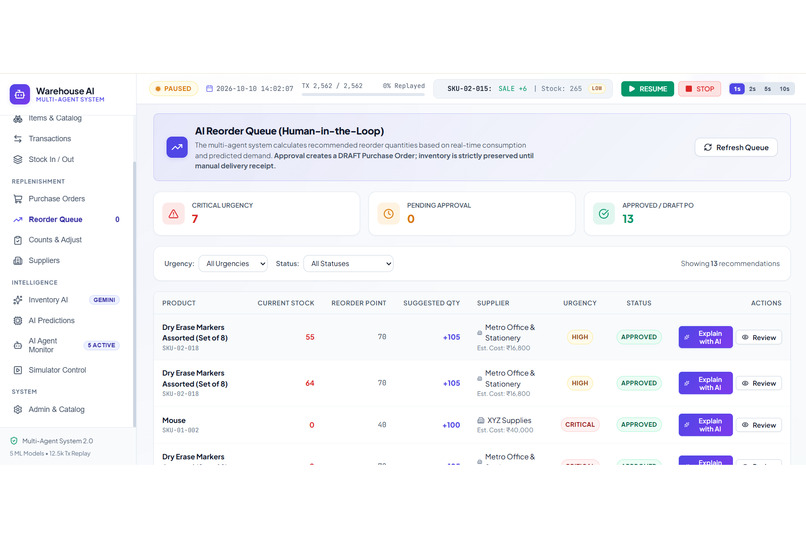
- ** Decision Agent :** Combines the results from all agents to generate final reorder recommendations.
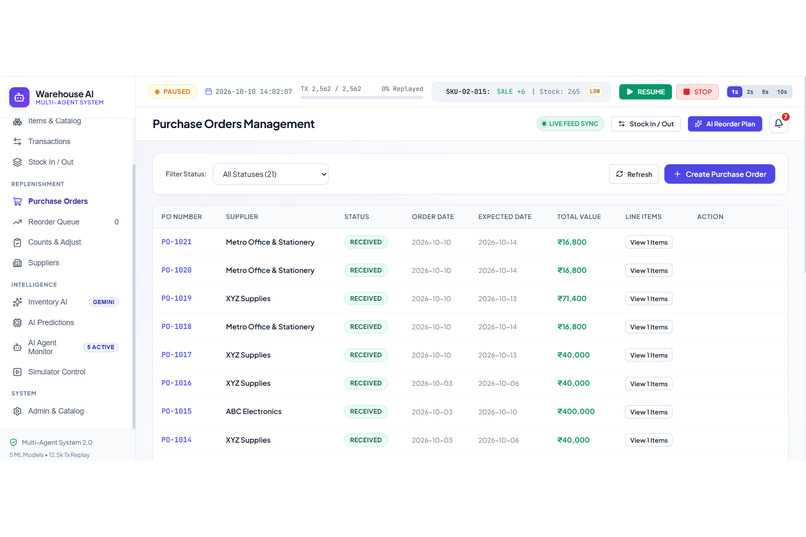
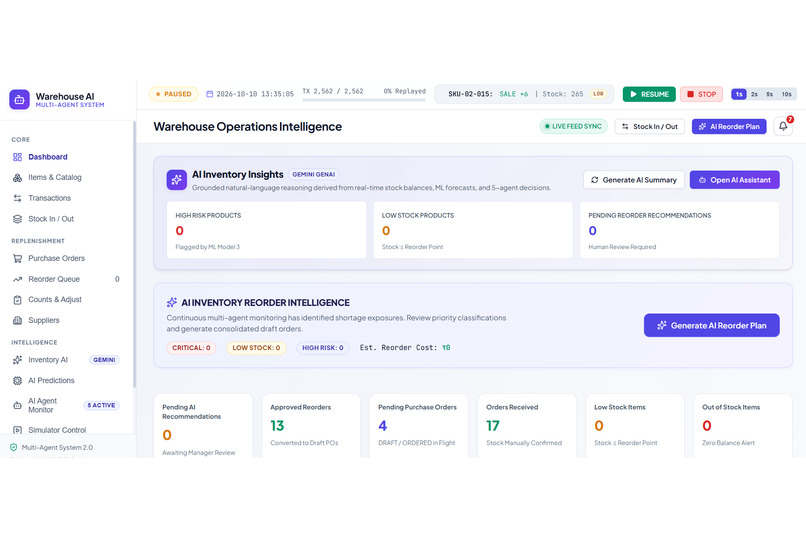
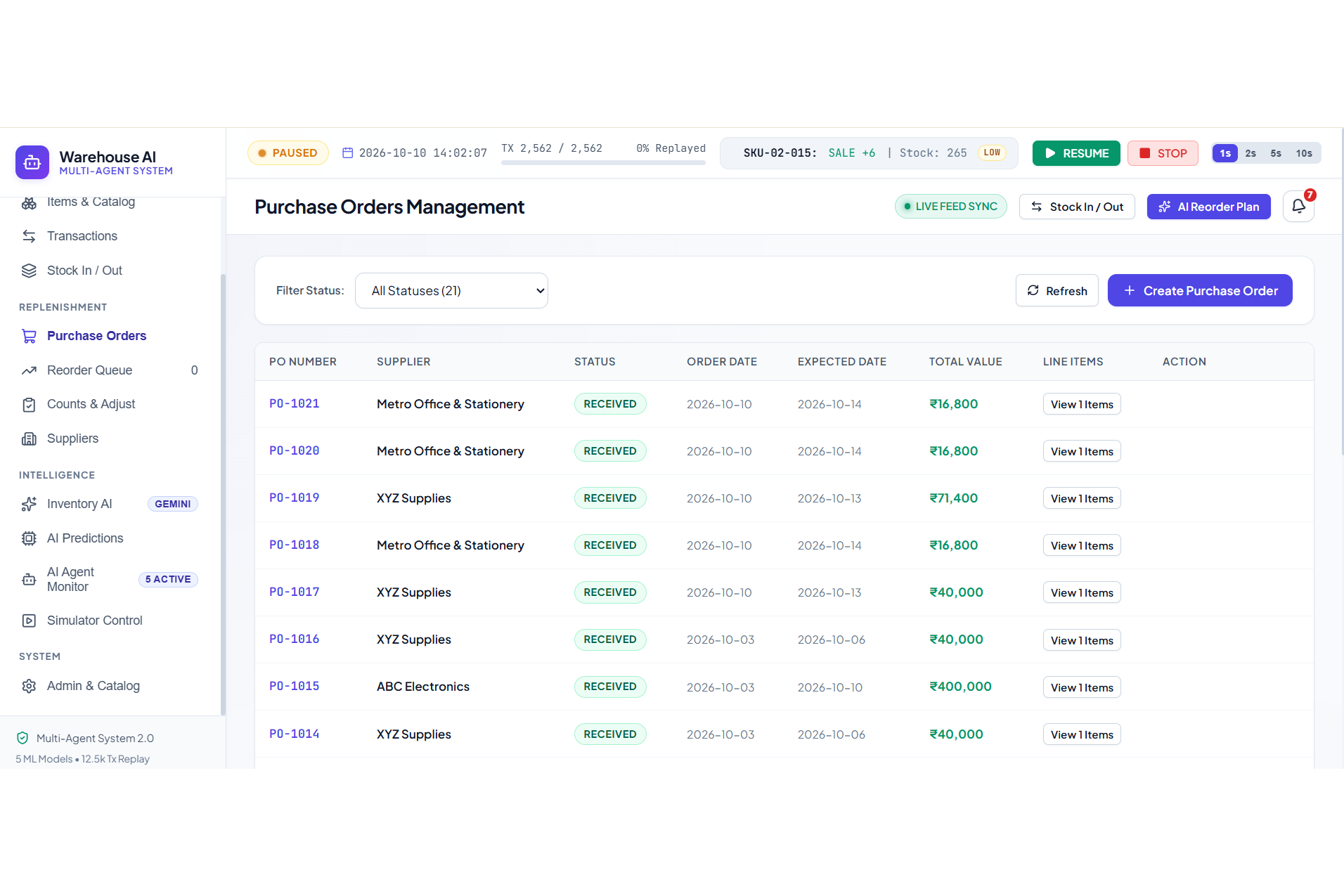
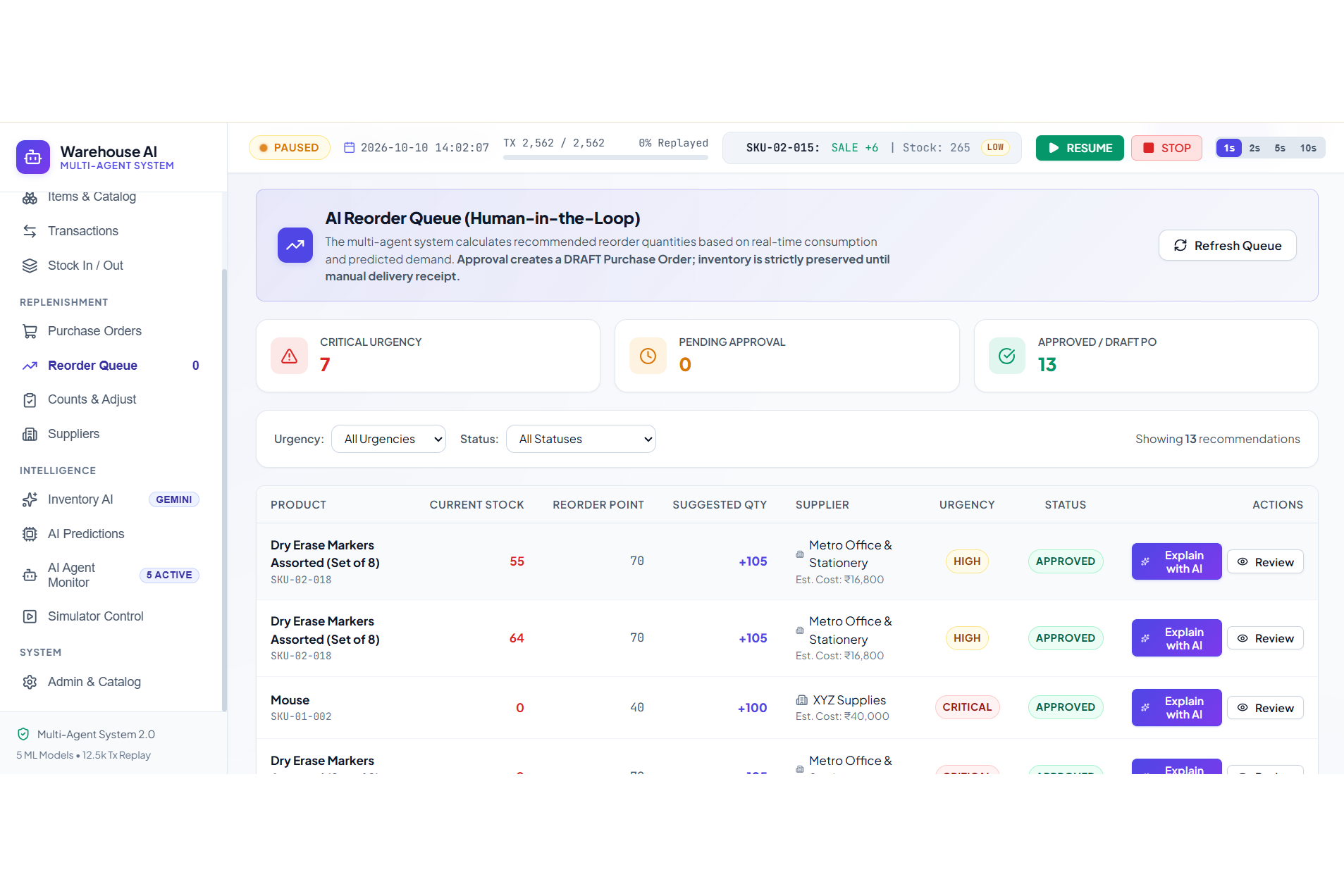
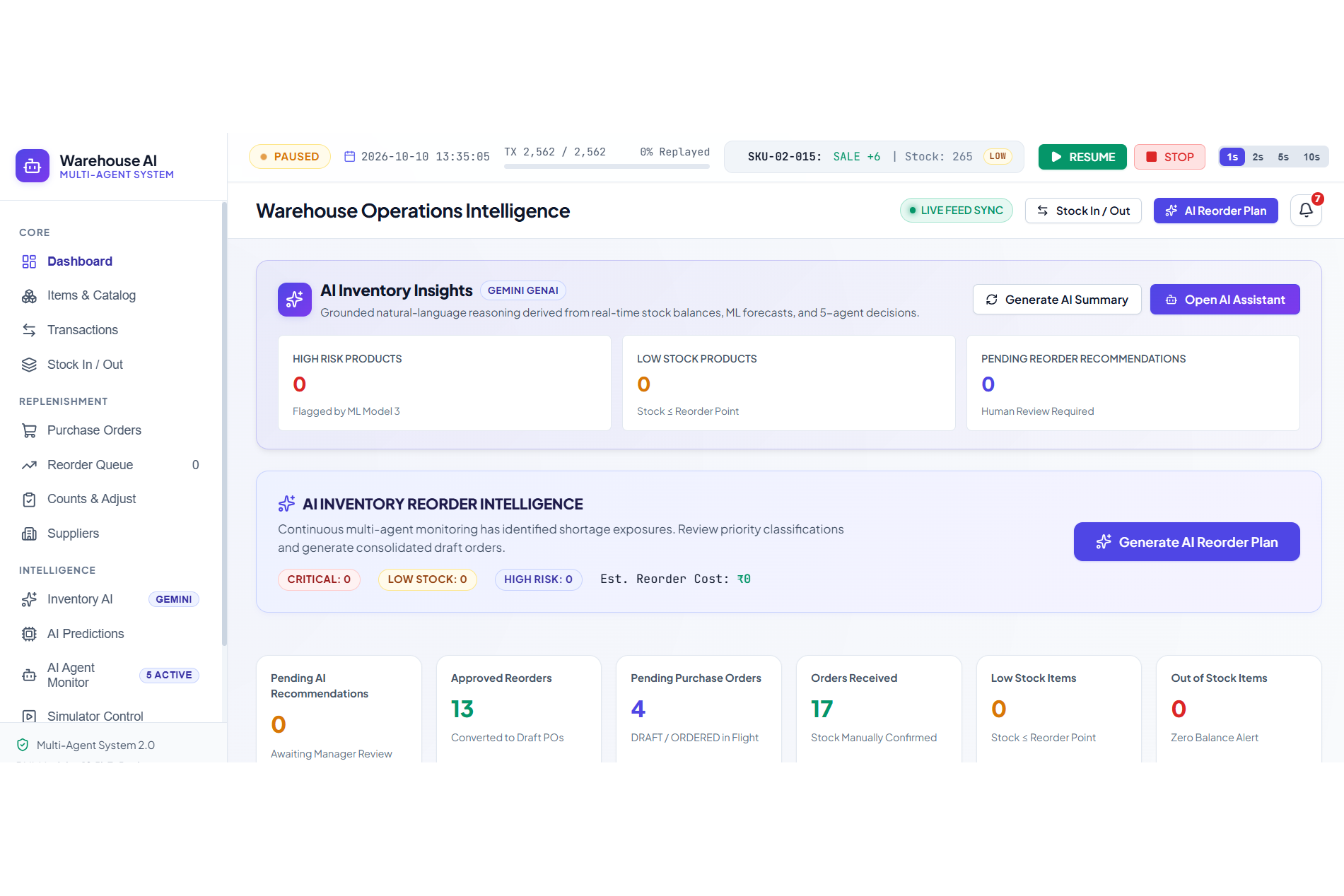
The system provides a real-time dashboard to monitor inventory, view predictions, track alerts, manage suppliers, and handle purchase orders. Warehouse managers must approve reorder recommendations before purchase orders are created, ensuring human control over purchasing decisions.
How we built it
We developed the frontend using ** React.js and Vite ** , with Recharts for visualizing inventory data. The backend uses ** Python and FastAPI ** to handle API requests, inventory operations, and coordination between agents.
We used ** SQLite and SQLAlchemy ** to store product details, inventory levels, transaction history, supplier information, predictions, and purchase orders. We trained five machine learning models using ** Scikit-learn ** for demand forecasting, short-term demand prediction, stockout risk classification, reorder quantity estimation, and inventory status classification.
Historical warehouse transaction data is used for model training, while a transaction simulator generates sample sales to demonstrate inventory changes. We also implemented ** WebSockets ** for real-time dashboard updates and integrated the Google Gemini API for natural-language explanations of inventory decisions.
Challenges we ran into
One major challenge was coordinating five agents so that each could perform its task and pass the required information to the next agent. Combining machine learning predictions with business rules was also challenging, particularly when calculating reorder quantities using demand, safety stock, lead time, and existing purchase orders.
We also worked on maintaining consistent stock levels across multiple warehouse locations, preventing negative inventory, and displaying updates without refreshing the dashboard. Evaluating prediction accuracy taught us that machine learning outputs can be uncertain and should be supported by practical inventory rules.
Accomplishments that we're proud of
We are proud to have developed a warehouse management prototype that combines multi-agent coordination, machine learning, database management, and real-time visualization.
Our key accomplishments include:
- Implementing five specialized agents for inventory monitoring and reorder decisions.
- Training machine learning models for demand forecasting and inventory analysis.
- Managing 54 products across 8 warehouse locations.
- Developing a real-time dashboard with charts, alerts, and agent activity monitoring.
- Implementing human approval before purchase orders are created.
- Integrating inventory transactions, supplier details, reorder recommendations, and purchase order management into one application.
What we learned
Through this project, we gained practical experience in multi-agent system design, machine learning, feature engineering, REST API development, database management, and WebSocket communication. We learned how to connect a React frontend with a Python backend and coordinate multiple software components to solve a real-world problem.
We also understood that Al predictions are not always perfectly accurate. Combining machine learning with business rules and human approval can make inventory decisions more practical and reliable. This project helped us improve our problem-solving, debugging, teamwork, and software development skills.
What's next for Multi-Agent Warehouse Inventory and Reorder Prediction
In future versions, we plan to improve demand forecasting accuracy, introduce dynamic safety stock calculations, and compare multiple suppliers based on cost, reliability, and delivery time. We also aim to integrate barcode and RFID scanners for easier stock updates and explore cloud deployment with a scalable database.
Additional improvements could include seasonal demand analysis, enhanced Al explanations, and more comprehensive performance evaluation. Our long-term goal is to develop a scalable and intelligent warehouse management solution that reduces stockouts, minimizes excess inventory, and helps warehouse managers make better data-driven decisions.
Built With
- artificial-intelligence
- automation
- data-visualization
- demand-forecasting
- fastapi
- generative-ai
- google-gemini-api
- human-in-the-loop
- inventory-management
- javascript
- machine-learning
- multi-agent-systems
- numpy
- pandas
- predictive-analytics
- python
- react
- real-time-dashboard
- rest-api
- scikit-learn
- sqlalchemy
- sqlite
- supply-chain-management
- vite
- websockets

Log in or sign up for Devpost to join the conversation.