-
-
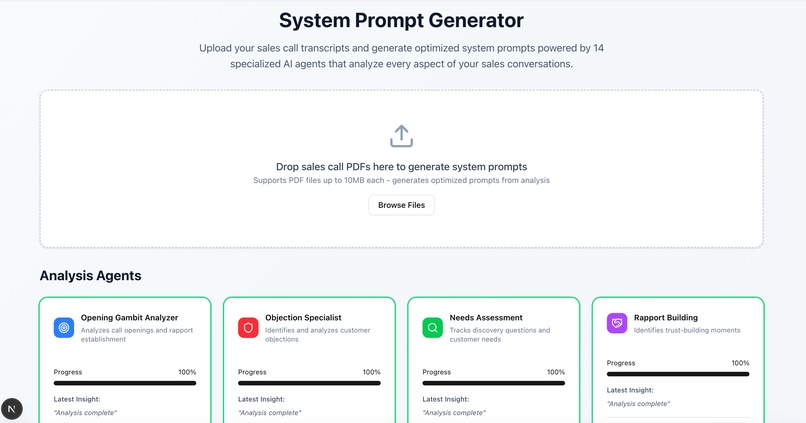
Dashboard

Inspiration Having spent years in life insurance sales, I lived with a constant question: what separated my good days from bad days? Every call was recorded, but reviewing hours of audio manually was impractical. I knew somewhere in those recordings were patterns - the right phrases, perfect timing, effective objection handling - that made the difference between closing and losing a deal. This hackathon was my chance to finally build the AI-powered analysis tool I wished I'd had.
What We Learned Building with Google's Agent Development Kit opened our eyes to the power of true multi-agent collaboration. We discovered that breaking down complex analysis into specialized agents (emotional intelligence, objection handling, compliance checking, etc.) created insights far richer than any single model could provide. We learned to orchestrate asynchronous agent workflows, manage inter-agent communication, and synthesize diverse perspectives into cohesive coaching strategies.
How We Built It We architected a 14-agent system using Google ADK with three processing phases:
- Phase 1 (Analysis): 9 specialized agents analyze different aspects of sales calls
- Phase 2 (Synthesis): 4 agents synthesize findings into actionable patterns
- Phase 3 (AI Integration): Advanced prompt generation with dynamic decision trees
We used Flask with WebSockets for real-time progress tracking, React/Next.js for an intuitive dashboard, and integrated Gemini models through ADK for powerful language understanding. The system processes PDF transcripts and delivers comprehensive coaching insights.
Challenges We Faced Our biggest challenge was migrating from a single-model architecture to ADK's multi-agent paradigm. Coordinating 14 agents required careful orchestration - we had to handle race conditions, ensure proper data flow between phases, and manage API rate limits.
Another hurdle was making AI insights actionable for salespeople. Raw analysis wasn't enough; we needed to transform complex patterns into clear, personalized coaching. This led us to develop our dynamic decision tree system and crisis recovery protocols.
Performance optimization proved tricky with 14 agents processing simultaneously. We implemented intelligent caching, parallel processing where possible, and a pause/skip system for individual agents. The real-time progress tracking via WebSockets was particularly challenging but crucial for user experience.
Built With
- adk)
- api
- flask
- gemini
- python
- react/next.js
- websockets

Log in or sign up for Devpost to join the conversation.