-
-
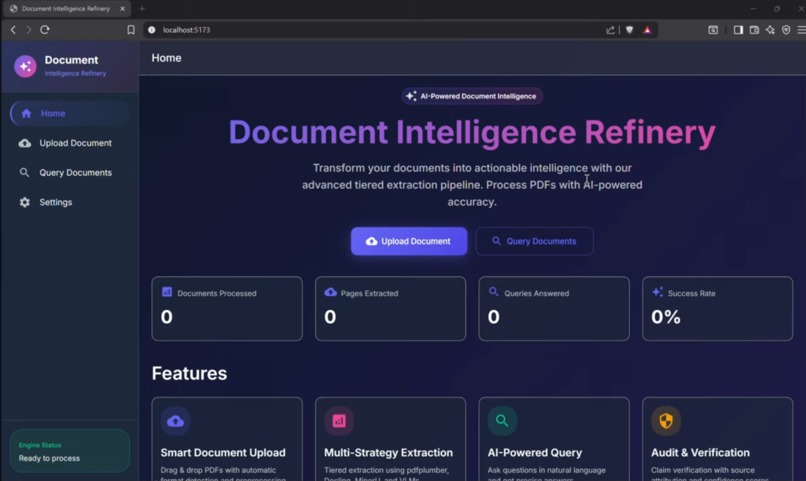
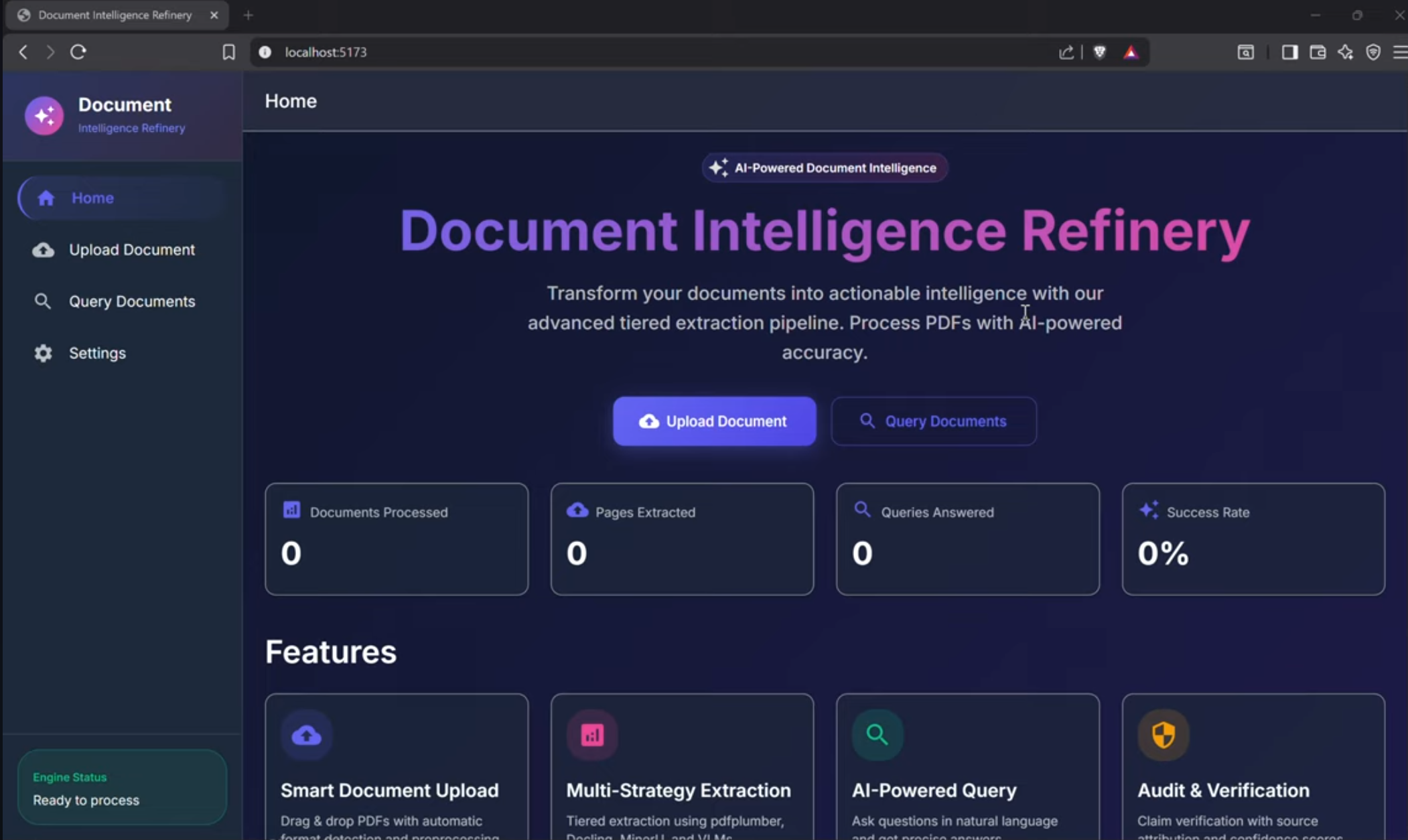
Document Intelligence Refinery
Inspiration
In today’s digital world, organizations are inundated with documents—PDFs, reports, invoices, and scanned forms. Extracting meaningful insights manually is slow, error-prone, and inefficient. I was inspired to create a solution that could transform unstructured documents into structured, actionable intelligence, allowing teams to make faster, data-driven decisions.
The idea came from observing how AI and automation are revolutionizing industries, yet document processing remains largely manual and fragmented.
What it does
The project ingests documents, extracts and structures their content, builds a searchable index, and lets users query the documents in natural language.
How i built it
I built it by creating a multi-stage document processing pipeline that combines AI agents, extraction tools, and indexing. Step by step:
Document Ingestion – I set up a system to accept PDFs, Word files, images, etc. Triage Agent – I built a classifier that analyzes each document to choose the right extraction strategy. Text & Structure Extraction – I integrated OCR and layout-aware parsers to extract text and metadata. Semantic Chunking – I developed logic to split the extracted text into meaningful, context-rich chunks. Indexing – I built a hierarchical PageIndex to make chunks searchable and navigable. Query Layer – I connected the index to a natural language interface so users can ask questions about the document. Integration & Automation – I orchestrated all components into a single pipeline using Python (with optional Rust modules for performance).
Challenges i ran into
I ran into several challenges while building the project:
Document Variety – Documents came in many formats, layouts, and qualities, making extraction inconsistent. OCR Accuracy – Scanned and low-quality documents sometimes produced errors that I had to correct or filter. Semantic Chunking – Breaking text into meaningful chunks without losing context was difficult, especially for complex documents. Indexing Large Documents – Handling very large documents efficiently without slowing down queries required optimization. Integration Complexity – Orchestrating multiple tools, AI agents, and parsers into a seamless pipeline took careful design. Query Accuracy – Making natural language queries return precise and relevant answers required tuning and testing the AI components.
Overall, balancing accuracy, speed, and scalability was the hardest part.
Accomplishments that i proud of
I’m proud of several accomplishments with this project:
Fully Automated Pipeline – I built a system that can take any document, process it intelligently, and make it queryable without manual intervention. AI-Driven Triage – I successfully implemented an agent that decides the best extraction strategy for each document type. Semantic Understanding – I developed a chunking and indexing system that preserves context, making queries much more accurate. Natural Language Querying – I enabled users to ask questions about documents in plain language and get precise answers. Scalable Architecture – I created a modular pipeline that can handle large and diverse document sets efficiently. Learning & Growth – I deepened my expertise in AI agents, document parsing, OCR, and system integration through hands-on problem solving.
These achievements turned a complex, messy process into a structured, intelligent, and usable tool.
What i learned
While building this project, I gained hands-on experience in:
Natural Language Processing (NLP): Techniques for extracting context, key entities, and relationships from text. Document Parsing: Handling PDFs, DOCX files, and scanned images. Data Pipelines: Automating the flow from raw documents to structured databases. AI Model Integration: Using pretrained and fine-tuned models for classification, summarization, and insight extraction. System Design: Building a scalable architecture that can process large volumes of documents efficiently.
Additionally, I honed my problem-solving skills in error handling, data consistency, and performance optimization.
What's next for The Document Intelligence Refinery
Next for The Document Intelligence Refinery, I plan to:
Expand Document Support – Add more file types, including complex spreadsheets, scanned forms, and images with tables. Improve OCR & Extraction Accuracy – Integrate advanced OCR models and AI-based layout understanding to reduce errors. Enhanced Query Intelligence – Make natural language queries smarter, with better context awareness and summarization. Collaboration Features – Enable multiple users to annotate, share, and discuss insights directly from documents. Performance & Scalability – Optimize the pipeline to handle massive document collections quickly and efficiently. AI Agent Customization – Allow users to plug in custom AI agents for domain-specific processing. Integration with Workflows – Build APIs and connectors so the system can integrate with other tools, like CRMs, data warehouses, or knowledge bases.
The goal is to make the system not just a document analyzer, but a full-fledged knowledge refinery that can power decision-making from any document source.
Built With
- docker
- docling
- faiss
- fastapi
- langchain
- langgraph
- layout-parser
- pdfplumber
- pydantic
- pymupdf
- pytest
- python
- rust
- tesseract
- typescript
- uvicorn
- vlms

Log in or sign up for Devpost to join the conversation.