-
-
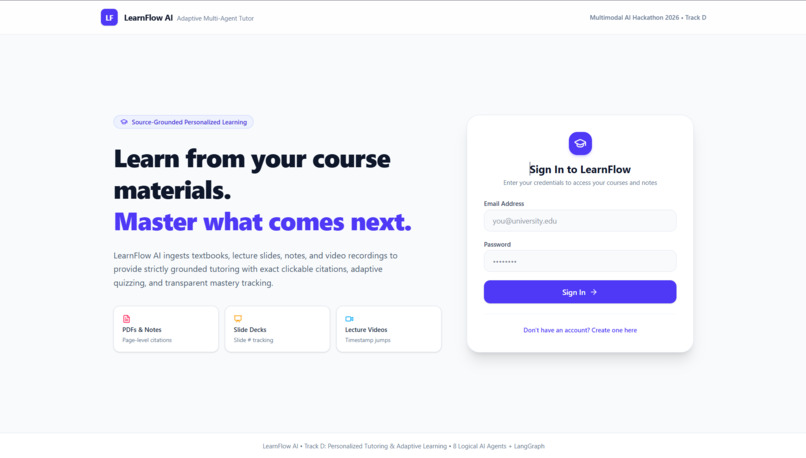
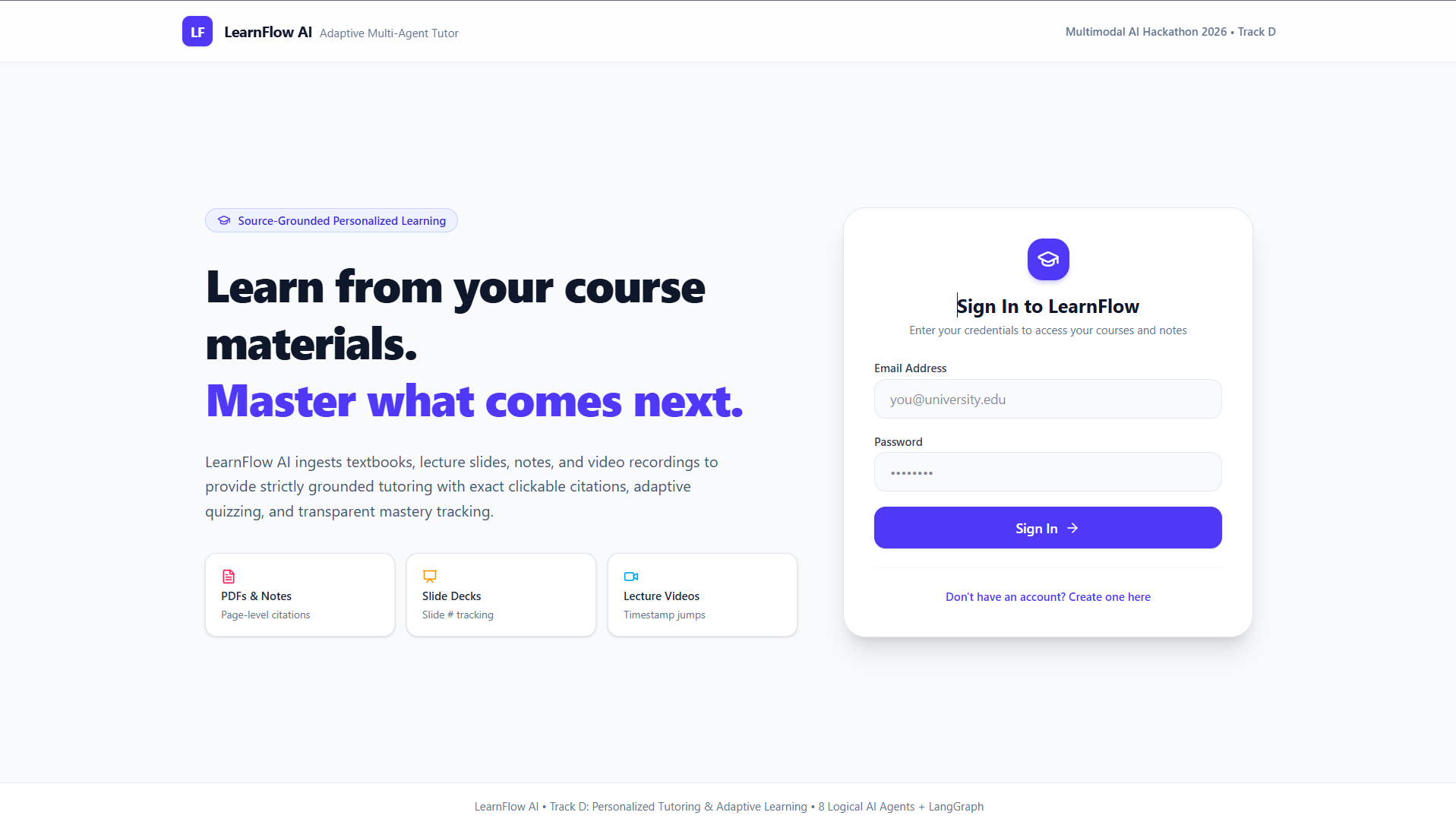
Login Page: Secure and user-friendly authentication for personalized learning.
-
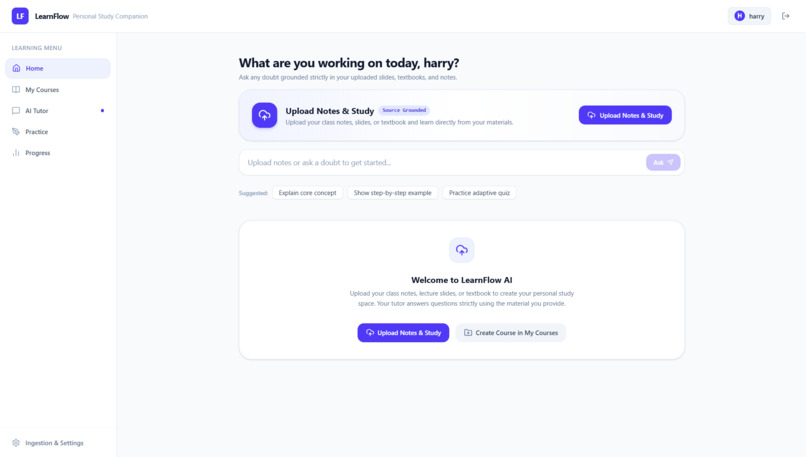
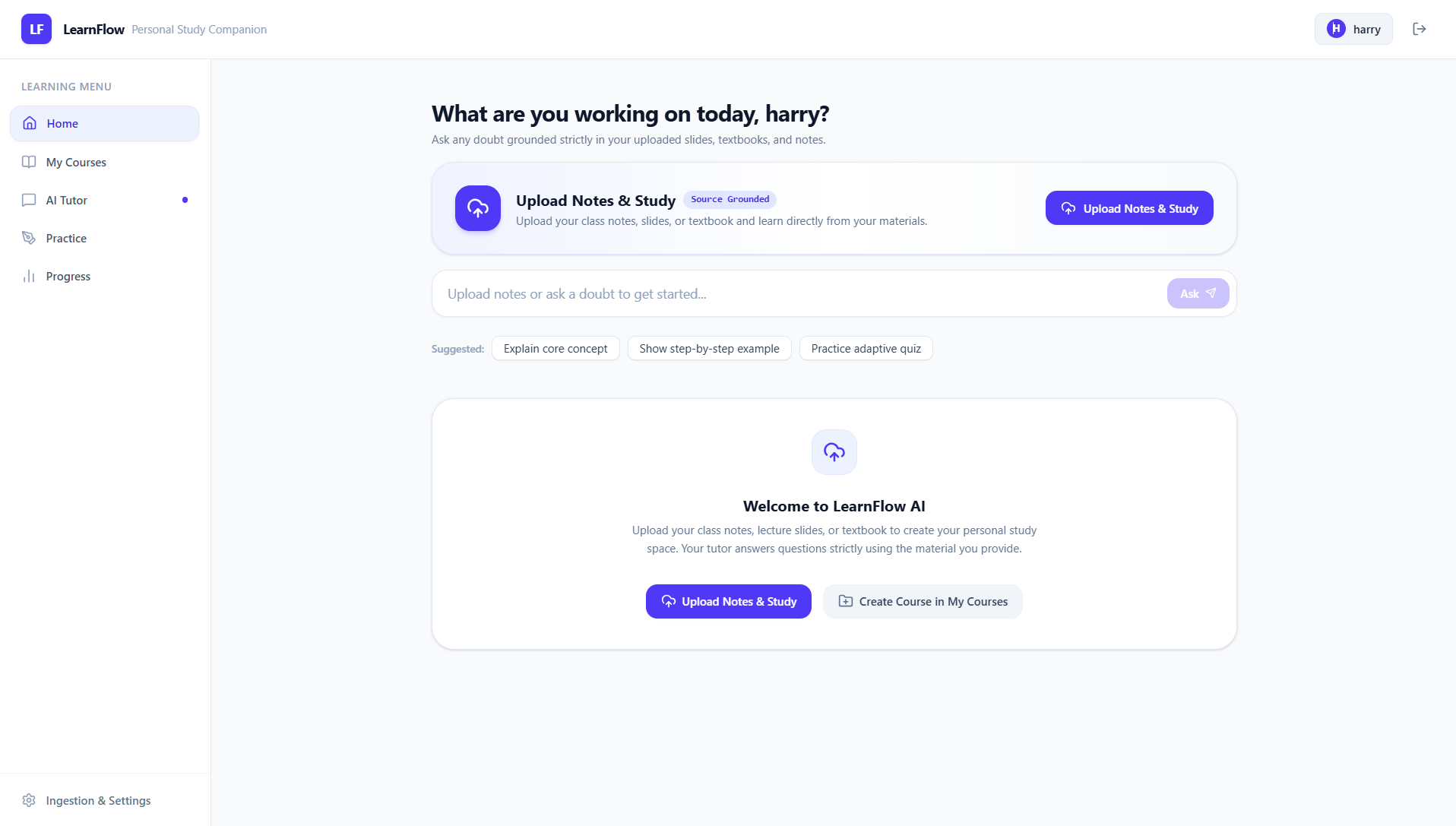
Dashboard: A centralized workspace for courses, AI tutoring, and study materials.
-
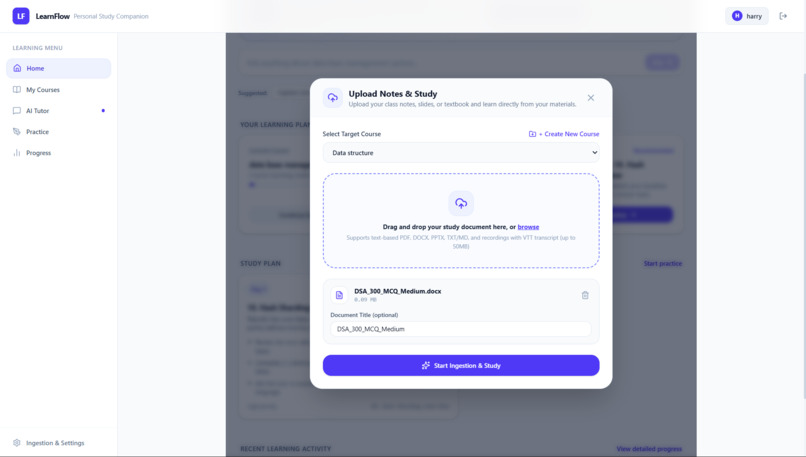
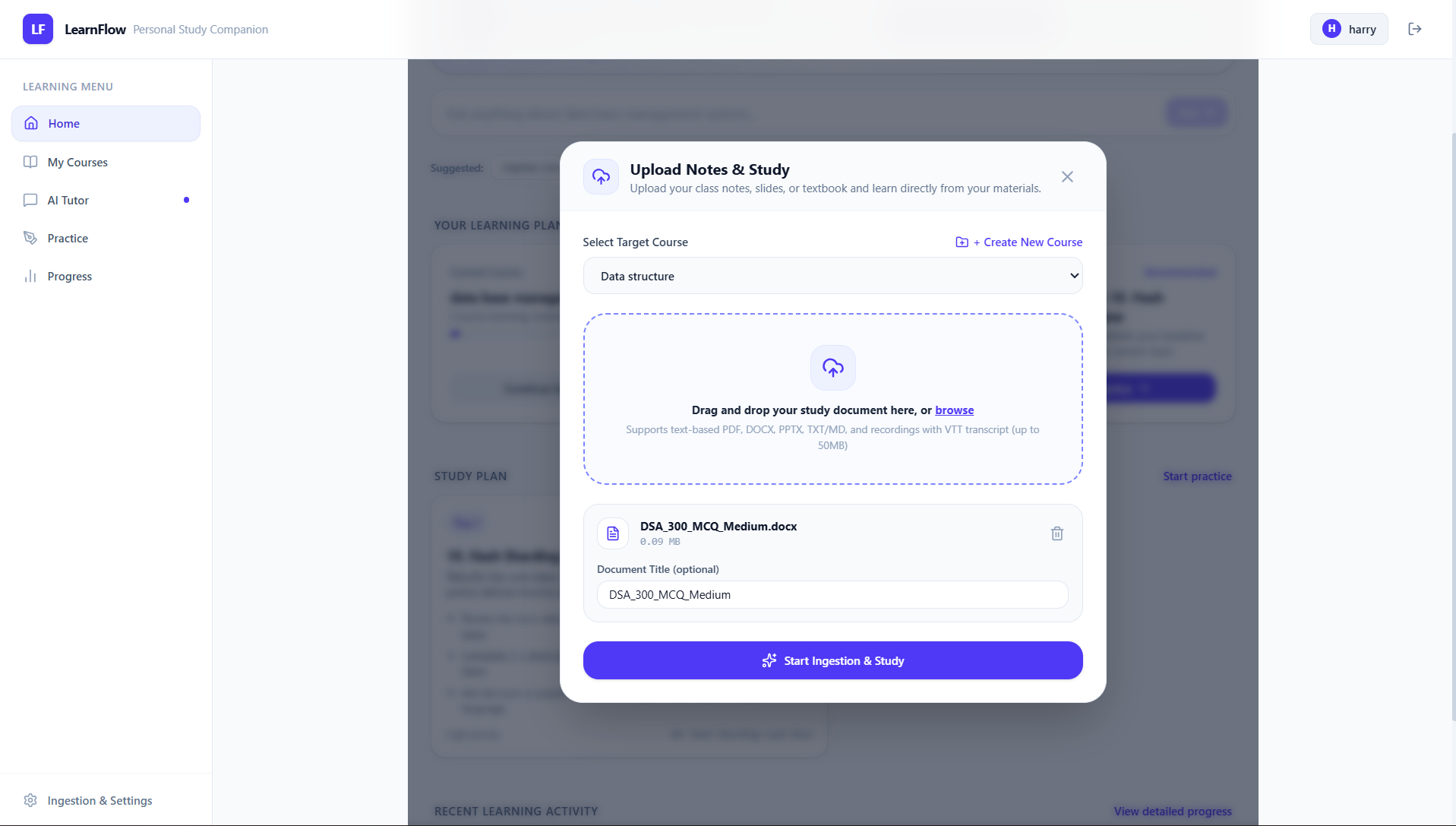
Document Upload: Upload PDFs, slides, notes, and lecture transcripts for AI-powered learning.
-
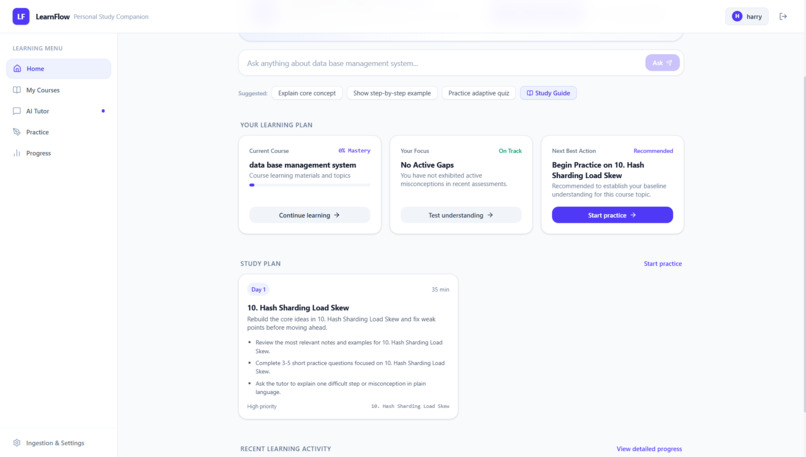
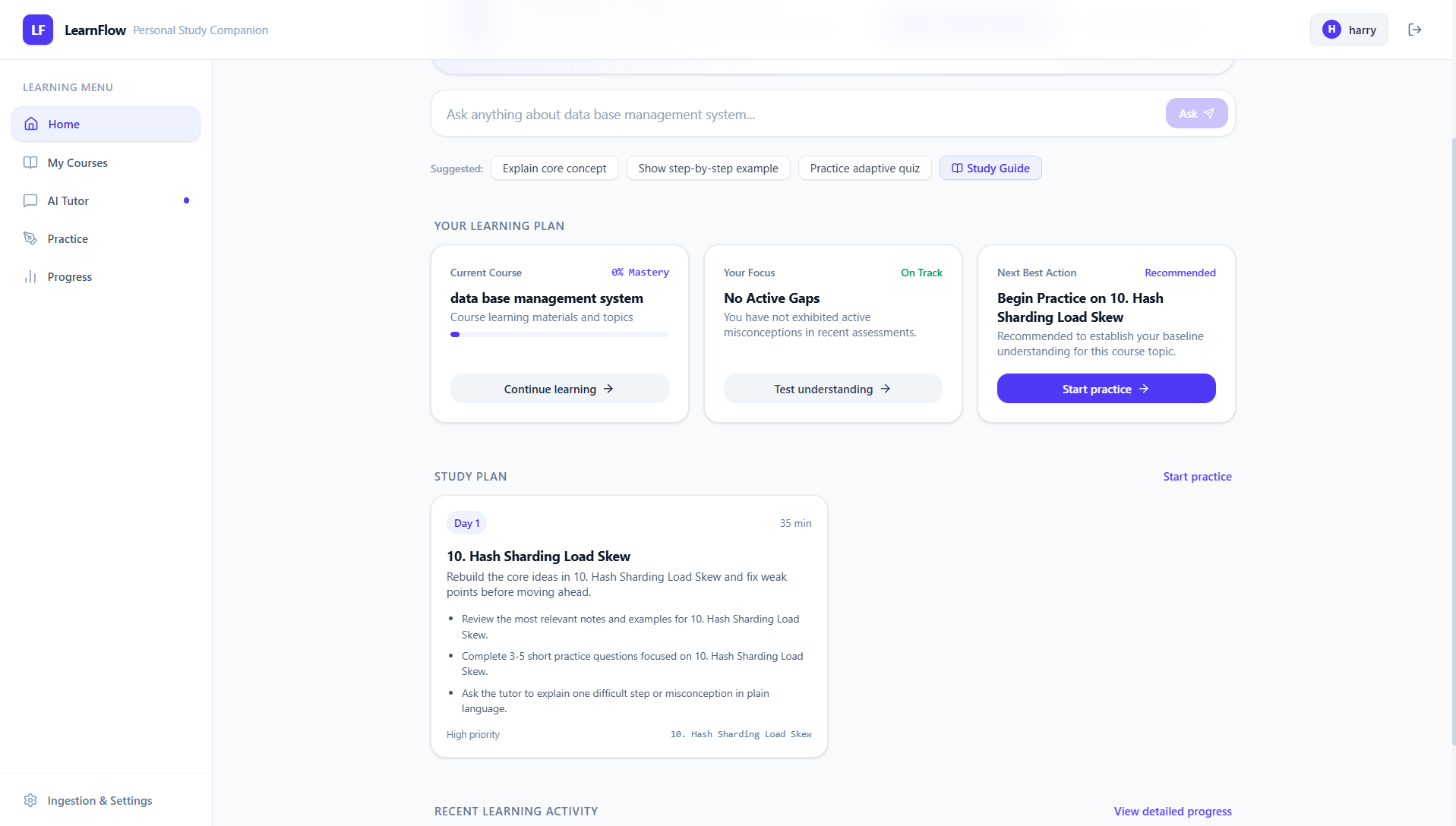
Personalized Study Plan: AI identifies learning gaps and recommends the next best learning activity.
-
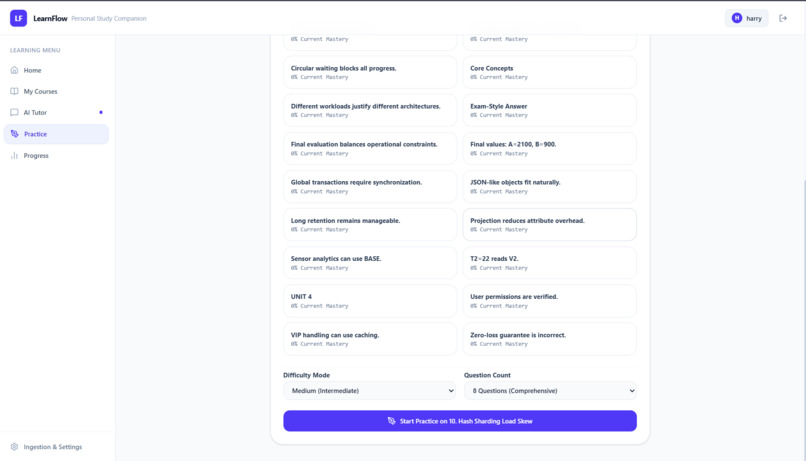
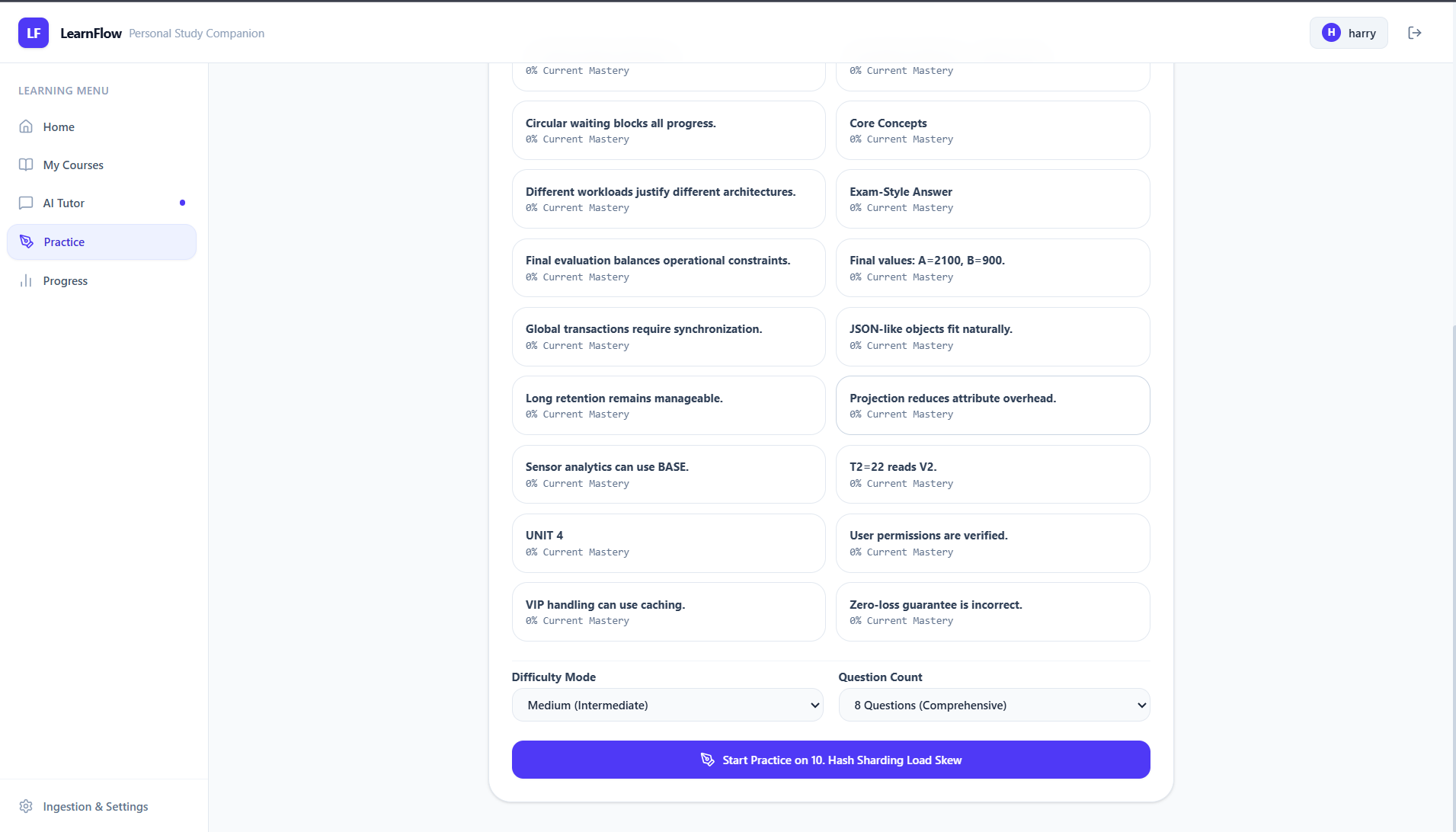
Adaptive Practice: Customize topics, difficulty levels, and question counts for targeted practice.
-
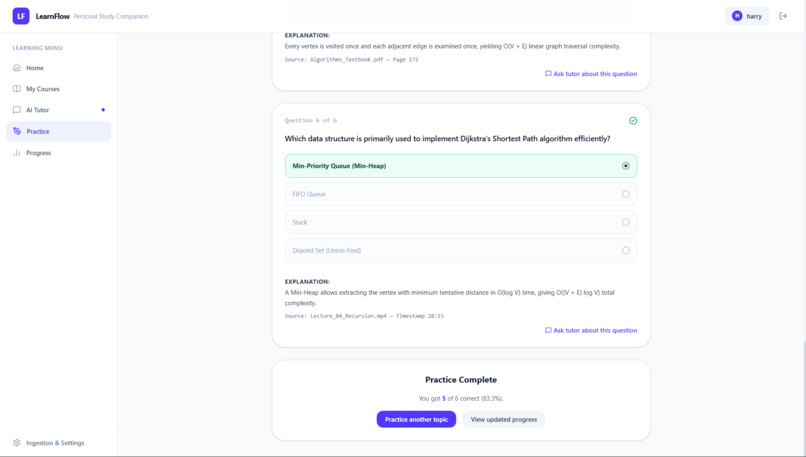
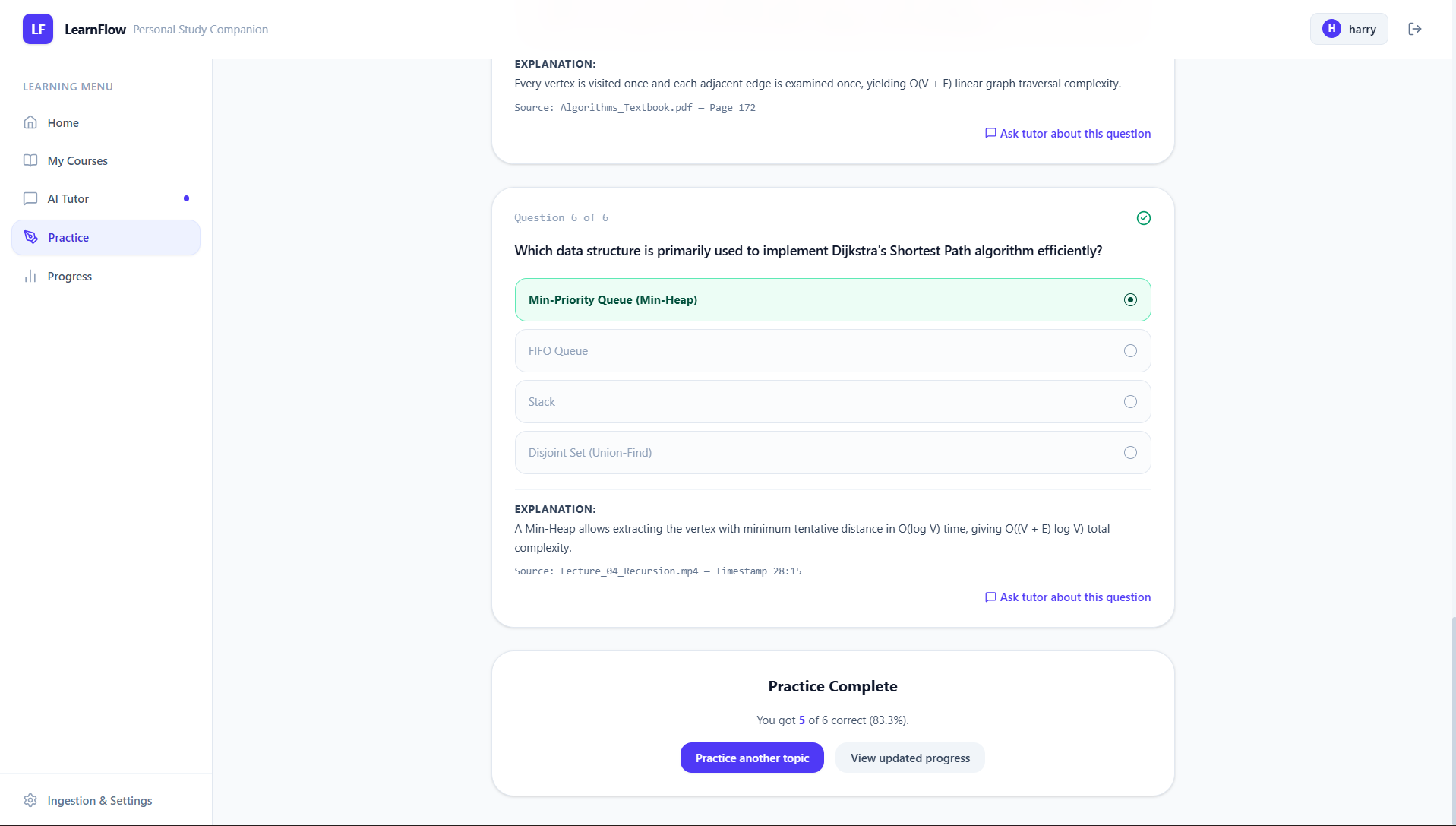
AI Quiz: Interactive questions provide instant feedback, explanations, and source references.
-
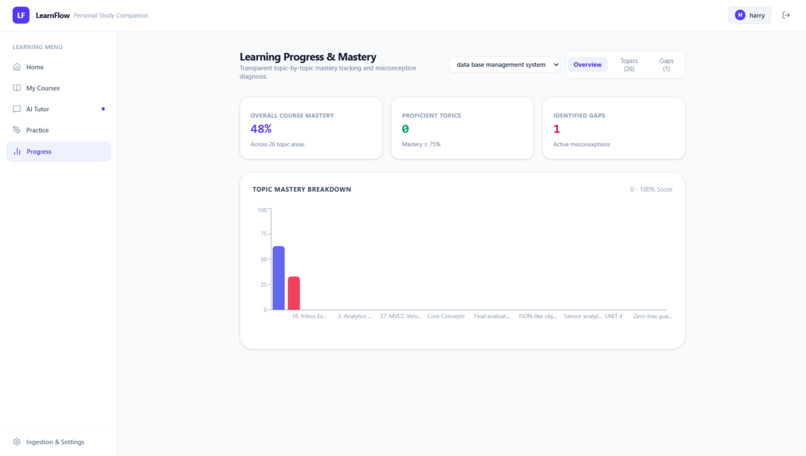
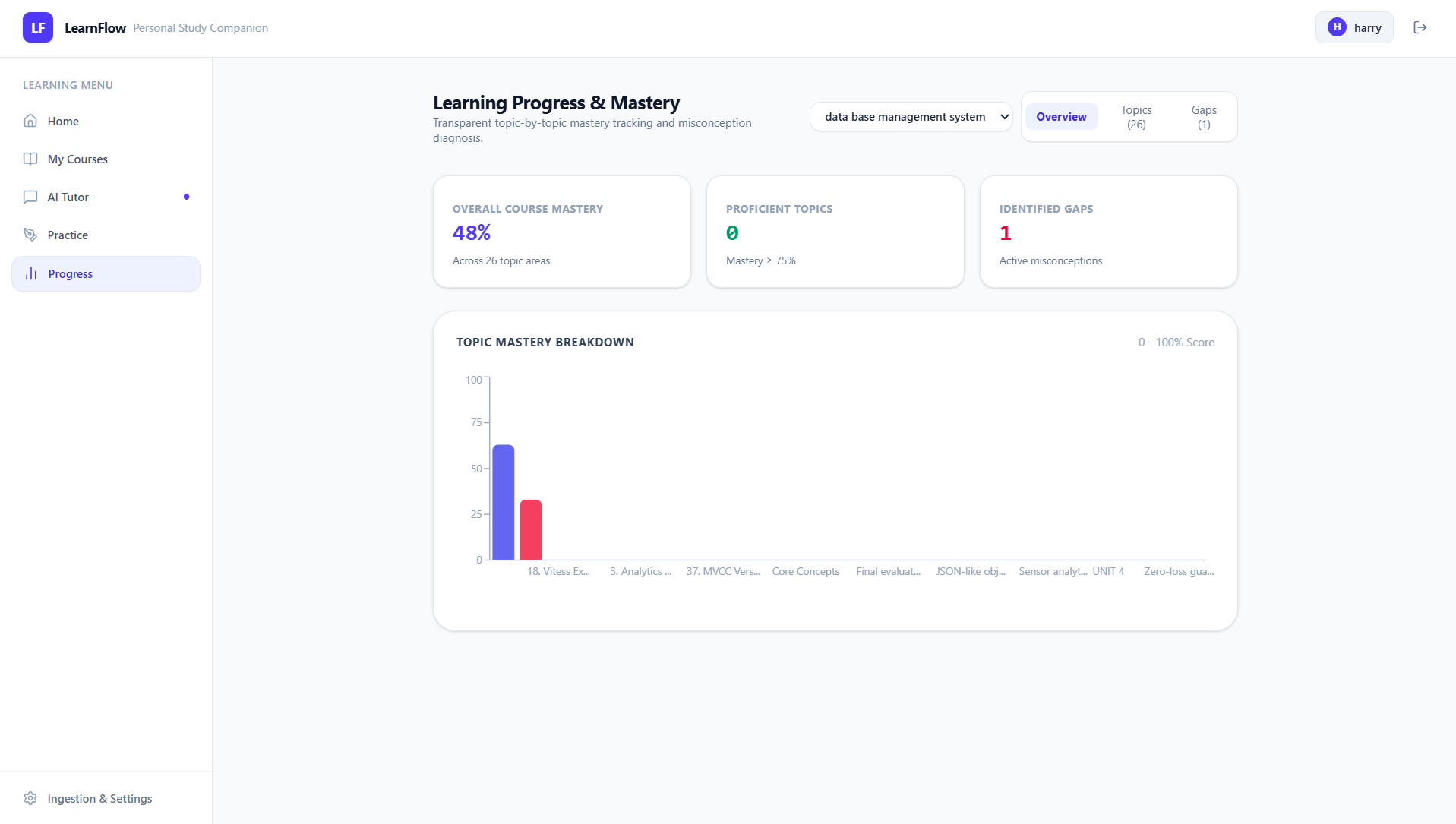
Progress Analytics: Visualize course mastery, topic performance, and knowledge gaps to improve learning outcomes.
💡 Inspiration
Students today learn from a combination of lecture videos, textbooks, PDFs, and presentation slides. However, these resources are often scattered across different platforms, making it difficult to connect concepts, find the right explanation, and understand what to study next.
Generic AI assistants can answer questions quickly, but they may provide information that is not grounded in the student's actual course material. More importantly, they usually do not maintain a detailed understanding of a student's strengths, weaknesses, misconceptions, and learning progress.
We wanted to build a learning companion that understands both the course material and the learner.
🚀 What We Built
LearnFlow AI is a multi-agent AI study companion that transforms lecture videos, textbooks, and slides into a source-grounded knowledge base and uses it to deliver personalized tutoring and adaptive assessments.
The system follows a continuous learning loop:
Learn → Assess → Analyze → Personalize → Learn Again
Students can upload their course materials and interact with them through a source-grounded AI tutor. The system identifies topics, concepts, subtopics, and prerequisites while preserving the original source location such as a textbook page, slide number, or video timestamp.
When a student asks a question, LearnFlow AI retrieves relevant course content and generates an answer grounded in those sources. Instead of simply providing an answer, the system can point the student back to the exact material used to generate the response.
The platform also generates adaptive assessments including MCQs, short-answer questions, and numerical problems. Questions are tagged with their topic, difficulty, and source, and are verified before being presented to the learner.
🧠 Multi-Agent Architecture
LearnFlow AI uses specialized AI agents coordinated through a multi-agent workflow.
1. Multimodal Ingestion Agent
Processes lecture videos, textbooks, slides, images, and diagrams.
2. Knowledge Organization Agent
Identifies topics, subtopics, concepts, and prerequisites and connects them to their original sources.
3. Grounded Tutor Agent
Answers student questions using the course knowledge base and provides source citations.
4. Assessment Generation Agent
Creates adaptive MCQs, short-answer questions, and numerical problems based on the selected topic and learner level.
5. Question Verification Agent
Checks generated questions and answer keys to reduce incorrect or unsupported assessments.
6. Misconception Analysis Agent
Analyzes incorrect answers to identify possible conceptual misunderstandings instead of simply marking an answer as wrong.
7. Learner Model Agent
Maintains topic-level mastery estimates and learning history across assessments and tutoring interactions.
8. Personalization Agent
Uses the learner's current mastery and weaknesses to recommend what the student should learn or practice next.
These agents work together rather than operating as isolated AI tools.
🔄 Adaptive Learning Loop
The core of LearnFlow AI is a continuous feedback loop.
A student learns a concept → takes an assessment → receives feedback → the system analyzes mistakes → learner mastery is updated → the next learning activity is personalized.
For example:
Student struggles with Recursion
↓
The system detects repeated errors
↓
A possible misconception is identified
↓
The tutor provides a targeted explanation
↓
The system generates appropriate practice questions
↓
The student's mastery estimate is updated
↓
Future questions and recommendations adapt to the new learning state.
This allows the system to move beyond static question generation toward personalized learning.
📚 Source-Grounded Learning
A major focus of LearnFlow AI is keeping generated responses connected to the student's actual course material.
Each knowledge unit maintains its source information, such as:
- Textbook page
- Slide number
- Video timestamp
- Topic and concept
When possible, tutor responses are accompanied by these references so students can verify the explanation against their own material.
If a question is not covered by the uploaded course material, the system can clearly indicate that the information is outside the available source rather than presenting unsupported information as course content.
🎯 Personalization
Instead of giving every student the same sequence of questions, LearnFlow AI maintains a learner model.
For example:
| Topic | Mastery |
|---|---|
| Sorting | 90% |
| Trees | 72% |
| Graphs | 55% |
| Recursion | 40% |
If the system observes that a student is struggling with Recursion, it can prioritize that topic and provide targeted explanations and assessments.
The learner model is updated as the student interacts with the tutor and completes assessments.
🛠️ How We Built It
The platform is designed around three major layers:
Multimodal Knowledge Layer
Ingests and processes course materials and preserves source information.
Multi-Agent Intelligence Layer
Uses specialized agents for tutoring, assessment, verification, misconception analysis, learner modeling, and personalization.
Interactive Learning Layer
Provides the student dashboard, source-grounded chat, assessments, progress tracking, and personalized recommendations.
A shared orchestration layer coordinates communication between agents and maintains the overall learning workflow.
🧪 Evaluation
We plan to evaluate LearnFlow AI across both grounding quality and personalization effectiveness.
For the knowledge and retrieval pipeline, we evaluate:
- Faithfulness
- Answer relevancy
- Context precision
- Context recall
- Citation/source accuracy
For adaptive learning, we evaluate:
- Topic mastery improvement
- Personalization across sessions
- Question repetition rate
- Misconception detection
- Quality of recommendations
We will use a team-created evaluation set containing questions with known source locations as well as questions that fall outside the uploaded course material.
💻 What We Learned
Building LearnFlow AI showed us that creating an educational AI system is not simply about generating good answers.
The system must also understand where the answer came from, whether the question is supported by the course material, how well the student understands the topic, and what the student should learn next.
The multi-agent architecture helped us separate these responsibilities into focused components while allowing them to work together as one learning system.
🔮 Future Improvements
We plan to extend LearnFlow AI with:
- Visual course maps showing topics and prerequisites
- Automatically generated revision material
- Flashcards and audio study briefs
- Personalized study schedules
- Mixed-language tutoring
- Voice-based tutoring sessions
- More advanced learner-modeling techniques
Our long-term goal is to make LearnFlow AI a reliable study companion that adapts not only to what the student asks, but also to what the student understands.
Built With
- database
- fastapi
- langgraph
- llm
- machine-learning
- multimodelai
- natural-language-processing
- postgresql
- python
- rag
- react
- vector


Log in or sign up for Devpost to join the conversation.