Inspiration
Agricultural soils can continue producing for years while gradually losing fertility and functionality.
Compaction, declining organic matter, reduced biological activity, poor water infiltration, erosion, nutrient imbalances, and lack of soil cover are all signs that a soil may be losing its ability to support crops sustainably over the long term.
Mulching was created with one purpose: to help regenerate agricultural soils and restore their fertility through regenerative agriculture.
But regenerating soil is not as simple as applying a list of recommended practices.
Every field has a different climate, soil type, crop, water availability, and management history. A practice that works well on one farm may not be the priority on another.
Farmers may already notice that something is wrong, have access to laboratory results, or know about regenerative practices, and still lack clear answers to three fundamental questions:
What is actually limiting my soil?
What should I address first to regenerate it?
How do I know whether my soil is really improving?
Mulching was created to help answer those questions.
What it does
Mulching is a regenerative agriculture app designed to help farmers diagnose soil conditions, identify the main limitations affecting soil fertility, build a field-specific regeneration plan, and track how the soil changes over time.
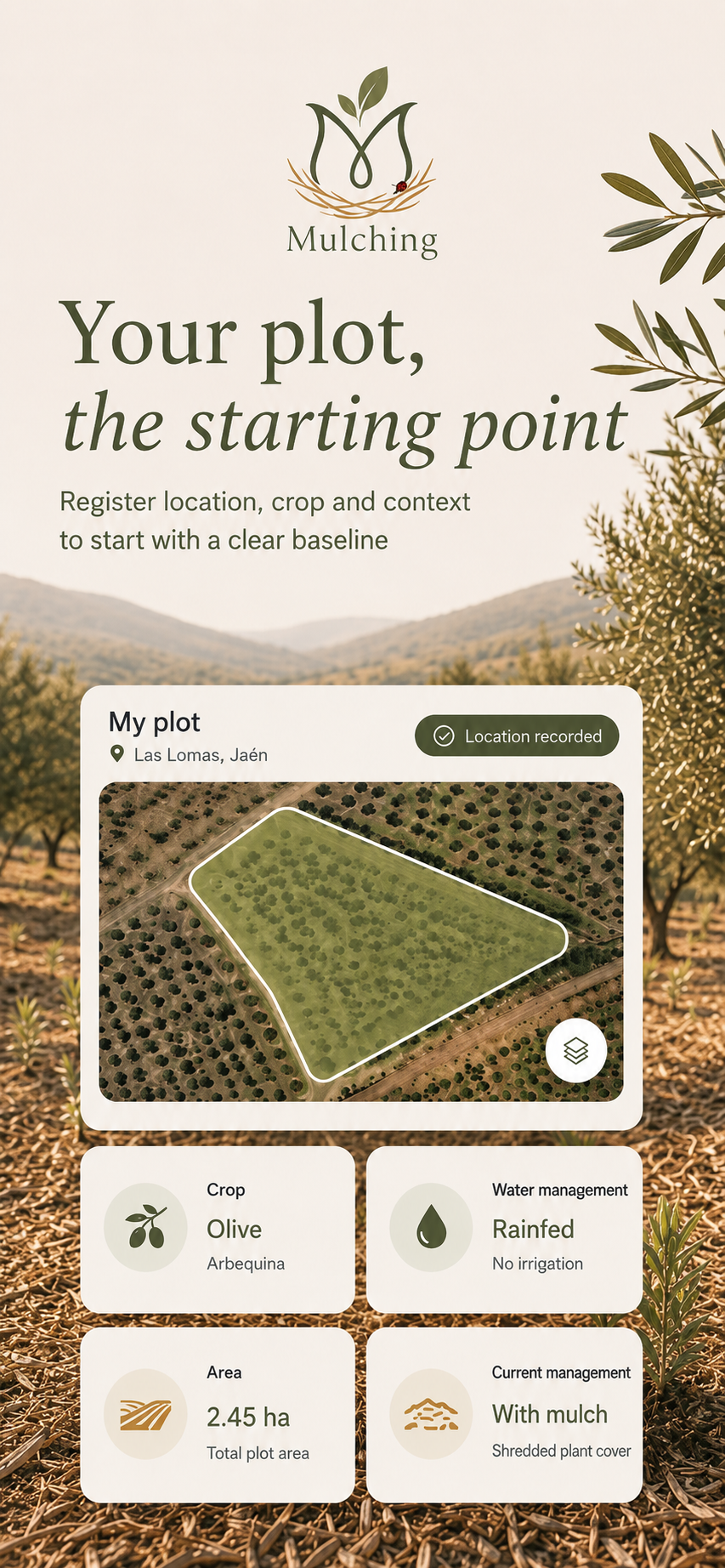
The user creates a field and adds information about the crop, management practices, terrain, water availability, and soil conditions.
Mulching then combines three main sources of information:
- field observations;
- physical and biological measurements;
- laboratory soil analysis.
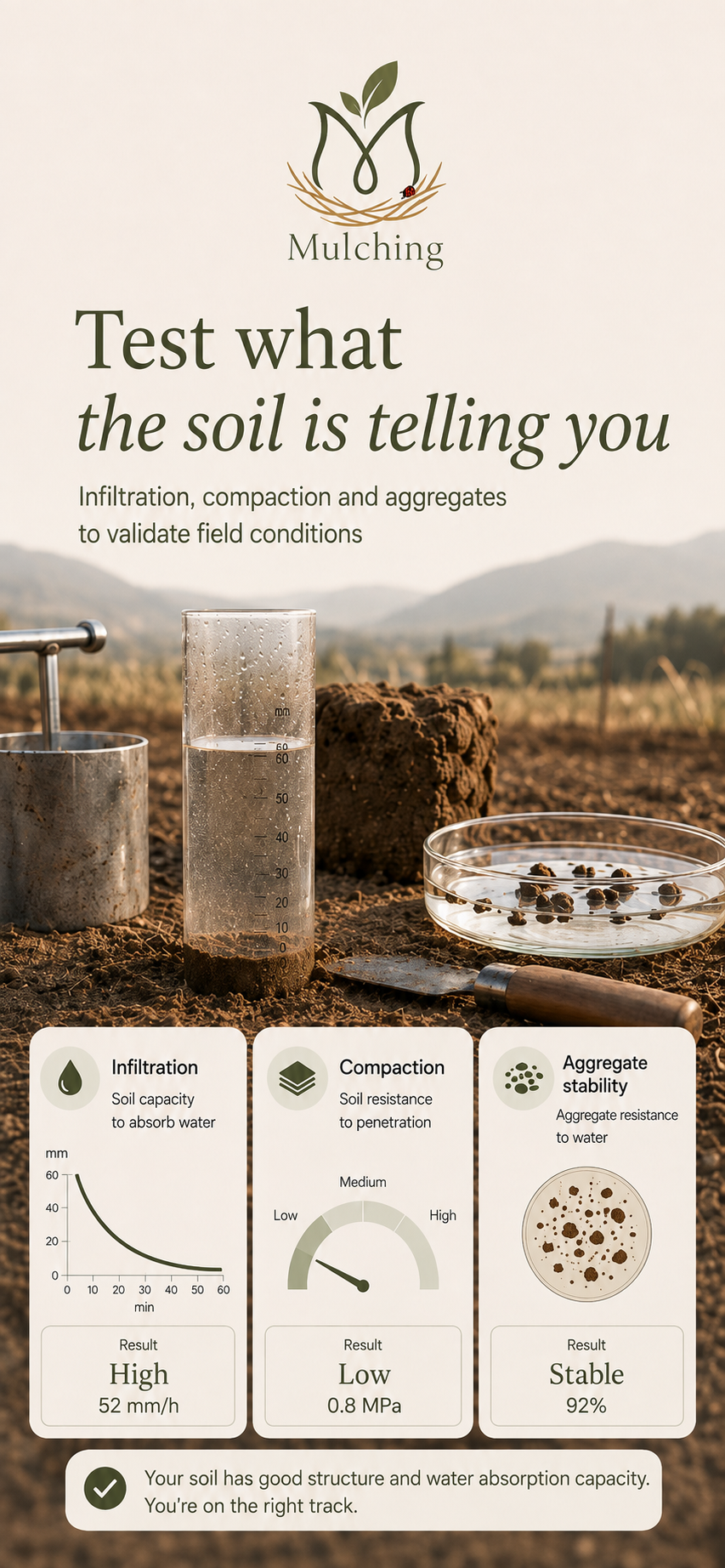
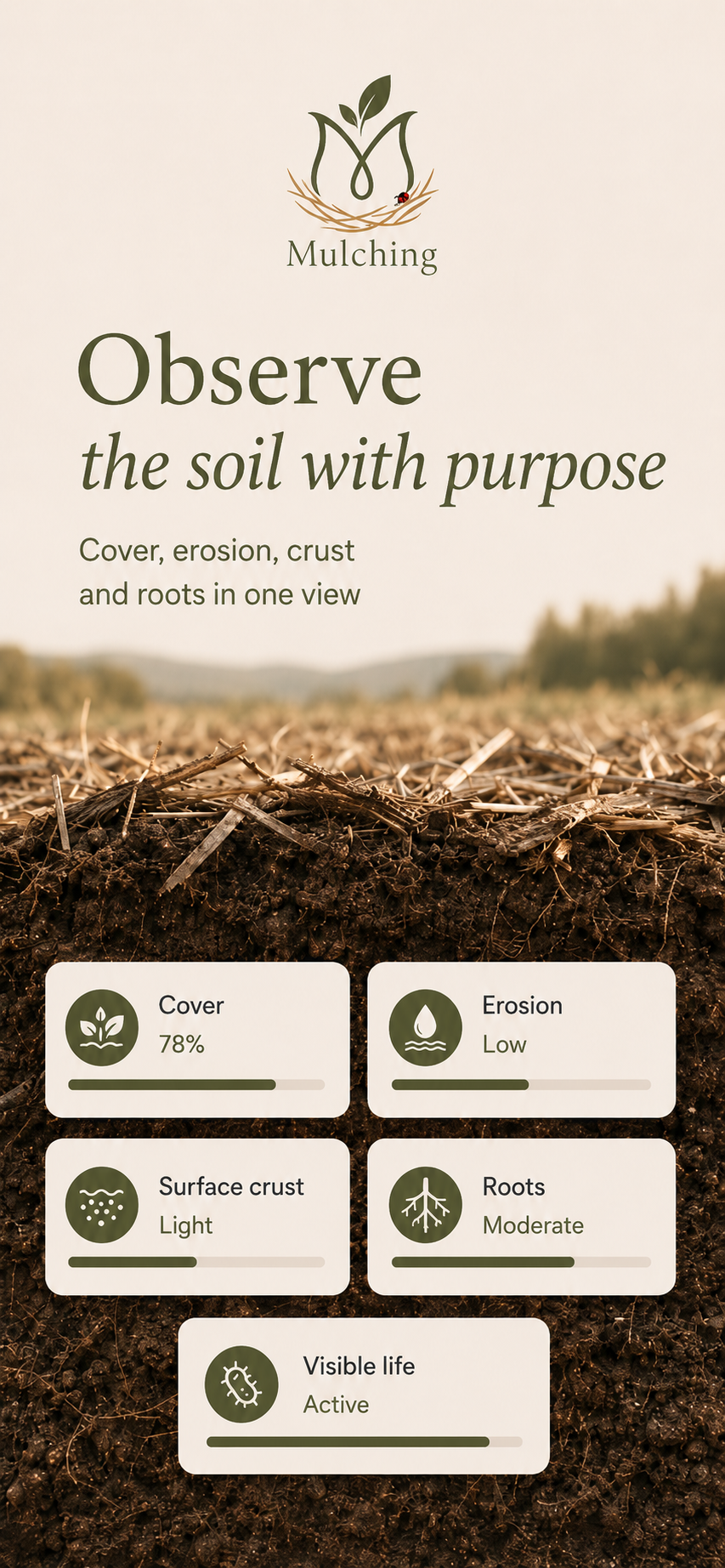
Field assessments can evaluate indicators such as soil cover, compaction, water infiltration, erosion, soil structure, root development, moisture, and visible biological activity.
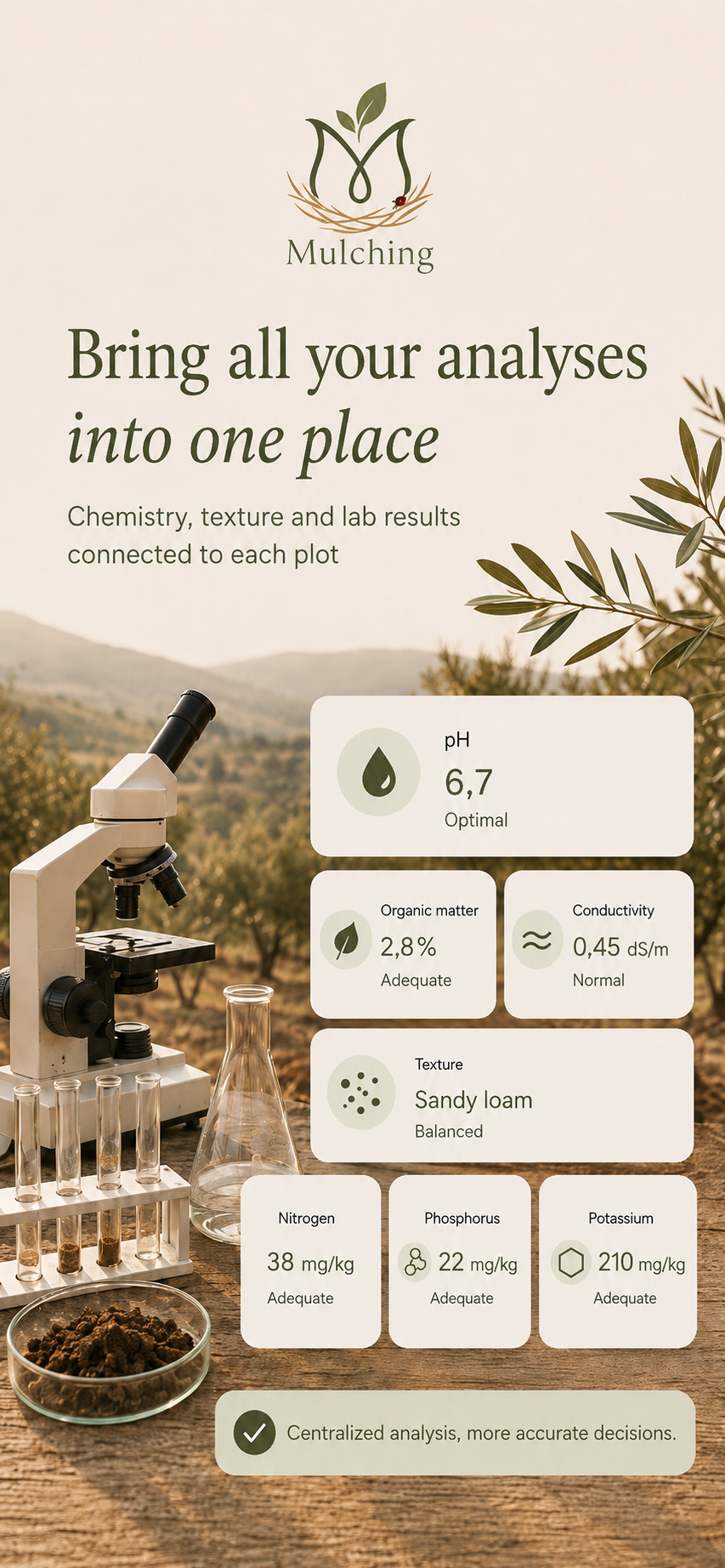
Laboratory analysis provides deeper information about parameters that cannot be reliably understood through visual assessment alone, including organic matter, pH, electrical conductivity, nutrients, soil texture, and other indicators related to soil fertility and functionality.
Mulching brings all of this information together to build a more complete picture of the field.
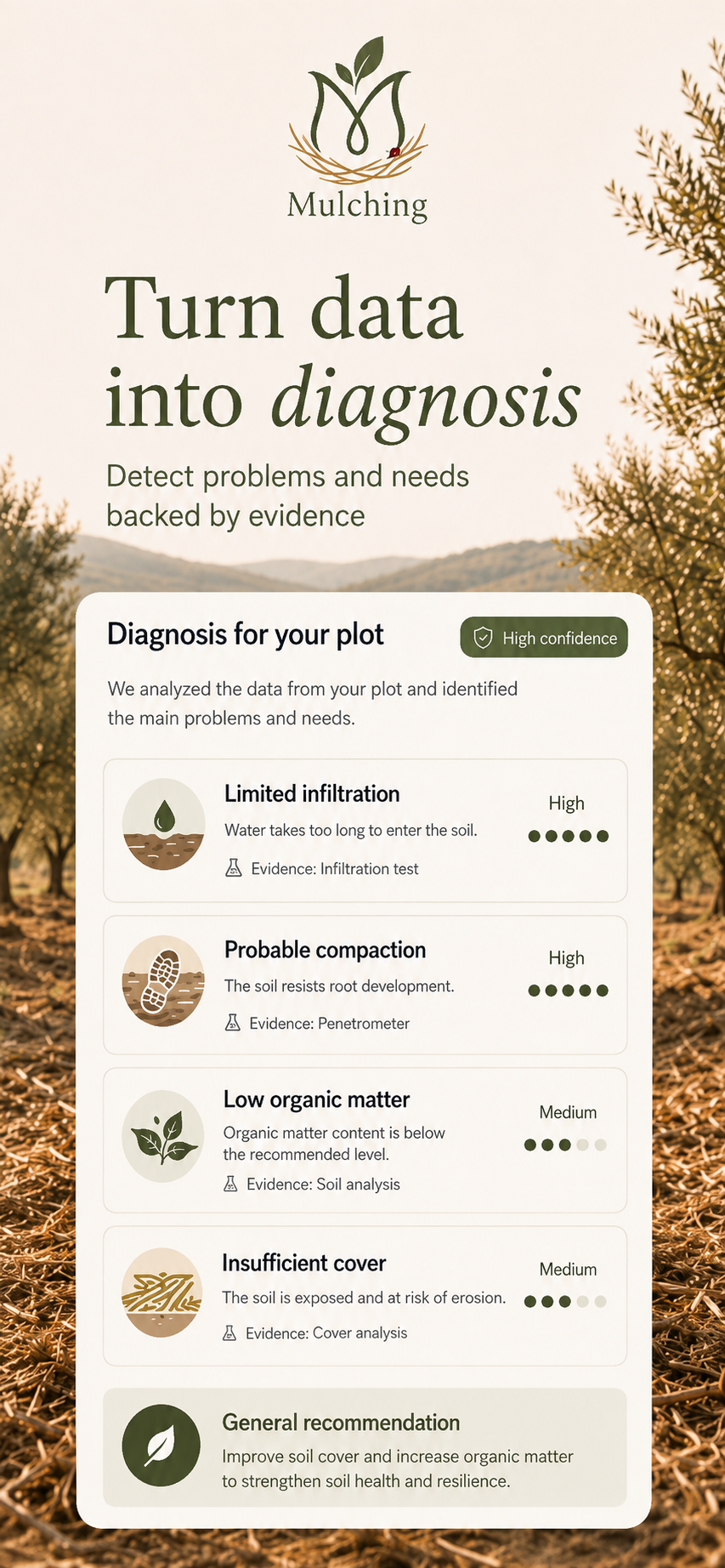
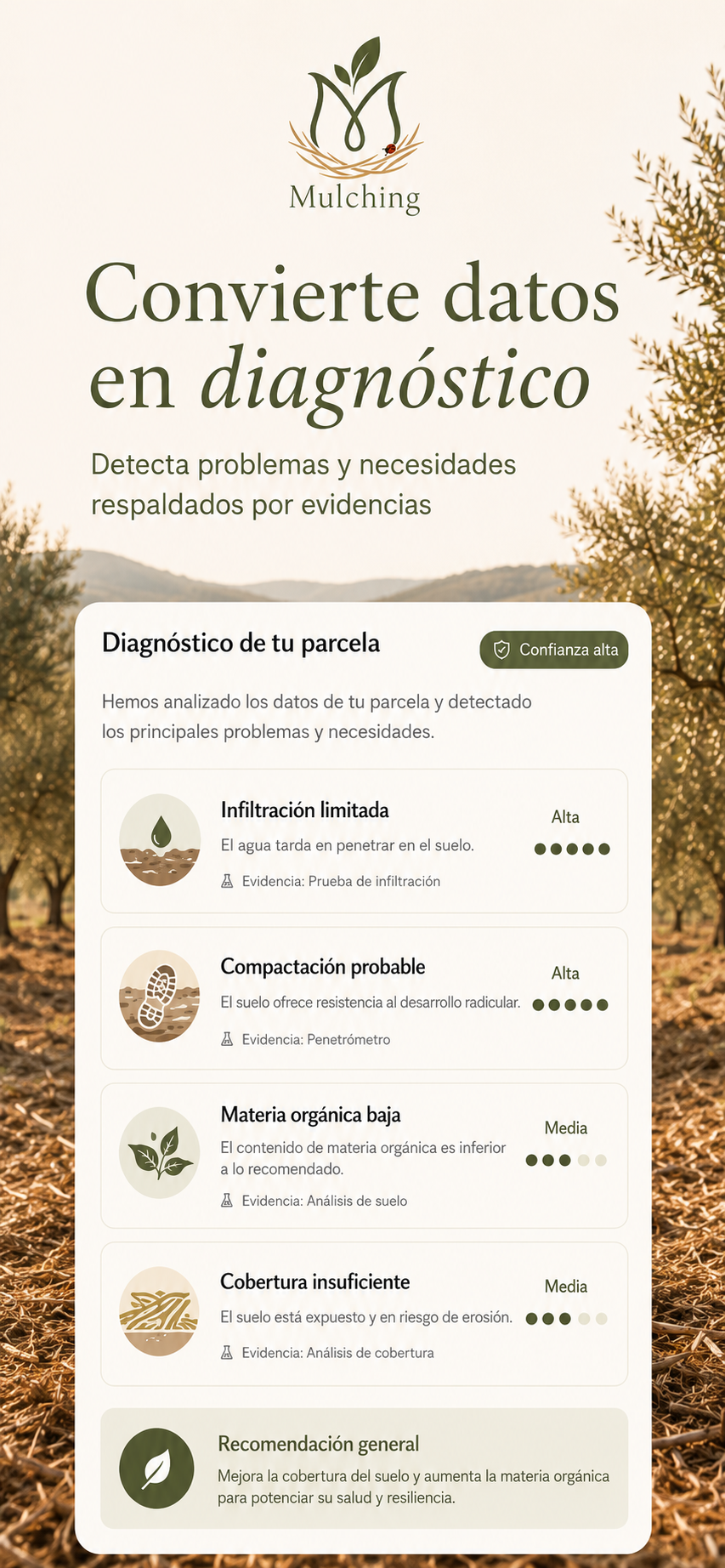
From there, the app helps identify which factors are limiting the soil the most, establish priorities, and build a regenerative management pathway adapted to that specific field.
The process follows a continuous cycle:
Analyze → Diagnose → Prioritize → Act → Measure → Compare → Adapt
Mulching is not designed simply to recommend regenerative practices.
The goal is to connect each action to a previously identified problem and then measure whether the soil indicators actually improve over time.
We want farmers to move from:
“I know something is wrong with my soil.”
to:
“I understand what is happening, what I should address first, and whether my decisions are actually working.”
How we built it
Mulching is being developed around three connected pillars:
software + field assessment + laboratory analysis.
We do not want to build a regenerative agriculture app based only on information entered into a screen or on generic recommendations.
The process starts by understanding the soil.
First, we use field observations and measurements to understand how the soil behaves physically under real conditions.
Second, we incorporate laboratory soil analysis to evaluate chemical and physical parameters that require more precise testing.
Finally, Mulching combines all of this information with the field context and its management history to build a diagnosis and a regenerative management pathway.
The system can integrate:
field context + management history + field observations + measurements + laboratory analysis
Using this baseline, Mulching helps determine which problems should be addressed first and which actions make the most sense under the conditions of that particular field.
But the process does not end with a recommendation.
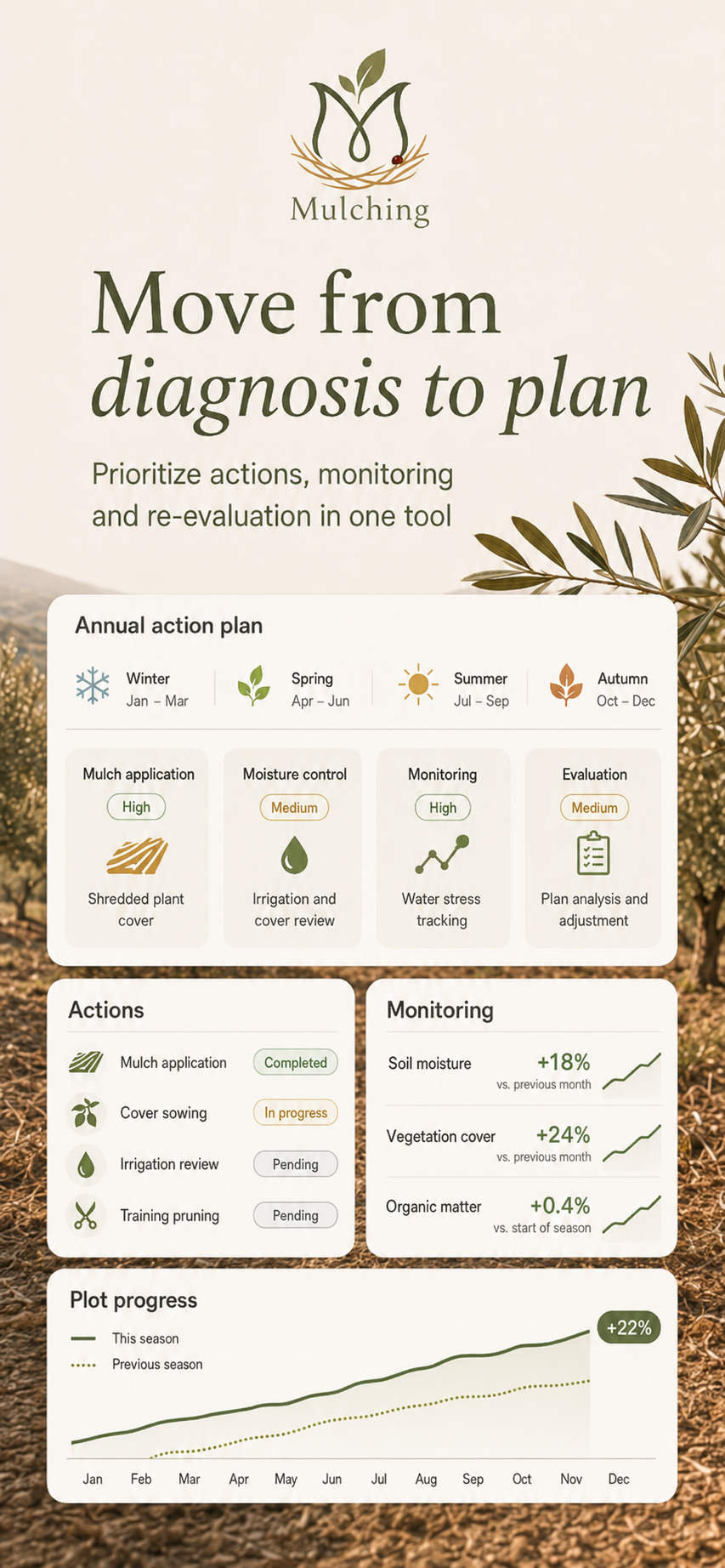
Management actions are recorded, and over time field measurements and laboratory analyses can be repeated.
This allows the farmer to compare the initial condition of the soil with its evolution.
The complete cycle we are building is:
FIELD → LABORATORY → DIAGNOSIS → REGENERATION PLAN → ACTION → MONITORING → NEW MEASUREMENT
Mulching Lab
To validate this entire process, we created Mulching Lab, our pilot field in Spain.
Mulching Lab allows us to take the development of the application beyond the screen and work with real soil under real agricultural conditions.
We are building an initial soil baseline using field observations, practical measurements, and laboratory analysis.
From that information, we can identify the main limitations affecting the field, apply regenerative management decisions, and repeat the measurements over time.
This allows us to study how soil indicators change as management changes.
Mulching Lab creates a continuous feedback loop between the digital product and the real world:
measure → analyze → diagnose → act → measure again → learn → improve Mulching
Our goal is for the product to evolve through real-world evidence, field data, agronomic knowledge, and continuous validation.
Challenges we ran into
One of our biggest challenges is that soil is a complex system.
There is no single recipe for regenerating it.
Climate, soil texture, water availability, crop type, organic matter, biological activity, nutrient availability, and previous management can completely change which action should be prioritized.
Because of this, one of our main challenges has been avoiding turning Mulching into just another library of regenerative practices.
We want to create a clear relationship between:
detected problem → priority → action → monitoring → result
Another important challenge is transforming a large amount of information into understandable decisions.
A laboratory soil analysis can contain many different parameters.
Field assessments can generate even more information.
But showing more data to a farmer does not necessarily mean providing more value.
One of our main goals is to transform that complexity into simple answers:
What is happening? Why does it matter? What should be addressed first?
We also need to maintain a balance between technical rigor and ease of use.
Mulching must be useful without requiring the farmer to become a soil scientist.
Accomplishments that we're proud of
One of the accomplishments we are most proud of is taking Mulching beyond the screen.
Creating Mulching Lab allows us to test the assumptions behind the product on a real field.
We are building an initial soil baseline, carrying out field measurements, incorporating laboratory analysis, and creating a monitoring system that will allow us to compare soil evolution over time.
We are also proud of designing Mulching around a complete regeneration cycle.
We do not want users to simply register a field or receive a recommendation.
We want them to be able to follow the entire process:
understand the initial condition → identify limitations → establish priorities → take action → measure again → evaluate results
For us, data only becomes truly valuable when it helps answer a practical question:
What does this result mean for my soil, and what should I do next?
What we learned
One of our biggest lessons is that the problem is not always a lack of information.
In many cases, the information already exists, but it is fragmented.
A farmer may have a laboratory report, know their field, observe certain problems, and understand different regenerative practices.
The difficulty is connecting all of those pieces.
Which data matters most?
Which problem has priority?
Which action makes sense first?
We have also learned that talking about regenerative agriculture only in terms of practices can be misleading.
Compost, cover crops, reduced tillage, organic matter inputs, or any other regenerative strategy should respond to the actual needs of the soil.
That is why Mulching starts with diagnosis.
First, we want to understand:
What is limiting the functionality of this soil?
Then we can build a strategy.
We have also learned that monitoring is essential.
Applying a regenerative practice does not automatically mean that the soil has improved.
That is why we need an initial baseline and repeated measurements that allow us to evaluate change over time.
This turns regeneration into a continuous process:
observe → analyze → act → measure → learn → adapt
What's next for Mulching
Our next step is to continue developing Mulching while expanding validation through Mulching Lab and progressively working with additional farms.
We want to strengthen the connection between field assessments, laboratory soil analysis, and Mulching's diagnostic system.
We are also working toward a workflow where users can request or upload a laboratory soil analysis, receive the results inside Mulching, and use that information as part of the diagnosis of their field.
From there, Mulching can build a regeneration plan, organize actions over time, and provide structured monitoring.
Future field measurements and laboratory analyses can then be compared with the original baseline.
We want users to clearly see:
how the soil started → which problems were detected → which actions were taken → how the soil evolved
We also want to continue improving the prioritization system so that Mulching can transform increasingly complex soil information into simple, actionable decisions.
Our vision is for Mulching to support farmers throughout the entire process:
analyze the soil → understand what is limiting it → build a plan → start regenerating → monitor progress → measure change
Because the purpose of Mulching is not simply to recommend regenerative agriculture.
The purpose is to help restore soil fertility and functionality — and provide evidence that the soil is actually moving in the right direction.
Built With
- api
- django
- docker
- expo.io
- framework
- jwt
- native
- nginx
- postgresql
- python
- react
- rest
- typescript

Log in or sign up for Devpost to join the conversation.