Inspiration
Mucus is the first (inoculation) and last (contagion) line of contact of the human body with the virus. In spite of its importance on infection progression, it is yet not known how its chemistry and properties affect virus penetration, propagation and/or elimination. Yet, some patients exhibit different abilities to propagate the virus, which may stem from the properties of the mucus, as these vary from patient to patient. The Bac3Gel team is made of an interdisciplinary and multicenter team with both academic and business orientations. We have been developing in vitro mucus models of different body districts, in specific airway mucus models in both physiologic and pathological states.
What it does
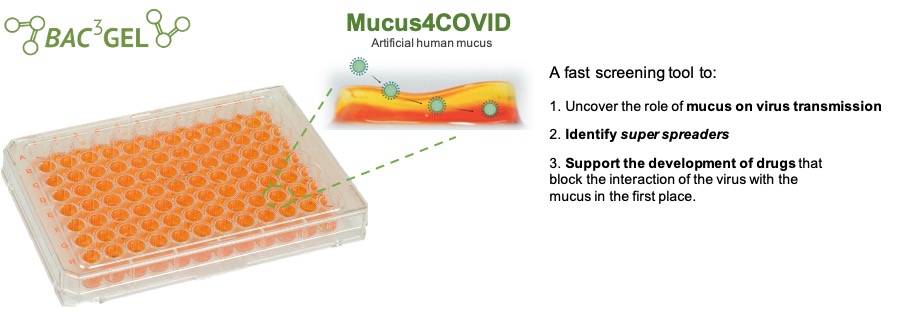
Bac3Gel intends to exploit our knowledge to produce a custom-tailored mucus models that can be specifically used to investigate inoculation and contagion cycle to ultimately help tackle the COVID-19 pandemic. By providing in vitro models of mucus, we intend to determine how the virus travels through the different mucus to identify the most susceptible potential patients, as well as the so-called super-spreaders. Ultimately, this knowledge can support the development of new drugs that block the interaction of the virus with the mucus, and thus stop infection progression earlier on
How we built it
Bac3Gel is fully composed of natural ingredients present in the native human mucus. By playing with different concentrations of these molecules it is possible to recreate in the lab different types of mucus with equal physicochemical properties seen in healthy and diseased subjects. By analyzing the way the COVID-19 virus interacts with different types of human lung mucus, it is possible to draw a pattern route that the virus takes from when it arrives to the mucus until it reaches the pneumocytes underneath it
Challenges we ran into
By knowing the viscoelastic properties of the mucus of a patient, it is possible to recreate it using Bac3Gel technology. Yet, the ability to learn these properties is the current challenge. In a typical setup, patients cough the airway sputum, which is then analyzed for viscoelastic profile in a rheometer. However, the sputum is not a great representation of the mucus. We are looking for a tool that extract a sample of the mucus in situ for further testing in the lab or an equipment that analyzes the viscoelastic properties immediately in situ. Find a partner that uses computer science to determine interaction patterns, and therefore to cluster patients according to their susceptibility to the infection, and their ability to spread the virus. In this way, it is possible to better predict which subjects should stay longer in quarantine, and which cluster of patients is able or not to spread the virus.
Accomplishments that we're proud of
We are proud to have developed a range of different human mucus models in vitro of a series of native human mucus for different body districts, such as airway, intestinal, stomach and cervicovaginal by exploiting a truly interdisciplinary team. The innovative aspect of our technology and approach has been distinguished with different awards on innovation, namely Switch2Product – Innovation Challenge, Innovation in Bioengineering Award and StartCup Lombardia, as well as at scientific conferences, including two young scientist awards by 3Rs Italian Interuniversity Center and one young scientist travel award at the 19th Annual Congress of EUSAAT. We are currently incorporating Bac3Gel as a startup
What we learned
Up to now, our mucus models have been exploited to predict drug diffusion across the mucus layer and to recreate bacterial infections and communities tipically located in the mucus. After literature research, we understood that our model could be expanded to tackle COVID-19 crisis, as a new and simple solution to understand the role on virus propagation.
What's next for Mucus4COVID
To improve the development of our in vitro model and its impact on this crisis, we need experts on : virology, bioinformatics and drug designers.
Built With
- biomaterials
- drugs
- models
- mucin
- mucus
- screening


Log in or sign up for Devpost to join the conversation.