-
-
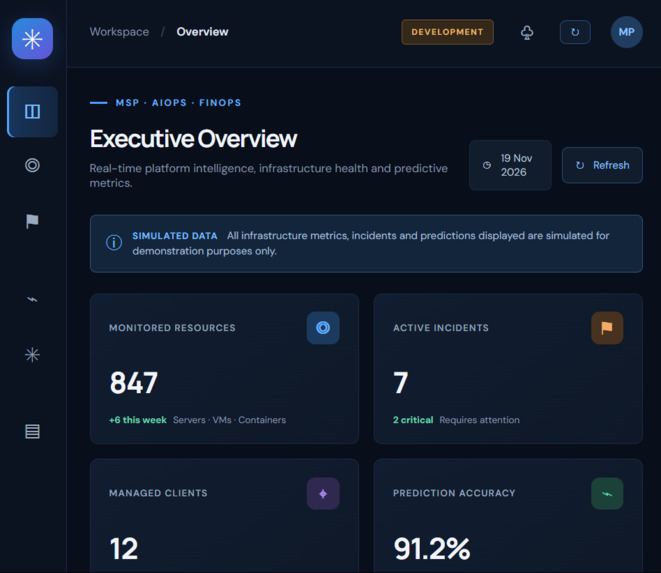
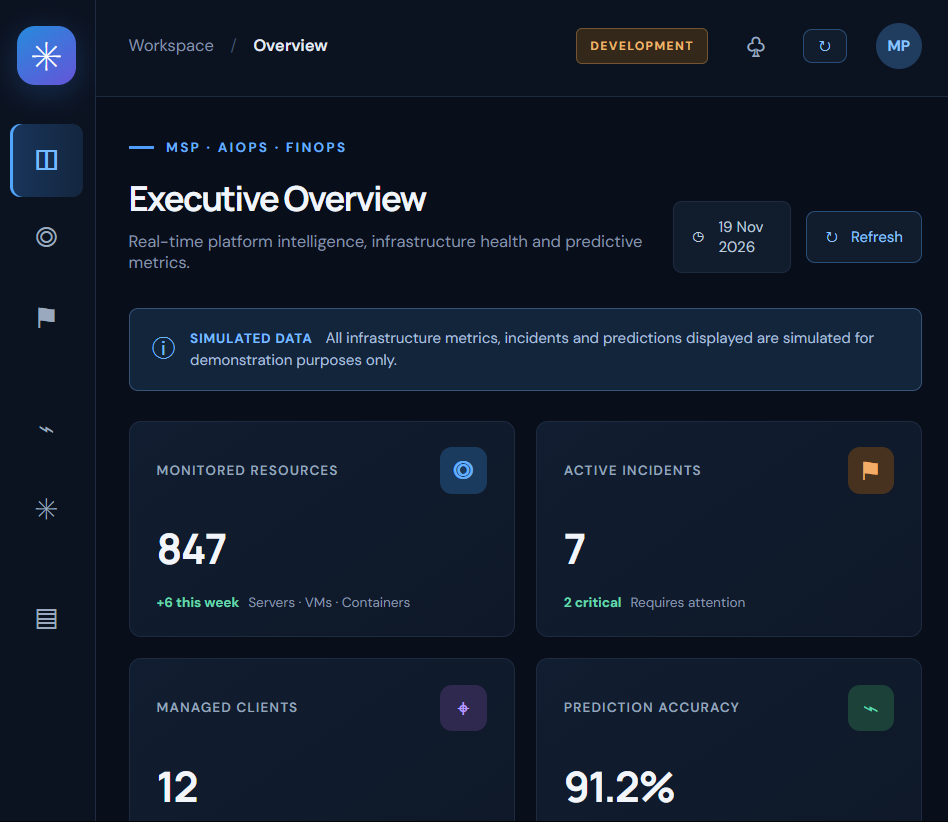
KPIs en tiempo real — 847 recursos, 7 incidentes, 12 clientes, 91.2% precisión predictiva
-
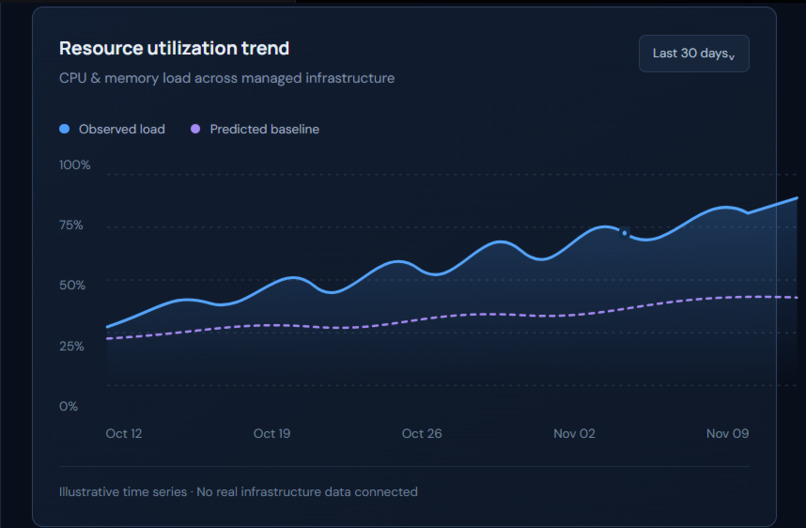
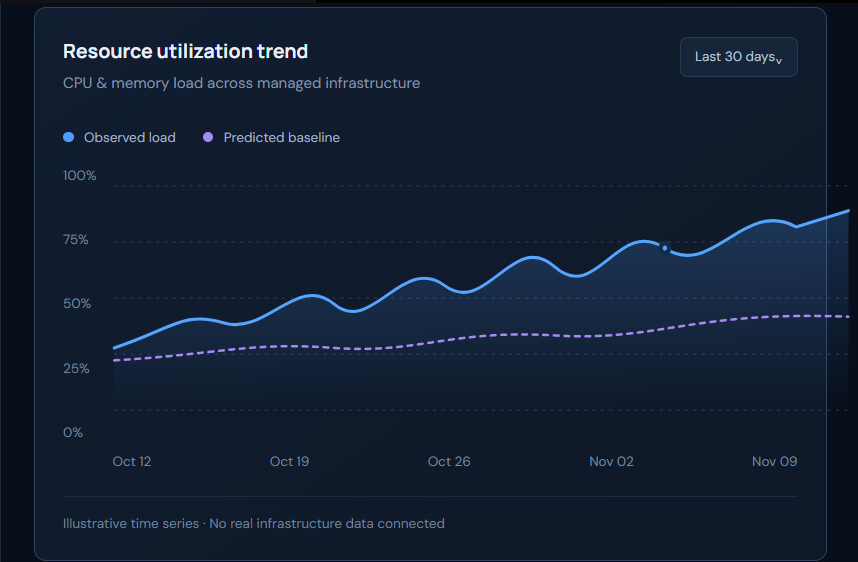
Tendencia de utilización: carga observada vs. línea base predictiva (30 días). Anticipa necesidad de escalamiento
-
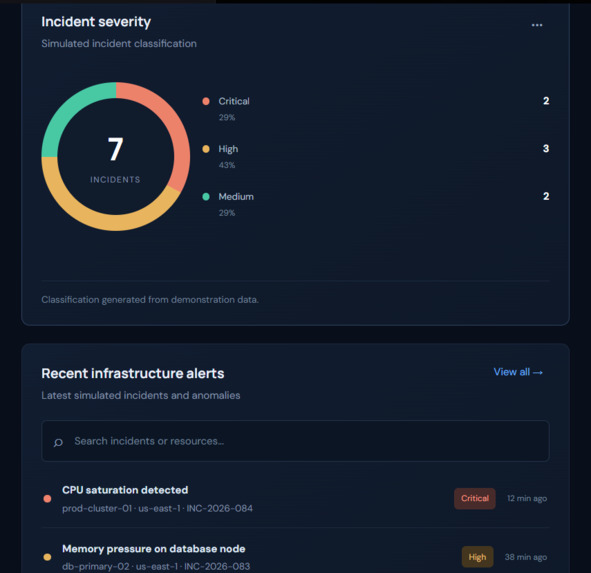
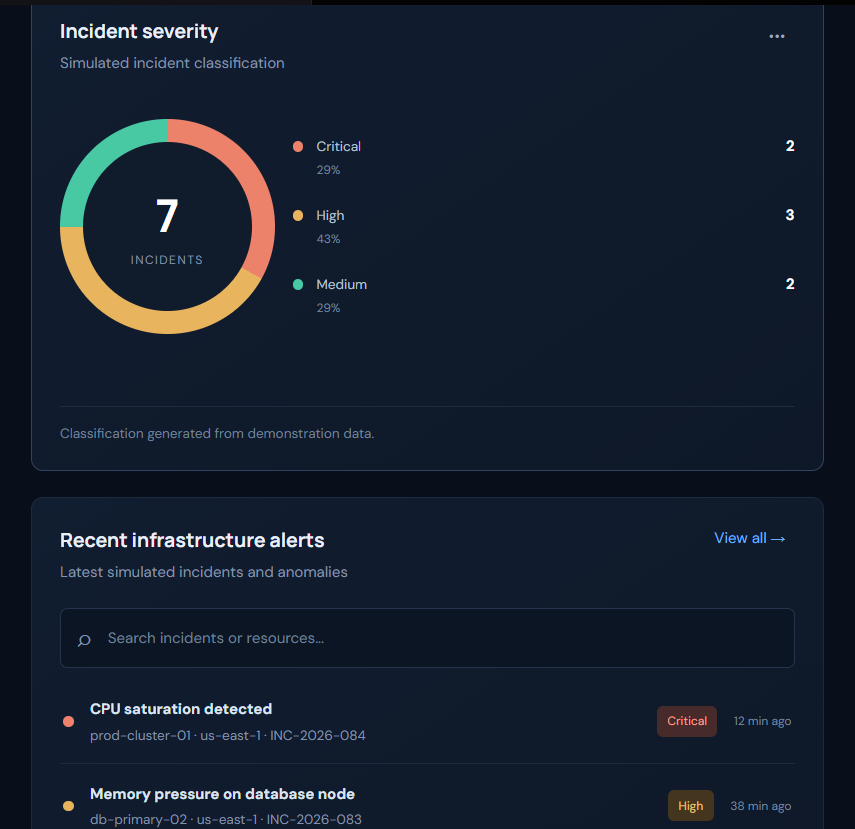
Clasificación automática de incidentes por severidad (Sentinel AI) y alertas de infraestructura en tiempo real
-
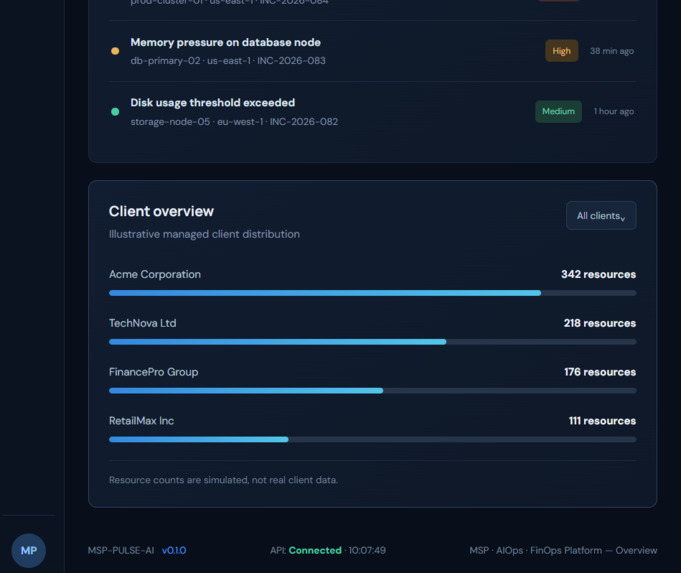
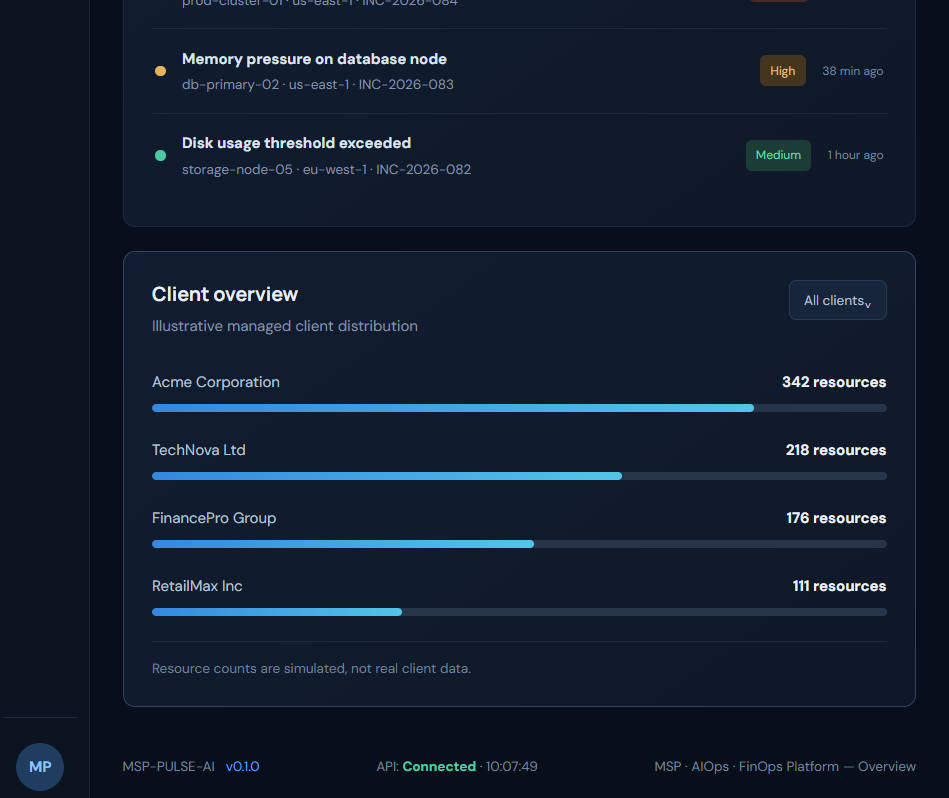
Gestión multi-tenant: distribución de recursos por cliente con aislamiento total de datos entre organizaciones
Inspiration
As someone working closely with Managed Service Providers, I've seen the same pattern repeat: an alert fires at 2 AM, the on-call engineer scrambles through dashboards, tries to correlate dozens of alerts, estimates the blast radius, and searches for the root cause — all while the client's business is losing money. This reactive cycle costs MSPs thousands of hours per year.
I asked myself: what if we could automate the exact mental workflow an NOC operator follows when an alert fires? Not a generic chatbot — a purpose-built multi-agent pipeline that detects, predicts, recommends, and quantifies, just like a senior engineer would.
What it does
MSP-PULSE-AI is an intelligent AIOps platform with four specialized AI agents working in a coordinated pipeline:
| Agent | Role |
|---|---|
| 🛡 Sentinel AI | Detects anomalies in CPU, RAM, disk and network using statistical methods (z-score, IQR, rate-of-change) |
| 📈 Predictive AI | Forecasts capacity saturation and failure risk using linear regression and moving averages |
| 🔧 Remediation AI | Proposes corrective actions with root cause, risk level, and impact — human approval required |
| 💼 Business Intelligence AI | Calculates economic impact, MTTD/MTTR, and generates executive reports |
Amazon Bedrock (Nova Lite) enriches every analysis with tailored narratives for three audiences: Technical operators, Executives, and NOC teams — all from the same structured data.
Key metrics:
- MTTD < 2 minutes — anomaly detection per analysis cycle
- -40% MTTR — with AI-generated remediation recommendations
- 85% alert fatigue reduction — through correlation and deduplication
- ~$0.001 per analysis — using Amazon Nova Lite
How we built it
Backend: Python 3.12 + FastAPI with multi-tenant architecture (strict data isolation per organization). Four AI agents built with deterministic statistical algorithms — no LLM-generated predictions or metrics. Amazon Bedrock adds natural language enrichment via the Converse API.
AI Integration: We use the three layers of the AWS AI stack:
- Layer 1 (Infrastructure): CDK skeleton for DynamoDB, S3, Lambda, EventBridge, CloudWatch
- Layer 2 (Models & Agents): Amazon Bedrock (Nova Lite) + Strands Agents SDK with 3 registered tools
- Layer 3 (Applications): React dashboard + FastAPI REST API
Dual Adapter Pattern: Every AWS service has a local fallback. Toggle AWS_BEDROCK_ENABLED=true to activate Bedrock — the platform works 100% offline for development, zero cost.
Frontend: React 18 + TypeScript + Vite with a dedicated AI Agents module showing real-time pipeline execution, severity badges, and Bedrock enhancement status.
Testing: 162 automated tests covering agents, orchestrator, AWS adapters, multi-tenant isolation, and data simulation.
Challenges we ran into
Predictions without hallucinations: LLMs can invent plausible-sounding metrics. We enforced a strict rule: all numerical predictions come from statistical algorithms (
statistics,math), never from a language model. Bedrock only generates narrative text.Multi-tenant data isolation: Ensuring no organization can ever see another's data required filtering every single database query by
organization_id— across all agents, repositories, and API endpoints.Human-in-the-loop for remediation: The Remediation agent must never execute actions automatically. We designed it to only recommend, with mandatory human approval tracked in an audit trail.
Zero-cost development: Building a full AWS integration without spending credits required the dual adapter pattern — local fallbacks for every service, activated by a single environment variable.
Accomplishments that we're proud of
- Pipeline latency < 500ms for a full 4-agent analysis in local mode
- 162 tests passing with zero AWS credentials required
- Three audience views from Amazon Bedrock — same data, different narratives for operator, executive, and NOC
- Production-ready CDK with DynamoDB (On-Demand + TTL), S3 (lifecycle policies), Lambda, EventBridge, and CloudWatch alarms
- The workflow is something only an MSP would think to automate — not another chatbot over docs
What we learned
- The Bedrock Converse API is remarkably easy to integrate and works consistently across Nova and Claude models
- Strands Agents SDK provides a clean abstraction for tool-based agent orchestration
- Statistical anomaly detection (z-score + IQR) works surprisingly well for infrastructure metrics without needing ML training
- Designing for multi-tenant from day one saves enormous refactoring later
What's next for MSP-PULSE-AI
- Deploy to AWS using the CDK skeleton already in the repo
- Bedrock AgentCore for managed agent deployment
- Real-time streaming via EventBridge for sub-second anomaly detection
- Auto-remediation with approval workflows — Slack/Teams integration for human-in-the-loop
- Custom model fine-tuning on SageMaker with real MSP incident data
Built With
- alembic
- amazon
- amazon-web-services
- bedrock
- boto3
- cdk
- cloudwatch
- eventbridge
- lambda
- lite
- nova
- pydantic
- python
- react
- s3
- sdk
- strands
- tailwind
- typescript
