-
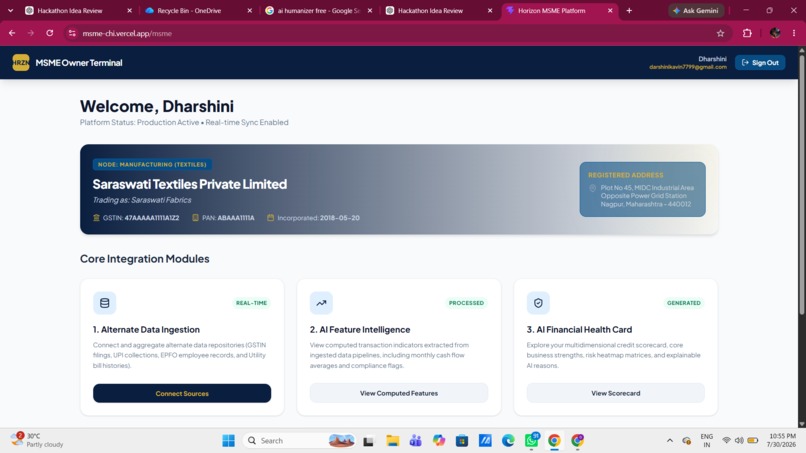
Main page
-
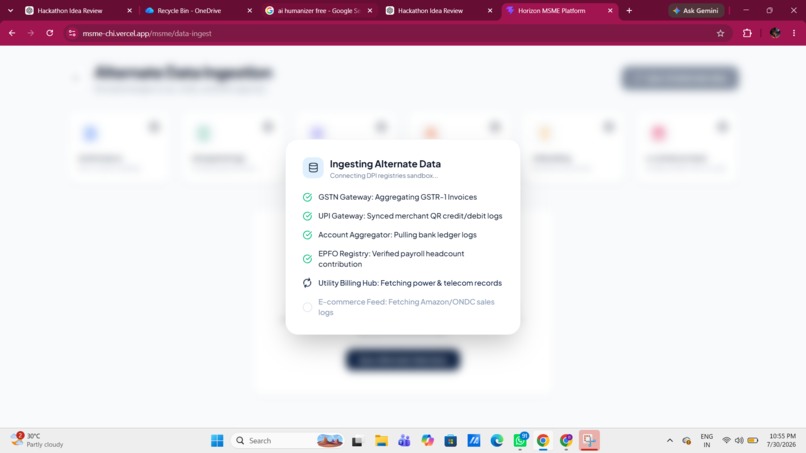
Sync
-
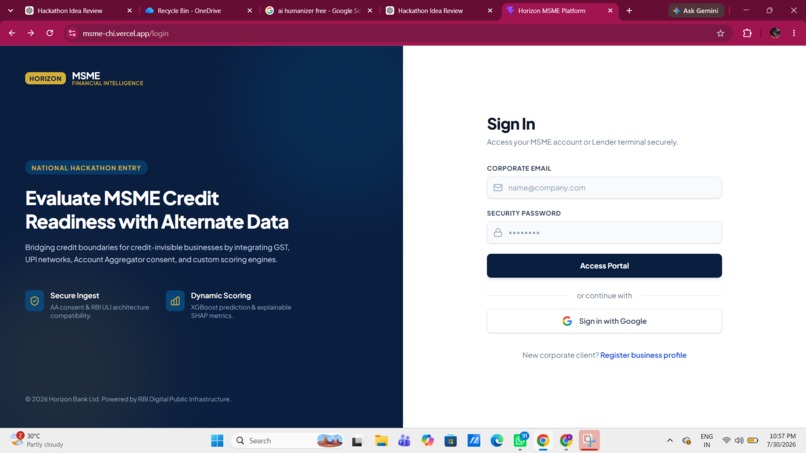
Sign up / Login
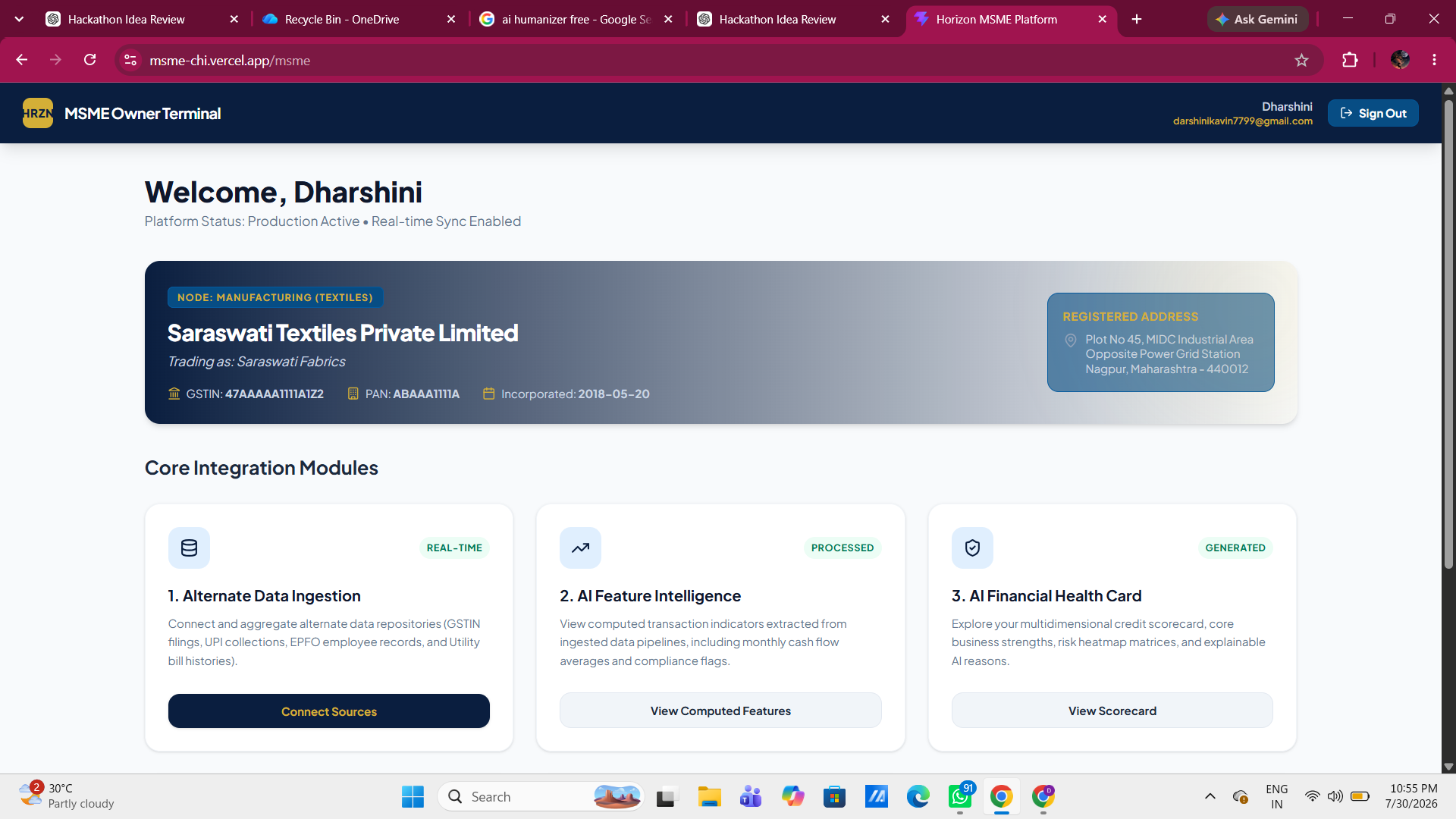
MSME Financial Health Intelligence
Problem Statement
Many MSMEs struggle to get formal loans because they do not have a strong traditional credit history. This makes them credit-invisible, even when their business is financially healthy.
At the same time, lenders often have limited information to understand the actual financial condition of small businesses. This creates a gap between financially healthy MSMEs and access to formal credit.
Solution
We built an AI-powered platform that uses alternate financial data from GST, UPI, banking, EPFO, utility payments, and e-commerce to understand the financial health of an MSME.
The platform generates an explainable Financial Health Score from 300 to 900, along with the factors affecting the score and practical suggestions for improvement.
Our goal is simple: help MSMEs become more credit-ready while giving lenders better information to make informed lending decisions.
Inspiration
MSMEs play a huge role in India's economy, but many small businesses still find it difficult to access formal credit because they do not have a strong conventional credit history.
This made us think about a simple question:
What if a business could prove its financial health even without a traditional credit score?
A business might have regular GST filings, steady UPI transactions, stable cash flow, employees, timely utility payments, and consistent e-commerce sales. However, these signals are usually spread across different systems and do not give the business owner a simple picture of their overall financial health.
That idea led us to build MSME Financial Health Intelligence.
Our platform brings these signals together and converts them into an easy-to-understand 300–900 Financial Health Score, along with a clear roadmap to improve credit readiness.
What We Built
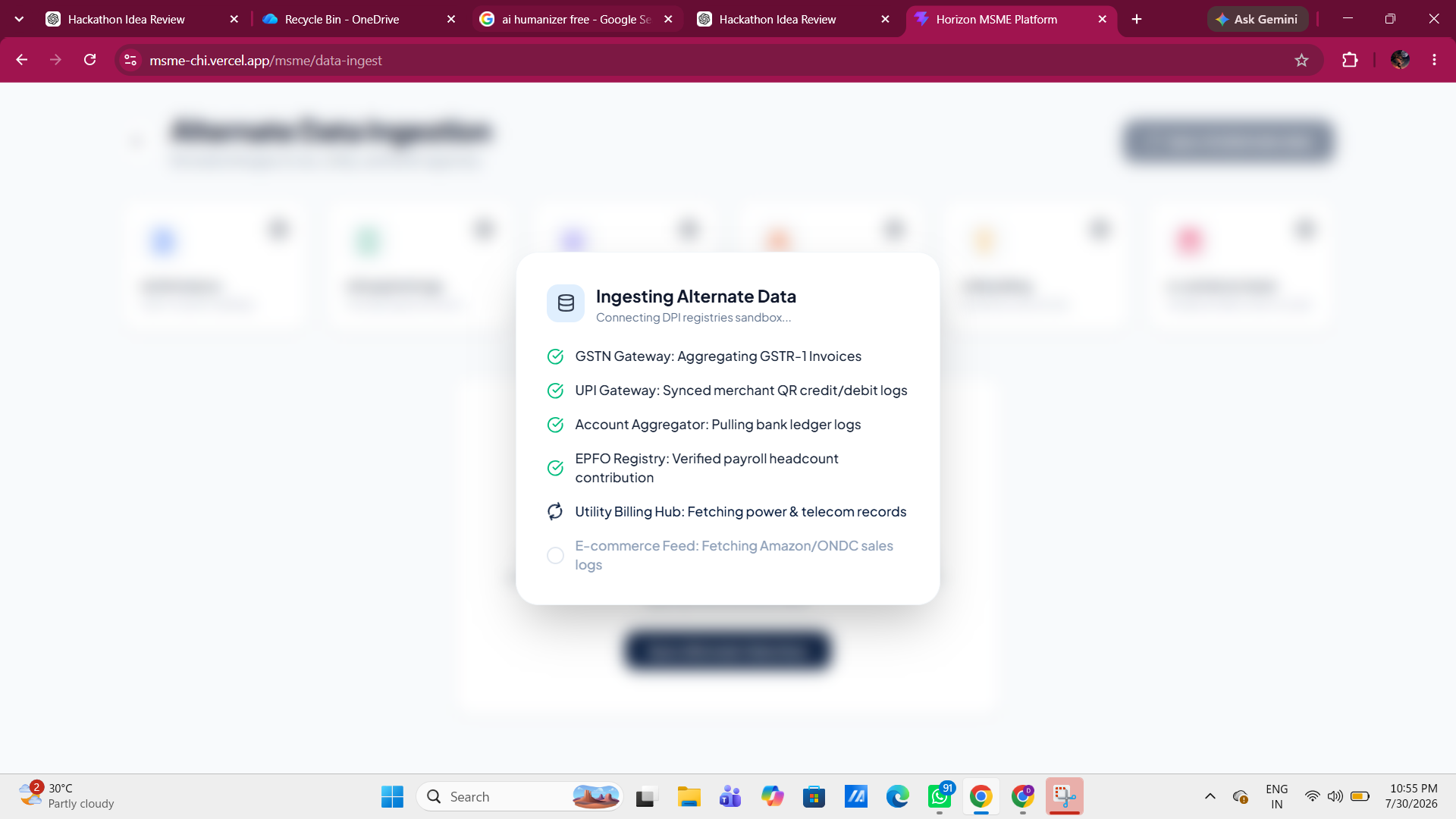
Our platform works with six major alternate data sources:
- GST — turnover and filing behaviour
- UPI — transaction volume and consistency
- Account Aggregator — cash-flow patterns
- EPFO — workforce and payroll stability
- Utility Payments — payment discipline
- E-commerce — sales activity
The system processes these signals and converts them into useful financial indicators.
We did not want to build a system that simply gives a number. We wanted users to understand why they received that score.
For example:
Financial Health Score: 724/900 — PRIME
The MSME can view its performance across areas such as:
- Revenue Stability
- Compliance
- Liquidity
- Workforce Stability
The platform also highlights the positive and negative factors affecting the score and provides practical suggestions, such as improving payment consistency or maintaining better cash-flow coverage.
How It Works
Our overall workflow is:
Alternate Data → Feature Engineering → AI Scoring → Explainable AI → Financial Health Card → Improvement Roadmap → Loan Readiness
The scoring engine produces a normalized score:
$$ Score \in [300,900] $$
Instead of depending on a single metric, the score considers multiple aspects of an MSME's financial health.
The AI layer also provides feature-level explanations, helping both MSME owners and lenders understand what is influencing the assessment.
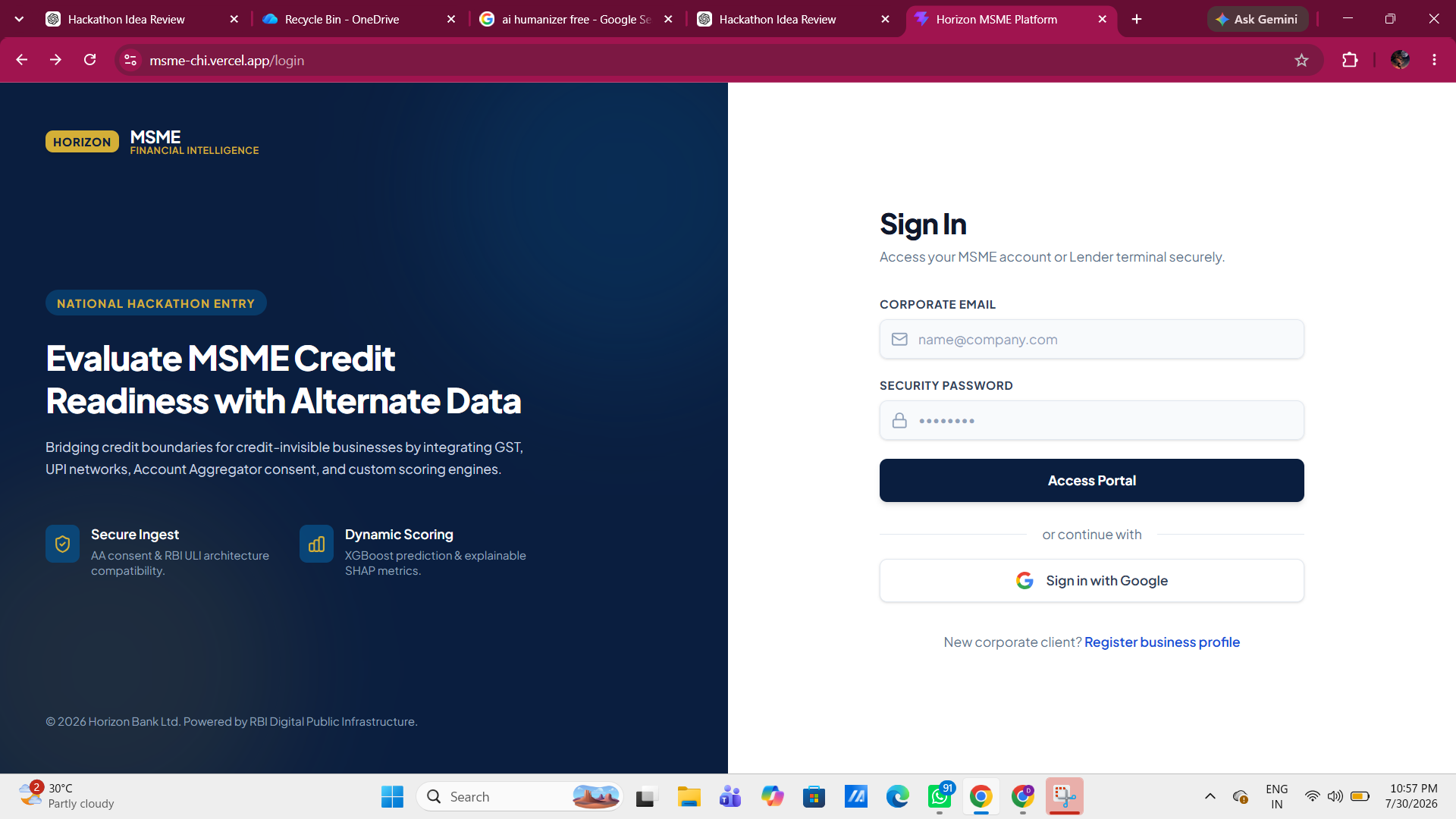
For lenders, we designed a consent-based underwriting dashboard. With the MSME's permission, lenders can access the relevant financial information, view the Financial Health Card, understand important risk factors, and make more informed lending decisions.
How We Built It
We developed the project as a modular full-stack application.
Frontend
- React
- TypeScript
- Vite
- Tailwind CSS
- React Query
- React Router
- Recharts
- Framer Motion
The frontend has separate experiences for MSME owners, lenders, and administrators.
Backend
- Java
- Spring Boot
- Spring Security
- Firebase Admin SDK
- REST APIs
The backend handles business profiles, authentication, data ingestion, consent workflows, and communication with the AI service.
AI/ML Service
- Python
- FastAPI
- NumPy
- Pandas
- scikit-learn
- XGBoost
- SHAP
- LIME
The AI service handles feature engineering, financial health scoring, explainability, and cash-flow forecasting.
Infrastructure
- Firebase Authentication
- Firestore
- Docker
- Docker Compose
For our hackathon prototype, we used simulated sector-aware data to represent real-world financial data sources. This allowed us to demonstrate the complete workflow without depending on production credentials or restricted financial APIs.
What We Learned
This project taught us that building an AI solution for finance is about much more than model accuracy.
Some of the key things we learned were:
- Explainability matters — financial decisions need clear and understandable reasons.
- Privacy and consent are important — financial information has to be handled responsibly.
- Feature engineering makes a difference — raw transaction data is not useful until it is converted into meaningful indicators.
- Every sector is different — the financial pattern of a retail business can be very different from that of a manufacturing business.
- Integration is just as important as AI — a model becomes useful only when it is part of a working product.
- Users need actions, not just scores — an MSME owner should know what they can do to improve.
The biggest lesson for us was to move beyond asking:
“Can we predict creditworthiness?”
and instead ask:
“Can we help a business understand and improve its financial health?”
Challenges We Faced
One of our biggest challenges was building a realistic solution without having access to sensitive, real-world financial data.
To solve this, we created simulated 12-month datasets across multiple alternate data sources. At the same time, we designed the architecture so that real data providers could be integrated in the future.
Another challenge was making the AI output easy to understand. A black-box score would not be very useful to either an MSME owner or a bank officer.
So, we included explainability in the system and converted model outputs into simple reasons and actionable recommendations.
We also had to bring several technologies together — React, Spring Boot, FastAPI, Firebase, and Docker — into one working system.
This helped us understand the practical side of building a real application, including authentication, role-based access, API security, data flow, and communication between different services.
Why It Matters
Our goal is not to build just another lending platform.
We want to create a financial intelligence layer for underserved MSMEs.
A business should not be considered financially invisible simply because it does not have a traditional credit history.
By combining alternate financial signals with explainable AI, our platform can help MSMEs:
Understand → Improve → Prove → Access Credit
At the same time, lenders get a more structured and transparent view of businesses that may otherwise be difficult to assess.
What's Next
Our current prototype demonstrates the complete workflow using simulated data.
In the future, we plan to work towards:
- Real GST data integration
- Consent-based Account Aggregator integration
- Live transaction data pipelines
- Historical repayment-based ML training
- Continuous financial health monitoring
- Advanced model monitoring and drift detection
- Integration with lending partners
- Automated credit decision workflows
Our long-term vision is to build a system where an MSME's financial health is continuously measured, clearly explained, and actively improved.
This can help more small businesses become visible and better prepared to participate in the formal financial system.
Our Vision
Every MSME should have a financial health story that lenders can understand.
With MSME Financial Health Intelligence, we are trying to turn that story into data, useful insights, and real opportunities for better access to credit.
Built With
- aiml
- css
- fastapi
- java
- python
- react
- restapi
- springboot
- typescript


Log in or sign up for Devpost to join the conversation.