-
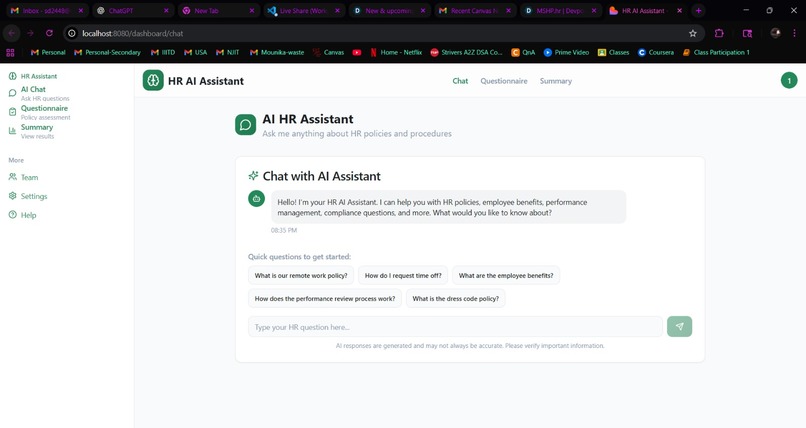
Interface
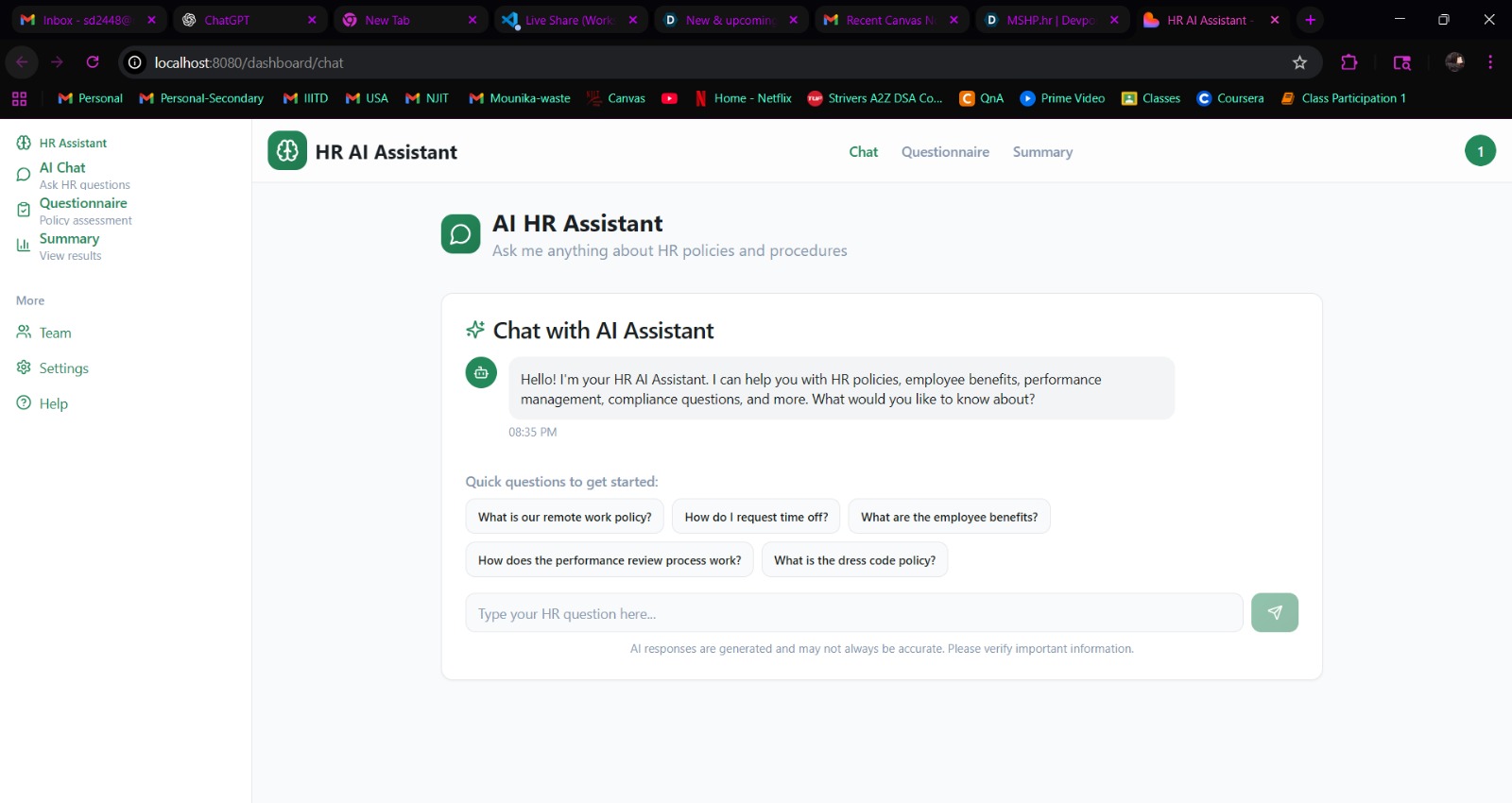
Inspiration
The idea for HR-Mate was born from the frustrating reality that employees waste valuable time searching through outdated manuals or waiting days for HR responses to simple, repetitive policy questions (like "What's the paid time off policy?"). We realized this inefficiency strains both employee productivity and the HR department's bandwidth. Our inspiration was to create a 24/7, instant-response AI assistant that not only resolves common HR inquiries reliably but also gathers crucial data on policy clarity and employee satisfaction through a dynamic questionnaire, transforming the HR experience from a bottleneck into a seamless resource.
What it does
HR-Mate is a full-stack web application designed to be the single source of truth for all employee HR needs. AI Chat Assistant: It provides instant, accurate, and policy-compliant answers to natural language questions about company HR policies (e.g., leave, benefits, grievance procedures) by connecting to a dedicated OpenAI GPT agent. Policy Questionnaire: It hosts a structured, multi-format HR policy questionnaire (MCQs, Yes/No, Short Answer) that allows management to collect anonymous, actionable feedback on how well employees understand core company policies. Secure Dashboard: It features secure login/signup and a dashboard that displays both the chat interface and a summary of the user's questionnaire submission status.
How we built it
We implemented a modern, component-based MERN-like architecture leveraging the power of role-specific tool prompts: Frontend (React.js): The Frontend developer used the prompt to generate a highly responsive UI with TailwindCSS, building out the Login/Signup, Chat, and Questionnaire components. React's state management ensured a fluid user experience for the chat history and form inputs. Backend (Node.js + Express): The Backend developer generated a secure REST API with Express, implementing authentication for /login and /signup. This API acts as the core relay, forwarding chat requests to the AI service via the /ask_ai endpoint and handling persistence for user data and questionnaire responses in MongoDB. AI/NLP: The AI developer created the core intelligence by crafting a system-level prompt and a proprietary HR FAQ dataset. This prompt was integrated into the Node.js /ask_ai endpoint via the OpenAI API, ensuring the AI responses are consistently authoritative and concise. Data/UX: This role generated the structured 10-point HR policy questionnaire and the end-to-end QA test cases, ensuring all four components (Auth, Chat, Submission, Summary) were functional and the data structure was optimal for the MongoDB schema.
Challenges we ran into
Excellent! These are the standard sections for a hackathon project submission.
I will populate them using the context of the four role-based prompts (Frontend, Backend, AI/NLP, Data/UX) and the project name HR-Mate.
💡 Inspiration The idea for HR-Mate was born from the frustrating reality that employees waste valuable time searching through outdated manuals or waiting days for HR responses to simple, repetitive policy questions (like "What's the paid time off policy?"). We realized this inefficiency strains both employee productivity and the HR department's bandwidth. Our inspiration was to create a 24/7, instant-response AI assistant that not only resolves common HR inquiries reliably but also gathers crucial data on policy clarity and employee satisfaction through a dynamic questionnaire, transforming the HR experience from a bottleneck into a seamless resource.
⚙️ What it does HR-Mate is a full-stack web application designed to be the single source of truth for all employee HR needs.
AI Chat Assistant: It provides instant, accurate, and policy-compliant answers to natural language questions about company HR policies (e.g., leave, benefits, grievance procedures) by connecting to a dedicated OpenAI GPT agent.
Policy Questionnaire: It hosts a structured, multi-format HR policy questionnaire (MCQs, Yes/No, Short Answer) that allows management to collect anonymous, actionable feedback on how well employees understand core company policies.
Secure Dashboard: It features secure login/signup and a dashboard that displays both the chat interface and a summary of the user's questionnaire submission status.
🏗️ How we built it We implemented a modern, component-based MERN-like architecture leveraging the power of role-specific tool prompts:
Frontend (React.js): The Frontend developer used the prompt to generate a highly responsive UI with TailwindCSS, building out the Login/Signup, Chat, and Questionnaire components. React's state management ensured a fluid user experience for the chat history and form inputs.
Backend (Node.js + Express): The Backend developer generated a secure REST API with Express, implementing authentication for /login and /signup. This API acts as the core relay, forwarding chat requests to the AI service via the /ask_ai endpoint and handling persistence for user data and questionnaire responses in MongoDB.
AI/NLP: The AI developer created the core intelligence by crafting a system-level prompt and a proprietary HR FAQ dataset. This prompt was integrated into the Node.js /ask_ai endpoint via the OpenAI API, ensuring the AI responses are consistently authoritative and concise.
Data/UX: This role generated the structured 10-point HR policy questionnaire and the end-to-end QA test cases, ensuring all four components (Auth, Chat, Submission, Summary) were functional and the data structure was optimal for the MongoDB schema.
🚧 Challenges we ran into Prompt Consistency: Ensuring the OpenAI agent maintained a professional, non-generic, and highly accurate HR voice was challenging. We had to iterate on our system prompt to eliminate "fluff" and enforce strict policy adherence. Asynchronous Integration: Debugging the end-to-end flow—from the React chat box, through the Express API proxy, to the external OpenAI API, and back—required careful handling of asynchronous calls and error states in the backend. Form Validation & State: Building robust client-side validation for the Login/Signup and the multi-type questionnaire (MCQ vs. text) while maintaining the form state in React proved more complex than anticipated in a tight timeline.
Accomplishments that we're proud of
Full Stack in 24 Hours: We successfully implemented a secure, working full-stack application with user authentication, a persistent database, and an external AI API integration, all from scratch. Contextual Accuracy: We are particularly proud of the high quality of the AI's responses, which, thanks to the dedicated HR FAQ dataset, provides answers superior to a general-purpose chatbot. Plug-and-Play Efficiency: The success of our project is a testament to the power of our role-specific AI prompts, which allowed each team member to generate complex, copy-paste-ready components in minutes, proving the viability of this workflow for future hackathons.
What we learned
We gained deep practical experience in orchestrating a microservice architecture with a primary focus on API security and latency management. Most importantly, we learned that in the age of generative AI, the value of a developer shifts from writing boilerplate code to expertly designing prompts and integrating diverse services to create a unified, functional product. We cemented our understanding of using TailwindCSS for rapid, responsive design and the power of a Node/Express backend as a flexible, non-blocking service layer.
What's next for MSHP.hr
RAG Implementation: Move from simple prompt-priming to a full Retrieval-Augmented Generation (RAG) pipeline, allowing HR-Mate to query policy directly from uploaded company documents (PDFs/DOCX) instead of a fixed FAQ list. Manager Dashboard: Implement a secure manager-facing dashboard for viewing aggregated and anonymized questionnaire data, allowing HR to track policy comprehension scores and identify areas of confusion. Proactive HR: Integrate push notifications or email alerts for mandatory policy review deadlines and integrate with a calendar API to automate leave application submissions.
Built With
- dataset
- express.js
- git
- github
- jwt
- mongodb
- node.js
- openai
- react.js
- tailwindcss
- vscode

Log in or sign up for Devpost to join the conversation.