-
-
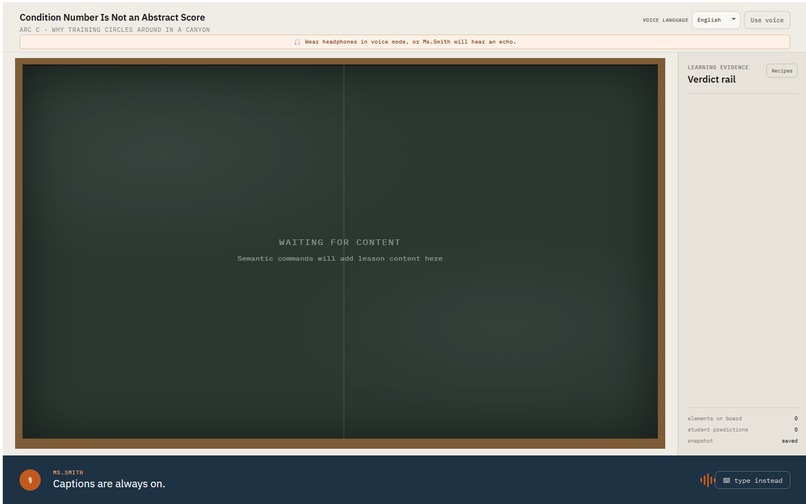
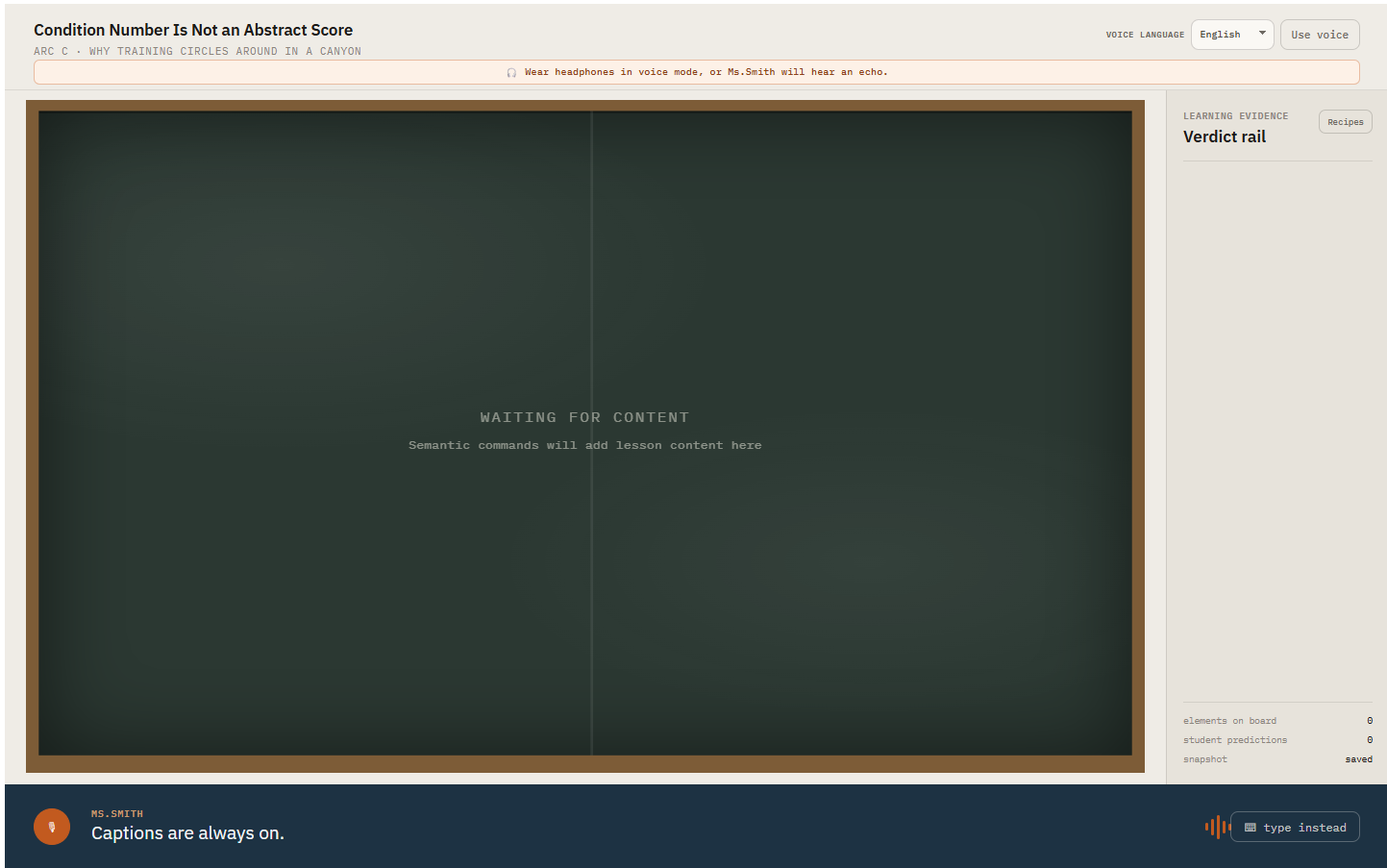
Ms.Smith classroom snapshoot
Inspiration
I spent five years studying mathematics at the University of Waterloo. When I took real analysis, I kept getting stuck — not because I wasn't working hard, but because the concepts were simply invisible. Take the $\varepsilon$–$\delta$ definition of a limit:
$$\forall \varepsilon > 0,\ \exists \delta > 0 \ \text{ s.t. }\ 0 < |x - a| < \delta \implies |f(x) - L| < \varepsilon$$
You either see it in your head, or you don't.
To be clear, STEM visualization itself isn't new — 3Blue1Brown, Brilliant, and Desmos are all excellent. But they share one limitation: the visuals are pre-made, for a generic audience. When you're stuck on your specific confusion at 2am, a library of someone else's animations doesn't help. Meanwhile, the AI study tools (NotebookLM being the most polished) generate flashcards, quizzes, podcasts, summaries — great for reading-heavy courses, useless against abstraction. Nobody gives you a teacher who draws your answer, live. And this gap isn't a niche pain: according to the NCES report STEM Attrition, 48% of STEM undergraduates end up leaving the field, mostly in the first two years — in exactly these abstract courses.
So I built Ms. Smith: which is an AI teacher that draws while she talks. Ask her why continuity doesn't imply uniform continuity, and she doesn't recite the definition — she draws the $\varepsilon$-band live, slides it along $f(x) = 1/x$, and lets you watch $\delta$ collapse near zero. The first stroke appears in under [X] seconds.
The journey: from Luma to Ms. Smith
Ms. Smith has a predecessor called Luma — a name chosen deliberately. In English, Luma echoes the Latin lumen: a light that guides you through the dark. In Chinese, its sound carries the meaning of 整理 (sorting things out) and 理解 (understanding). That was the whole promise: take what's tangled and abstract, and make it clear.
Luma was text-based. I tested it on my own classmates: of the 20 people I showed it to, 10 tried it and 3–4 became regular users. A tiny sample — but that retention told me the pain was real, and it gave me the confidence to keep going.
Two things triggered the upgrade. First, OpenAI's latest voice model made a natural, teacher-like spoken experience finally possible. Second, Luma's usage taught me that for STEM, visuals beat text: students grasp a moving, manipulable picture far faster than a paragraph — and unlike text, a visual can be interactive.
How I built it
I ran a two-agent workflow: Claude as the architect and Codex as the builder. With Claude, I turned an idea I'd carried for years into a concrete spec — the orchestration design, the technical details, the UI. Then Codex implemented and tested against that spec, while I iterated between the two.
Challenges
The hardest part was the orchestration architecture, which had to solve two problems at once.
Latency. Real-time voice plus real-time visuals is unforgiving: every design decision trades speed against quality, and a teacher who pauses for ten seconds before answering isn't a teacher.
Correctness. This one is existential for a STEM tool: a wrong diagram is worse than no diagram, because the student walks away with a broken intuition. Voice models are fast but not rigorous — you can't let one freehand real analysis. My solution: a stronger reasoning model does the actual mathematics and emits a structured visual spec, which is rendered deterministically on the board. The voice layer delivers the explanation and handles the conversation, but it never invents the math. Fast where speed matters, rigorous where truth matters.
Landing this split took repeated rounds of experiments — moving responsibilities between layers, measuring latency, checking correctness — before the architecture held up.
What I learned
- For STEM learning, seeing a concept beats reading about it — and interactivity beats both.
- Small honest experiments (20 classmates) teach you more than big plans.
- The bottleneck in real-time AI products is rarely the model — it's the orchestration around it.
What's next
Copying the best teacher costs zero. So the students who benefit most are the ones who never had access to one — community colleges, small towns, remote rural classrooms. That's where Ms. Smith is headed.
Built With
- css-modules
- html5
- katex
- next.js
- node.js
- openai-api
- openai-realtime-api
- openai-responses-api
- react
- typescript
- vercel
- webrtc
- zod
- zustand

Log in or sign up for Devpost to join the conversation.