-
-
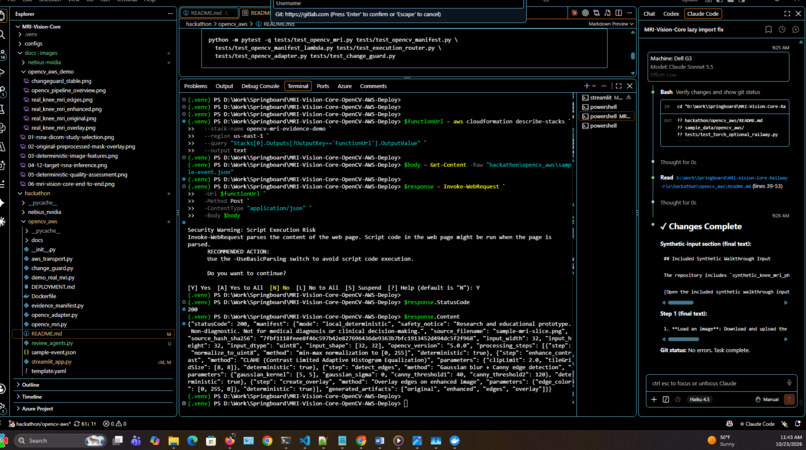
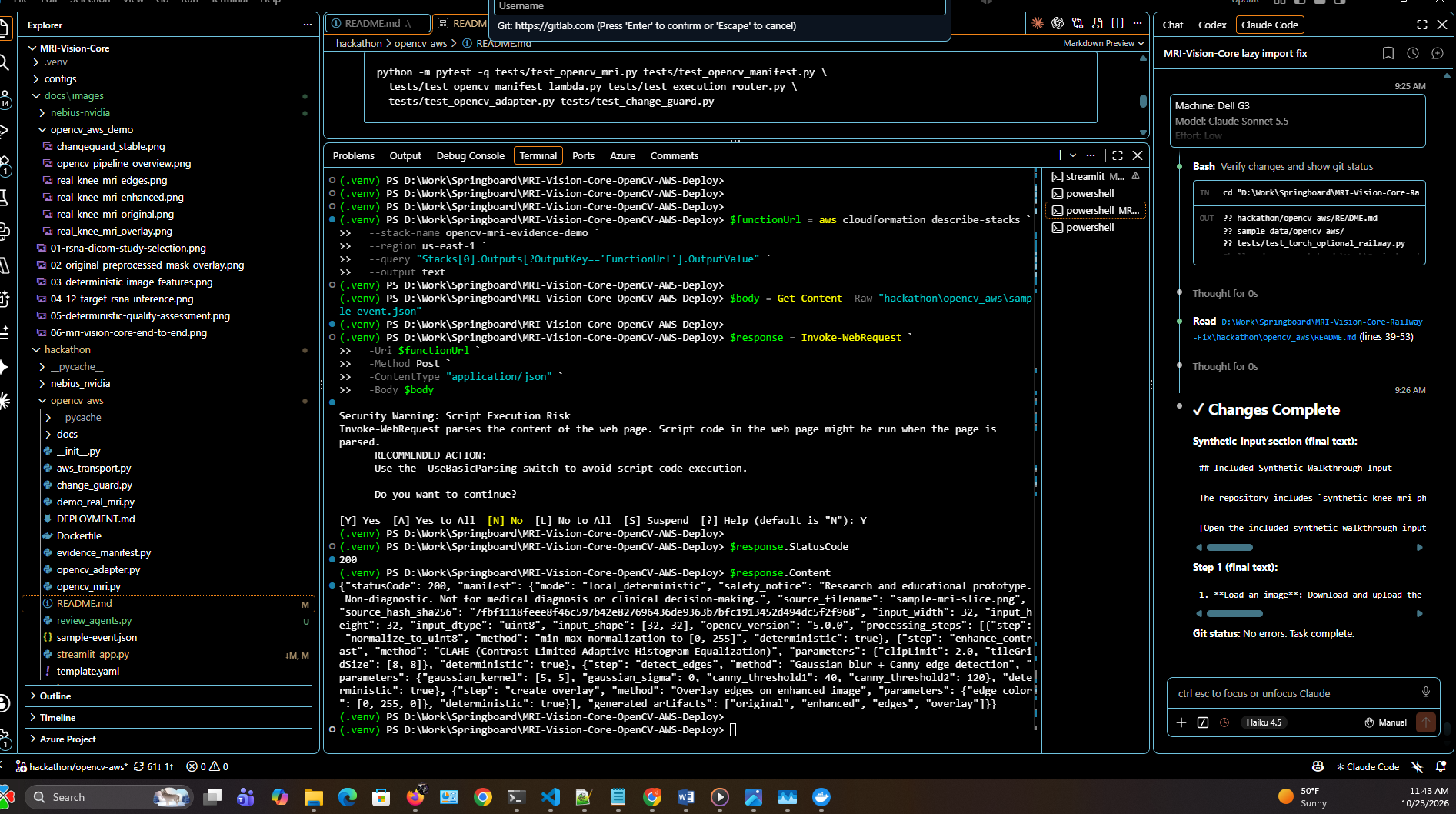
Successful POST to the deployed AWS Lambda Function URL, returning HTTP 200 and a JSON evidence manifest from the repository sample event.
-
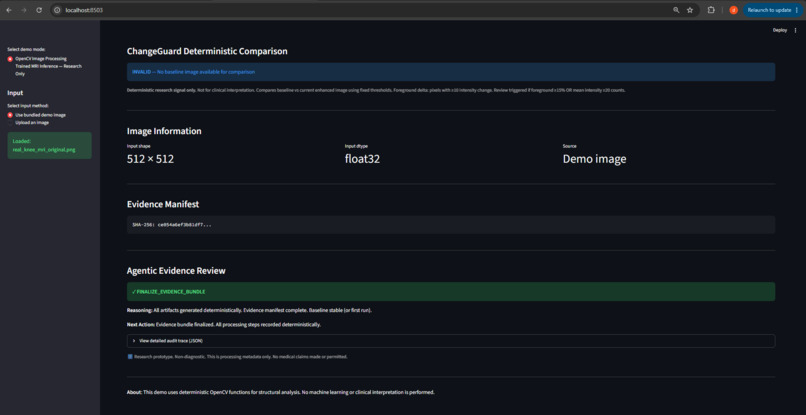
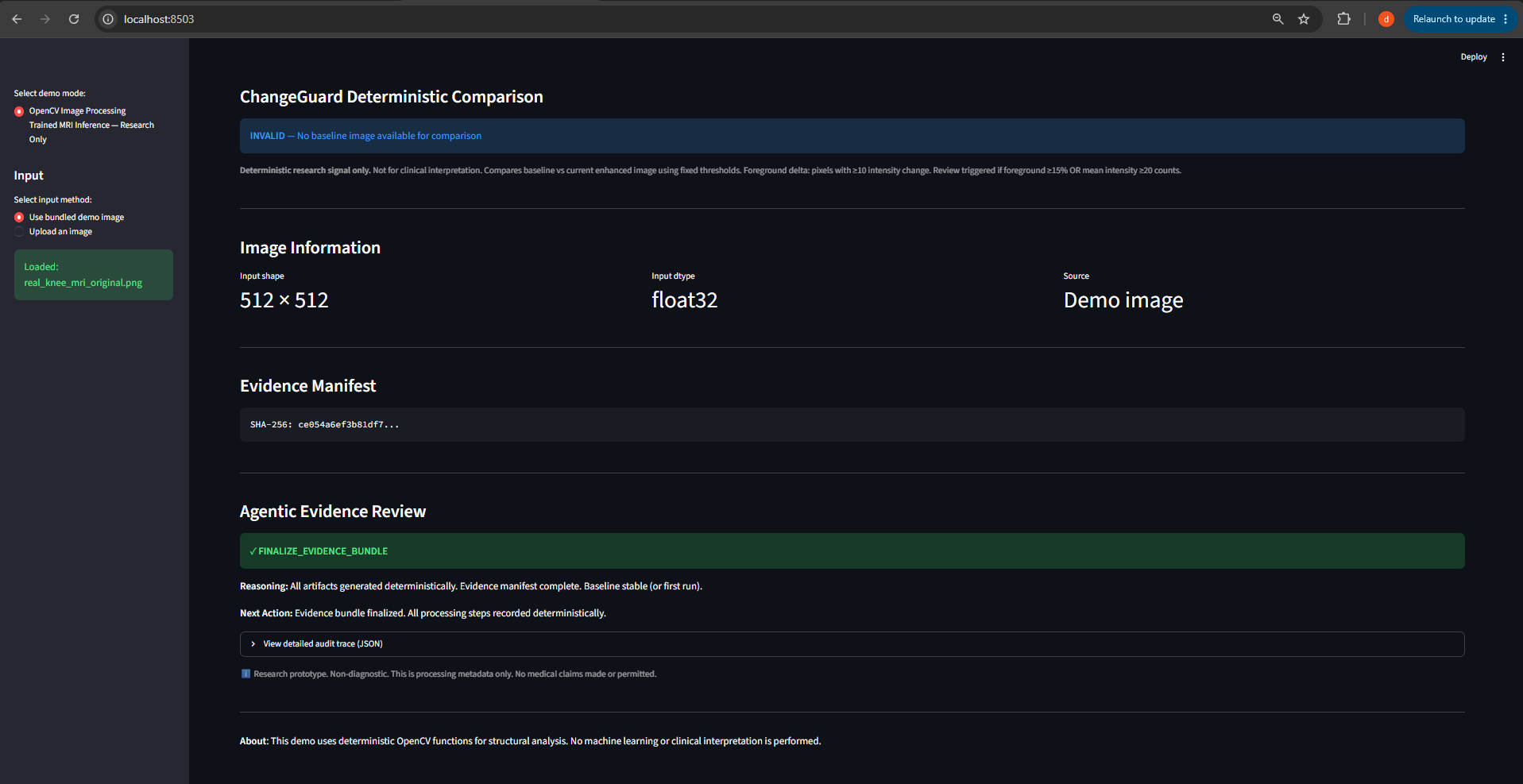
Deterministic Evidence Review Agent evaluates the OpenCV evidence manifest and ChangeGuard result, then selects one non-diagnostic outcome
-
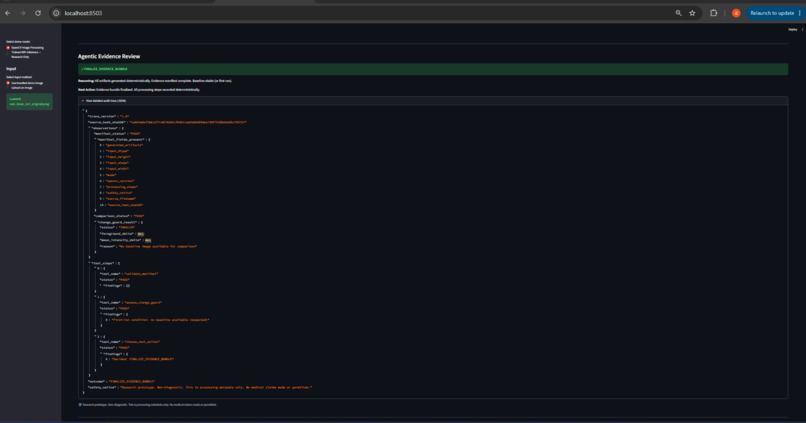
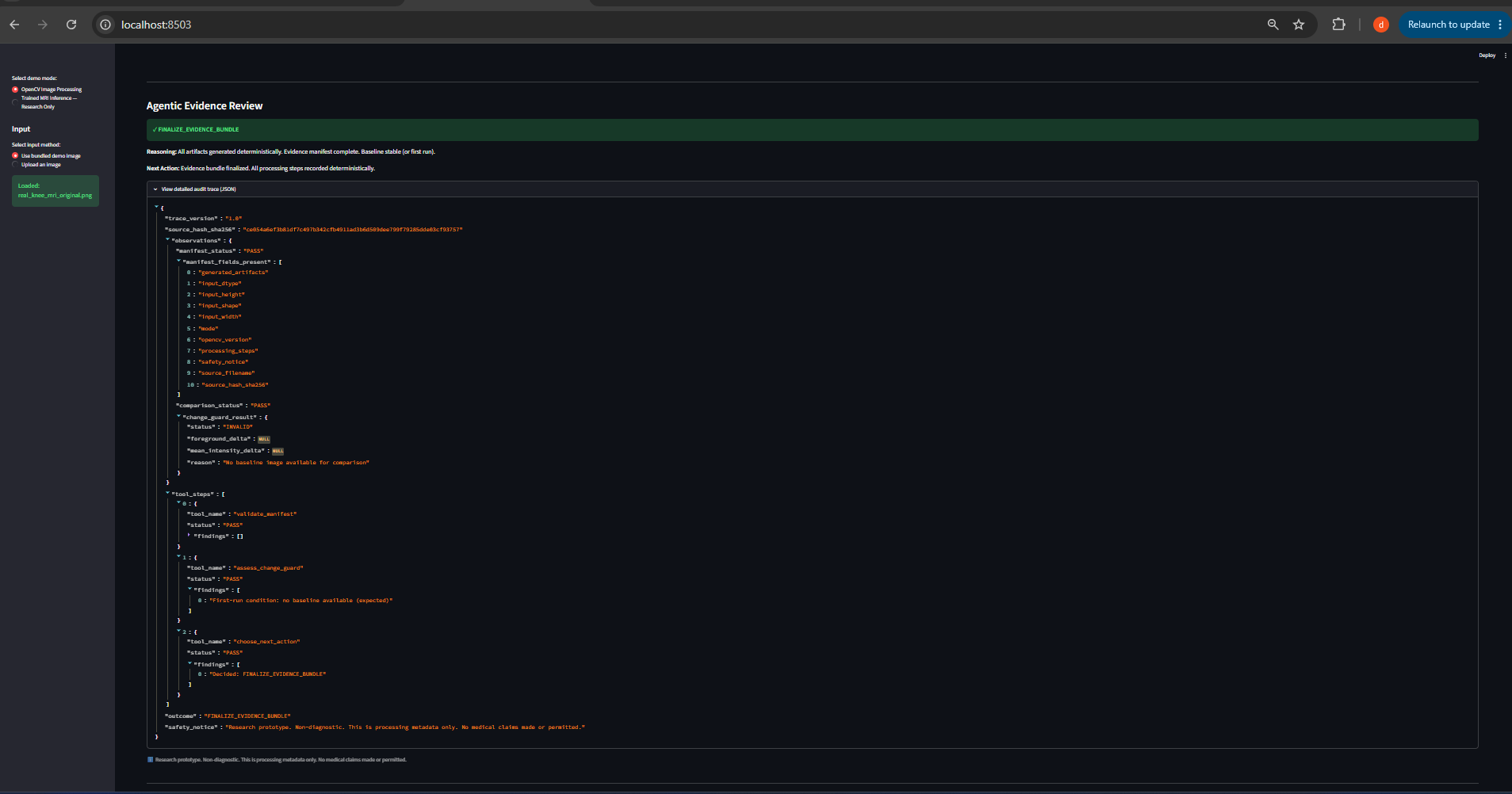
Inspectable audit trace showing manifest validation, baseline assessment, decision rationale, and the prescribed next action.
Inspiration
Image-processing demos can look impressive without making their processing steps, evidence, or review decisions easy to inspect. MRI Vision Core explores a more accountable approach: deterministic OpenCV processing, explicit evidence records, baseline-aware comparison, and a visible human-control path.
What it does
The Railway demo accepts a PNG/JPG or included synthetic walkthrough image and runs a local deterministic OpenCV 5 pipeline. It produces four visual artifacts:
- normalized original
- contrast-enhanced image
- detected edges
- green-edge overlay
It also generates an evidence manifest with the source SHA-256, image dimensions and dtype, OpenCV version, deterministic processing steps, artifact names, and research-only safety metadata.
A deterministic Evidence Review Agent validates the manifest, assesses ChangeGuard baseline information when available, and returns one auditable outcome:
FINALIZE_EVIDENCE_BUNDLEREQUEST_MORE_EVIDENCEPENDING_HUMAN_APPROVAL
How we built it
We built the interactive workflow with Python, Streamlit, NumPy, and OpenCV 5. The evidence pipeline records deterministic processing metadata and artifact names. ChangeGuard compares outputs against a prior baseline when one exists.
The AWS component is a separately deployed Lambda Function URL using an OpenCV 5 container, AWS SAM template, Dockerfile, and documented repository sample JSON event. It returns a JSON evidence manifest. The Railway UI runs independently and does not invoke Lambda or an LLM.
Challenges we ran into
The main challenge was building a visually understandable demonstration without overstating what image processing can establish. We separated deterministic visual processing from clinical claims, used synthetic walkthrough data, added safety language, and made the review state auditable.
We also kept PyTorch-dependent trained inference optional so the lightweight Railway deployment can start without PyTorch.
Accomplishments that we're proud of
- A live interactive Railway OpenCV demo
- A separately deployed AWS Lambda evidence-manifest API
- Deterministic artifacts and SHA-256 evidence manifests
- ChangeGuard baseline-aware comparison
- An auditable Evidence Review Agent with a non-bypassable human-approval outcome
- Public architecture diagrams, tests, deployment material, and walkthrough documentation
What we learned
We learned that a credible computer-vision demonstration needs more than a processed image. Reproducibility, explicit limits, traceable decisions, fallback behavior, and human control make the workflow easier to inspect and safer to communicate.
What's next for MRI Vision Core: Deterministic OpenCV Evidence Workflow
Next, we plan to extend synthetic workflow-validation scenarios, improve review visualization, and continue separating deterministic evidence processing from any future research-model experiments. Any future work will preserve the research-only, non-diagnostic boundary and require appropriate validation before making broader claims.

Log in or sign up for Devpost to join the conversation.