-
-
MR RigBuilder: Assembling a High-End Workstation
Our team specializes in developing immersive skill-building applications for various domains, including industrial, emergencies, and defense, etc. During our brainstorming session for the hackathon, we decided to focus on creating a rig builder application. This decision was driven by the opportunity to showcase our expertise in developing skill-building virtual reality (VR) applications, while also presenting it in a mixed reality (MR) format. Additionally, many well-known VR applications demonstrate how to assemble and disassemble a personal computer, making our concept relatable to a broader audience.
The Application:
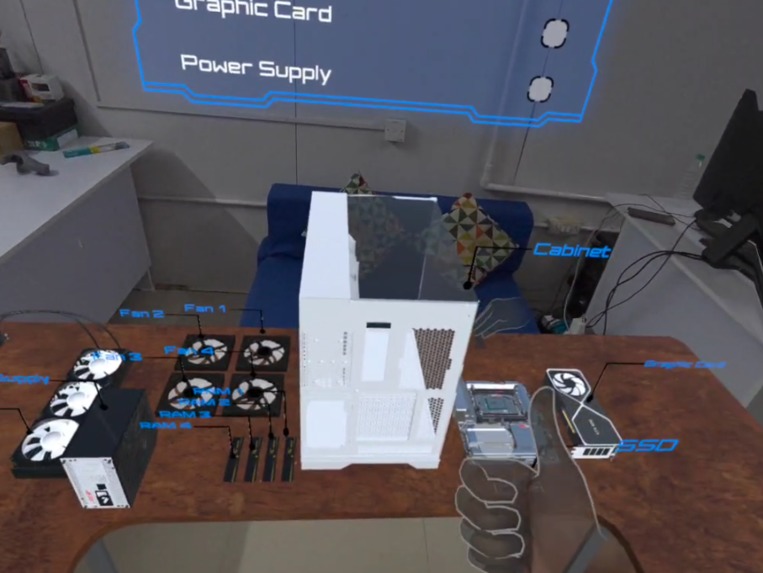
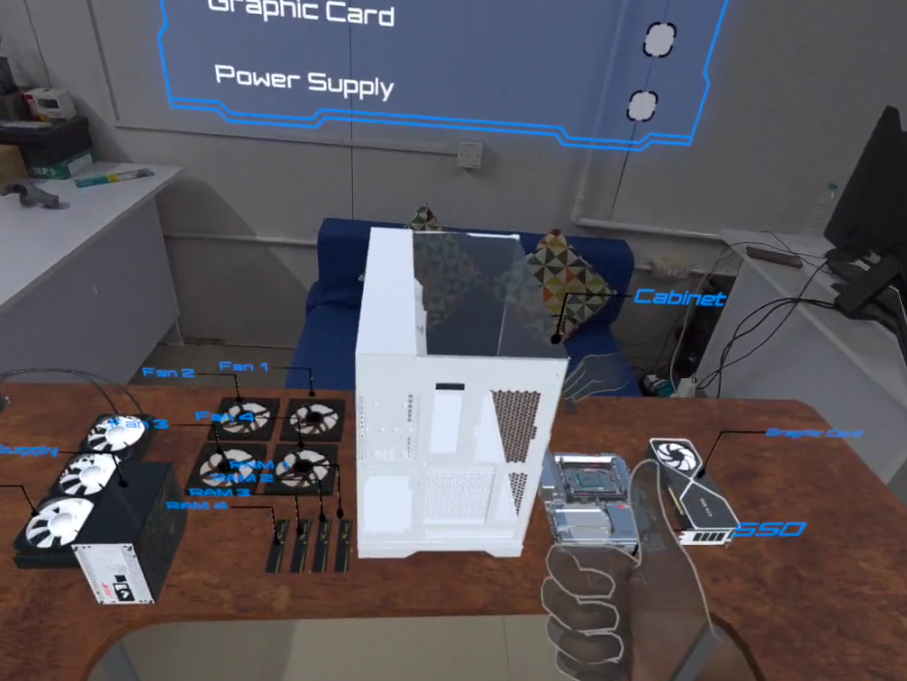
We have created a mixed reality application for the Oculus Quest, designed to train users on assembling a high-end workstation by integrating components such as processors, RAM, SSDs, GPUs, and more onto the motherboard and subsequently into the cabinet. Leveraging the Quest's passthrough and hand-tracking features, this application serves as a proof of concept (POC) for skill-building and learning new skills using mixed reality technology. Initially, users select various components, including the type of motherboard, SSD, cooling fans, GPUs, and more from a provided set of options. Once all components are chosen, the workstation assembly process begins. Animations guide users on where each component should be placed within the motherboard or cabinet. Users can then physically pick up and place the components in their designated locations using hand gestures. Upon successful assembly, users receive a congratulatory message.
Development Process:
The development process began with designing detailed 3D models for all the components. Next, we created a visually appealing and user-friendly UI canvas for the application. Subsequently, all these assets were imported into the Unity game engine, where the application was built and integrated.
Challenges Faced:
One of the primary challenges we encountered was restricting the triangle count and total number of objects in a scene to prevent drastic frame rate drops on the Oculus Quest. Additionally, we had to ensure that our scripts did not overload the update() function, which could lead to performance issues.
Accomplishments and Learnings:
Despite the limited time available, we take pride in the significant progress we made on this application. While some fine-tuning and finishing touches are still required, we are confident that this type of skill-building application can reduce eye strain and make the process of learning new skills more interactive and relatable. Throughout the development process, we gained invaluable insights into building mixed-reality applications and how they differ from virtual and augmented-reality applications. Notably, we received feedback from older adult users who seemed more receptive to this MR application compared to VR applications.
Future Development:
Due to time constraints, we were unable to fully complete the application despite our best efforts. Moving forward, we plan to finalize the fine-tuning and add the remaining finishing touches. Additionally, we aim to incorporate new functionalities, such as allowing users to choose components within a specified budget and implementing object detection capabilities to spawn virtual models when focused on real-world components like CPUs. In summary, our team has successfully developed a mixed reality skill-building application for the Oculus Quest, focused on assembling high-end workstations. Through this project, we have demonstrated our expertise in creating immersive and interactive learning experiences while gaining valuable insights into mixed reality development. We remain committed to refining and expanding this application to provide an even more engaging and effective skill-building platform.


Log in or sign up for Devpost to join the conversation.