Inspiration
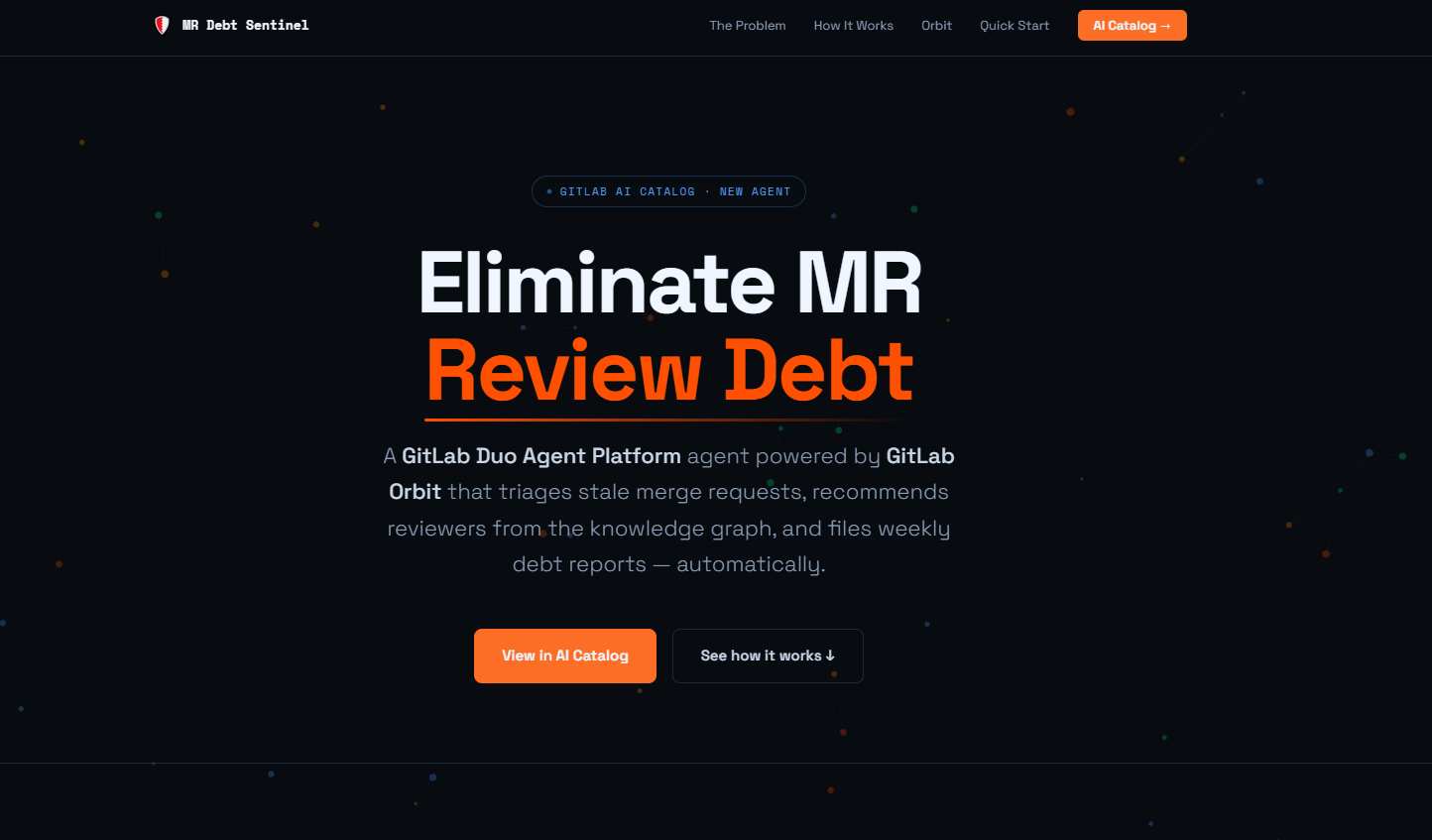
Every engineering team I've observed has the same silent problem: merge requests that sit unreviewed for days, lose context, accumulate conflicts, and eventually cost 3× the original effort to resurrect. Nobody lets MRs rot on purpose — it happens in the gap between the tools teams have and the process they can realistically maintain. I built MR Debt Sentinel to close that gap permanently.
What I Learned
Building on the GitLab Duo Agent Platform taught me how powerful constrained, purpose-built agents are compared to general-purpose assistants. The most important insight was how GitLab Orbit's knowledge graph changes the quality of decisions an agent can make — knowing who actually committed to a file in the last 90 days is fundamentally more useful than who's listed in CODEOWNERS. I also learned the importance of guardrails in agentic systems: an agent that can act on your repository needs hard limits that developers can trust unconditionally.
How I Built It
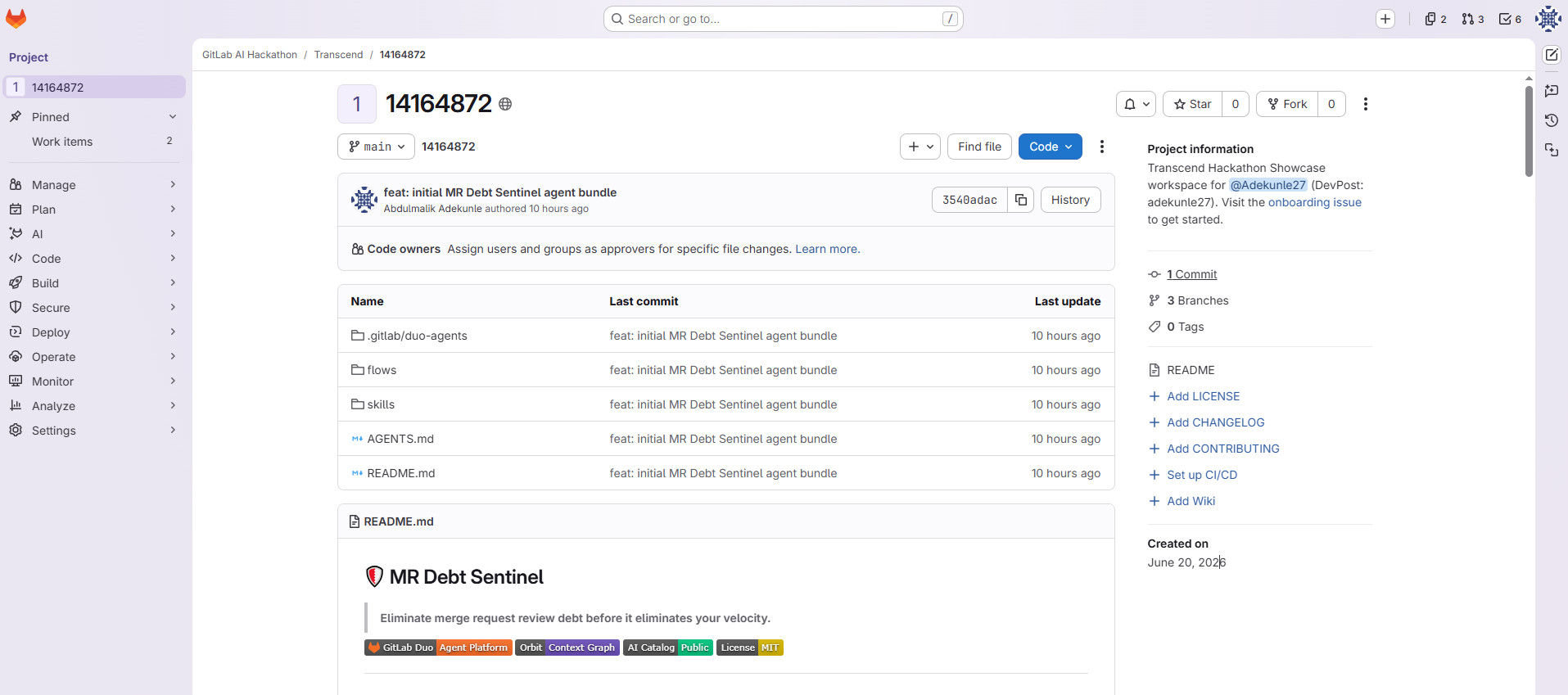
MR Debt Sentinel is a five-component bundle built entirely on the GitLab Duo Agent Platform:
- Custom Agent (
mr-debt-sentinel) — interactive on-demand triage via GitLab Duo Chat, applying a four-tier severity rubric (🔴 CRITICAL / 🟠 HIGH / 🟡 MEDIUM / 🟢 LOW) and using Orbit context for reviewer recommendations - Multi-agent Flow (
mr-debt-weekly-report-flow) — a scheduled three-agent pipeline (Scanner → Triage Actor → Report Writer) that runs every Monday at 08:00 UTC - Three Skills —
/mr-health-checkfor single-MR assessment,/orbit-context-fetchfor Orbit-powered reviewer ranking, and/stale-mr-closerfor safe auditable MR closure
The agent uses 12 GitLab Duo tools including get_merge_request,
create_merge_request_note, update_merge_request, run_glql_query, and
get_pipeline_failing_jobs. Reviewer recommendations are ranked by a composite
score: (commit_count × 2) + last_modified_bonus - current_review_load.
Challenges
The biggest challenge was designing guardrails that make the agent genuinely
trustworthy. An agent that can label, comment on, and close merge requests
autonomously is dangerous without hard limits. I spent significant time on the
exclusion logic — skipping Draft MRs, respecting do-not-triage labels,
protecting security branches, capping reviewer assignments at 5 open reviews,
and requiring explicit human confirmation before any destructive action. Getting
that balance right — powerful enough to be useful, constrained enough to be
safe — was the core design challenge of this project.
Built With
- gitlab-duo-agent-platform
- gitlab-duo-chat
- gitlab-graphql-api
- gitlab-orbit
- gitlab-rest-api
- glql
- markdown
- yaml


Log in or sign up for Devpost to join the conversation.