Inspiration
AI agents are beginning to access APIs, tools, data, and services autonomously—but the machine-payments ecosystem is changing quickly. Important developments are scattered across protocol documentation, GitHub repositories, company blogs, standards work, and community discussions.
MPP Pulse was created to make this emerging space easier to follow. It focuses on what changed, what shipped, what is proposed, and which developments may matter to builders, payments teams, investors, and researchers.
What it does
MPP Pulse is an always-on intelligence agent that produces a cited weekly brief covering:
- Machine Payments Protocol (MPP)
- Tempo and the Tempo ecosystem
- x402 and HTTP 402
- Payment Auth specifications
- GitHub implementation activity
- Agent-payment infrastructure
- Relevant announcements, integrations, and adoption signals
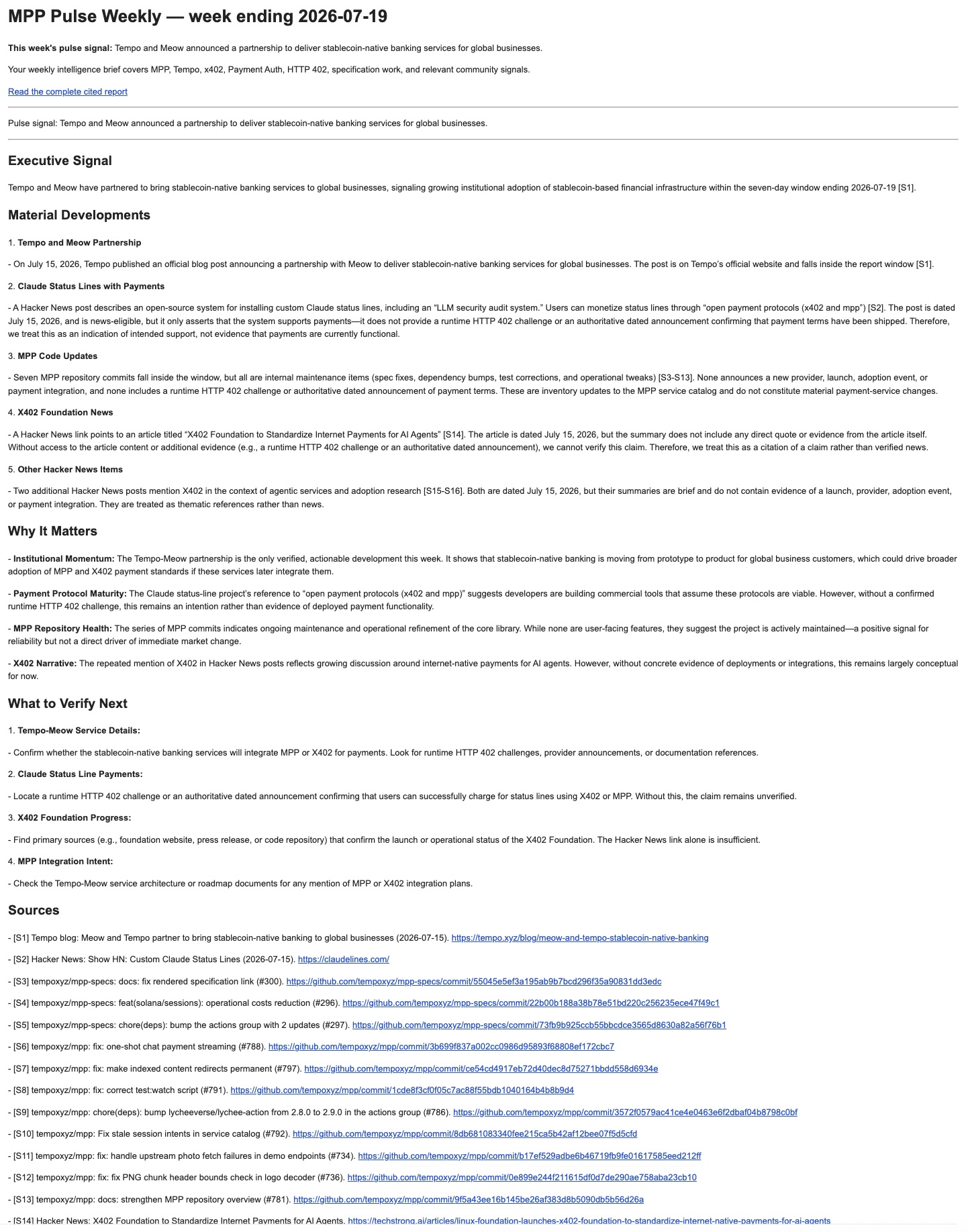
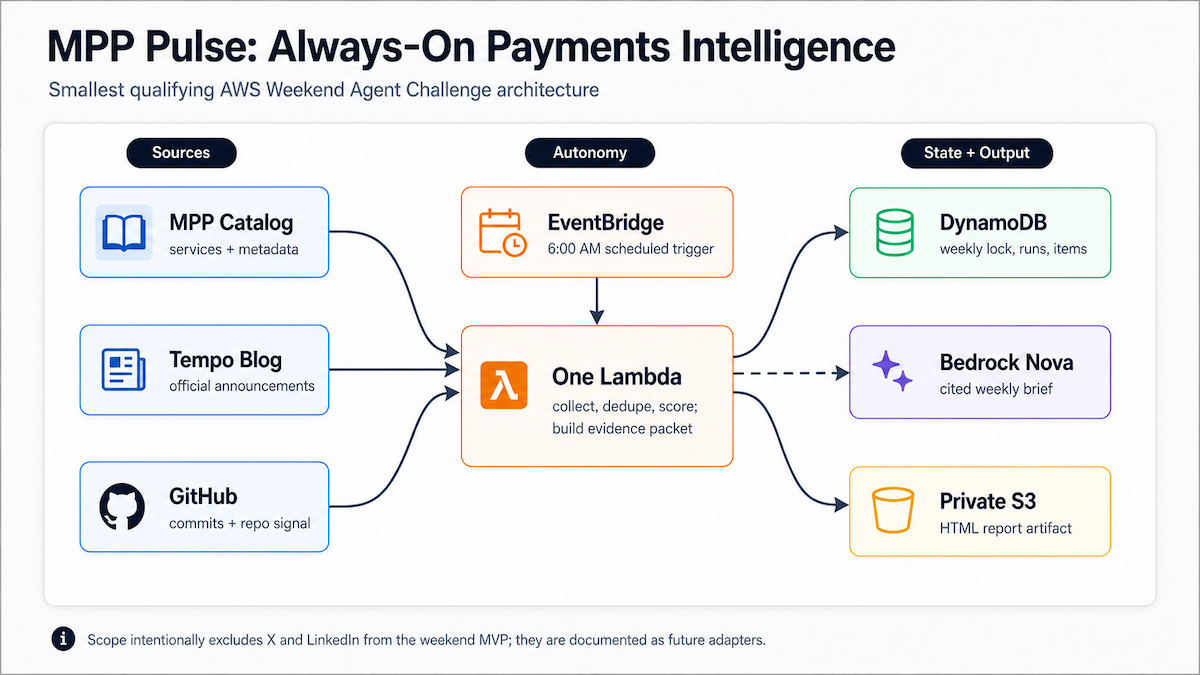
The agent runs automatically on AWS using a scheduled EventBridge trigger. It collects evidence from selected sources, normalizes and filters results, identifies duplicates, assigns relevance, and sends a source-linked report by email.
The report distinguishes between announcements, proposals, merged implementation changes, documentation, catalog inventory, verified deployments, and community signals requiring further verification.
How we built it
MPP Pulse was built with Codex using GPT-5.6 as the primary development partner.
The project uses:
- Amazon EventBridge Scheduler for autonomous weekly execution
- AWS Lambda for orchestration and collection
- Amazon DynamoDB for run state and evidence indexing
- Amazon S3 for report artifacts and operational evidence
- Amazon Bedrock with Amazon Nova for report synthesis
- Amazon SES for email delivery
- AWS SAM for infrastructure definition and deployment
- GitHub for source control and documentation
Codex accelerated the workflow across architecture, Lambda implementation, AWS infrastructure, persistence design, testing, source-quality controls, deployment, documentation, and troubleshooting.
GPT-5.6 supported architectural reasoning, implementation, editorial classification, documentation, and review. A key design decision was to keep the first version focused: one scheduled Lambda and a small number of high-value sources rather than an overbuilt social-media ingestion system.
Challenges I ran into
The biggest challenge was precision. Broad terms such as “HTTP 402,” “agent,” or “payment” produce many unrelated results.
I addressed this by prioritizing first-party sources and requiring evidence to have a meaningful connection to MPP, Tempo, x402, Payment Auth, or machine payments. Generic community content is excluded or clearly labeled for verification.
Another challenge was distinguishing catalog inventory from news. An MPP service directory can show that a provider exists, but that does not necessarily mean something changed during the reporting period. MPP Pulse treats catalog data as discovery evidence and gives greater weight to dated announcements, merged code, specification revisions, and verified runtime behavior.
The system also needed to be resilient. Network failures, rate limits, unavailable feeds, and model errors should not erase useful results from other sources. Collectors fail independently, and the system can produce a source-linked fallback report when AI synthesis is unavailable.
Accomplishments that I'm proud of
- Built and deployed a working always-on AWS agent.
- Created a complete weekly machine-payments intelligence workflow.
- Added evidence classification and source-precision controls.
- Implemented cited report generation with a source ledger.
- Added operational logging and autonomous invocation evidence.
- Published the project as an open-source MIT-licensed repository.
- Created a public project page
- Used Codex and GPT-5.6 throughout architecture, implementation, testing, deployment, and documentation.
- Designed the workflow for both human readers and machine-readable research consumers.
What I learned
I learned that an intel agent needs stronger source discipline than a general-purpose news summarizer. Collecting links is relatively easy; determining whether an item is relevant, current, material, and properly supported requires explicit rules and careful review.
I also learned that serverless AWS services are well suited to small autonomous research systems. EventBridge, Lambda, DynamoDB, S3, Bedrock, and SES provide enough capability to build a useful workflow without managing servers.
Using Codex changed the development process as well. Its most valuable role was helping move between architecture, implementation, deployment, testing, editorial judgment, and documentation while maintaining a coherent project.
What's next for MPP Pulse - Machine Payments Weekly Intel Brief
The next phase will focus on improving reliability, evidence quality, and usefulness for readers.
Planned areas include:
- Better longitudinal reporting across weekly briefs
- More precise change detection
- Additional protocol and implementation sources
- Improved corroboration between primary and community evidence
- More useful report formats for developers, researchers, and payments teams
- A lightweight subscription and review workflow
- Continued evaluation of machine-payments intelligence for both people and software agents
The project will remain focused on trustworthy, cited intelligence rather than maximizing the number of collected links.
Built With
- 402
- amazon
- amazon-web-services
- bedrock
- codex
- dynamodb
- eventbridge
- github
- gpt-5.6
- http
- lambda
- markdown
- mpp
- nova
- payment
- python
- s3
- scheduler
- ses
- tempo
- x402

Log in or sign up for Devpost to join the conversation.