-
-

Moxscore logo
-
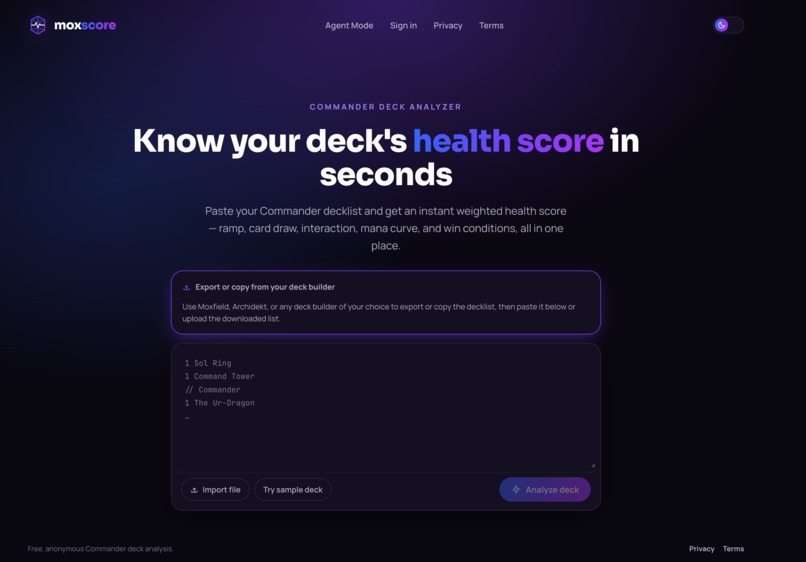
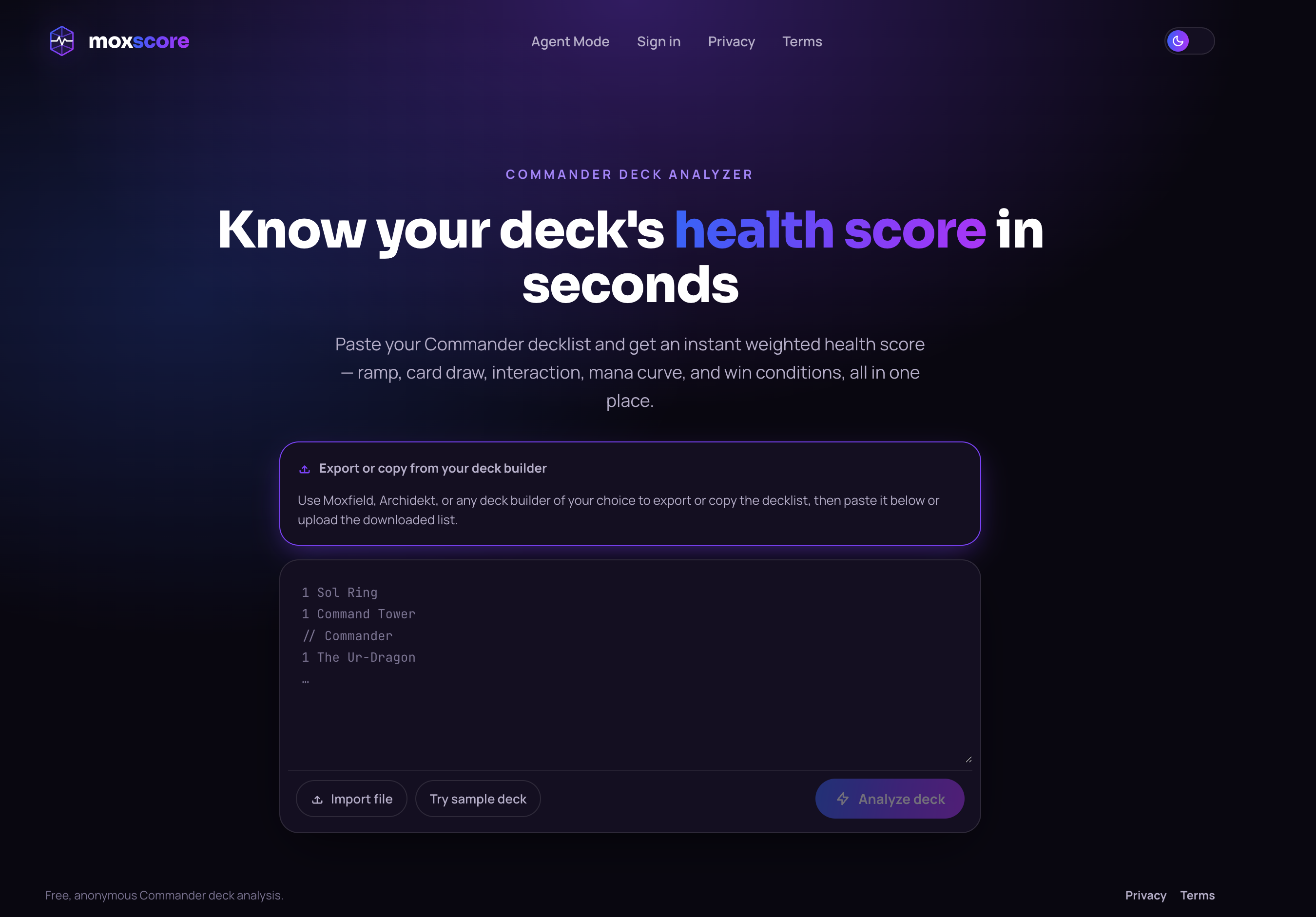
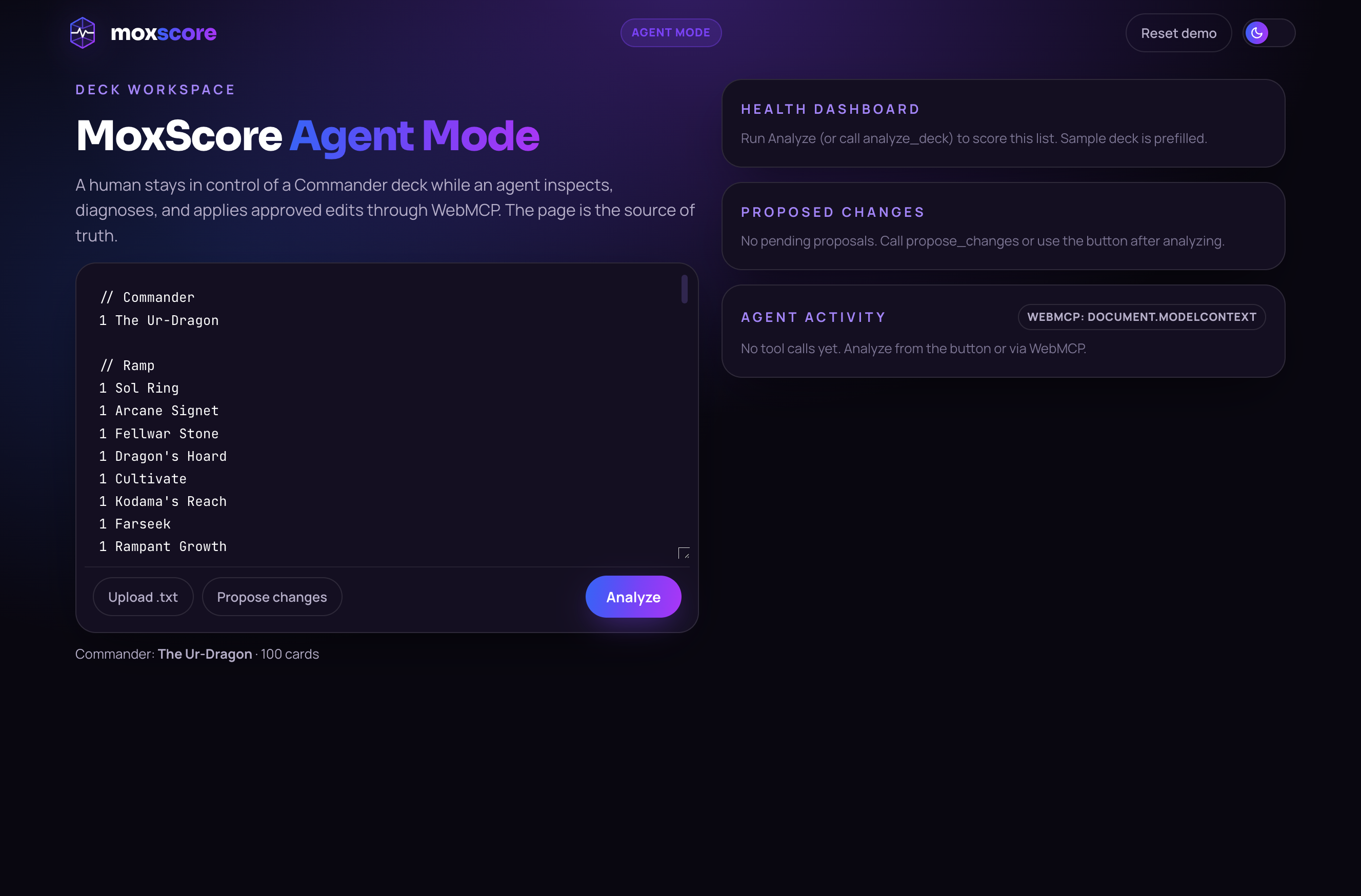
Home page
-
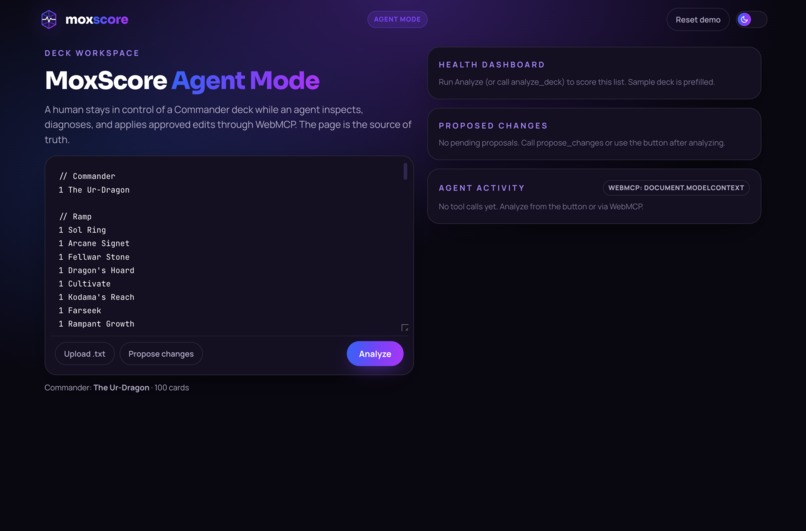
You can add your commander deck by pasting or uploading it in a textfile
-
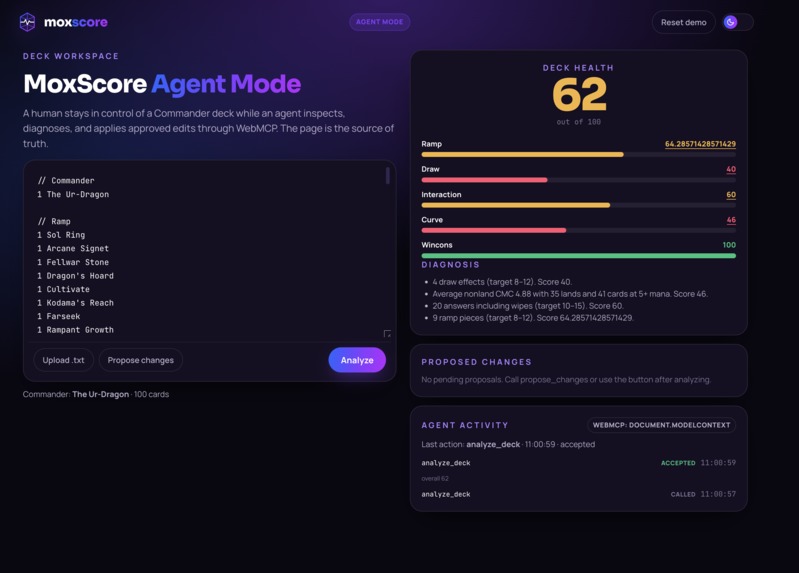
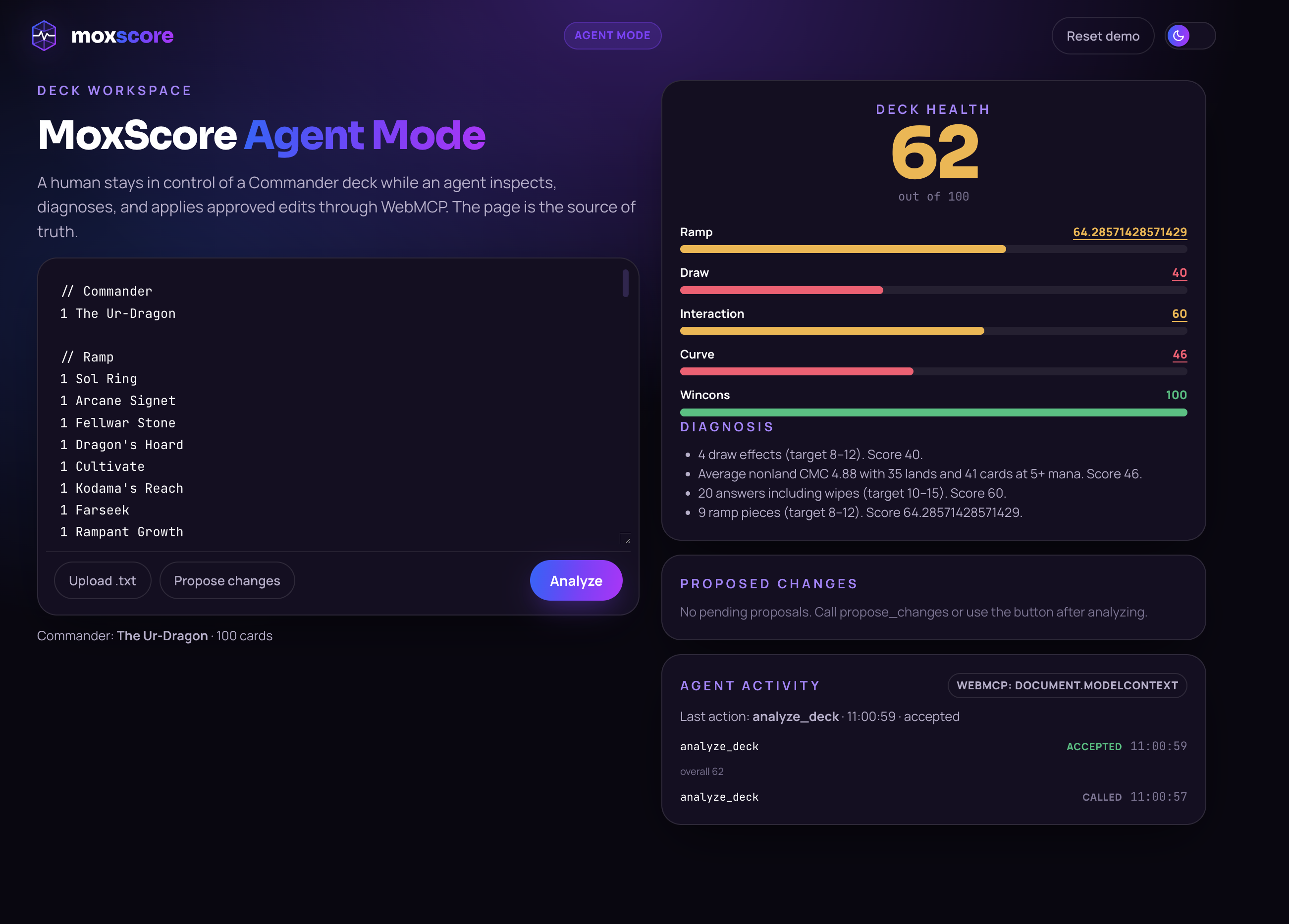
Agents can ask for analysis, propose changes and reanalyze

Inspiration
Commander decklists can be hard to read at a glance. A list of 100 cards does not immediately reveal whether a deck has enough ramp, draw, interaction, lands, or a healthy mana curve.
I built Moxscore to turn a decklist into understandable signals and practical next steps, without handing players an unexplained, black-box verdict. My goal was to have a really useful tool that helps me tune my decks towards the bracket I aim for.
What it does
Moxscore is a browser-based Commander deck analyser. Paste a decklist, upload an export to receive:
- A transparent deck health score
- Role breakdowns for areas such as ramp, draw, interaction, lands, and mana
- A mana-curve view
- Combo signals and a beta Commander-bracket estimate
- Deterministic category- and card-level tuning guidance
The core analysis runs locally in the browser, with no account required. WebMCP makes this analysis accessible to agents through clear, structured interactions as well as the normal player-facing interface.
How we built it
I designed Moxscore around a simple pipeline: ingest a Commander decklist, normalize the cards, classify cards into useful deck roles, calculate structural signals, and turn those signals into readable guidance.
The scoring system is heuristic and deterministic rather than AI-generated. That means players can understand what is being measured and why a recommendation appeared. I paired that analysis with a browser-first interface and WebMCP capabilities so both people and agents can work with the same deck-analysis flow.
Challenges we ran into
The hardest part was making analysis useful without pretending it is absolute truth. Commander decks are highly contextual: a card that looks weak in isolation may be essential to a commander, theme, budget, or playgroup.
A real challenge was also had to handle varied decklist formats, incomplete exports, card-role ambiguity, and the challenge of translating many individual card signals into guidance that is concise and actionable. For WebMCP, we needed to make the important actions and outputs explicit enough for an agent to use reliably.
Accomplishments that we're proud of
We are proud that Moxscore provides a useful first read of a 100-card deck in seconds while keeping its reasoning grounded in visible deck structure.
We are especially happy with:
- Local, account-free core analysis
- Transparent deterministic scoring instead of a black-box verdict
- A practical health score, role breakdown, and mana-curve view in one place
- Guidance that points to categories and cards, not just a number
- A WebMCP-enabled experience that lets agents participate in deck analysis meaningfully
What we learned
We learned that the best agent-facing website actions are not vague commands—they need clear inputs, predictable outputs, and useful boundaries. WebMCP encouraged us to think carefully about what “analyse this deck” should mean and what structured information should come back.
We also learned that transparency is a feature. For a hobby as nuanced as Commander, players need guidance they can inspect, challenge, and adapt to their own table.
What's next for Moxscore
Next, we want to improve card-role classification, expand import reliability, refine the bracket estimate, and add more context-aware tuning suggestions.
In the product roadmap there are accounts with bracket aimed AI enhanced suggestions, pod analytics to see how 4 decks could stack up against each other Discord bot extensions to make it even more accessible.
I also want to deepen the WebMCP experience so agents can help players explore specific questions e.g whether a deck needs more interaction, where its curve is crowded, or which structural changes are most likely to improve consistency, or go deeper in specific meta, all while keeping the final deckbuilding decisions with the player.
Built With
- html
- javascript
- postgresql
- supabase
- typescript
- vercel

Log in or sign up for Devpost to join the conversation.