-
-
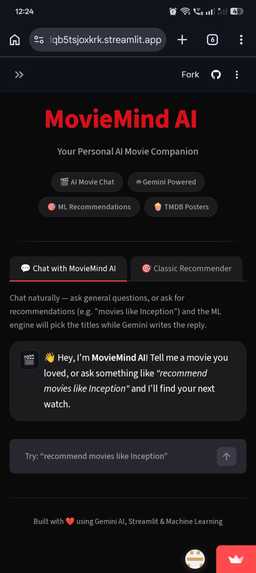
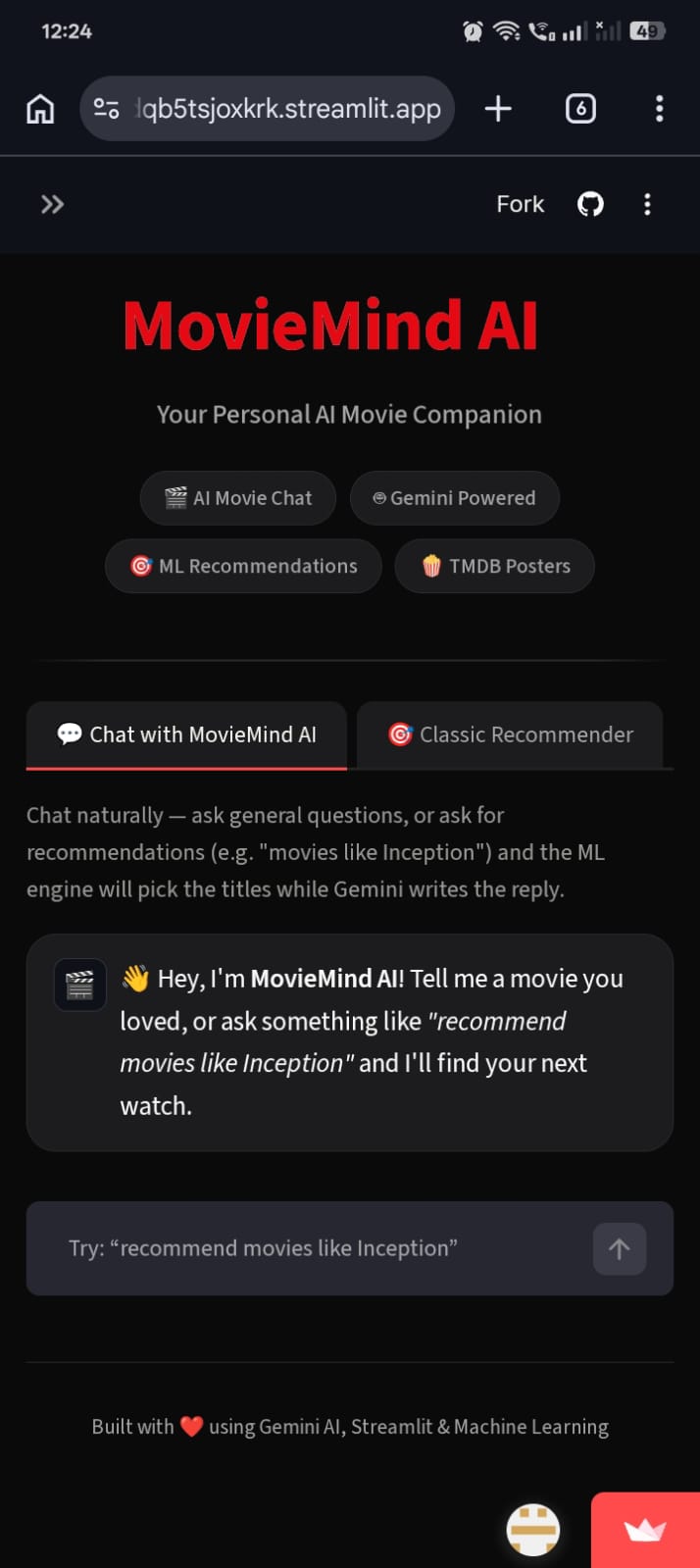
mobile interface
-
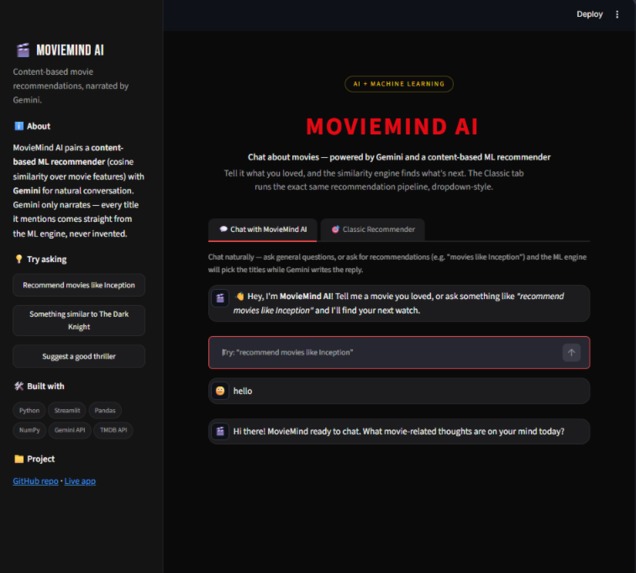
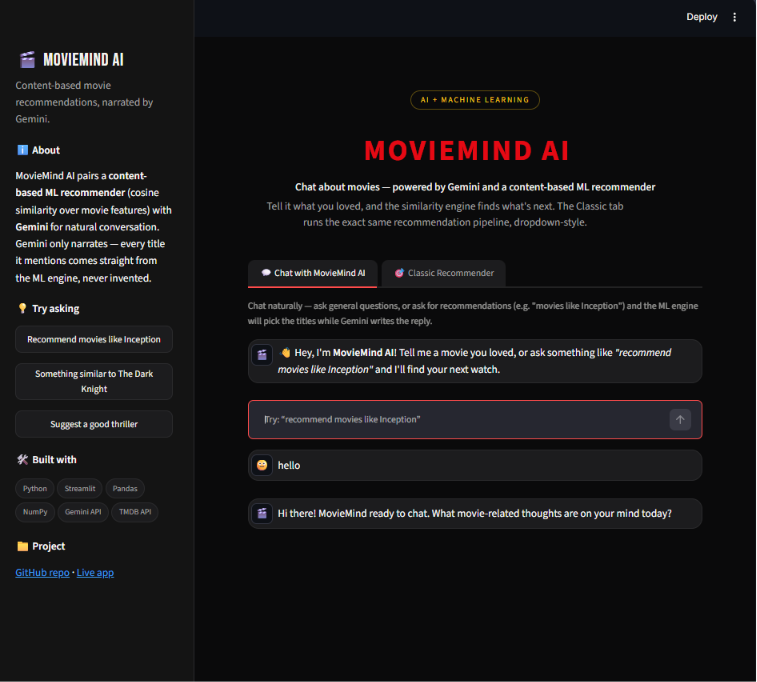
home page interface
-
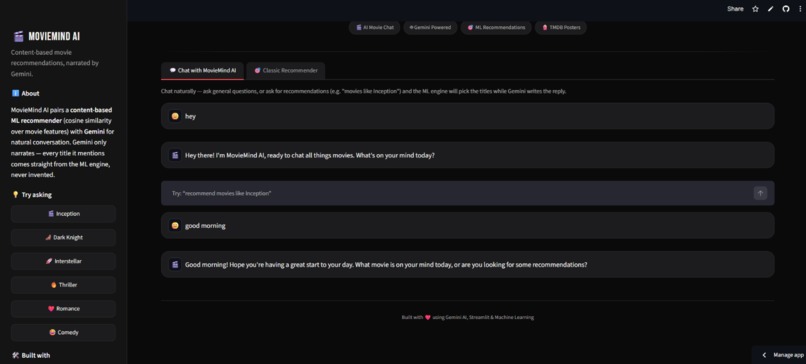
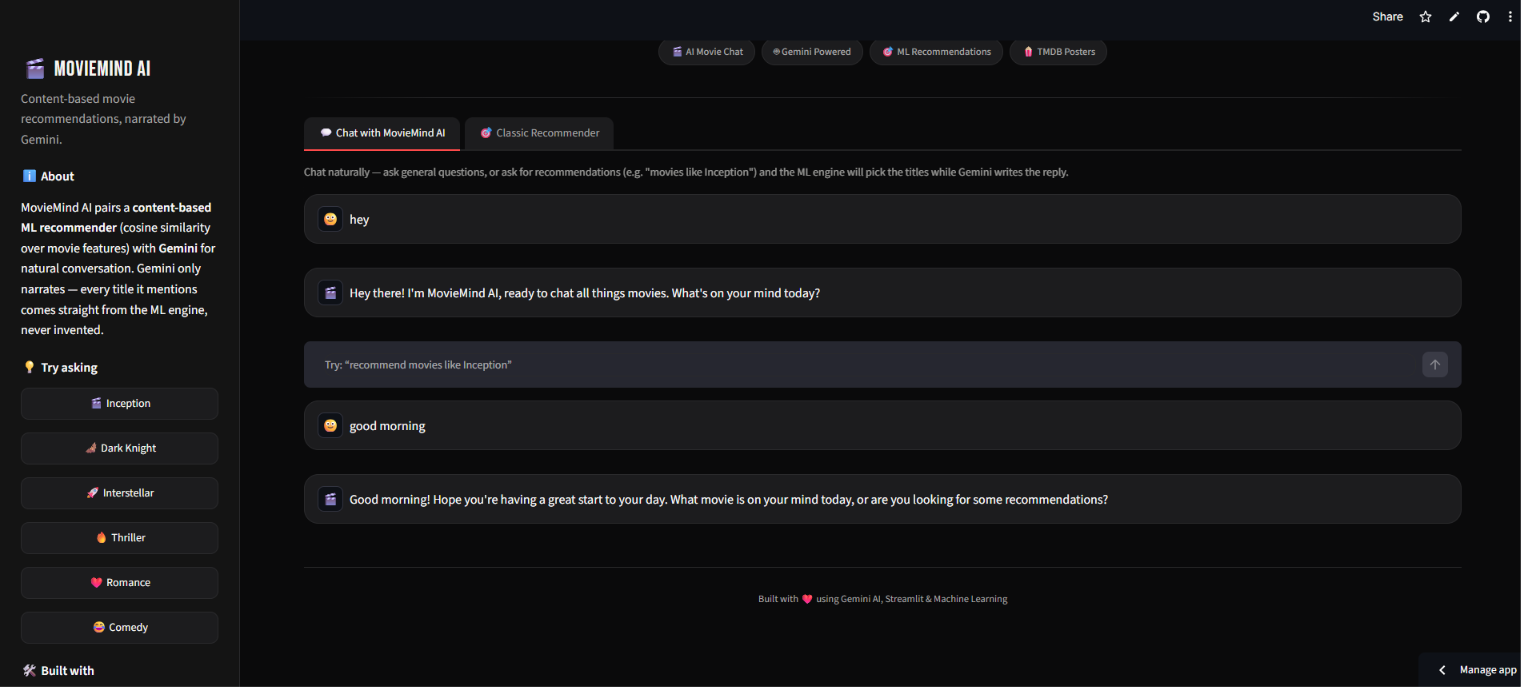
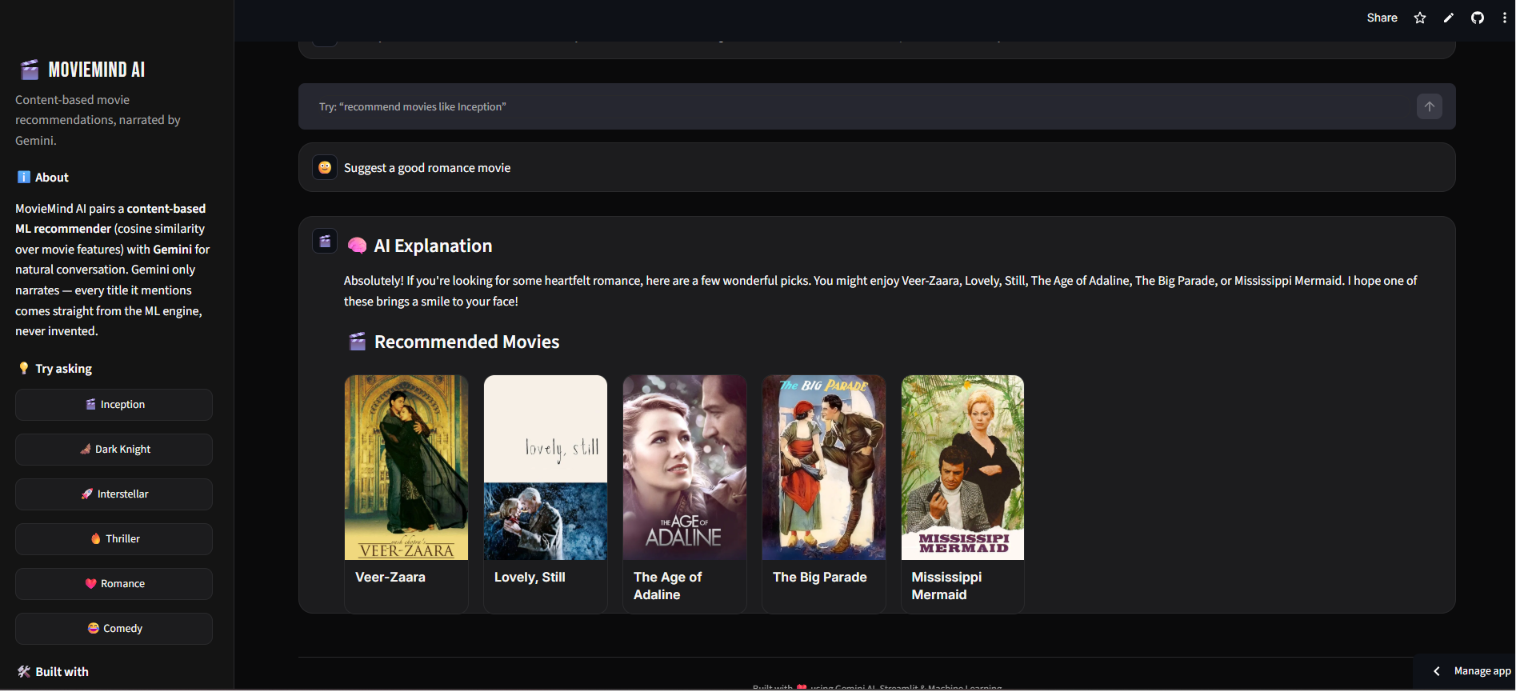
greeting screenshot with AI
-
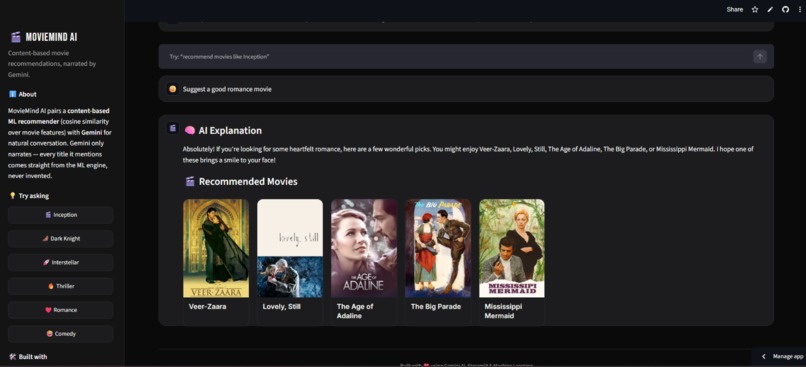
recommender with AI explanation
-
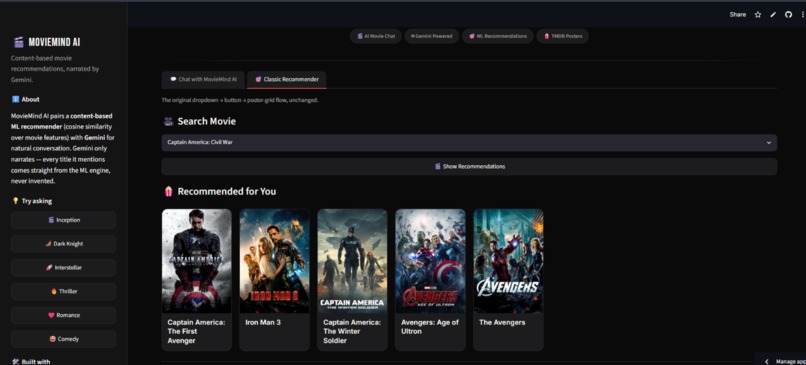
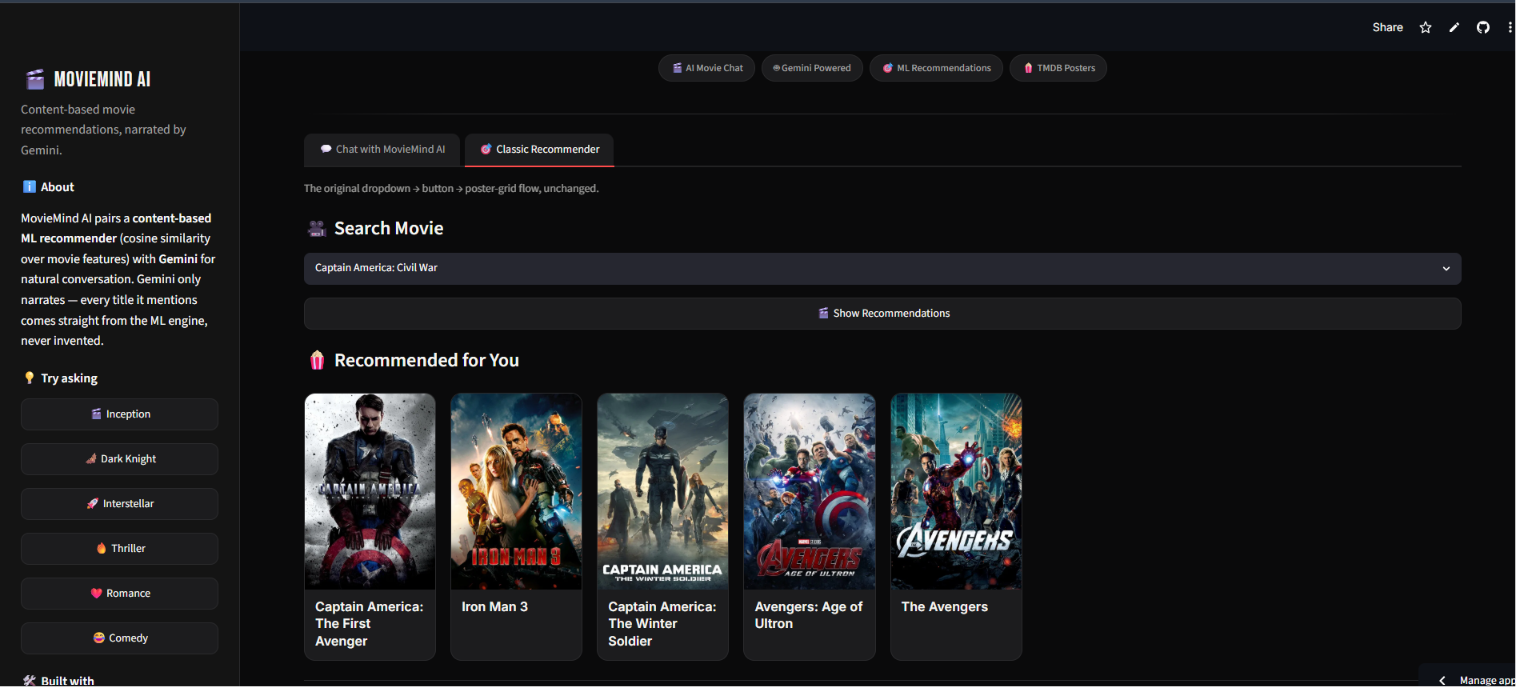
classic recommender
🎬 MovieMind AI
About the Project
We've all spent way too much time scrolling through endless movie lists, trying to decide what to watch next. While there are many recommendation platforms available, most of them simply suggest movies without explaining why they were chosen. I wanted to build something that feels more like talking to a movie-loving friend than using a search engine.
That's how MovieMind AI came to life.
MovieMind AI is an AI-powered movie recommendation system that combines a content-based machine learning model with Google's Gemini API. It not only recommends movies similar to the one you like but also provides AI-generated explanations that help users understand why those recommendations are a good match. To make the experience more engaging, movie posters are displayed using the TMDB API, all within an interactive Streamlit application.
How I Built It
I started by building the recommendation engine using a content-based filtering approach. After preprocessing the movie dataset, I used feature engineering and cosine similarity to identify movies with similar characteristics and generate recommendations.
Once the recommendation engine was working, I integrated the Google Gemini API to make the application more conversational by generating natural-language explanations for the recommendations. I also used the TMDB API to fetch movie posters and Streamlit to create and deploy the web application with a clean and interactive interface.
Tech Stack
- Python
- Streamlit
- Scikit-learn
- Pandas
- NumPy
- Google Gemini API
- TMDB API
Challenges I Faced
One of the biggest challenges was integrating an external AI service while keeping the application reliable. During development, I ran into Gemini API quota limitations, which meant AI explanations weren't always available. Instead of letting that affect the entire application, I redesigned the workflow so the recommendation engine continues to work independently, while the app clearly informs users if AI explanations are temporarily unavailable.
Another challenge was getting movie posters to load correctly after deployment. Configuring API keys securely with Streamlit Secrets helped solve the issue and made the deployment much smoother.
What I Learned
This project taught me much more than just building a recommendation system. I gained hands-on experience with recommendation algorithms, API integration, prompt engineering, deployment, and designing applications that can handle real-world issues like API failures gracefully. More importantly, I learned that building AI applications isn't just about making them intelligent—it's also about making them reliable and user-friendly.
Future Improvements
If I continue developing MovieMind AI, I'd love to:
- Add collaborative filtering for more personalized recommendations.
- Support user accounts and watchlists.
- Allow filtering by language, country, release year, and streaming platform.
- Improve conversational memory for a more natural AI experience.
- Optimize API usage with caching and smarter prompt handling.
- Expand the project into a scalable backend service that could support both web and mobile applications.
Building MovieMind AI has been an exciting learning experience, combining machine learning, generative AI, and software engineering into a project that solves a real-world problem in a practical and interactive way.

Log in or sign up for Devpost to join the conversation.