Latest Android APK download
Download the latest Flix Android APK — a standalone build connected to the live Flix service. No developer tools are required.
Inspiration
My spouse and I struggle almost every day to decide what movie or show to watch. We can spend more time scrolling through streaming services than actually watching something. Even when we use apps designed to track movies or recommend content, they often feel clunky. We find their recommendations rarely reflect our individual tastes, and they do not make it easy to find something we both want to watch.
I had already been using Codex extensively for another project when I saw the OpenAI Build Week announcement. I wanted to find out how far I could take an idea using Codex as my primary development partner.
I had read about “one-shot” development, so I started by describing the complete product I wanted. Codex produced a working MVP from that first implementation prompt. From there, I continued directing the product through conversation. Within roughly 25ish product prompts, Flix had evolved from an idea into a refined, connected application.
What it does
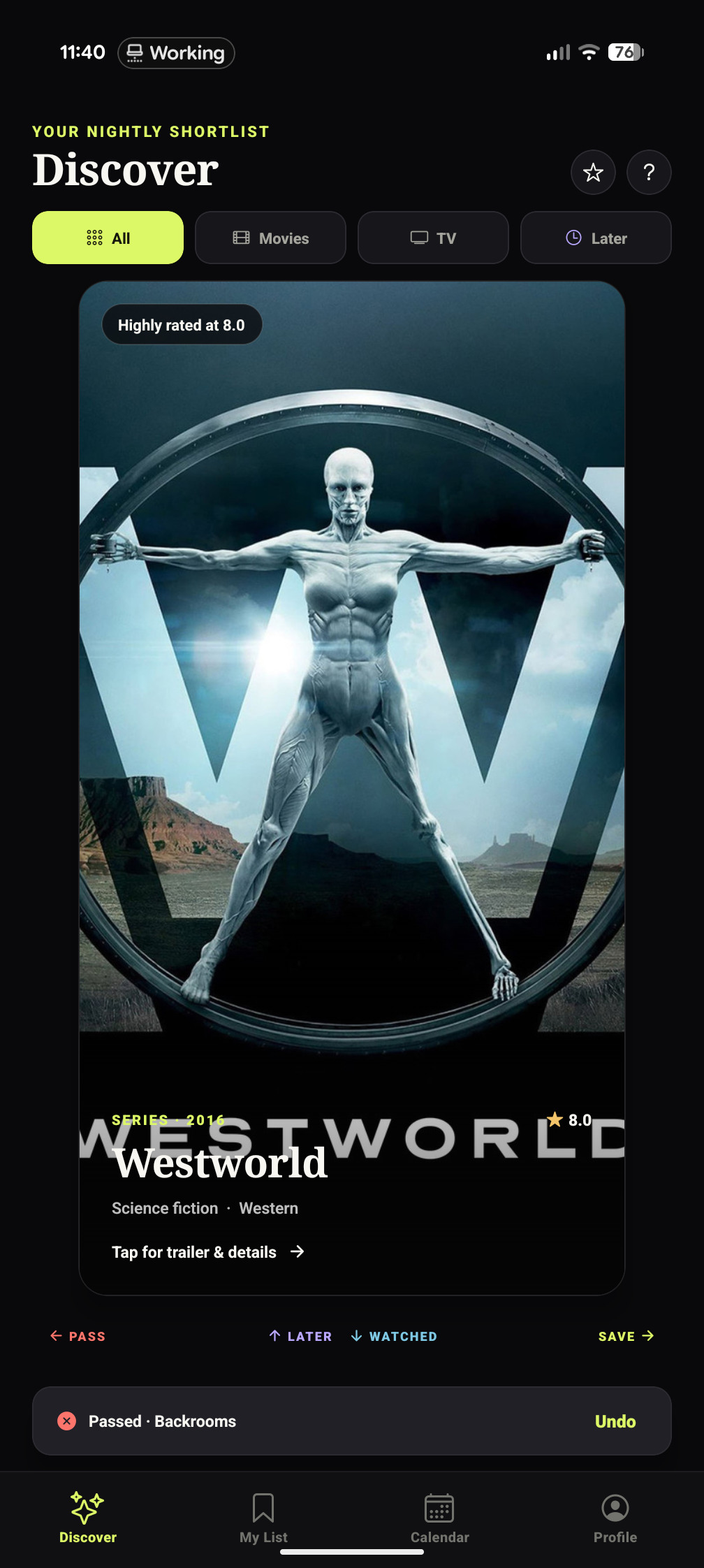
Flix turns finding something to watch into a fast, personalized swipe experience.
Users will swipe right to save a title, left to pass, up to reconsider it later, or down to mark it as already watched. Every swipe helps Flix understand the user’s preferred genres, ratings, and types of content so the recommendation feed improves over time. Overall the feeds will be tailor to the user fairly quickly
Flix also includes:
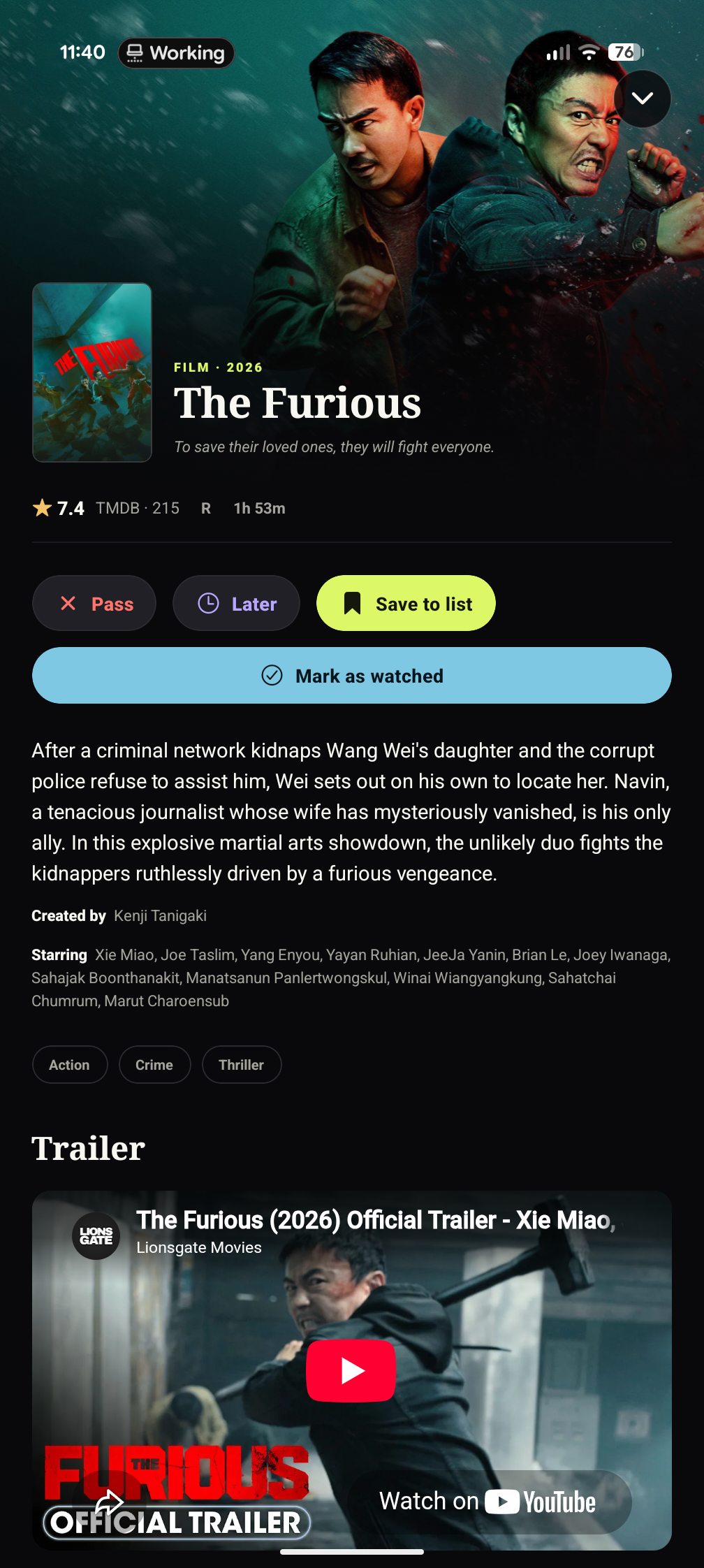
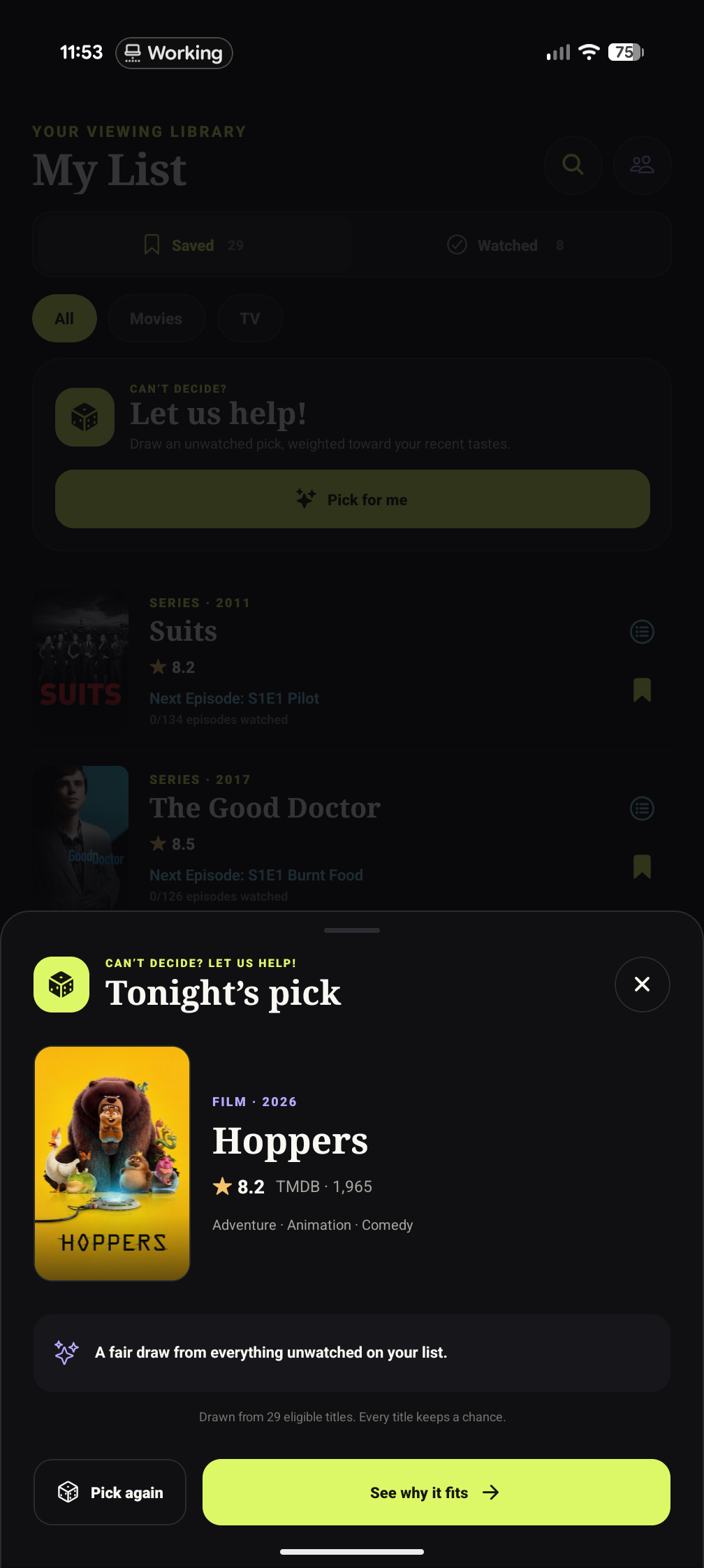
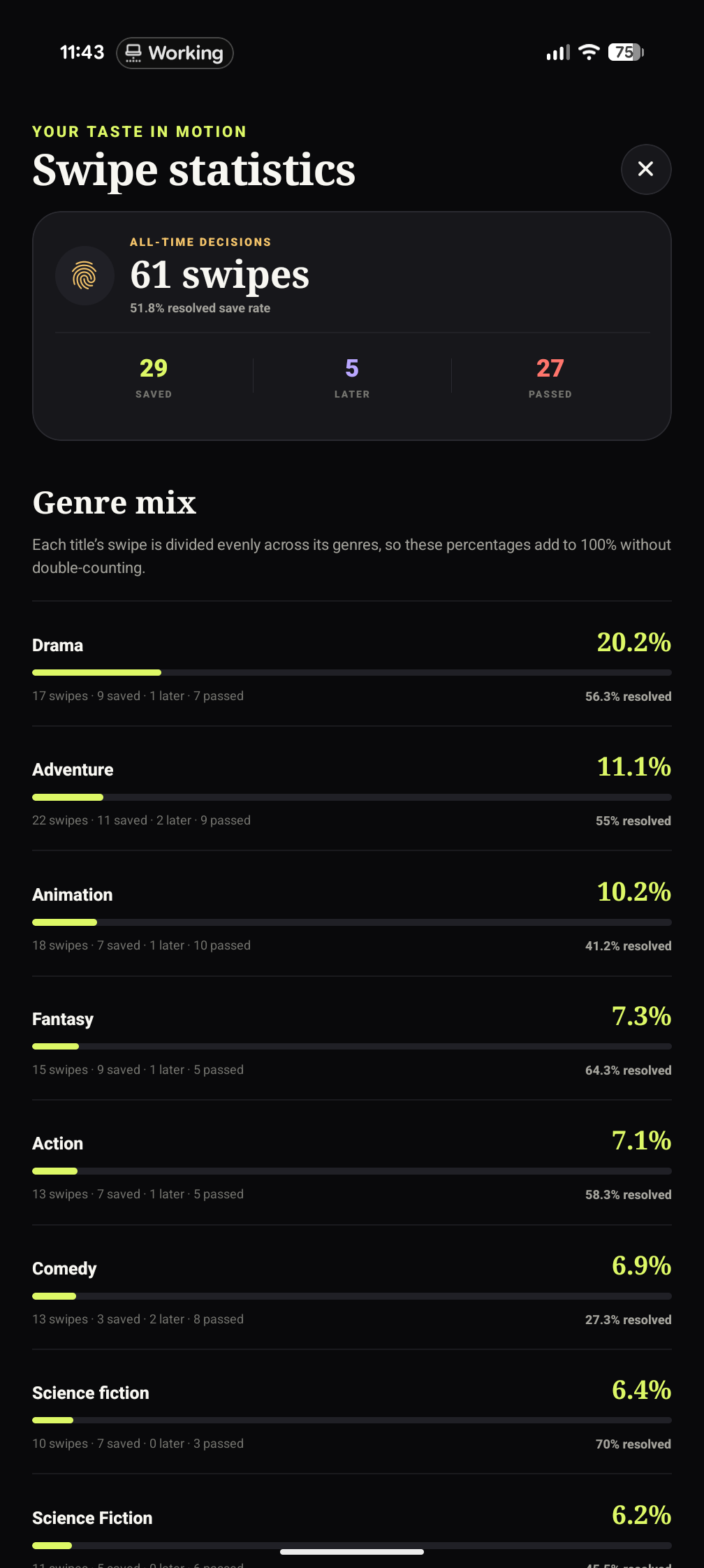
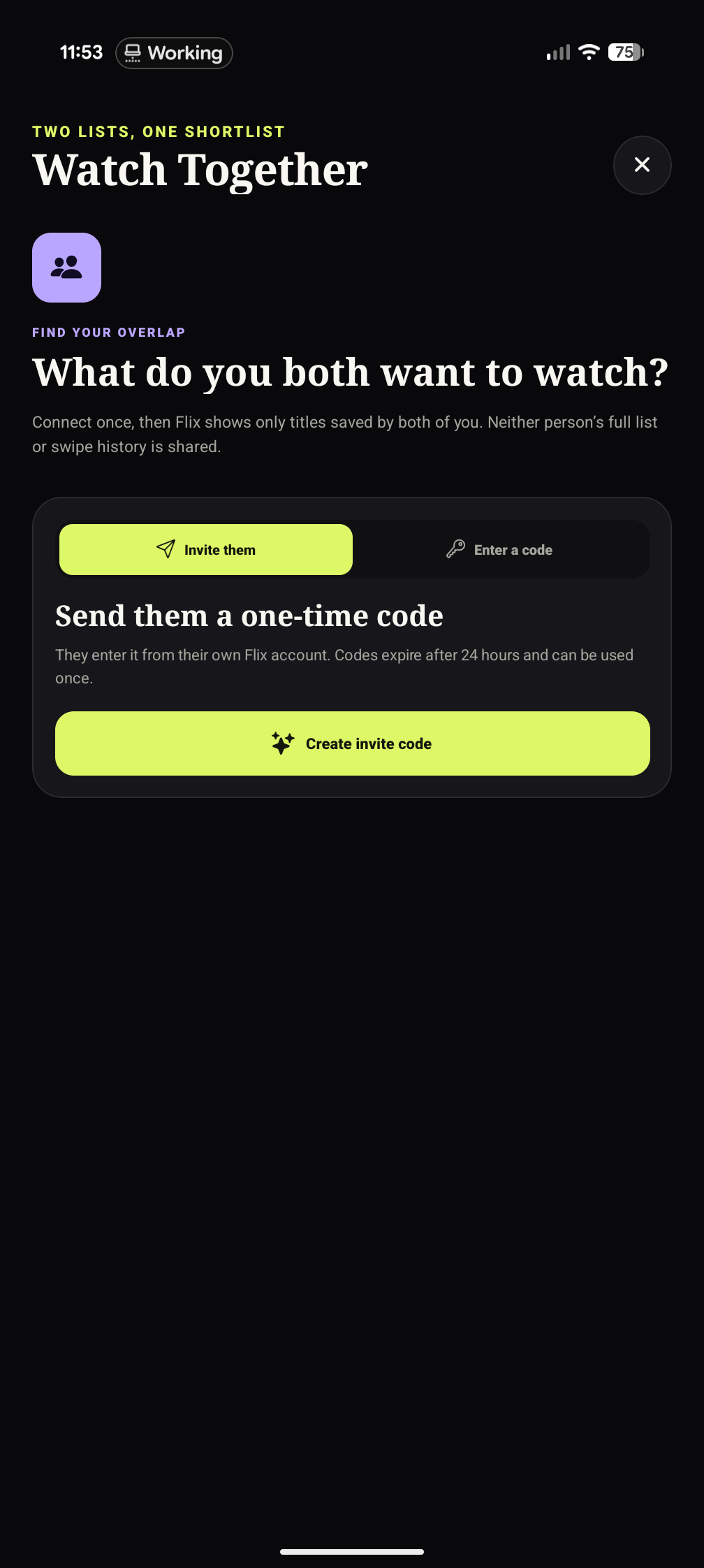
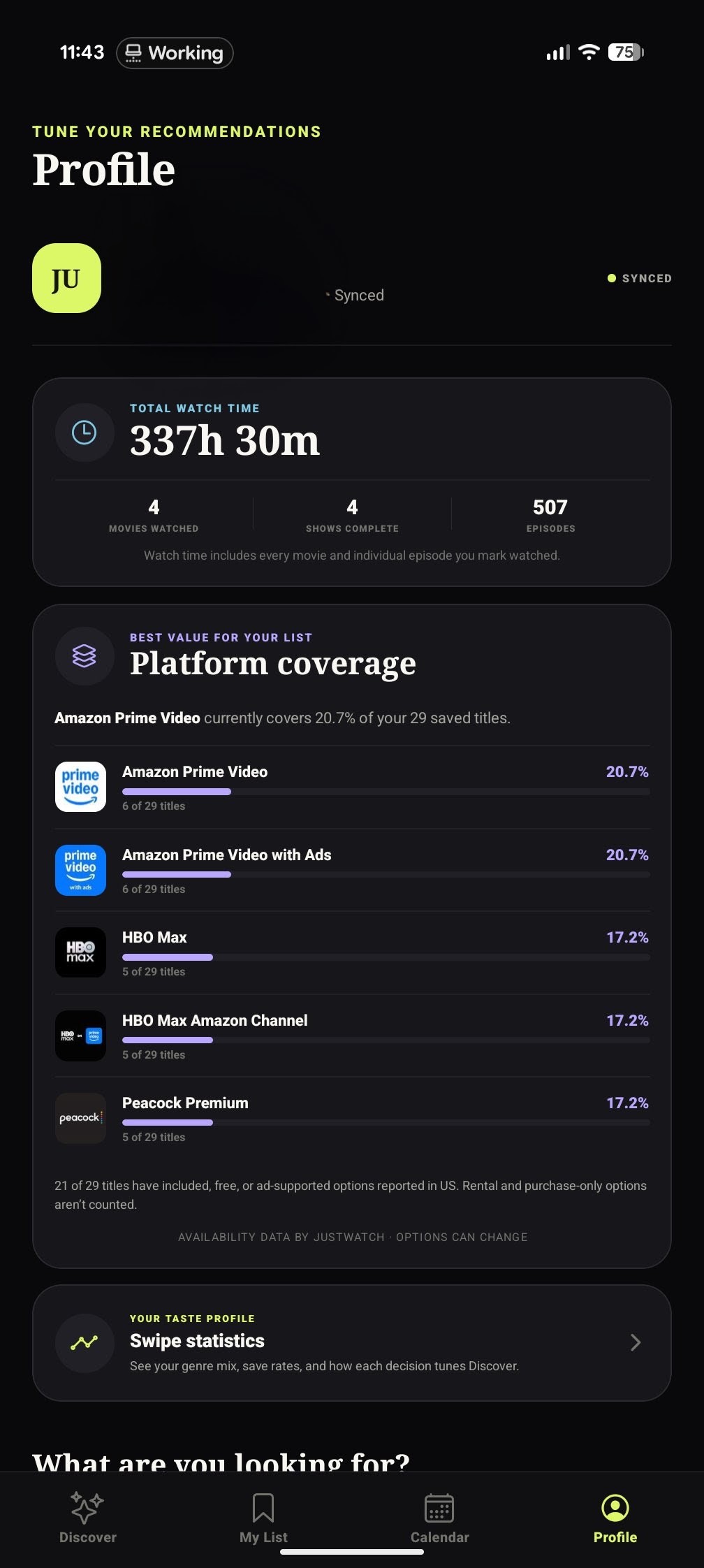
An endless, personalized feed of real movies and TV shows Separate movie, TV, and later swipe feeds Search and list importing for quickly building a library Trailers, cast information, ratings, reviews, release information, and streaming availability A saved list and a personalized release calendar Movie watch tracking and episode-by-episode TV progress Bulk season completion and “Next Episode” guidance Profile statistics for genre preferences, completed titles, episodes, and total watch time Platform coverage showing what percentage of a user’s saved list is available on each streaming service A weighted random picker for nights when the user cannot decide “Watch Together,” which securely compares two users’ saved lists and displays only their mutual matches A shared random picker for choosing from those mutual matches Optional accounts: guests can use Flix locally without signing up, while accounts enable cross-device synchronization Automatic migration of guest activity when someone later creates an account
The goal is not simply to provide another searchable movie database. The core of Flix is making discovery fast, personal, collaborative, and enjoyable.
How I built it
I built Flix using GPT-5.6 Sol at Extra High reasoning through one continuous Codex conversation. I supplied the product direction, feedback, accounts, and credentials. Codex handled the implementation across the codebase.
Most of the work was directed from my phone through the ChatGPT app using a remote connection to my PC. Codex inspected the repository, wrote and modified the code, ran commands, diagnosed problems, created database migrations, tested the application, operated deployment tools, pushed changes to GitHub, and produced installable Android development builds.
The stack includes:
Expo and React Native with TypeScript for the mobile application Expo Development Client and EAS Build for Android development builds Node.js and Fastify for the backend API Render’s free tier for API hosting Supabase’s free tier for authentication and PostgreSQL storage The TMDB API for real movie, television, trailer, episode, review, and watch-provider data React Query for server-state management Zustand and AsyncStorage for local and guest state GitHub for version control and automatic deployment
Flix uses a hybrid catalog system instead of attempting to import the entire TMDB database. It discovers titles through TMDB, caches what Flix surfaces, hydrates complete information only when needed, and fetches season and episode data when a show is opened or saved. User decisions and recommendation data remain in Flix’s own database.
Codex also helped create the visual identity, including the final geometric logo, Android adaptive icon, themed icon, splash screen, and in-app branding.
Challenges I ran into
The overall development experience was remarkably smooth, but Flix still presented several interesting engineering challenges.
One of the biggest was making swiping feel instant while safely recording every decision. Initially, the next card waited for the API request to finish, creating a two-to-three-second delay. I redesigned the flow to advance the deck optimistically, preload upcoming posters, write decisions through a background queue, and preserve undo and offline behavior. The final stress test keeps the deck responsive even when API writes are intentionally delayed.
Another challenge was creating an endless personalized feed without loading or storing TMDB’s entire catalog. Codex and I built a ranking system that considers recent swipe behavior, genres, ratings, popularity, and previous decisions while continuously replenishing the feed.
Optional accounts also created an important data problem: someone who uses Flix as a guest should not lose their history when they later sign up. We implemented a migration process that merges the device’s saved titles, passes, Later queue, preferences, watched movies, and episode progress into the new account.
We also worked through free-tier memory limits, API caching, email confirmation redirects, secret management, regional streaming availability, episode-level television tracking, and responsive layouts across multiple Android screen sizes.
Accomplishments that I am proud of
Flix went from an idea to a functioning online application in less than 48 hours.
It has a live API, real movie and television data, optional authentication, cross-device synchronization, offline guest support, personalized recommendations, collaborative list matching, streaming-platform analysis, and an installable Android development build.
The project currently passes 37 API tests, eight full end-to-end product flows, TypeScript validation, Expo configuration checks, and production export checks. The interface was also visually tested across narrow phone, standard phone, tablet, and desktop dimensions.
I am especially proud that this was accomplished in one continuous Codex conversation and used less than one week of credits on the 5× plan. I was able to direct approximately 90% of the development from my phone while continuing with my normal daily routine.
What I learned
The biggest lesson was that Codex can be much more than a tool for generating isolated code snippets. It can act as a persistent development partner across product planning, architecture, frontend design, backend implementation, databases, testing, debugging, security review, deployment, and release preparation.
The initial one-shot implementation created an incredible amount of momentum, but the continuous collaboration was what turned the MVP into a real product. I could explain a problem in plain language, review the result on my phone, and then continue refining it without needing to restate the entire project.
Being able to build this while away from my desk was a major eye-opener. The combination of Codex, the ChatGPT app, and remote computer access made software development feel much more accessible and flexible than the traditional workflow.
I also learned that strong product direction still matters. Codex handled the implementation, but the best results came from clearly describing the user experience, testing it as a real user, and continuing to challenge anything that did not feel fast, intuitive, or useful.
What's next for Flix
My goal is to launch Flix on the Google Play Store and Apple App Store as soon as it is ready for public testing.
Before launch, I plan to run a closed beta, collect real user feedback, continue improving the recommendation algorithm, and strengthen production monitoring and scalability.
Future features may include:
Push notifications for new episodes and movie releases More import sources and improved automatic list matching Shared household profiles and larger watch groups More detailed streaming-subscription value comparisons Expanded preference controls and recommendation explanations Better regional availability and release-date coverage Community-requested features driven by actual usage
I want Flix to become a community-driven product that solves a simple but universal problem: spending less time deciding what to watch and more time enjoying it.
Built With
- 5.6
- codex
- sol


Log in or sign up for Devpost to join the conversation.