-
-
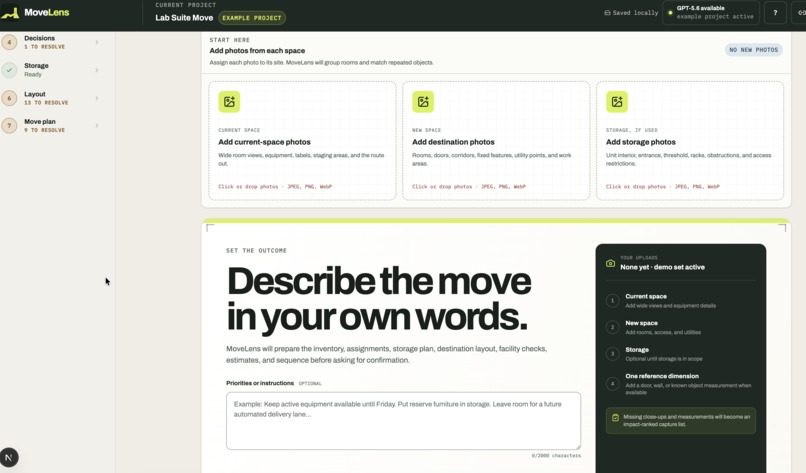
Site Home Page
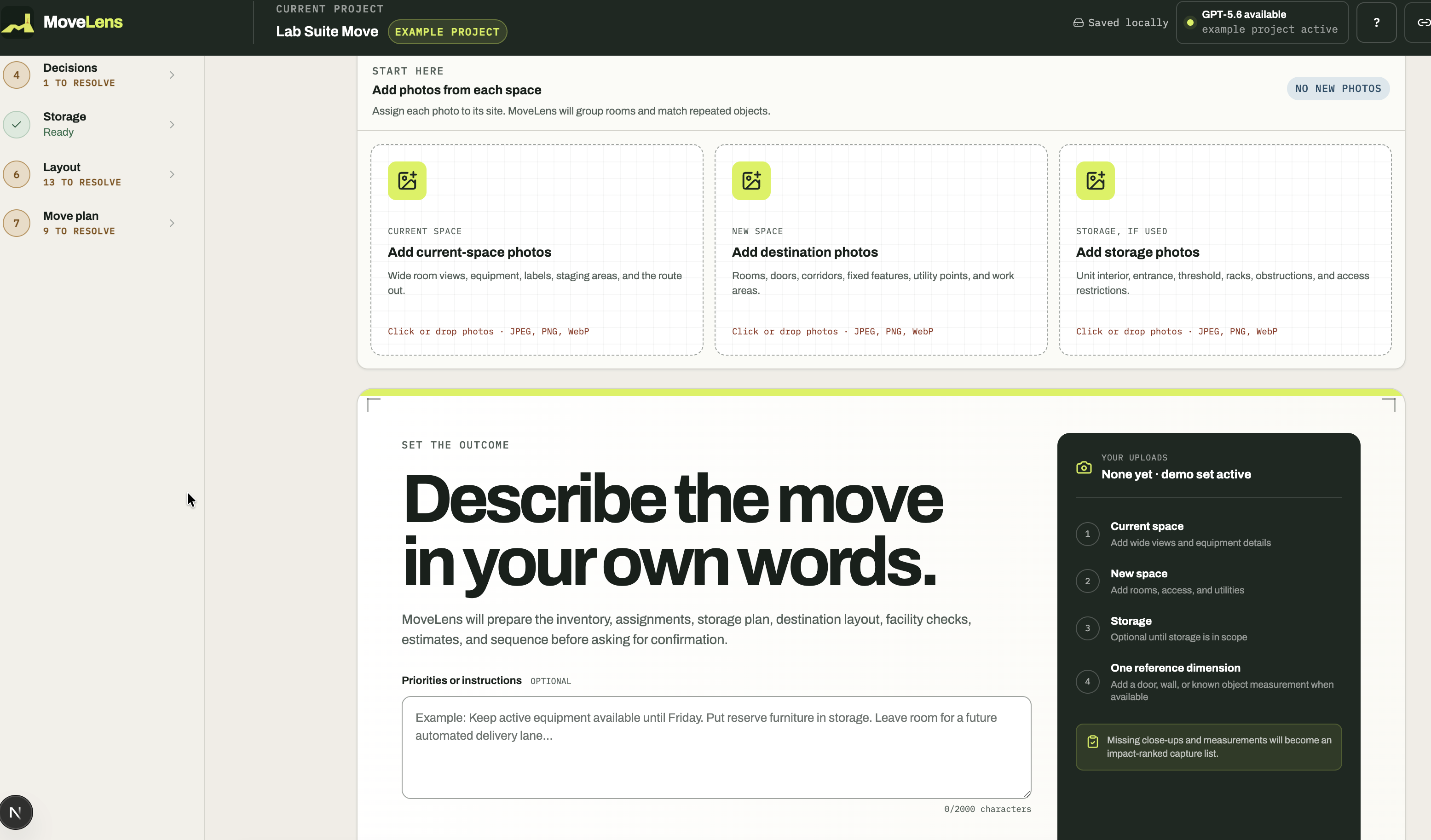
Inspiration
I've had to setup lab spaces, and move labs (biotech) several times. It's super overwhelming. Now with codex (and GPT-5.6-Sol) this is way easier. So, what I wanted was to hand off pictures of my current space and equipment, and some info on the new space and any storage, and have AI figure the rest out. With GPT's great image gen ability and vision, I was hoping codex could take a look at everything, inventory it, reasonably estimate the size and weight of everything, and help plan out a move and then also generate 'the future' with images of the new space after the move. So, I wanted an app that felt both like mind reading (figure out what to do with alll this stuff) and time-traveling (here is the new space setup). I actually made this during an ongoing move as well, so great timing for the hackathon!
## What it does
MoveLens analyzes images of the current space, destination, and storage area and builds a move plan for review.
Add room photos, floor-plan images, and available measurements. GPT-5.6 prepares a typed draft covering rooms, inventory, item decisions, placements, questions, safety flags, and tasks.
Review model-produced records with AI-draft labels and confidence levels. Correcting a weight recalculates the related cost, schedule, and truck estimates.
Send items that cannot be identified or approved from photos to specialist review. In the synthetic café demo, MoveLens excludes a fire-suppression cylinder from storage because the facility prohibits it.
Review destination placements in measured 2D and metric 3D views. Recorded dimensions, routes, utility points, and work zones appear with the proposed equipment positions. Missing or incompatible services are flagged for review.
Review storage-unit recommendations at lean, expected, and conservative sizes. The packing plan includes access bands, stack rules, loading order, and retrieval paths.
Review the work sequence, receiving and staging plan, crew range, person-hours, workdays, packing materials, and estimated cost.
Print a move book, item labels, and location signs. Export the current planning revision with item records, placements, utilities, open checks, pick lists, and schedule files.
When image generation is enabled, create an installed-room interpretation from a reviewed destination photo. MoveLens labels the result as a visual interpretation and links it to the source image and planning revision.
All examples use synthetic data. Before analysis, the browser re-encodes selected images under generated IDs to remove original filenames and embedded metadata. Users can cover sensitive regions before sending a prepared image for analysis. MoveLens does not write uploaded images to server storage.
## How I built it
I built MoveLens during Build Week and used Codex for the large majority of the implementation. Codex helped build the typed project model, GPT-5.6 routes, estimate logic, spatial editors, storage packing, move-package exports, synthetic examples, and automated tests.
I made the key product decisions: use ranges instead of false precision, keep observations separate from model inferences, preserve user corrections, and require review before accepting item decisions or placement coordinates.
Before changes landed, they had to pass lint, type-checking, and the complete test suite. The public repository currently passes 925 automated tests, a production build, and browser tests covering the complete example, spatial views, storage planning, exports, accessibility, and mobile layouts.
GPT-5.6 performs two structured-output tasks: photo analysis and plain-language plan revisions. GPT-5.6 with GPT Image 2 creates optional installed-room views from reviewed source images. Deterministic TypeScript validates references and calculates the estimates, placement checks, storage plan, and exported package. ## Challenges The main challenges were:
- Keeping model estimates visible and correctable while recalculating dependent costs, schedules, and plans.
- Keeping the 2D layout, 3D model, storage plan, installed views, and exports attached to the same planning revision.
- Modeling storage positions at unit boundaries without reporting false collisions.
- Testing retrieval paths and access clearances for individual stored items.
- Linking generated room views to the correct source images, viewpoint, item scope, and planning revision.
## What's next
The next step is a hosted pilot with shared quotas and a controlled API budget. I also want to add shared review roles for facilities teams, movers, and compliance reviewers, along with imports for existing equipment lists, room measurements, and recorded utility points.
Built With
- 2
- api
- codex
- gpt
- gpt-5.6
- image
- indexeddb
- next.js
- openai
- playwright
- react
- three.js
- typescript
- webgl
- zod

Log in or sign up for Devpost to join the conversation.