Inspiration
In the hustle of daily life, finding the time to travel to a court and train can be hard. We want to create a mobile basketball hoop that brings the game to you, fitting training seamlessly into your busy schedule. Whether it is a quick hooping break during your lunch at work, outside on a walk, or inside your house, it's mobility can let you practice your basketball techniques at your own convenience.
What it does
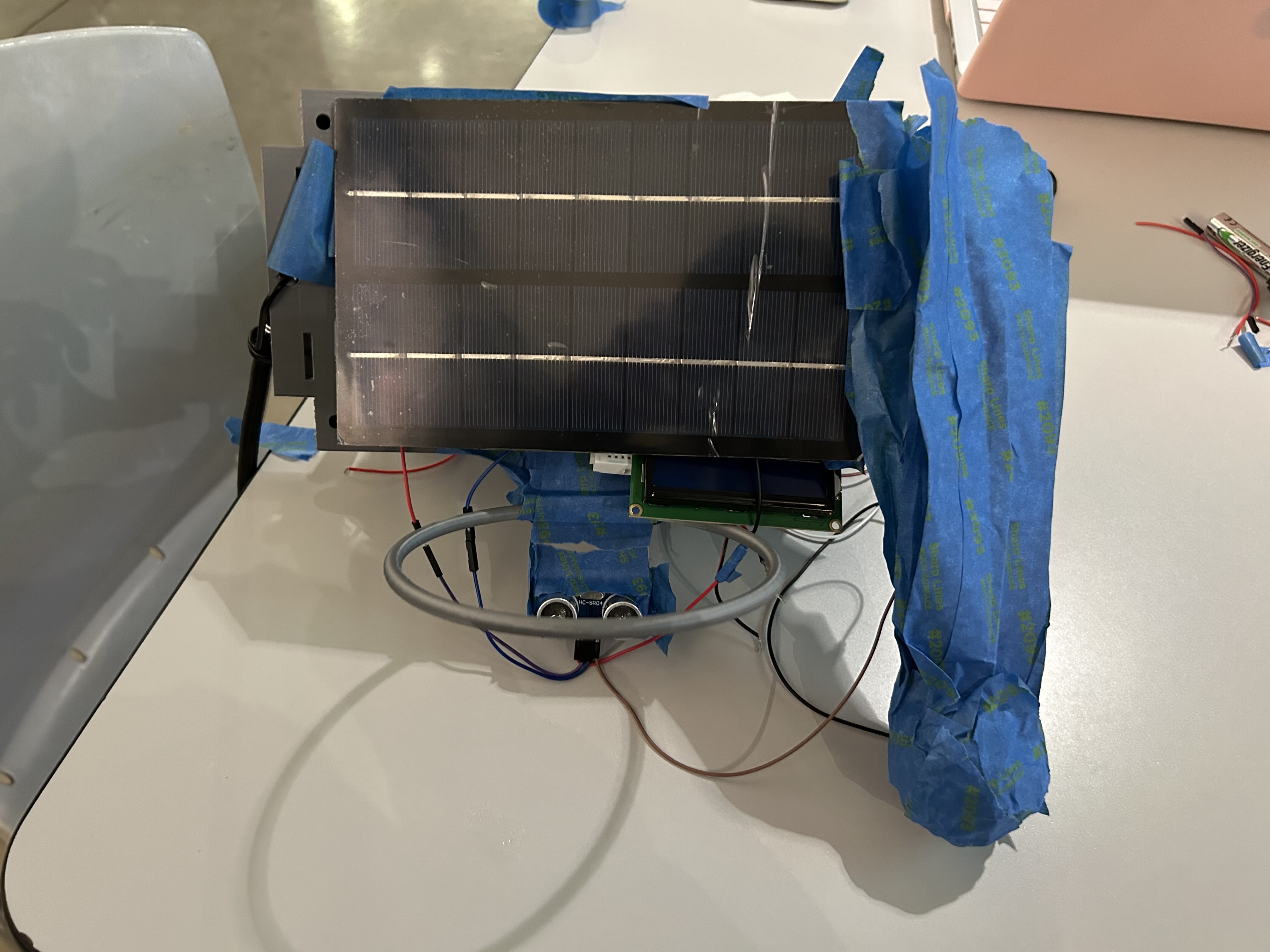
The mobile basketball hoop is designed to be convenient so that you can easily hook the hoop with bungee cords on a tree and start shooting. It comes with an automatic counter system, where a point will be added every time a ball goes through the hoop and display the score.
How we built it
Backboard and Frame: We sketched the design for the hoop, backboard, and battery case holder and replicated it with CAD on OnShape. We printed all the parts together and wired the battery holder so that the batteries were connected in series. Then, we attached wires to the solar panel's cathode and anode. We also connected a Diode to the anode of the solar panel to prevent backcharging to the panel. Then, we wired everything into a central breadboard and connected it to the Arduino, which will read and execute our code. The ultrasonic sensor attached to the bottom of the hoop will detect when the ball passes through it and the LCD display will show a counter which will increase by one.
Challenges we ran into
We bought a digital counter that we were gonna use to keep track and display the score every time the ball makes it through the hoop. However, there was no documentation on the object's electronics so we couldn't wire it with our project. The 2nd display would not consistently display the current count.
As everyone was so busy with school, it was hard to find meeting times that everyone could make and work on the project together. We ended up assigning individual tasks for every person to finish, but there was a lack of communication, so the actual execution of the project was pushed back until late into the quarter.
While putting the design together, the ultrasonic sensor wouldn't detect the balls that we originally bought because the material wouldn't bounce the soundwaves back. We made a new ball by wrapping a ping-pong ball in tape. However, when we dropped the ball down, it traveled too fast for the ultrasonic sensor to detect it. We ended up constructing a tail on the ball so that it would spend more time in front of the censor, detecting it and increasing the counter by one.
Accomplishments that we're proud of
- Cading the design
- Solving the display issue
- Making our own custom ball
What we learned
We learned that the ultrasonic sensor does not detect tennis balls because the ball has a fuzzy surface, which will scatter or absorb the ultrasonic waves instead of reflecting them back to the sensor. We also learned how to wire a battery pack in series and how to use GitHub.
What's next for Move-N-Shoot
Improving the design of the backboard so that the solar panel, counter, and breadboard could fit more efficiently. That way, our product could be more compact and easier to carry around. We also look to changing the design to hide the wires and improving the aesthetic.

Log in or sign up for Devpost to join the conversation.