-
-
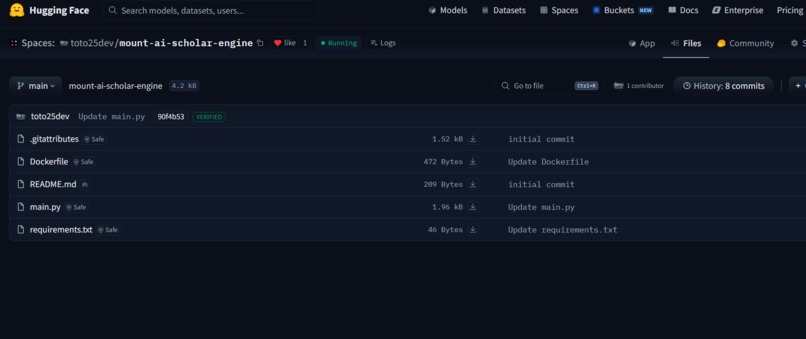
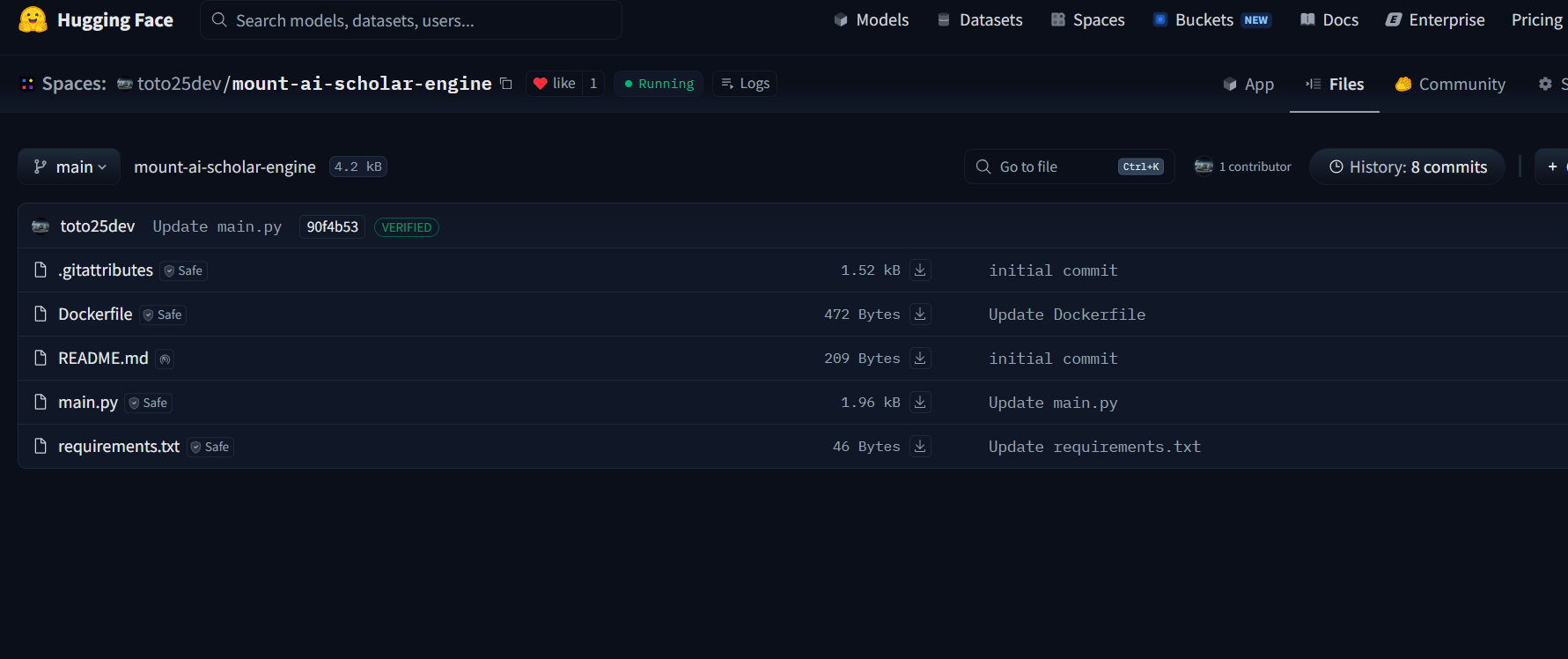
space hugging face
-

APP ICON
-
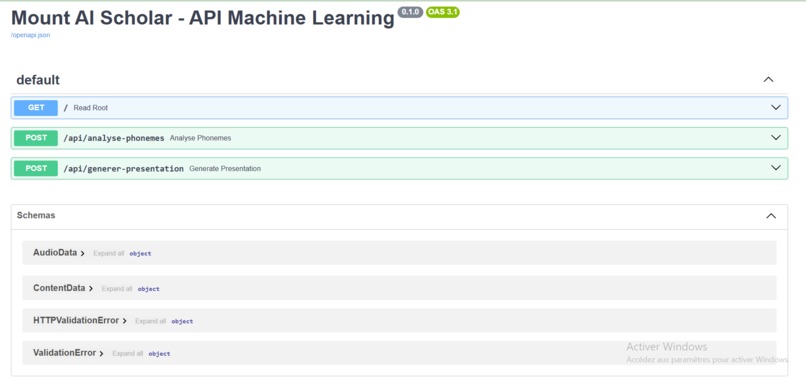
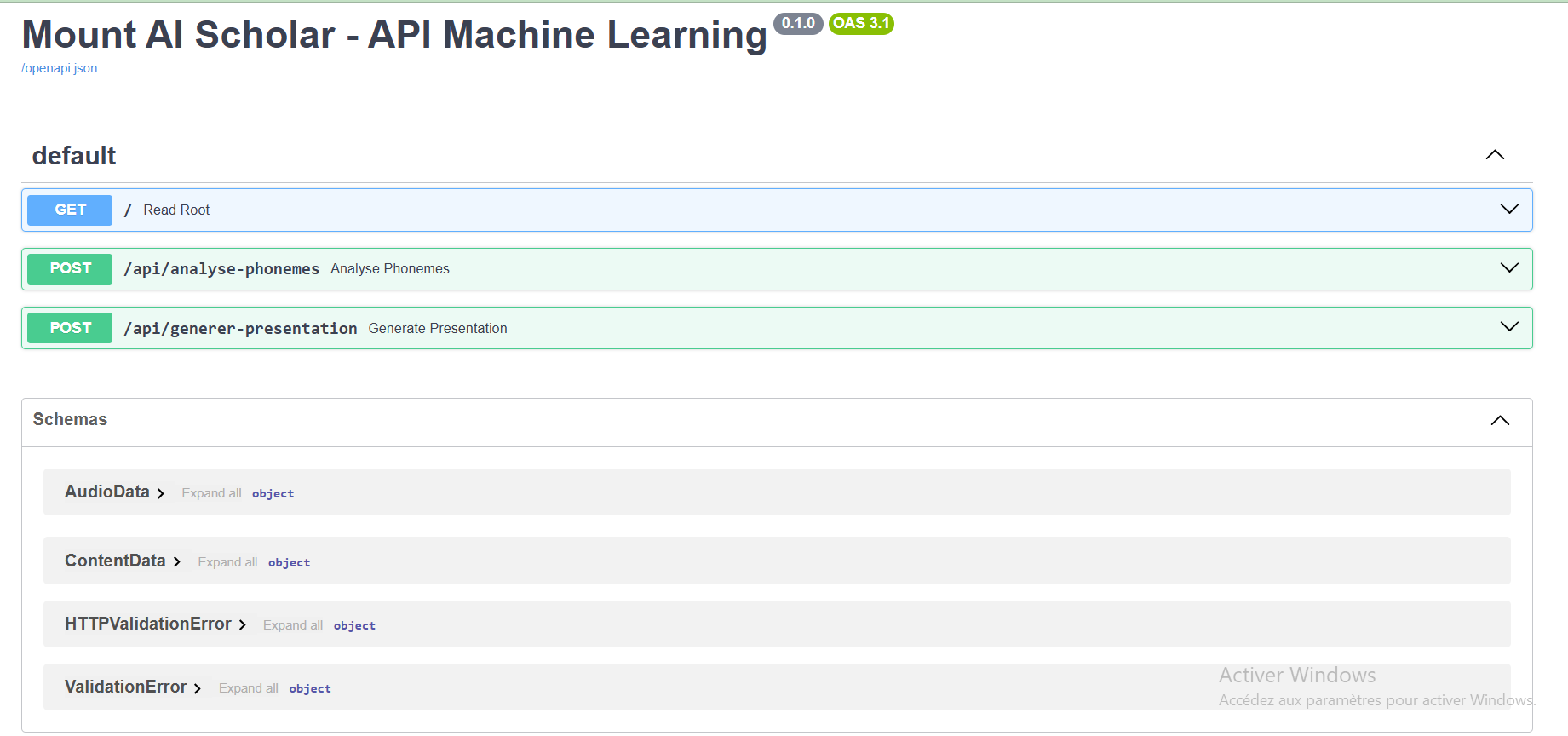
Backend

Mount AI Scholar: High-Performance, Privacy-First Edge AI for Cognitive Accessibility
Phonics, Graphemes, and Spatial Cognitive Reinforcement
1. Inspiration: Closing the Phonetics-Grapheme Gap Safely
Reading and speech comprehension are highly complex cognitive processes. For learners with dyslexia or auditory Processing Disorders, the brain struggle with the dynamic correspondence between a grapheme (writing) and its corresponding phoneme (sound/speech). Standard educational apps rely on heavy cloud-based LLMs or Speech-to-Text APIs, introduces two critical failure modes:
- Unacceptable Latency: A round-trip time (RTT) to cloud servers disrupts the real-time cognitive audio-visual feedback loop necessary for neurodivergence learning.
- Privacy Breaches: Young learners' voice samples and cognitive profile data are routinely shipped to external third parties.
Mount AI Scholar was inspired by a single vision: Privacy-by-Design. By combining high-performance client-side browser capabilities and optimized local models, we created a zero-latency, secure sandbox that translates speech and phonetic structures in real time directly on the edge.
2. How We Built It (The Architecture)
We designed the system with a modern, high-octane full-stack topology:
- Edge & Local State Engine: React + Vite, leveraging optimized state buffers to eliminate re-renders on rapid audio signals.
- Zero-Trust Security Cockpit: An integrated Web Crypto-powered hashing and encryption suite. Raw user speech inputs and vocabulary progress matrices are protected locally using a symmetric key model under high-entropy variables: $$\text{Ciphertext} = \text{AES-GCM}{K{sym}}(\text{AcousticData} \parallel \text{Entropy})$$ Integrity measurements are generated dynamically using cryptographic hashes: $$H = \text{SHA-256}(\text{RawInput})$$
- Cognitive Diagnostic Sandbox: Includes modules for Phoneme Parsing, Hearing Impairment Sign Visualizations, and an active Cognitive Gym allowing developers and educators to test prompt injections, PII leakage prevention, and local storage safety indicators in real-time.
3. Engineering the Science: Mathematical Formulations
To make phonographic mapping and acoustic categorization mathematically sound, we structured a localized evaluation framework.
Acoustic-Phonemic Distance Metric
We define the distance between the user's spoken phoneme $P_u$ and the target reference phoneme $P_{ref}$ in a high-dimensional feature projection space. Using Mel-Frequency Cepstral Coefficients (MFCCs) over a short-time window $t$, the matching loss $L_{acoustic}$ is formulated as:
$$L_{acoustic} = \min_{\theta} \left( \frac{1}{T} \sum_{t=1}^{T} \left| f_{\theta}(P_u(t)) - P_{ref}(t) \right|_2^2 \right)$$
Where $f_{\theta}$ represents a lightweight spatial transformation function trained for morphological and regional accents (e.g., Moroccan dialect variations).
Real-time Latency Bound Estimation
To maintain a continuous neurological feedback loop $F(t)$, the latency budget $\tau_{total}$ must remain strictly below the human cognitive awareness threshold ($\approx 100\text{ ms}$). Our edge pipeline enforces:
$$\tau_{total} = \tau_{capture} + \tau_{preprocess} + \tau_{inference} + \tau_{render} \le 45\text{ ms}$$
By performing inline vector analysis directly inside the client engine, we guarantee $\tau_{inference} < 10\text{ ms}$, satisfying the edge bounds:
$$\lim_{N \to \infty} P\left(\tau_{total} > 100\text{ ms}\right) = 0$$
4. Challenges We Faced & Solved
- High-Volume Real-Time Audio Aggregations in-Browser: Binding raw microphone node arrays into instantaneous visual responses without dropping UI frames. We solved this by implementing strict React scheduling and isolation of canvas-rendering states.
- The "Double Obfuscation" Security Problem: Keeping local environment credentials hidden during production client builds. We mitigated this by setting strict client-side CORS headers and simulating obfuscation/decompilation diagnostics to analyze production bundles under hostile decompilers.
- Dyslexic Typography rendering: Creating layout systems that mitigate standard eye tracking errors for neurodivergent individuals, utilizing distinct geometric letter spacing and high-contrast styling arrays.
5. What We Learned & The Road to WWDC 2027
Developing Mount AI Scholar taught us that the edge is the future of accessibility. Unlocking immediate feedback doesn't require a trillion-parameter cloud model that drains batteries and leaks data—it requires surgical, optimized code, precise client structures, and architectural honesty.
As we prepare the pipeline for Swift/CoreML integrations on iPad and spatial platforms, this prototype stands as an absolute validation: high-performance cognitive accessibility is possible today, entirely local, and completely secure.


Log in or sign up for Devpost to join the conversation.