-
-
Cover
-
Inspiration
Nobody answered.
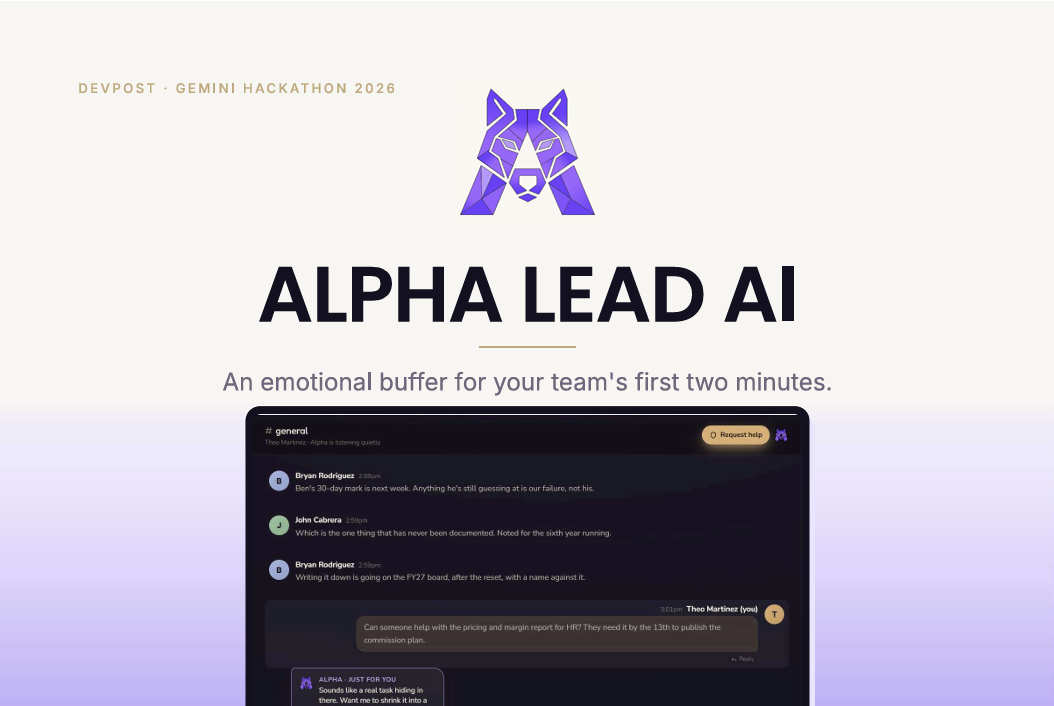
In February 2025, close to the end of the cycle and the fiscal year in March, Elias got a request from his direct leader: the financial and product pricing report for HR. The busiest time of the year for him and the pricing strategy team of five he leads. He types:
Can someone in the team help with the Pricing report for HR?
And it got lost in the never-ending waterfall of messages. Everyone keeps working and the message becomes history.
March comes around. He asks if anyone had done it. Dead silence. He assigned it to the team as a task. The message was not missed, it was avoided. Answering means claiming a task you are not sure you can finish, and admitting you have not started costs you standing in front of everyone you work with. Silence costs nothing. Elias did not chase anyone privately either, because chasing reads as micromanagement. He also told us giving feedback to younger team members is hard. So he absorbed it. The cheapest thing in the room emotionally and the most expensive by every other measure.
Twenty-three minutes to recover focus after one interruption, from Gloria Mark's research at UC Irvine. Microsoft's 2025 Work Trend Index says the average worker is interrupted every two minutes. That is 275 times in a nine to five. We modeled three. At 23 minutes of recovery each, 275 stops meaning anything, and we wanted a number a CFO would not throw out. So, a senior engineer's salary against that recovery time:
$$ C_{\text{interruption}} = \frac{\$160{,}000}{2{,}080\,\text{h}} \times \frac{23}{60}\,\text{h} = \$29.49 $$
$$ C_{\text{year}} = \$29.49 \times 3\,\frac{\text{interruptions}}{\text{day}} \times 250\,\text{days} = \$22{,}115 $$
Three a day. The quiet version. At five a day it is $36,862, and this is our own math on top of their research, not a published figure. Both numbers are still too small, because for Elias it was not losing money. He lost the night, and risked his health. This is when we understood it was never about a lazy team. Google's Project Aristotle found psychological safety and trust are what separate the teams that perform. From the outside it looked like procrastination. The problem is emotional regulation.
What it does
Alpha Lead AI has a leader side and a collaborator side, designed with both in mind. Here is what it does on each.
For leaders, Alpha AI goes past basic task tracking. This side of the app has tools made to assist the leader on the project: automations, professional frameworks like the Eisenhower Matrix, and goal tracking. Here is how Alpha AI stands out from a regular task manager with automations.
Leader Tool: Project & Goal Assist
For leaders it works from the very beginning. You have a project and nothing concrete yet? Start a new project and Alpha AI guides you through. Fill in the description, how you want to manage it with scrum, design thinking, or any other framework, and add the collaborators. The AI sets your project up from there, creating each task and milestone and assigning it to the collaborator who fits best.
Leader Tool: Alpha Space
Alpha Lead AI also provides templates used by high performance leaders in each industry. They come out of public research and textbooks. The marketing ones come out of Kotler. Today we cover programming, marketing, project management, and creatives like illustrators. Every leader gets years of experience at their fingertips. Just type in the Alpha Space chat:
@Alpha I'm stuck with this market research investigation task.
Alpha AI recommends the best framework, canvas, or strategy. For that one it comes back with the steps you need, buyer persona, buyer journey mapping, SWOT. It also guides you and, in your own words, builds the PDF or doc file, ready to present or store in your data source.
Leader & Collaborator Tool: Transparent Feedback
Elias said something spot on. Giving feedback is not easy, and it has to be tailored to each generation and each person. With feedback strategies behind it like SBI, start stop continue, and starfish, the AI guides you and hands you a finished template to give your team members, removing any miscommunication. It works the other way around too. Start a feedback campaign and Alpha gathers the details from your team and gives it to you fully transparent and fully anonymous. If Elias's team felt he wasn't doing a good job at communicating, he would have known from these campaigns. So it doesn't matter if you're a new leader, you will have what you need to be a confident one. If you're experienced, it will just streamline your work.
Leader & Collaborator Tool: Team Chat Collaboration with AI
One feature we like is that the chat consolidates your chats from other platforms, so you never miss anything. Google Chat is the one connected today. If someone types in any of your linked chats:
Can someone help me with a financial report for this third quarter 2026.
Alpha AI marks it as a possible task and asks if you want to convert it or dismiss it. And if you're away, Alpha AI makes sure you know when you're back, with a notification and a place on your home page in your daily summary. This way Elias would never have found himself carrying the entire team's weight at the last second.
Leader & Collaborator Tool: Unified Data Source
Someone types in the team chat:
@Alpha Fetch me the marketing research from 2025.
Alpha AI responds:
@Elias here is the document link for the Marketing research from 2025: https://docs.google.com/document/d/EXAMPLE
You can also ask for a summary of documents and files directly from your team chat. Alpha AI gives your team members everything they need with a single call. Your team can also add or remove files from the data source. Google Drive and Google Calendar are what we connect to today.
Leader & Collaborator Tool: Alpha Analysis
Before a deadline breaks. Before a team member burns out from carrying the weight of the team silently. If you have any doubts you can ask Alpha AI directly in the analysis tab:
What's the probability of finishing on time?
And Alpha AI would answer you with:
According to the report, the probability of finishing on time is 50%.
It reads the KPIs you selected and your tasks against their due dates. That project was created that same day with no history to pull from, so 50% is what it gave back. In the analysis page you get a full breakdown of the progress and coordination of the team and goals. And if you ever need an explanation on what any of the numbers mean, you always have Alpha AI chat available to summarize or connect the data for you.
Collaborator Tool: Check Engine
A check engine light anyone can pull when stuck, which reaches the leader as a risk and never as a name to shame. It catches the block in the moment. Nobody waits on the leader and nobody has to interrupt the leader, because Alpha matches you with the best available collaborator the leader designated for assistance. What the leader sees is the risk that got resolved, never who pulled the light. It gives your team the confidence and the trust to ask for help, and it surfaces bottlenecks before they are too late.
How we built it
We split the work into 3 responsibilities: Marketing, Project Management, and Software Engineering, then divided tasks by our strengths and field of expertise. But everything started with Marketing.
Marketing
We started by defining our methodology. We chose Design Thinking because it puts the customer and the real user at the center of the problem. Then we assigned roles. A decision maker, and creatives to keep the group moving.
Design thinking helped us find the true core issue. It was not always so clear. We started with market research on the productivity industry. After gathering our certainties we moved to the rest: our assumptions and doubts. We clarified those with qualitative and quantitative research on our target customer. We also ran social listening to hear what leaders were saying on Reddit, LinkedIn, and Facebook. This is where we ran 2 interviews, to validate the market research, the demand, and the social listening. Only 2, because of the 60 days we had from our late start.
Elias, who leads the pricing strategy team of five. William, who heads cyber security with a team of 8 engineers and developers. Both gave us permission to tell their story. We are leaving their companies out of it, because that consent is the companies' to give and not ours.
William's company had just brought in a tool that looks like a Pokémon game on a Game Boy, except the map is their office. Every person is a character that moves on the screen as they move around the floor. His software engineers had started feeling uneasy about being tracked, down to going to the bathroom. What he asked for was something that keeps track of projects and tickets and improves team efficiency without making people feel micromanaged.
Both expressed an urgent need for a solution in their teams. Elias put a number on it:
If a tool like this exists, I'm willing to pay $10 to $15 to have it in my team.
We start above him. $20 a month for starting teams, a 14-day free trial, and a custom tier for bigger teams. $15 is where we want to land, and we would rather come down in price than climb it. The prices and the policies are on the landing page and the buttons work. Nobody is paying yet. We are still testing, and Stripe does not reach a lot of countries.
Project Management
Once the methodology was picked, our project manager set up the Kanban schedule, which blends a visual Kanban board with a time-driven timeline. Our weekly Thursday meetings went on it for important follow-ups, progress check-ins, and ideas. The project manager also started keeping track of all expenses.
Software Engineer
Once the schedule, mockups and flowcharts were complete, our engineer started the build. He laid out the services and the best tools for our solution.
Tech Stack:
- Next.js 16 App Router + React 19
- TypeScript + Tailwind CSS v4
- Prisma + PostgreSQL (Cloud SQL on GCP)
- NextAuth.js
- Stripe
- GCP: Cloud Run, Cloud Build, Artifact Registry, Cloud SQL, Secret Manager, Cloud Logging, Cloud Monitoring, Vertex AI (Gemini)
Challenges we ran into
We ran into challenges all throughout the hackathon. From really understanding the customer's true pain point, to keeping everything moving on time, to actually building the software. Here are a few memorable ones.
Brand & Identity
One of the most memorable challenges for the entire team was moving from facts, data and doubts to the software we have now, with its identity and its goals. Understanding human behavior, why we do what we do, and how to actually provide a real solution was very challenging, and one of the important parts. And then picking colors, designing logos, picking names. The app name started out as Teamfly, EasyDo, TeamTune, among others.
When we got to really listening to experts in the field, we connected with their needs and found patterns from other experiences and our own. That was a great shed of light in the middle of a dark alley. It gave us the way out to establish the brand: logos, colors, mockups, architecture, and the reason why we are doing what we are doing.
Scheduling & Deadlines
Our engineer is from Peru, project manager from Guatemala, marketer from Guatemala, all with different professions and schedules. Because of the time difference, setting meeting times was a challenge at the beginning. When we said 8pm it really meant 9pm for Peru. We had a few moments like this. We also had setbacks going from programming to design, to test, and back to design. The good thing is we chose Design Thinking, which was created for exactly this kind of agile scenario. It helped us keep a full understanding and vision of the app even though the path was not a straight one.
Accomplishments that we're proud of
We are mostly proud of finishing this hackathon as a team. There were ups and downs, and we stayed together, worked through the hard times and stayed constant. We are proud of the spectacular teamwork we had, in a team working together for the first time, strangers. The team clicked and it felt like everyone was in sync. We will be using Alpha Lead AI to accomplish our own goals and projects.
We are also very proud of getting correct responses from the AI. Some AI processes take complex thinking and logic to respond, which took time and dedication from our engineer. We are proud of the mission and vision of the web app too.
What we learned
We were wrong about who has the problem.
We started building this for one person, because one person's procrastination is what bothered us. The interviews took that away. Team output is not a stack of individual disciplines. It is a property of what people feel safe doing in front of each other.
The eye cannot say to the hand, I have no need of you, nor again the head to the feet, I have no need of you. — 1 Corinthians 12:21
We read that the easy way at first, as a line about workers. It is also a line about the head, which has to be equipped to work with the body — so Alpha carries leadership material and feedback that runs both ways. In an unbalanced team someone absorbs the dead weight in silence. Elias was that person and nobody on his team knew it.
What's next for Alpha Lead - AI that goes first
We plan on expanding, making this software available around the world, and getting our first 100 teams.
Two steps get us there. First, the rest of the chat surface: WhatsApp, Teams, Messenger. Second, the rest of the data, with more drives, more sources and any calendar with an API in one place, so finding a document never means leaving the conversation.
If someone on your team is already carrying the night shift alone, you know before it becomes a problem.
We also plan on giving back to our communities. We believe knowledge is power. In my experience, it wasn't until I understood something that I was able to improve and apply new strategies. Those strategies become tools that are helping us build our dream today. That's why we also want to give back by teaching our younger communities to dream big and how to build does big dreams.
Built With
- claude
- drizzleorm
- gemini
- next.js
- opencode
- postgresql
- react
- tailwind
- typescript

Log in or sign up for Devpost to join the conversation.