-
-
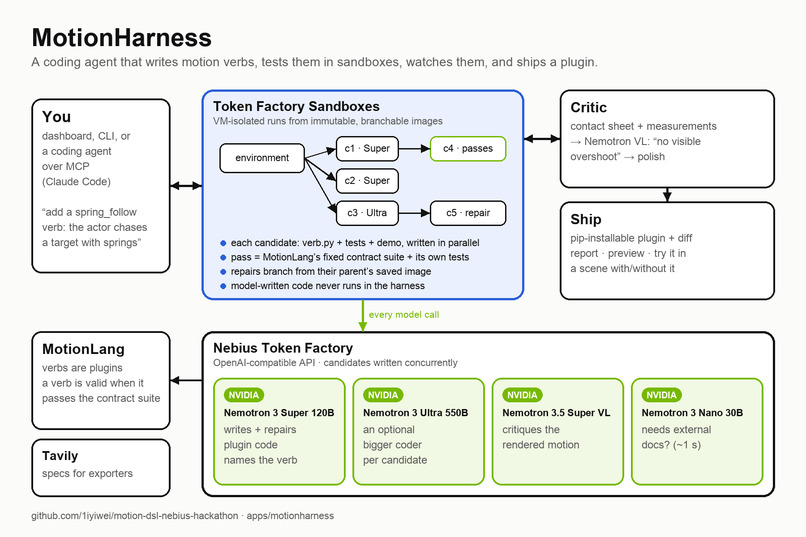
architecture card
-
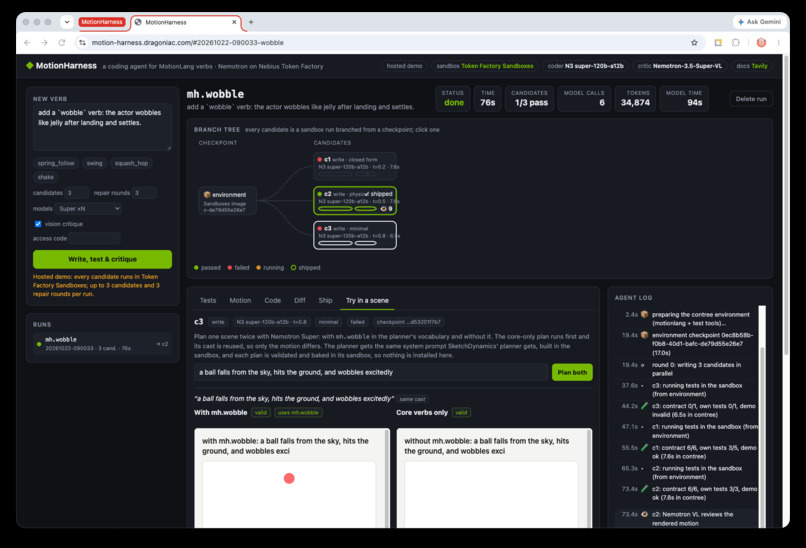
UI screen shot
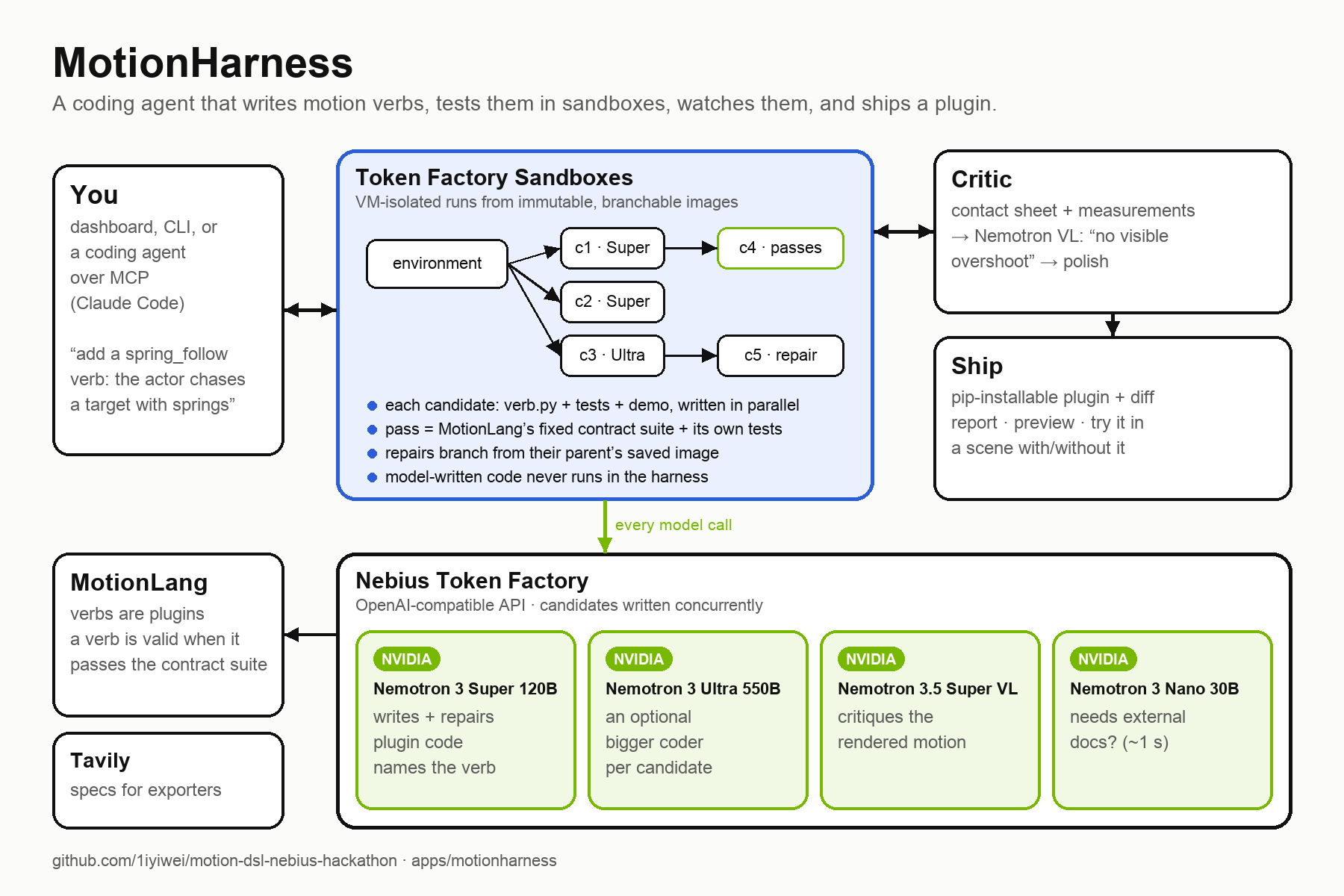
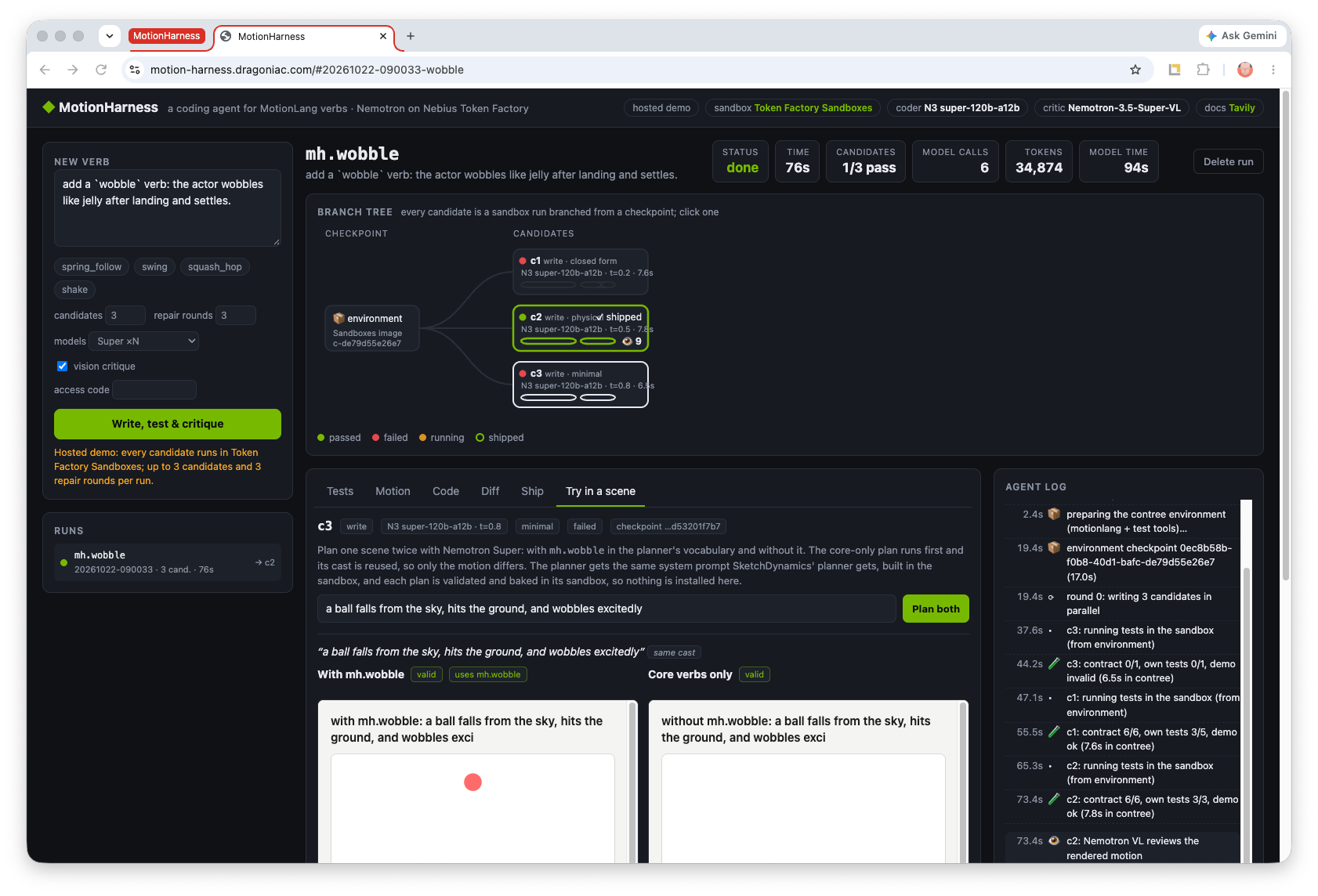
Describe a new motion behaviour in one sentence, for example "add a spring_follow verb: the actor chases a target with spring physics, overshooting a little". MotionHarness has NVIDIA Nemotron write several candidate implementations as MotionLang plugins, each with its own tests and a demo scene. It runs every candidate in a sandbox branched from one prepared checkpoint, against a fixed contract test suite and the candidate's own tests. Nemotron VL then looks at the rendered motion. The agent repairs what fails, polishes what the critic rejects, and ships the winner as an installable package with a diff, a test report and a preview. A dashboard shows the branch tree, every test, the frames the critic saw and every model call.
What it does
MotionHarness is for technical artists and graphics developers who extend a motion system. Its target is MotionLang, the declarative 2D motion language behind our SketchDynamics app. In MotionLang, verbs (bounce, spring_to, orbit, …) are entry-point plugins, and a verb is valid exactly when it passes a generic contract suite: deterministic, identity at start, continuous, bounded for any valid parameters, schema round-trip.
For one task, MotionHarness:
- Writes three candidates in parallel with Nemotron 3 Super (or Ultra), each from a different angle: a closed-form solution, an explicit physical model, or the minimal implementation. A candidate is the plugin module, 3–6 tests of what this verb should do, and a demo document.
- Tests each candidate in a sandbox: install the package, run the contract suite and its own tests, check that the verb appears in the JSON Schema and in the planner's prompt, and bake the demo. Only a JSON bundle comes back; the harness never imports model-written code.
- Repairs failing candidates from the verbatim test output. Each repair branches from its parent's sandbox checkpoint, so the dashboard's tree is the tree of sandbox images.
- Critiques passing candidates: the demo is rendered to a contact sheet (onion skin, keyframes, position/scale/rotation curves) and sent to Nemotron 3.5 Super VL with exact measurements (travel, overshoot %, settle time). If the motion doesn't match the task, for example a "spring" that never overshoots, the candidate is polished and tested again.
- Ships the winner: a
pip install-able package registering the verb under themotionlang.verbsentry point, a diff,report.md, a playablepreview.htmland the contact sheet. The new verb is immediately part of the schema and prompt that SketchDynamics' planner uses.
Then you can try the verb in a scene: type a prompt ("a ball falls from the sky and wobbles on its way") and the planner that SketchDynamics uses plans it twice with the same cast, once with the new verb in its vocabulary and once with core verbs only, side by side. Both plans are validated in sandboxes, so nothing gets installed. You can then download the plugin, or install and uninstall it in one click to compare apps with and without it.
It runs as a CLI (motionharness new-verb "…"), a web dashboard (motionharness serve) and an MCP server (motionharness mcp), so Claude Code or Cursor can ask it for a tested verb.
Inspiration
Building SketchDynamics, we added verbs by hand: write the math, write tests, look at it, notice the overshoot is wrong, fix it. MotionLang was designed so that adding a verb never touches the core and a verb is valid when it passes a contract suite. That makes "write a verb" a well-posed task for a coding agent with a sandbox. fog (Liu & Chilton) has an LLM write motion functions on the fly; we wanted the same open vocabulary, but gated by tests and a visual check before any planner sees the new verb. LogoMotion's visually grounded repair loop inspired the critic step.
How we built it
- Models (all on Nebius Token Factory): Nemotron 3 Super 120B writes and repairs code (reasoning on), plans the "try in a scene" documents, and checks that a verb's name reads as an action ("the actor swings", not "pendulums"; reasoning off, ~1 s); Nemotron 3 Ultra 550B is available per candidate; Nemotron 3.5 Super VL critiques rendered motion (reasoning off, JSON mode, ~2 s); Nemotron 3 Nano decides whether a task depends on an external spec (reasoning off, ~1 s), and Tavily fetches it.
- Sandboxes: a
Sandboxinterface with a Token Factory Sandboxes backend (contree-sdk): an environment image with Python, motionlang and the test tools is built once and cached by content hash. Every candidate isrun(disposable=False)from an image and returns a new image, which is the next repair's branch point. Candidates run concurrently. A local subprocess backend with the same semantics (directories as images, secrets stripped) runs when Sandboxes isn't configured. - The prompt: the plugin contract, the base class source and four core verbs as reference implementations, plus the document format, all generated from the installed library, so the agent always sees the current API.
- Rendering: Pillow draws the contact sheet from baked tracks (plain data from the sandbox), including SVG path flattening, so no browser is needed.
- Dashboard: FastAPI + vanilla JS, no build step. It polls the run record (
run.json), which is also the CLI's and MCP's source of truth. - Hosting: a hosted mode for public demos runs generated code only in Token Factory Sandboxes (and refuses runs while they're unavailable), disables installing into the server, caps runs, and adds an access code, a per-visitor rate limit and a daily token budget.
- Tests: 22 tests with a scripted fake model cover a repair, a critique-driven polish, a polish that breaks the tests and gets repaired, candidates that never pass, the contract gate on a good and a broken plugin, a fake Sandboxes client (checkpoint branching, platform errors, an inactive project), try-in-a-scene, hosted mode, the dashboard API (including path traversal) and the MCP tools.
Challenges we ran into
- Sandboxes access and a flaky control plane: Sandboxes is in Beta behind project activation, so we built behind a
Sandboxinterface whose local backend has the same checkpoint-and-branch semantics, and the agent worked from day one. When activation arrived (Oct 20), the API returned intermittent 500s, and a run that uploaded ~33 small files concurrently failed every time. Packing each job into one tar (one upload per run) and retrying 5xx with backoff fixed it: environment image in ~15 s, each candidate in 8–10 s, three in parallel. - Hidden failures: our first live run reported "verb not registered" because a relative path made the plugin invisible to the test process, which hid the real error (
from motionlang.model import Vec2, a type that doesn't exist). Surfacing the import traceback to the model fixed most first-round failures. - Tests pass, motion is wrong: the first spring candidate passed every test but was critically damped, so it never overshot. The vision critic caught it. Then it went the other way: VL accepted a follower that ended 20 px off the target as "overshoot". Passing exact measurements with the image, and telling the critic they win, fixed that.
- Finding a library bug: pendulum candidates kept failing their own tests with "changes nothing" (
E_NOOP) although they swing 16°. The agent's failures led us to a real validator bug: the no-op check sampled five points, which landed on the swing's zero crossings. - Measurements that lie: for a property that wobbles and returns to its start, "overshoot past the final value" divided by a near-zero travel and told the critic "8333% overshoot". Claude Code, calling MotionHarness over MCP, spotted it in the critique. Oscillating properties are now described by their peak deviation instead.
- Format slips: models put
(unchanged)inside a code fence, or ignored few-shot examples in JSON mode. Each became a parser rule or a schema-shaped question.
Accomplishments that we're proud of
- An agent whose acceptance gate is a real, fixed test suite from the library it extends, not tests it wrote for itself alone.
- Visual verification of motion with measurements, so "looks right" is checked too, not just "runs".
- The branch tree is literal: each node is a sandbox checkpoint, and repairs branch from their parent's state.
- The output is useful right away: one
pip installand the new verb is in the planner's vocabulary.
What we learned
- Contract tests turn "write me a feature" into a well-posed agent task; the more the library declares about itself (schema, prompt, examples), the less the agent has to guess.
- Vision models judge motion well from curves and onion skins, but need numbers to be reliable on small effects.
- Showing the repair loop (what failed, verbatim, and what changed) is what makes an agent's result trustworthy.
What's next
- Exporters as a task kind (Lottie, After Effects, Blender), with Tavily-fetched specs and round-trip tests.
- The MoVer benchmark: Nemotron → GSAP vs. Nemotron → MotionLang on a subset of MoVer's prompts, as a Nebius Serverless Job.
- Merging two half-good candidates, and golden-frame regression tests once a verb is accepted.

Log in or sign up for Devpost to join the conversation.