-
-
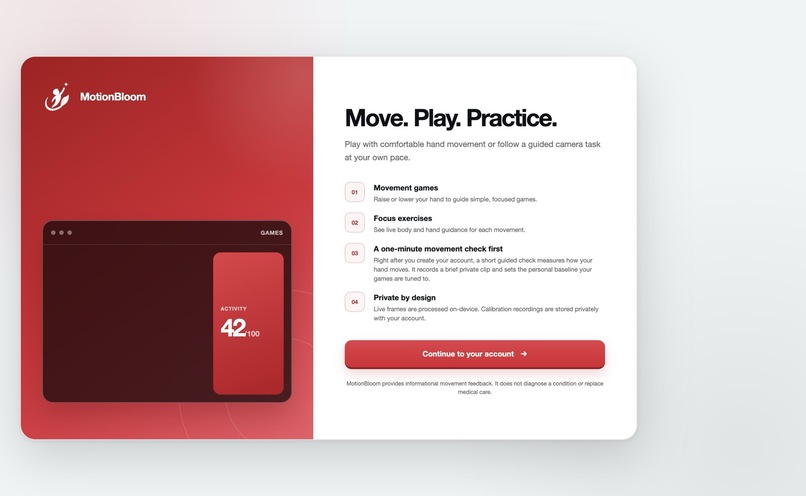
MotionBloom gives seniors clear access to guided neurorehabilitation activities and movement games.
-
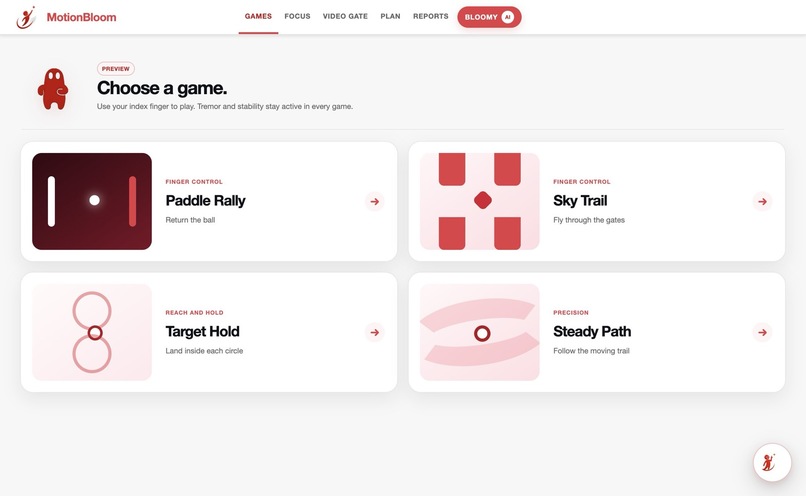
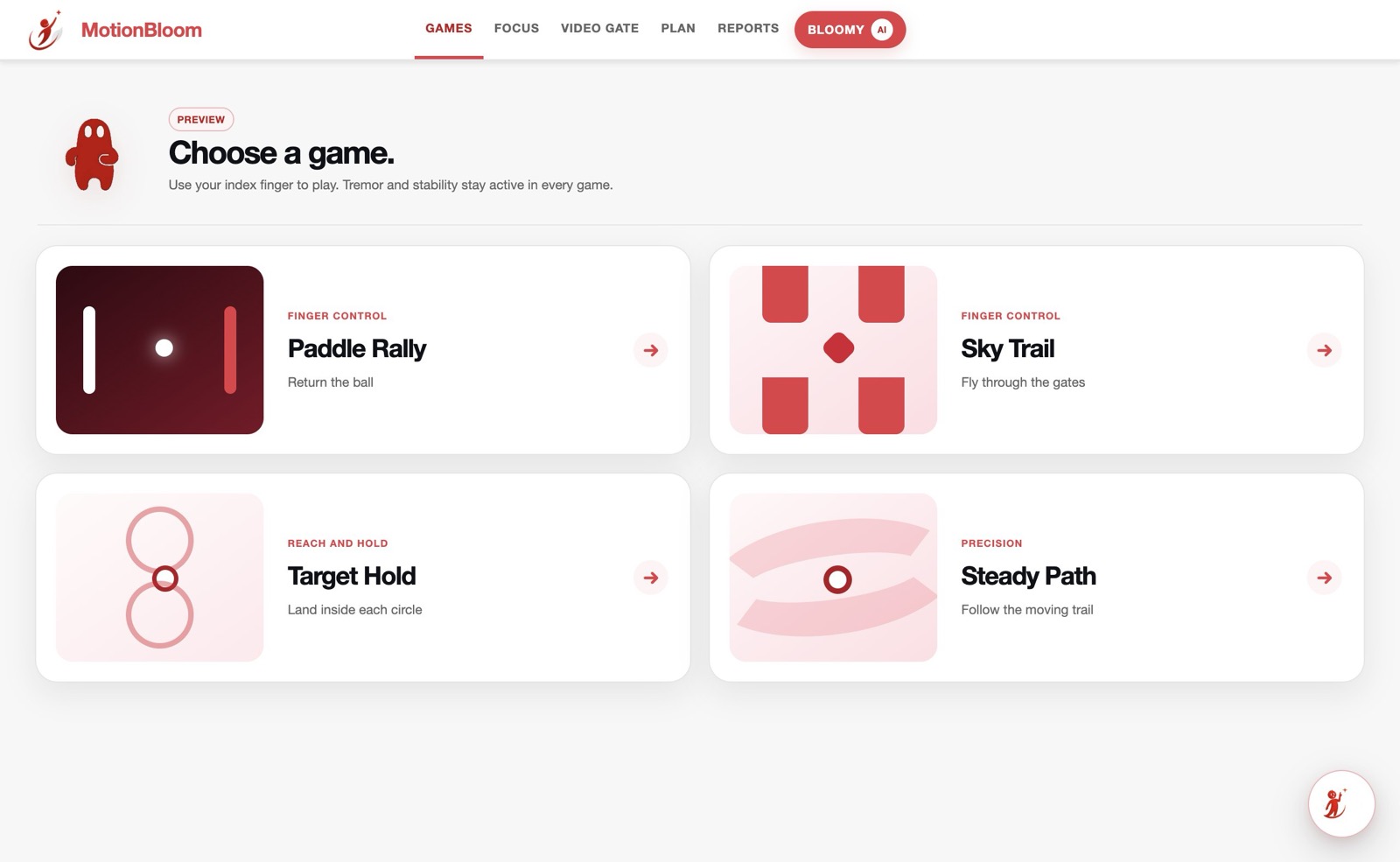
Four camera controlled games turn coordination and motor practice into approachable activities for seniors.
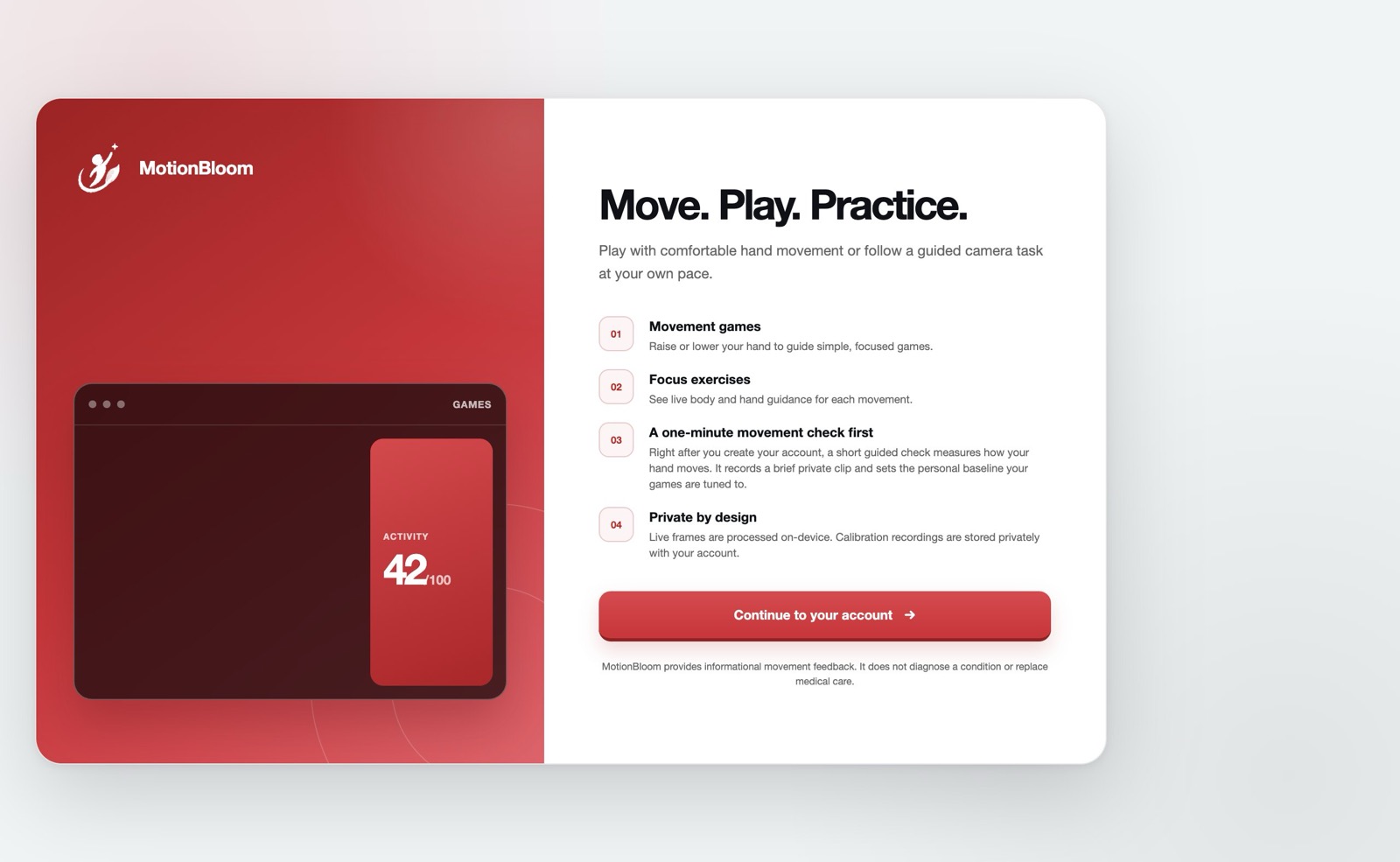
MotionBloom is a senior friendly neurorehabilitation support prototype designed to make repeated movement practice more engaging. Older adults recovering from a stroke, neurological condition, or injury may be asked to repeat simple motions to rebuild coordination and confidence. That practice can become tiring or discouraging, especially outside a supervised session. MotionBloom explores how an ordinary webcam can turn those movements into playful and understandable activities.
The application uses computer vision to translate hand and body movement into real time control. Seniors can guide a paddle, follow a path, reach toward a target, or practice holding a steadier position. These games encourage repetition, visual attention, coordination, and controlled movement without requiring a wearable or specialized controller. Guided focus activities provide clear positioning feedback, while the video reward feature connects completed movement prompts with extra viewing time. Planning and report tools help users revisit activities and review recent participation.
MotionBloom is intended to complement exercises selected by a qualified rehabilitation professional. It is not a medical device, does not diagnose or treat a condition, and does not replace a therapist or physician. Its camera based feedback is experimental and limited to the activity being performed. Any future use in a clinical rehabilitation program would require independent safety, accessibility, privacy, and clinical validation.
I built the desktop application with Electron, JavaScript, HTML, and CSS. MediaPipe Tasks Vision detects hand and pose landmarks from the webcam. A Python service supports camera signal analysis, and Supabase provides sign in and optional account features. Normal video processing occurs locally on the user's computer, and the application requests camera access without requesting microphone access.
One of the hardest challenges was making movement detection dependable enough for a senior audience. Real camera feeds change with lighting, distance, hand rotation, dropped frames, and temporary tracking loss. MotionBloom uses clear states for waiting, detection, active movement, excessive motion, and lost tracking. Instead of continuing with an outdated result, the interface explains when the signal is uncertain and helps the user recover. Stability calculations run in a background worker so the games remain responsive.
Accessibility was equally important. Seniors can move at different speeds and may have different levels of mobility, dexterity, balance, fatigue, or confidence. The activities use simple visual goals, progress feedback, clear recovery messages, and manual control alternatives. Each game evaluates only the movement needed for that task rather than turning camera data into a broad health score.
I am proud that MotionBloom combines four camera controlled games with guided activities, video rewards, planning, reports, privacy protections, and an extensive automated test suite. The repository also includes cross platform packaging, model verification, database security policies, and documentation about privacy and potential risks.
Building MotionBloom taught me that neurorehabilitation technology must respect the pace, limits, and dignity of each person. A useful tool should encourage practice while being honest when its input is uncertain. My next step is to co design the experience with seniors, caregivers, occupational therapists, and physical therapists, improve keyboard and manual controls, and study whether the activities are understandable and motivating. Clinical claims would only be appropriate after formal research and independent validation.


Log in or sign up for Devpost to join the conversation.