
Inspiration
MotionBlendAI is a real-time motion blending and analytics engine that brings animation data to life through Google Cloud AI and Fivetran-powered pipelines.
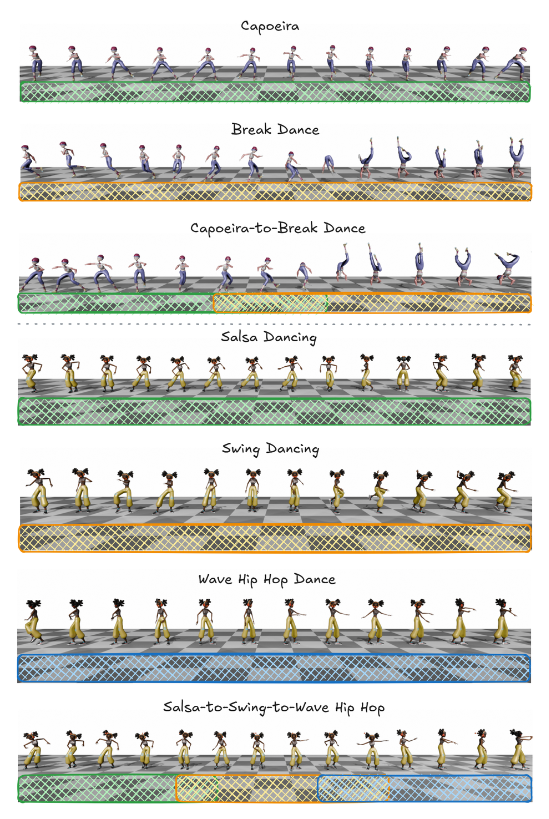
We were inspired by the 2025 research paper “Controllable Single-Shot Animation Blending with Temporal Conditioning” (Tselepi et al., Moverse Labs) and Google’s mission to democratize AI creativity through accessible platforms like Vertex AI and Gemini.
We wanted to prove that animation intelligence could be achieved not with massive datasets, but with elegant single-shot models and cloud-integrated pipelines that anyone can deploy.
What it does
Our system blends human motions such as Tai Chi Flow, Yoga Pose Flow, and Punch-Kick Combos in real time, then evaluates their smoothness using L2 velocity and acceleration metrics — all indexed in Elasticsearch for interactive visual analysis through Rydlr’s Artifacts Tab UI.
Moverse enables developers to:
- Blend two or more skeletal motions in a single forward pass using SPADE + FiLM conditioning layers implemented in PyTorch.
- Stream motion metrics (FID, Coverage, Diversity, L2 velocity/acceleration) to BigQuery through Fivetran’s automated connector.
- Query and visualise results instantly in Elasticsearch and Looker Studio dashboards.
- Use Vertex AI + Gemini to generate narrative summaries and visual captions for each blended artifact — making data storytelling part of the creative process.
The system effectively turns motion data into a living dataset, searchable, comparable, and ready for large-model training.
How we built it
We designed it to demonstrate how raw motion-capture data — once trapped in .bvh, .trc and .fbx files — can be transformed into searchable, AI-ready datasets that power next-generation applications in sports analytics, digital twins, and agentic simulation.
Challenges We Ran Into
- Building a unified skeleton identity map across multiple motion datasets (seed_motions vs blend_motions).
- Managing compute between Intel Mac local dev and Rydlr’s NVIDIA H100 cloud nodes.
- Achieving low-latency sync between Fivetran → BigQuery → Elasticsearch for live metrics visualisation.
- Maintaining smooth SPADE conditioning without normalisation drift — crucial for eliminating “jitter” at transition frames.
Accomplishments That We’re Proud Of
- Successfully reproduced single-shot motion blending on Google Cloud infrastructure.
- Created a fully automated Fivetran connector for motion-capture ingestion — the first of its kind.
- Integrated Gemini-based summarization for AI narrative captions describing each blend.
- Deployed an interactive Artifacts Tab that mirrors the visuals in academic motion blending research.
What We Learned
- Elastic and Fivetran together create a seamless bridge between data ingestion and AI search — the new standard for agentic applications.
- With Vertex AI, large-scale model training and evaluation can be conducted on-demand without managing GPUs manually.
- How to combine semantic embeddings, temporal conditioning, and metrics visualisation into one reproducible AI workflow.
- The importance of metadata consistency and schema mapping when automating multi-modal pipelines.
What’s Next for MotionBlendAI
- Extend support for live mocap streams using WebRTC and Gemini Enterprise live context.
- Deploy a public API endpoint for developers to query and visualise custom blends.
- Integrate AgentSpace orchestration for real-time collaboration between human animators and AI agents.
- Explore Motion-based (Sports Analytics, C-ROM for Healthcare Context, defense and combat simulation training) digital-twin use cases with Rydlr Cloud’s motion capture simulation team.

Log in or sign up for Devpost to join the conversation.