-
-
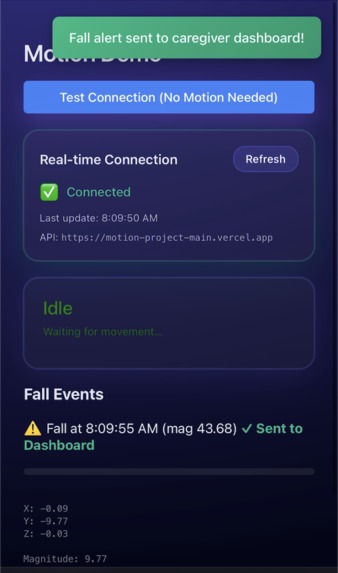
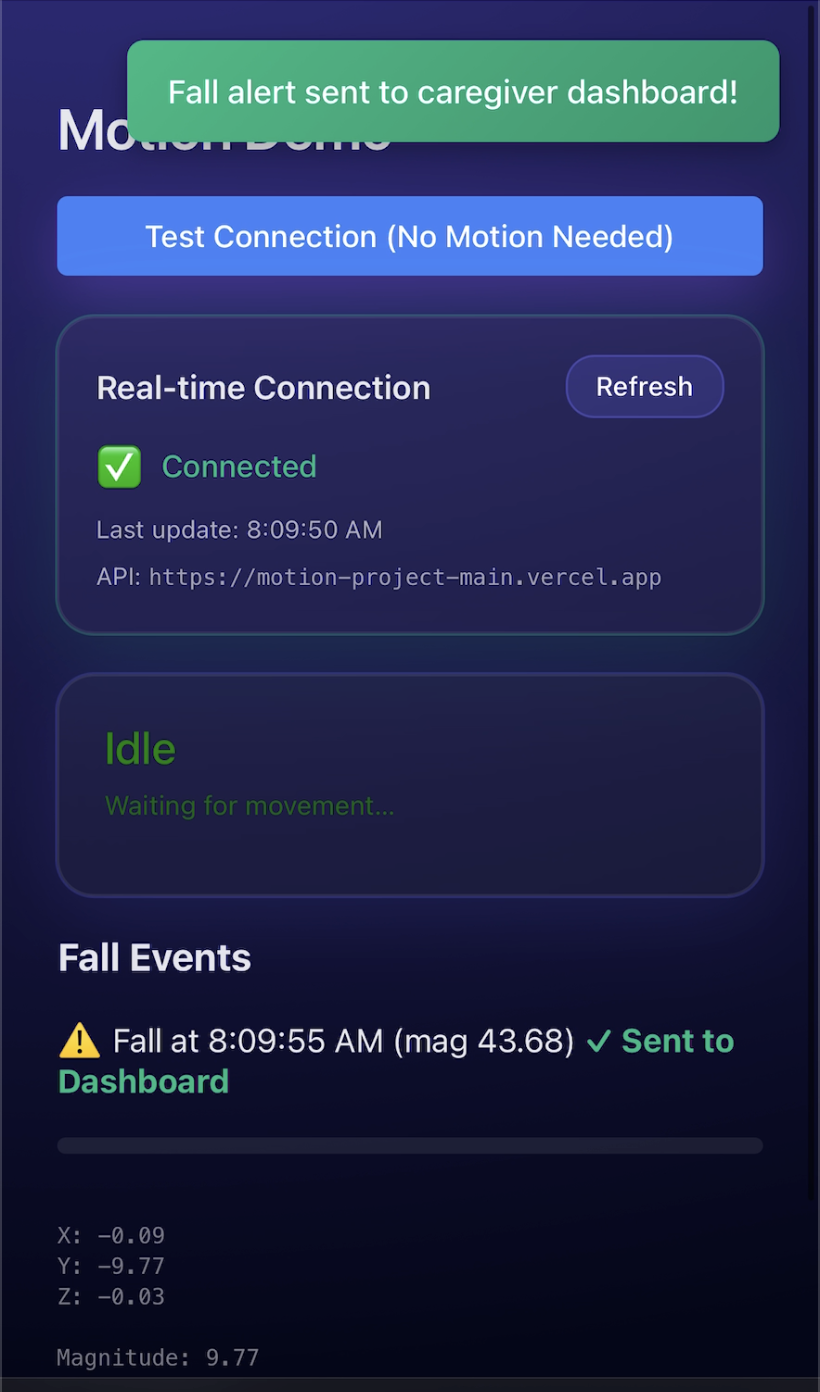
Real-time fall detection
-
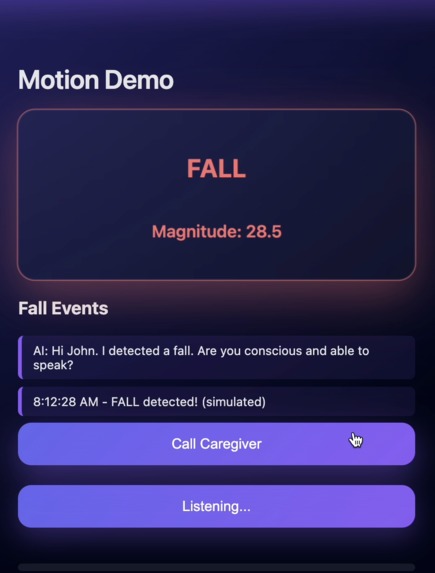
AI fall-response feature
-
Inspiration
Falls are one of the most common and dangerous incidents for elderly individuals and people with mobility challenges, yet they often happen when no one else is around. The most terrifying part is the unpredictability of falls and the significantly worse outcomes of delayed assistance.
This led us to ask: how can we provide immediate support after a fall, even when a caregiver cannot be physically present? Many families face financial, geographic, or time-related barriers to constant supervision. Motion was created to act as a lightweight safety system that responds automatically when a fall occurs.
What it does
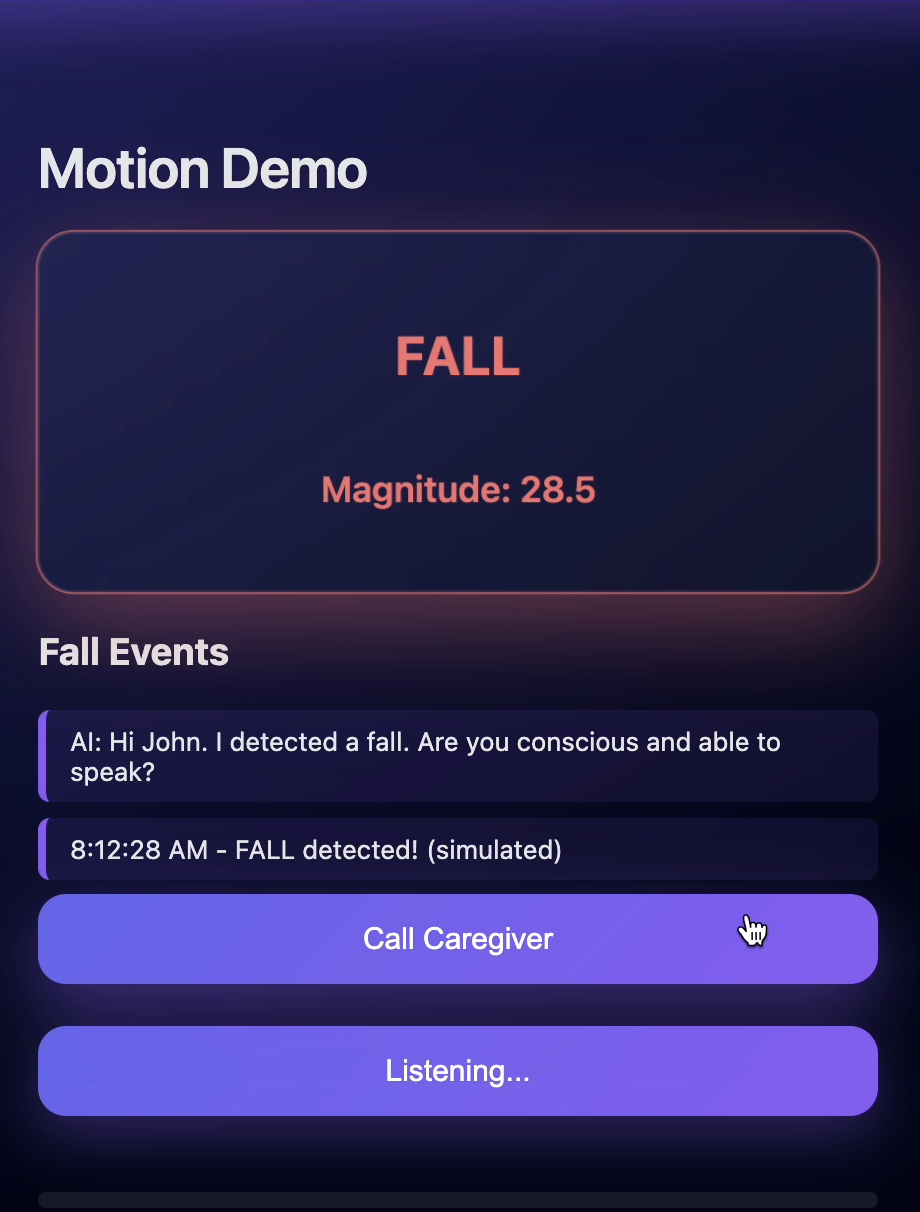
Motion is a motion-based safety application that detects falls using movement data and initiates follow-up actions in real time. When a fall is detected, the system sends alerts to a trusted contact and prompts the user through an audio-based check-in to confirm whether they are okay.
Rather than assuming every fall is an emergency, Motion allows the user to respond through simple voice interaction or inactivity signals. If no response is detected within a short time window, the system escalates the alert so that help can be dispatched.
Motion also supports basic location awareness and inactivity monitoring, allowing caregivers to be notified if something unusual occurs, such as prolonged stillness after movement.
How we built it
We built Motion using a JavaScript-based technology stack focused on real-time responsiveness and reliability. When a fall is detected, the backend triggers alert notifications and initiates an audio-based check-in flow. We experimented with lightweight AI-generated voice prompts to guide this interaction, but designed the system so that critical alerting and escalation logic remains deterministic and dependable.
Challenges we ran into
One of our biggest challenges was distinguishing between real falls and abrupt but safe movements, such as sitting down quickly or dropping the device. Designing fall-detection logic that was responsive without being overly sensitive required repeated testing and adjustment.
Another challenge was coordinating real-time detection with audio prompts. Ensuring that alerts, timing, and user responses remained synchronized, especially under simulated emergency conditions, introduced complexity across the frontend and backend.
Finally, integrating multiple moving parts under tight time constraints made system organization a challenge.
Accomplishments that we're proud of
We’re proud of how we scoped our features responsibly, focusing on reliability and usability. Despite the complexity of coordinating frontend, backend, and real-time data flows, we delivered a working demo that demonstrates Motion’s real-world potential.
What we learned
This project taught us the importance of building safety-focused systems with simplicity and reliability in mind. We learned to prioritize clear escalation paths and predictable behavior over complex features that could introduce uncertainty.
We also gained experience integrating real-time data pipelines. We learned how to scope experimental features, such as AI-assisted voice prompts, so that they support the system without becoming critical points of failure.
What's next for motion
In the future, we hope to improve Motion’s fall-detection accuracy by incorporating more personalized motion baselines. We also plan to refine the audio check-in flow, expand caregiver support, and improve accessibility. With further development, Motion could evolve into a reliable safety tool that democratizes independent living.

Log in or sign up for Devpost to join the conversation.