Inspiration
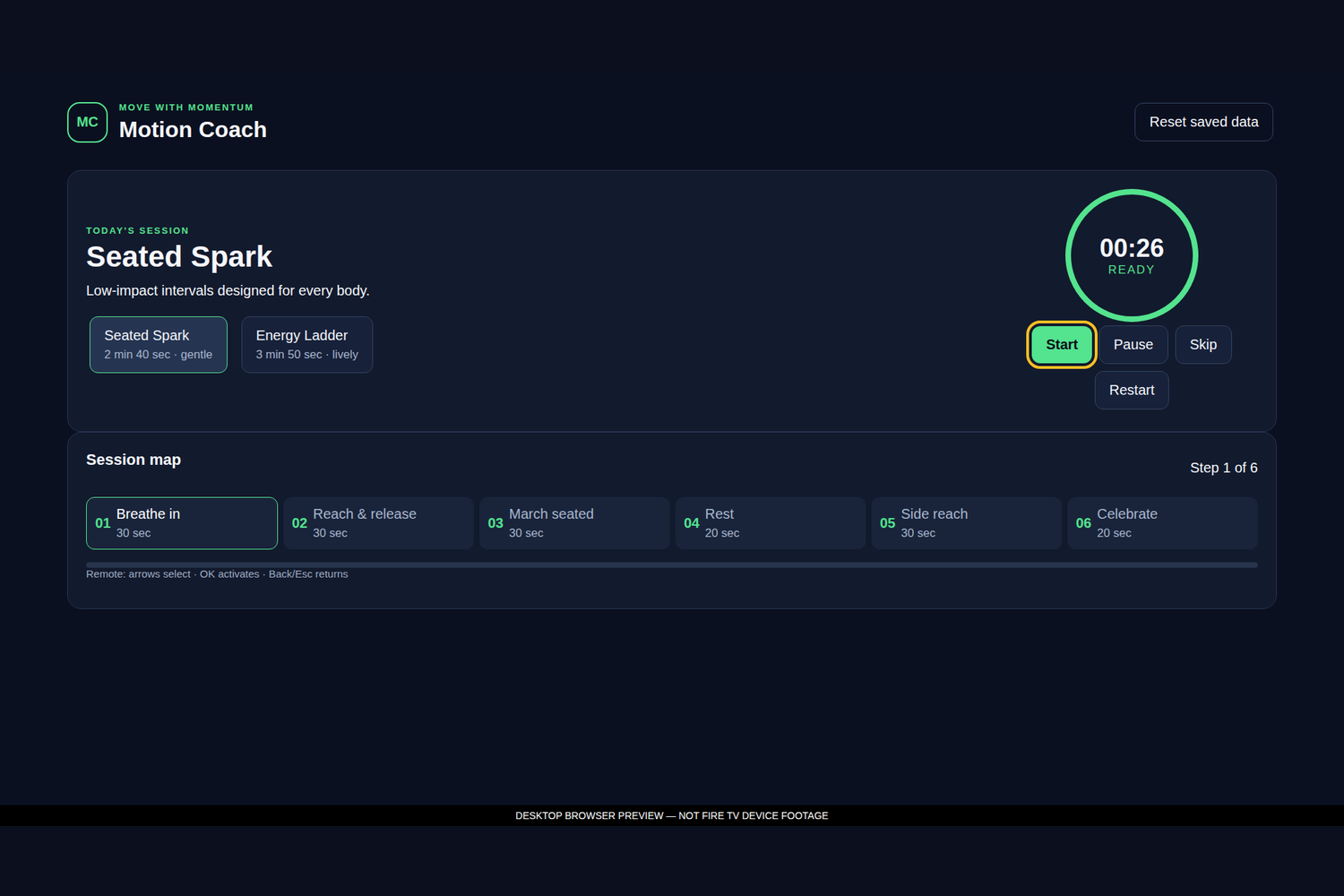
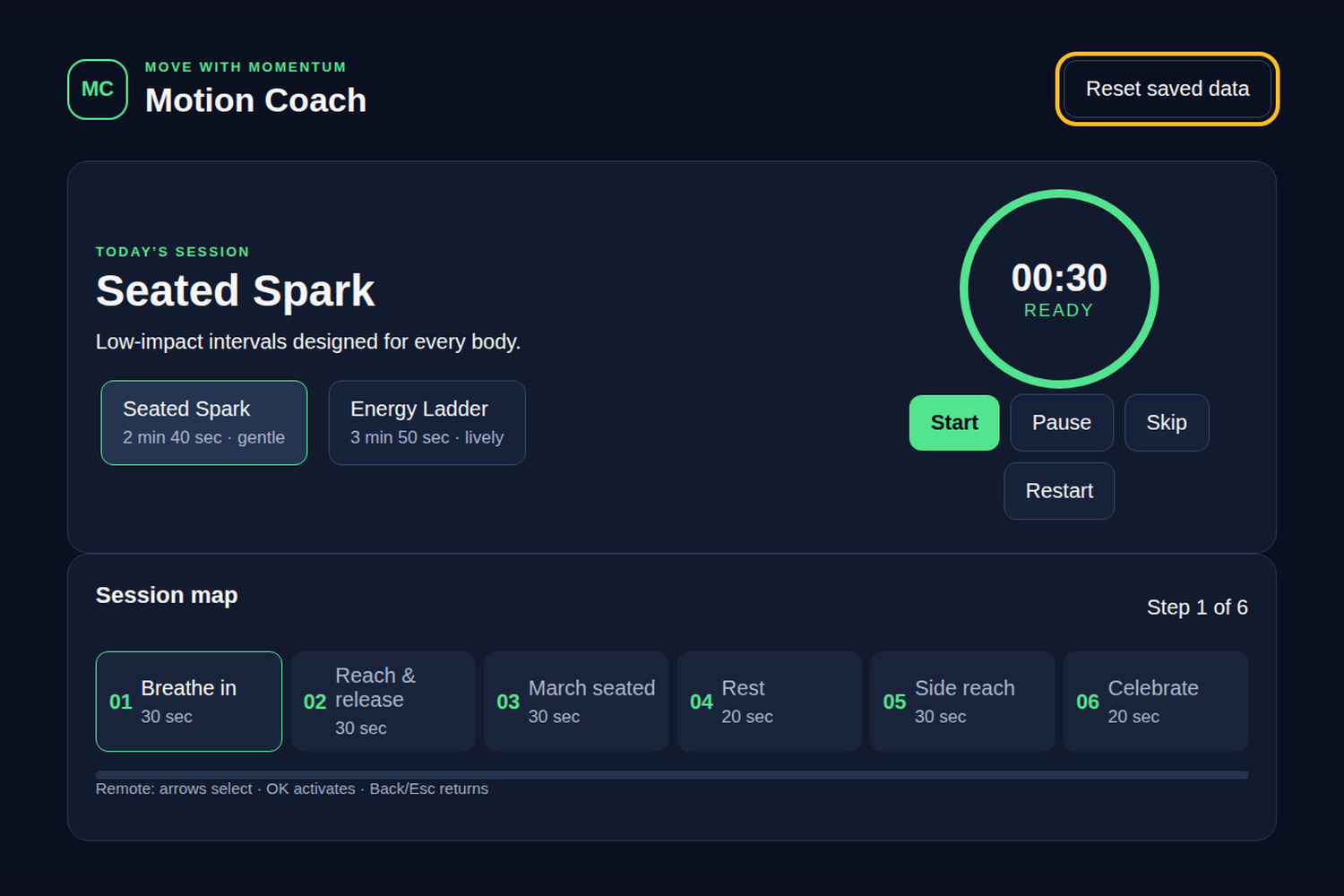
Motion Coach is a calm, living-room interval studio for people who want a simple movement prompt rather than a busy fitness dashboard. The two routines make the concept concrete: Seated Spark offers low-impact intervals designed for every body, while Energy Ladder provides a standing-friendly rhythm with recovery built in. The design target is a readable 10-foot TV experience that works with a remote, not a mouse.
What it does
A viewer chooses either routine and sees its named steps, duration, current phase, status, and progress bar. Start runs the countdown; pause, skip, and restart make the session controllable; completion marks the routine complete. The app remembers the selected routine and position in local browser storage and exposes Reset saved data. Arrow keys move focus or select a routine, Enter/Space activates controls, and Escape/Backspace pauses or navigates safely.
How we built it
The app is an offline-first HTML/CSS/JavaScript interface hosted by a native Java Android WebView for Fire OS. All content is bundled locally: the routine definitions and timer/state behavior live in app.js, boundary and formatting rules are isolated in domain.js, and the TV runtime supports remote-oriented interaction. CSS supplies the high-contrast, large-focus 10-foot presentation. There are no accounts, analytics, network calls, external assets, or copyrighted media. The Android host targets Fire OS Android devices at API 28 or newer; it is not a Vega OS package.
What we learned
Separating timer behavior from small domain functions made countdown formatting, progress bounds, routine transitions, and persisted-state validation straightforward to test. Persisting a stopped state rather than a live deadline also keeps reload behavior predictable.
Challenges
A TV UI has to make focus visible without hover and make every action reachable by directional input. Timer transitions, completion state, malformed localStorage, and safe Back behavior all needed explicit handling. The native package is a development build, not an Appstore publication identity.
Verification and next steps
Node domain tests and desktop Chromium interaction flows were executed, and the local Android packaging/signature checks succeeded. Verification was not performed on physical Fire OS hardware, so WebView performance, remote behavior, VoiceView, and device-specific layout remain open. The supplied images and silent video are local browser previews, not physical screenshots or video proof. This is an entrant-review draft produced with AI assistance; the entrant must review the source, rights, eligibility, and claims. The submission has not been uploaded. Next steps are real-device testing, accessibility review, and a genuine Fire TV demonstration recorded by the entrant.

Log in or sign up for Devpost to join the conversation.